"ARMS IN ARMS, WITH ARMS"
After Gordon's return from exile, two of his brothers took him home to see his mother.
Though George and Trevor Webster knew that their home in York, New Hanover, was under the watchful eye of members of the Security Branch, they were in one mind about the need for Agnes to see her "precious one" in the flesh.
Gordon, too, dearly wished to meet his mother.
George first took Gordon to Victor - the eldest of the Webster brothers - and then to Trevor, in Wentworth. When George and Gordon got to Trevor's house at 3 Rossdown Road, Wentworth, Trevor Webster was in the garden, planting a tree in his newly-acquired house's yard. Trevor broke down in tears.
"It was Saturday morning," Trevor remembers. "I hadn't seen my brother for a long time, and I was excited. He says to me, 'You're a planting a tree and thousands of people are dying around the country'. Then he said, 'Let's go to the farm. I want to see the old lady. My mother’."
When Agnes saw her youngest son, her hefty frame defied gravity as she jumped up, hugging and kissing him.
Two siblings, Clifford and Barbara, come between Gordon and his sister Margaret, who was born on 27 February 1957. Yet, growing up, Gordon was closest to Margaret.
When Gordon returned to the country, Margaret was working at Pietermaritzburg's Fort Napier hospital as a nursing assistant. She and her boyfriend from Swaziland, Sam Makhanya, were renting a room at a house in the Pietermaritzburg township of Dambuza.
"When I came back home from work, my mother said, 'Guess who's back. Gordon!’'" Margaret recalls. "I said, 'Mum, you're lying.' She showed me his clothes in his room."
If Margaret was still in any doubt that her youngest brother had come back from exile, they dissipated when Gordon materialised in the flesh outside the ward she was working in at Fort Napier hospital. He asked for the keys to her room in Dambuza and told her that she would find him there.
"He chose the wrong person," Margaret laughs as she recounts how her brother went on to involve her in his underground work for the armed wing of the African National Congress. "We practically grew up together. He should've gone to George. At least George is a lawyer."
Gordon also involved Margaret's boyfriend, who secured him a safe house in another township in Pietermaritzburg, Caluza.
Gordon's first meeting with Robert after his return from exile was at George's house in Sydenham. He agreed to help him get Vincent James out of the country.
He also wished to know if Robert was still keen on joining MK. After Robert had confirmed that he was indeed interested in joining MK, Gordon met him a week later.
"He came home to my place and just told me, 'I need about three or four hours to just brief you about the situation. What role you would play'. He gave me some political education; the ANC, 'Freedom Charter' and all that stuff."
Gordon also took him through courses like the theory of explosives.
"I remember in the notes which he gives me - they were hand-written -; 'part of your function as a guerrilla; the job is to annihilate the enemy. The gun is for killing'. There was no nice words. This I think was done for effect. To make your mind shift into the right gear."
Gordon informed him that he would be working in MK's 'Special Operations' unit with him. He told him that the ANC was under no illusions that it could ever win militarily against the Nationalist Party government's army.
"What we hoped to do was to conduct a propaganda war to continue to give the people hope. Also, to have some kind of economic cost being incurred by the state because of our actions. Also, to push these guys to negotiations. The idea was to force them to the [negotiating] table".
Special Ops was different to other units in the sense that it was not under MK's provincial structures like the "Natal machinery".
"Our commander would report directly to (then ANC president) Oliver Tambo," Robert explains. "Or via [MK chief] Joe Slovo to Oliver Tambo".
Gordon also explained the importance of secrecy in underground work. This was all part of what was called "MCW" - "Military Code Work" or "Military Combat Work".
"Basically, MCW teaches you subversion," Robert expands. "Secrecy. How to survive in the underground. How to avoid detection and how to cope with the stresses of the operations."
However, MK's culture of secrecy notwithstanding, Robert could not hide his intentions to become active in the political underground from his father. He approached Derrick in his welding workshop at Factorama, 'Utility Services'. Derrick remembers the meeting.
"I said to Robert, 'Look, don't go with anybody else. I will put you in touch with the right people'. He said, 'No Dad, when you were young you blew it. Now leave it to us young people'. I said, 'All right, but if you need help, come to me. I know a lot about what you're going to be busy with'."
Gordon and Robert travelled to Botswana in the Peugeot that Robert bought while he was working at Sasol. Gordon did not have a passport.
The plan was that Robert would drop him off in a village close to the Ramatlabama border gate.
Gordon would then alight to cross the border on foot.
Robert would go back to Mafikeng to stay overnight in a motel.
The following morning, Robert drove through the customs post without any problems.
"I went through all right. About 5 kilometres, I found him sitting by the side of the road, reading a book. Inside Botswana. He is just a person on the road. I stopped, and he gets in. He says to me, 'Hi! How are you? Did you sleep nice? You were sleeping nice in a hotel and I was sleeping in the bush. Life is nice, neh?'"
In Botswana, the rendezvous between the two activists and Gordon's contacts in MK was an hotel in Gaborone; the country's capital city of Botswana. The hotel was called Mphatlalatsane: "The Morning Star".
"'The Morning Star' is not a sophisticated motel," says Robert. "Gordon is saying, 'I hope these [MK] guys come because they must give me money. I want to stay in 'Oasis'. 'Oasis' is a 5-star hotel. Then he says, 'Don't think I'm a capitalist. It's just that you only live once. I want to sleep on a nice soft bed after sleeping in the bush'."
Three days went past without Gordon's MK contacts showing up.
On the fourth day, they met up with the two guerrillas, "Chris" and "Oupa". The two were also driving in a Peugeot. Later, Robert would know that "Chris" was really Lester Dumakude; "Oupa" Ernest Lekota Pule. Both African youths were in their late twenties to early thirties.
He immediately got the sense that the ANC operatives work twenty four hours.
Chris and Oupa wanted to know what the situation was like back home. Robert found the two members of the ANC's armed wing to be quite normal.
"There's no horns or tails. There's nothing funny about them. They are just cool. I noticed for example that Chris doesn't smile a lot, but he keeps saying, 'I want to go back inside (South Africa)'. He is the serious one. Oupa laughs easily. I can see both of them are very fit. They're making jokes, asking Gordon: 'Did the Boers not catch you the other night when you crossed?' They are not speaking in a way that you take the Boers lightly. They speak as if these guys spend a long time in a shooting range. Oupa is telling a story: 'The other day, we were coming across. These guys ambushed us. They can shoot. As I am running, the bullets are hitting a tree'. Even though they are serious minded, they see the light things. The fact that you can die easily is brought home."
Later that night, Chris and Oupa left with Gordon, borrowing the spare wheel to Robert's Peugeot.
The MK soldiers' car was also a Peugeot.
The following day, Gordon and Robert drove around Botswana.
"We drove around a lot. The reason he was showing me places is because later on, I'd have to arrange to meet with these guys [Chris and Oupa]. It would be my job to come and fetch the material [weapons for the guerrilla war]."
Robert was joining the ANC immediately after the organisation's monumental Kabwe conference. The conference was held in Zambia in the aftermath of a number of cross-border raids on suspected ANC bases by the SADF.
During these raids, even civilians unconnected to the liberation movement were killed. The ANC thus resolved to shift from its stance of avoiding civilian targets at all cost in its armed struggle against the white government.
During one cross-border raid into Botswana, the SADF had attacked a number of homes in Gaborone.
"He showed me the places where they [the SADF] had hit. I'm joining MK immediately after the 'Gaborone massacre'. They did not kill ANC people. They killed only civilians."
The 'massacre' had taken place on 14 June 1985, when the South African Defence Force staged a cross-border raid into Botswana.
Later on the afternoon of Robert's visit to Botswana, Chris and Oupa came to pick up Gordon, leaving Robert alone in the hotel room. Because Chris and Oupa's car was also a Peugeot, the borrowed Robert's spare-wheel.
When Gordon re-entered South Africa after military training in Angola, the idea was that he would return to college to continue his studies. Then he would have a good cover as he looked for a recruit to take along with to Botswana when he goes for briefings from his commander in Special Ops [operations], Rashid.
However, when he got home, he had found out that the SBs were on the lookout for him. Therefore, when he went to Botswana with Robert, one of the aims was to fill in Rashid on this changed situation.
But Specials Ops commander was not immediately available when the two were in Botswana.
Oupa and Chris tried to get Gordon to wait for Rashid in Botswana, but he was itching to return. He would come back later on.
"They were not my commanders," Gordon says of Oupa and Chris. "My commander was Rashid. Rashid is sitting there, he's thinking that I'm back and I've gone back to college. But things have changed. They are no longer the same - so now everything has changed. You had to be flexible on the ground."
He suggested to Oupa and Chris that they give him whatever weapons they could spare.
Since he did not have a passport, he would again cross the border on foot with the weapons, then re-connect with Robert in South Africa. The two activists had an elaborate plan to meet up on the BophuthaTswana/South African side of the border.
"I would park with my brake lights, the back of the car facing towards Botswana," Robert relates. "Every now and again, I would press the brakes. From wherever he is, he would be able to see where I am - it's through the bushes - as he is jumping through the fence. It's quite a hill on the Botswana side as you're coming down into South Africa. He'd have to know where I am to get me. He'd be carrying some weapons with him, also. There couldn't be much time wasted. He'd have to get to me as quickly as possible in case there's a chase across."
Both men loved reggae music. They used the music to send coded signals to each other in the middle of the night.
"I'd also be playing music in the car. If everything was okay, I'd be playing Gregory Isaacs. 'Night nurse', I remember. That would be playing in the car. If I play something else, he mustn't come to the car."
Gordon took some time to reach where Robert was parked.
There was an army patrol at the border, and he had had to be careful to avoid being noticed.
"I didn't even notice him coming, because I was watching the rear-view mirror. Suddenly, he was there. It was about nine o'clock. He is very nervous. Very nervous! He is sweating because he has the AK-47. He puts it down in the car."
He was carrying a rucksack which was filled with about six hand grenades and a number of limpet mines.
"He just threw them on the floor of the car, and then we left."
They had to drive through the night without stopping because they knew there were often police roadblocks along the way.
When they reached Pietermaritzburg at dawn, Gordon directed Robert to take a road leading to New Hanover.
McBride had never been to Gordon's home at York before. The road leading to the Websters' smallholding goes through a lush gum and wattle plantation. He commanded Robert to stop on quiet road and alighted.
"He is going to the bush to do a toilet. He says, 'Just take the spare wheel out'. I ask him why. He says, 'Just take it out. There's something. There's a present in there for you'. I say, 'What the hell is this man talking about?' I take the spare wheel out. I see it is shaped square."
Robert then realised that, when Chris, Oupa and Gordon 'borrowed' his spare wheel, they were actually going to put weapons in it. He had driven across the border with weapons hidden in the spare wheel.
"Now another shock is hitting me. Going through the border, there was a guy - the border patrol guy; I am waiting to get searched. This guy is so lazy. I call him, 'Check, I'm going. I'm finished with my passport'. This was on the Botswana side. It was my first time going out. I'm saying to him, 'Search the car. I want to go'. I'm inviting him to come. Then he says, 'Go'. I'm thinking to myself, 'What if he did search?' I got very angry with Gordon. It was unnecessary. I'm not a coward. But if I'm going to carry weapons across the border, I must know about them."
They then drove to St. John's church at York; an old building which used to be a German mission station at the turn of the twentieth century. In the church, there was a graveyard.
"We're carrying the stuff from the car," says Robert. "Suddenly, he gets very nervous. He is sweating. The reason he is sweating is that he is hoping none of the people around there would recognise him - would see what he was doing."
At the time, Robert did not know that the church was just three hundred metres or so from Gordon's home.
"We pull one of the gravestones; these granite stones; we pull it open and there's a gap. We push the stuff in."
Afterwards, he dropped Gordon off somewhere around Pietermaritzburg town and drove down to Durban.
Robert involvement his first mission as a member of the ANC's armed wing was unplanned. He had to fill in for Nazeem Cassiem, the radical Muslim activist who was his fellow student at Bechet. Gordon had recruited Nazeem into MK through Robert.
After training Nazeem at York, he wanted to "commit" him to Umkhonto We Sizwe – [MK] - the military wing of the ANC by sabotaging an electricity sub-station at Cato Manor with him.
The attempted sabotage failed, with the two guerrillas almost getting caught in the process.
Before his second field operation, Robert had to acquire a vehicle which they would use to smuggle weapons into the country. When he and Gordon went to Botswana, he had suggested that he could build a "secret compartment" in a van for the weapons. Gordon arranged to buy the van through his eldest brother Victor. Victor Webster, like Gordon's other brother Trevor, was staying in Wentworth.
"It was a Ford Cortina 1600," says Robert. "1982 model. It was powder blue in colour."
He also had to think of two women who could be recruited to act as couriers to go for the weapons in Botswana as Gordon and himself got down to "serious business" - sabotage. He had one such one woman in mind, Greta Apelgren. Greta, her younger sister Jeanette, brother Eric and other activists in Wentworth were running the Wentworth Improvement Project, "WIP".
WIP's office were located at Factorama, the small industrial park in Wentworth where Derrick McBride's welding factory and Doris McBride's ‘Day 'n Nite Diner’ were situated.
The Apelgrens were a large Catholic family - seven sisters, five brothers. Greta Apelgren - now Zahrah Markedien - is a petite, soft-spoken lady who was born on 14 August, 1952. She was born in Wentworth and grew up in Sydenham. She enrolled with the University of Western Cape ["UWC"] for a social work degree at the beginning of the seminal year of black students' politics, 1976.
This was at the height of the Black Consciousness movement, which sought to strengthen solidarity among (black) Africans, Indians and Coloureds. The three sections of the oppressed people in South Africa were being encouraged to see themselves as one: black.
On campus, she [Greta] had to make a choice between aligning herself with the Christian students' organisation and the radical student wing of the Black Consciousness movement, South African Students' Organisation (SASO).
"The Christian one was just a Catholic students' organisation. I think they were political, but they were not extremist. I think I was not used to militancy at that stage. I was curious to know more, so I joined the Black Power movement."
She says the Black Consciousness movement transformed her.
"I can say that Black Consciousness cleared my mind a lot. Of notions like 'I'm a Coloured and I'm closer to a white' and all that rubbish. Because when you went to the white relatives, then it was another story. So I had to make a decision and make a choice: I am a black!"
She graduated from the University of Western Cape with a Bachelor of Social Science degree in 1978.
Then she went to work for child welfare in Wentworth. Among her duties was to chase down fathers who were trying to avoid maintaining their children.
In the early eighties, there were many school boycotts in Wentworth. As a result, many youths started loitering around.
Some parents in the township formed an organisation called Wentworth Improvement Project (WIP). Greta lent her weight to WIP.
"The youths were doing nothing. Starting to form gangs. They couldn't cope with the boycotts. The youths were suicidal and in turmoil. WIP was getting them to do gardening projects. Just to keep them occupied. And discos."
In fact, Greta got involved in WIP through her one of her younger sisters, Jeanette, who was five years younger than her. She too was a social worker, having qualified from the local university of Durban-Westville.
"Jeanette's actually a more bubbly personality," says Greta. "She was approached by the parents from WIP. She was seen as a youth leader. She dragged me into it."
In 1983, Greta was approached by activists from Alan Taylor residence to mobilise the community for the UDF. Although she was never detained during this time, she was being monitored by the Special Branch.
"They would always come to my office, whenever we had a youth meeting there. After a while, I used to laugh at these people and not get scared. They'd also come to the house. By surprise so we never had time to hide things. They would want to catch you in the act. They would always find things, but never stuff that was banned."
Because of her high profile, Gordon says he was not happy with Robert's choice of her - and later, her younger sister Jeanette - as the woman to act as a courier for them.
Robert, however, felt Greta's "solidness" as an activist far outweighed the demerits of using her because of her high profile.
"We discussed Greta. I say she is high profiled. She had been involved in community issues before. She'd be under the scrutiny of the cops. But then, the other aspect, she is solid. She is known to be solid. Either we take someone who is not high profiled but is risky in terms of solidness, or else we take someone who is solid, high profiled and is probably being watched. I suggested we rather work with someone who is solid. You can always fool the cops, but you can't change the heart."
Robert's reasoning prevailed.
Robert's second mission as an MK cadre was undertaken soon after the first abortive one.
Gordon wanted his unit to be the first to strike in anticipation of the ANC's annual new year message, which was scheduled to be released on 8 January, 1986.
Robert suggested that they go for a target around Wentworth; a sub-station at Chamberlain road, in Jacobs.
"In a sense, it was a mistake," Robert says with hindsight. "Technically speaking - because at a later stage, a lot of our operations were around in that area. It also drew attention to that area. The purpose was to wake up the community. To let them know the ANC is not far away."
The first time the two guerrillas went to the sub-station and attempted to sabotage it, the alarm went off after they had cut a big hole in the fence.
They then ran away.
"At some stage, the alarm stopped," Robert relates. "People had investigated and saw nothing wrong. They didn't see the big hole cut on the side of the fence. The same night we went back, Gordon and me."
Before that, the two had been working on the limpet mines at Robert's father's workshop.
The electricity sub-station was a walking distance away from the workshop.
"Now this is in fact my first on-the-job training course. Later on, I got trained in Botswana again; all the different types of explosives and that. My first one. I look at the thing. I see how it works. I see how they defuse it. You just unscrew it and defuse it. I say, 'okay, you can make this thing here (the limpet mine) in such a way it can't be defused'. He (Gordon) says, 'oh?'. 'You mix 'superglue', put it on the threads (of the limpet mine) and you screw this part (the cap) in. It will stick there forever. You can never pull it out'."
There is a cap which controls the lead timer in a limpet mine.
A safety pin in the mine keeps it inert.
The whole mechanism is under spring tension and, when the pin is removed, the mechanism is activated.
It starts cutting across the lead timer.
"The whole gadget, with the detonator at the end, you'd screw into the limpet mine. If you remove the safety pin, it immediately starts cutting through the lead. If the lead is thicker, it takes longer (to cut through). If it's thinner, it will go faster. That's been calibrated different colour codes. Different colours would mean different times. What happens now, there's threads in the mine. There's also a cap so that no one can get in it. It must explode."
After showing Robert the operation of the mines, Gordon left the workshop.
"He then decides, 'You carry on. You set the thing'."
Robert made a monumental decision - to use lead timers which were coloured differently. Different times for limpet mines which were going to be activated at the same time at the sub-station. Therefore, the mines were set to explode at different times. He was also going to use superglue to make it almost impossible to open the mines to defuse them.
"I know they'll be battling to defuse them. They won't defuse them because I've put the glue on. The one would go first, and they'll come and investigate and find the next one that had not yet exploded."
The new guerrilla was in effect pioneering two things in his second mission for Umkhonto We Sizwe - "MK".
"Two things there. The 'come-hither method' and the other one, you cannot defuse it [the limpet mine]."
"We did the operation that night. I can't remember the details. I just know that we stormed the place [the electricity sub-station]. All we had to do was carry the two limpet mines. We didn't have to have [a] back up. I remember us having a pistol with us."
The limpet mines have magnetic bases, and could be placed on any metal surface.
By then, Robert knew about the calming effects of Lexotan, the medication which his father was taking for his epileptic fits. He introduced Gordon to the anti-anxiety tablets. Each took two as they approached the electricity sub-station.
Robert went to the electricity transformer which was closest to the entrance, Gordon to the farther one.
Before going to place the limpet mines at the electricity sub-station, Robert had started work on the van which Gordon had bought through his eldest brother, Victor Webster.
He was constructing a secret compartment under the car's chassis.
Derrick was also in the workshop at the time. He knew very what his son and Gordon were up to, but kept quiet.
"I'm busy, welding in the car," Robert remembers. "I've even forgotten about what we had just done. I think we used red and green [timers]. It's about forty minutes and an hour. The light [in the workshop] first shakes, then you feel the blast. Then you hear it afterwards."
The bomb blast threw the whole of Wentworth into darkness.
"I hope this darkness brings light to Wentworth," Derrick quipped as lights went off in the township, alluding to the political apathy of the township's residents.
When the second limpet mine went off, a number of Special Branch policeman were inside the sub-station, doing investigations. One policeman was Colonel Robert Welman.
"Then the next one went off," says Robert. "It caught these guys inside, trying to defuse it. From where I was, I could see. It's close to my house. Across. Also, you could hear the people. They're laughing and shouting when the guy [Colonel Wellman] was burning. He was running around with all this hot oil."
Colonel Welman and two other policemen, Mervyn Dunn and Detective Sergeant Roelf van der Merwe sustained serious burns while trying to defuse the limpet mine.
Welman died three weeks later.
Then Derrick told his son about the implications of Welman's death; the gallows.
"I had prepared myself years ago that that's where I'm going to end (at the gallows), and I told Robert about that. I told him, 'If you engage in this, the gallows is the ultimate for those who don't succeed fully’."
Derrick says, because of Welman's notoriety among activists, he had no compassion for the member of the Security Branch.
"That bomb had Welman's name on it," he says. "It was generally known that Welman, as the senior security policeman, condoned a lot of the atrocities of the SBs [members of the Special Branch]. He was like their master. They knew he'd cover up every kind of thing that was wrong."
When Gordon introduced Robert to MK, he also acquainted him to a way to cope with the operations they were to undertake. This was also meant to help minimise the chances of getting caught. The mechanism was a sort of a denial: once an operation had been undertaken, a cadre was encouraged to wipe it off his or her mind.
The motto was: "IT'S A DREAM. IT NEVER HAPPENED!"
Robert's next assignment after sabotaging the Jacobs electricity sub-station was to recruit Greta Apelgren into MK and leave with her for Botswana. Although Greta was taken by surprise, she was game.
"She asks me, 'Since when are you involved in this [MK]?' I then say, 'It doesn't matter'. Very serious conversation. I then say to her, 'I'm running out of time'. It is early evening. I asked her if she had a passport. She said, 'Yes'. 'We might have to travel a short distance somewhere. We might need a passport'. I ask her, 'Are you willing to come? Are you busy now?' She says, 'No, I can come'. I then say to her, 'I will come and pick you up in two hours' time. Be ready'. She says 'Yes'. She doesn't know what to say."
She had not suspected that Robert was interested in - let alone involved in - resistance politics, be it covertly or overtly.
She just knew him to be a student at Bechet, training to be a teacher. At one stage when she and him were growing up, their homes had been in the same street.
That was before the McBrides relocated to Hardy Place.
But then, during their childhood, Robert was close to Greta's younger sister Penelope - "Penny" - who was born after Jeanette.
"He phoned me," says Greta about Robert's first contact with her. "I think he phoned me at work and said that he wanted to see me that evening. I just knew him as a college student. He said he wanted to talk to me. He didn't say much over the phone."
Robert went to see Greta at the house she was sharing with Penny and Penny's boyfriend in Wentworth. It was about seven o'clock in the evening.
Because of the earlier attempted sabotage of the Mobil Oil refinery and the attack of the Jacobs sub-station the previous night, Greta suspected that there was an ANC unit operating in Wentworth. She was in Wentworth when the Jacobs sub-station exploded. Robert picked Greta up from her house two hours later.
"We are on the road now. There's just the two of us. She says, 'Where are we going to now?' I say, 'No, I can't tell you now, but I'll tell you later'. She says, 'I thought we were going to the Transkei', and I say, 'We might still be going to [the] Transkei'. And then she says, 'I thought we were going to Swaziland', and I say, 'We might still be going to Swaziland'."
Then Greta said to Robert, "Wherever you're taking me must be past Johannesburg."
Robert replied, "Yes, it's past Johannesburg."
"He still didn't tell me," she says.
"When we were halfway through I say, 'We are going to Botswana'," Robert reports, smiling. "Like she wants to cry. She says, 'Oh no! It's far.' We are moving, and nothing is going to stop us now. We go through; we travel right through the night. We're one of the first cars at the border (in the morning)."
Robert and Gordon had surmised that the customs officers on the BophuthaTswana side of the homeland's border with Botswana were not as vigilant as their South African counterparts.
They least expected Coloureds to be active members of the ANC's armed wing.
In all his travels to Botswana, Robert was to use this customs post.
In Gaborone, they booked into Oasis hotel under assumed names - Michael Jacobs and Denise Jacobs.
"We are a couple," says Robert. "Sometime in the night, these guys [Chris and Oupa] come and fetch me. Late in the night, around one o'clock."
Chris and Oupa took Robert to a rural place called Mogoditshane, deep in Botswana.
"Greta and the van stay behind. They have their van also. We go to this mud hut, on the rocks in the field. We go into this hut. In this hut, there's shelves. On the shelves, there's explosives; weapons and things. Just out in the open. I'm looking and I say, 'this is what I want!'. While we're sitting, we've got a lamp or candles."
Chris and Oupa took Robert through a number of courses on handling explosives. Limpet mines, hand grenades, land mines, different types of timers like electrical and mechanical ones.
"They are also bringing bags to put into this house. These guys are strong. They're small guys, but they'll pick up a big bag and put it on his [their] shoulder[s]. Of course this is one o'clock in the morning, and we still have to go somewhere else."
In those three hours with Chris and Oupa in the mud hut at Mogoditshane, Robert learnt a lot. He was also instructed him on how to construct a so-called Dead Letter Box - "DLB". Robert explains that "DLB" is actually a misnomer for an arms cache.
"DLB, in a classical sense, is a place that you use to drop messages in. But we called the arms caches we prepared 'DLBs'." They taught him how to separate the soil when digging a hole to serve as a DLB.
"One important thing, in a very simplistic sense is always - even if it takes a long time - move away the soil from the hole in such a way that it doesn't spill. Then you put the top soil on the top again when you cover it up. The soil that is underneath goes in first so that you cannot notice the DLB. You put grass on it, and a few dry broken branches over it."
Gordon Webster's forged passport was now ready. They gave it to Robert to take it to him.
Chris and Oupa had weapons for him to take and to smuggle into the country [South Africa].
"I loaded the stuff onto the car. I went to a place somewhere in town – Gaborone - at some garage. I think it was a Sunday. I had to show them how to load it; how this thing works. They could not see it. It was so well done."
The secret compartment over the chassis looked concave from outside, as if there was no space inside.
"What they could get in there was four AKs, about ten limpet mines and a lot of ammunition and magazines. And a lot of hand grenades. I had made a place for fuses and detonators, underneath the seat. What you do is that you screw it back in, put ‘'beecham' [bitumen] so that the screws cannot be seen, and just paint it quickly and stick the mat down over again."
Robert and Greta went past the Ramatlabama border post in the afternoon.
Greta knew that Robert was carrying some subversive material in the van.
"He's driving," she says. "It's an open bakkie, so there isn't much room to hide anything. So whatever it is it was being carried underneath carefully. I can see there's nothing. [But] I know it's here some place. We go through the border post. The men come and check and whatever. If I looked and didn't find nothing, they wouldn't find anything. So I'm not afraid. They don't find anything."
After going through the border, Robert's excitement made him volunteer information to his companion.
"He was so excited," she recalls. "I couldn't be excited because I didn't know what he was excited about. Then he sort of said, 'We made it! There's special compartment underneath'."
Somewhere on the way, on the South African side of the border, they came to a roadblock. The police searched the vehicle, but could not detect the safe compartment.
"Then we drive. Fortunately, Greta can drive, so she drives us and I fall asleep,” Robert relates. "At some stage when we're coming home, I start flirting with her. Greta is about seven or eight years older than me [I am]. I don't know what I'm saying to her. All the pressure is off me. Naughtiness is in my mind."
"He blames me," Greta smiles coyly when asked who made the first move as she and Robert drove back home from Botswana.
"We were very tired, and it was early hours of the morning."
They pulled over to the side of the road around Warden to rest.
"I was sleeping on his chest. We got very close to each other."
Robert had recently broken off a relationship with his girlfriend, Claudette. He had fallen in love with Claudette when he was nineteen. Claudette came from a rural area near Ixopo, in Natal. At the time he broke off the relationship with Claudette, he was at Bechet, about to enlist with MK.
"Basically, I couldn't really have emotional ties. I knew I was getting involved in a dangerous part of my life. Probably I'm not gonna survive. I didn't want to have emotional ties. It was easy to deal with operations and the situation in the country without an attachment."
Soon after their return from Botswana, he left home to move in with Greta.
Claudette was related to Greta. "She's like, her father and my mother are second cousins," says Greta.
Robert found it "very pleasant" to live with Greta.
"We had an inner relationship which other people did not know about. We were as comrades, even though we were lovers. That made it much easier. Eric [Greta's brother] lived there in one of the rooms. Penny, her other sister, lived in one of the other rooms."
When they returned from Botswana, the ANC was talking about "taking the struggle to white areas" so that whites, too, could feel the pain of apartheid and thus pressurise the Nationalist Party government to change.
In pursuance of this policy, Robert and Gordon attacked the Huntley's Hill power station in the elite white suburb of Westville.
Earlier on, when Robert and Greta were away, Gordon had attacked a sub-station in Shongweni with Welela Khumalo.
In MK, McBride felt he had found his "vocation".
"Funny enough, I became very good at the subversion; the secrecy; the operations themselves. When I was speaking to Ricky [Robert's childhood friend Rashad Leonard], he was saying, 'I know I have the brains to outfox these policemen'. There was the expectation that you will be caught quickly, but you felt you could give these guys a run for their money. It's that attitude of confidence that creates the idea that you can actually function well.”
"There was satisfaction - at last, I'm here. Like a rich man when he gets his first million. He's out to make money. He feels good. Joining MK, knowing I'll really be part of the struggle against the horrible system of apartheid, that for me was 'my first million'. I felt very comfortable, very relaxed in what I was doing. I can remember only once being nervous."
When in Durban, Gordon lived in a number of places. Either at Trevor's house in Wentworth - 3 Rossdown Road, at Pam Cele's Lamontville house or with his girlfriend, Anne Mjikwa, in Canville.
"On the north coast somewhere," says Robert. "They [Gordon and Anne] stayed at an Indian landlord's place. I think I had only been there in the dark. Occasionally, I'd arrange to meet him at the bottom of the road."
"You know Robert was more serious in the revolution than I was," Gordon reports.. "Probably there's another aspect to it; that made Robert so revolutionary. He couldn't speak Zulu. I tried to teach him, but he took long to learn. He would always envy me whenever I spoke Zulu. I would say to him, 'Your background is your background, so don't try to be blacker than black'. That was a problem to him. He liked it [the idea of being black] to such an extent, he hated the Boers more than I did."
As he was working with Robert, Gordon was also expanding his unit. In his mission, he often chose people who he felt were unlikely to sell him out. Blood being thicker than water, some of them were his brothers and sisters.
The bakkie with the secret compartments to smuggle weapons across the border in was bought in the name of Victor, his eldest brother.
Margaret, one of his sisters, had introduced him to her boyfriend Sam Makhanya and Welela Khumalo, her landlord's politically active nephew.
Trevor, the catalyst for Gordon's extraordinarily close relationship with Robert McBride also ended up getting involved.
"Trevor, I trusted him a lot," he says. "And also, I liked him. He's got this relaxed attitude. Whatever your request you have, Trevor would be able to help. We are good friends. I don't even regard him as my brother. He was a friend. Trevor, I loved him very much. I used to phone him from 'Maritzburg - maybe nine o'clock or ten o'clock in the evening; 'Come and pick me up'. Without qualms, he'd come. Sometimes he used to be absent from school to come and help me."
He and Robert had unlimited access to Trevor's house. At the time, Trevor was spending a lot of time away from work staying at the house of his Zulu girlfriend Pam Cele. Pam, a nursing sister, had a house in the African township of Lamontville.
Trevor was teaching at a place of safety in Wentworth.
In the beginning of 1986, bombs were going off so regularly in Durban that it came to be known as "bomb city". Three families - the McBrides, the Websters and the Apelgrens - contributed much to the bombing campaigns around Durban.
Greta Apelgren was soon joined by her younger sister Jeanette in MK. Initially, Gordon and Robert had roped her in when they were going to bury arms at a DLB ["Dead Letter Box"] in the bush in Shongweni. They reasoned that two young couples travelling in the middle of the night in the area would arouse less suspicion than two young men.
Then they felt they needed her when they embarked on another trip to Botswana.
Though Robert's heart was no longer in his studies, Gordon had advised him to stay on at Bechet college as a cover. Whenever he was leaving the country to go to Botswana, the explanation was that he was on holiday from college.
"Gordon decides that I can't always be on holiday, and people could start to get suspicious of me at the border gate," says Robert. "I am not using any other border gate. Any other border gate goes through South African immigrations people.. Ramatlabama is only the [BophuthaTswana] homeland guys, which is safe, because they are not trained to be so vigilant. Other areas - there is one called Ramotse; it leads into Zeerust. It is mainly used by the Transvaal 'machinery' guys [a unit of MK]. We just stick to this one. It might become necessary that Gordon sometimes goes across on his own with Jeanette, and I would go with Greta. Jeanette is also solid."
Gordon found Jeanette to be passionate about religion.
"I mean, I'm not a religious person. Very religious - every second word, there would be a quotation from the Bible. But she was okay. I know she took this very seriously."
Now that Gordon had a passport - albeit a forged one - the two couples travelled in two cars to Botswana; the blue Cortina van with a secret compartment and Jeanette' s bronze Mazda 323.
Robert and Greta were in the van, Jeanette and Gordon in the sedan.
This was going to be first time Robert meets the commander of Special Ops, Aboobaker Ismail, alias "Rashid".
"We're supposed to meet Oupa and Chris. I am with Greta, Gordon is with Jeanette. There's one road that goes to Francistown and Magalapye, and there's a road that branches to the International Airport. There's a lot of police. I don't know what's going on. Once we are there [at the airport], one of the guys, Oupa comes there with another guy who we've never met before. We call him 'Georgie'. Different people, different names. Actually this guy is Hassim Ibrahim."
Hassim Ibrahim is now director of the constitutional court in South Africa.
"['Georgie'] is our contact also with the guys. We must move away and meet with them somewhere else. The cops tell us - very nicely - to move to the other side of road. Only then do we see there's a whole convoy of cars coming. The Soviet Union guys; a long convoy. Something is going on. I don't know if it's a Frontline States meeting or not, but it's something big going on. We wait for them to go past, and we meet with these guys [Oupa and Georgie]. They give us money and tell us today - it's a Saturday - there's nothing to do. Tomorrow we will do work. They take the van away from us."
The four underground activists went to book at the Oasis hotel. Then Robert was fetched from the hotel for his meeting with the head of MK's Special Ops. When he got into the car, he was told to "take cover".
"You sort of lie on the floor (of the car) so you don't see where you're going. They took me to some suburb in Gaborone: a leafy suburb in Gaborone. I meet with him. I think someone makes coffee, tea or something."
Rashid got to speak to Robert alone.
"He is very slim. I can see he is Indian. He looks more middle Eastern than Indian. He moves sort of very purposefully. He is very soft-spoken. Very wary - he is always hiding. He is about thirty-five at that stage. I know him now - he is very important. Between me and [the ANC president] Tambo is only him. Or him and [MK chief strategist] Joe Slovo. I know he's very important. He is overall commander of Special Ops. That's how I understand it."
Gordon had gone with Robert to Rashid's house. When they arrived, Robert got to meet another new face: Victor. Victor [real name Johannes Molefe; also known as Johannes Mnisi] was an African man of about the same age as Rashid.
Robert later on learnt that Victor was involved in the car bomb which was planted in Church street, Pretoria.
Gordon and Victor seemed well acquainted to each other, chatting animatedly.
"Rashid then speaks to me on my own. He says that he has heard that I have some ideas about smuggling stuff and so on."
When Gordon had first returned to the country after his exile, Robert had suggested to him that the ANC could smuggle weapons into the country by setting up a front company which was ostensibly busting the international sanctions campaign against South Africa.
The company could deal in what, to the government, appears to be a surreptitious import of truck engines from overseas countries which were reluctant to trade with South Africa.
Weapons would be hidden inside the engines, and they would easily reach activists inside the country as the police turn a blind eye to what they perceive to be activities of a company that is an supporter of the Nationalist party government.
Robert mooted the idea to Rashid.
The Special Ops commander was impressed.
The ANC later on adapted Robert's idea.
It set up a front company which organised tours for overseas backpackers across the African continent in trucks.
Weapons were hidden inside the trucks, reaching activists inside South Africa after going across the length and breadth of Africa.
In his first meeting with Robert, Rashid wanted to find out from him if he had any idea of how to get weapons to the masses inside the country.
"Because we were looking at a people's war. There had been a measure of success in the Western Cape, where a lot of hand grenades, for example, had been used against police and collaborators. He then says it would be necessary to actually arm the masses because what's gonna happen is, when things intensify - as they will intensify - there's gonna be retaliation, and the targets would be the black population. You need to arm them to give them capacity."
On the day of McBride's meeting with Rashid, it was unusually cloudy in Botswana.
"Few drops of rain outside. Because the house is not well-lit. And it is daytime; the lights are off. The sun is not as strong as it normally is. In the sitting room I am sitting in, I clearly remember, it is a bit dark in there. The girls [Greta and Jeanette] are at the motel. It was [the] Oasis. We were foolish enough to use the same place every time."
Robert was told that he would not have to be sent to the camps to go and train.
"He's got the report that I'm a good combatant, and that I would stand out like a sore thumb in the camps because I'm very fair. Instead, they would add onto the training I had already been given. The use of weapons, fire-arms etcetera."
After the trip to Botswana, Jeanette Apelgren was involved in a sabotage mission of an electricity sub-station.
She and her elder sister provided logistical support, transporting Robert, Gordon and Welela Khumalo around before, and after the mission.
Robert and Gordon targeted electricity sub-stations for the propaganda value of the sabotages.
The other objective was to hurt the state financially.
They were always on the look-out for possible targets.
"If we are riding in a bus, we sat in different places where we see each other - we never sat next to each other," says Robert. "We would come past a power station. He would look at it. He would make no sign with his face, but our eyes will meet - 'It's a target'. Gordon had the ability to 'smell' the power stations. He would just know when there was one around."
Sometimes the operations were driven by important political dates.
"Like 'Sharpeville day', we had to do an operation," says Robert.
The choice of target to commemorate the killing of sixty-nine blacks by the South African Police in Sharpeville on March 21, 1960 was arrived at the last minute.
On March 21, 1986, Robert was writing his final examination at Bechet college. Gordon met him outside the college afterwards, and the two boarded a bus to Wentworth.
"We met somewhere around twelve o'clock," Gordon remembers. "We were speaking about when our next meeting is going to be. Then I said, 'What's the date today?' '21st March', [he replied]. 'Let's do something,’ [I said]."
The two decided to sabotage the sub-station at Chamberlain road, Jacobs again.
During the two couples' last visit to Botswana, Gordon had indicated to his superiors in MK that they needed more weapons.
The MK commanders replied that that was not a problem. All that Gordon and his fellow combatants had to do was to organise proper transport for the weapons and they would get them.
Then Robert's smuggling mind got into gear.
He reckoned that a caravan would work beautifully in transporting weapons secretly across the Ramatlabama border. They rented a caravan in Greta's name.
"I can't remember how the caravan came about. It was part of our discussion; something that would come naturally to me. Where to put the stuff. There's a place that I looked at underneath, where they keep the poles for the tents."
The place was similar to the one Robert was using for the secret compartment in the Ford Cortina.
They borrowed George's Mercedes Benz for the trip. The German car was a 1974 model.
Although Gordon told his brother that they were going on a camping trip to Kruger National Park, George knew better. He nonetheless had no qualms lending a hand to the struggle.
In Botswana, Rashid informed the two combatants who had met at Bechet that they were now to operate separately.
Robert was to take over as commander of the unit, and Gordon would have to start another unit in the Pietermaritzburg area.
Gordon planned a formal ceremony to mark his separation from Robert.
"He had the thing of having 'the last suppers' and 'last drinks' together," says Robert. "After an operation or before an operation, we would have a good meal. Like drinking whiskies after an operation. Maybe it's like a superstition. It was consciously making an effort to enjoy life. We were not used to eating in restaurants. It was necessary to spoil yourselves, sort of kind of thing."
They had 'the supper' at an elite, exclusive restaurant at the Durban beach-front; "the Roma revolving restaurant".
"He takes us to the restaurant. I remember him saying we should impress our girls and take them to this expensive restaurant. I think he had his eye on Jeanette also. He was very formal, because he gave them a long talk."
Gordon was dressed formally.
"He always wore pants. He hardly ever wore jeans. And a shirt tucked into his pants. Always very neat. Gentle. I can't remember how I was dressed, but the girls were all done up because it was expected of them. I would be the commander; to work together with me. He would be going on his own because the unit has been successful."
Robert chuckles when he remembers the booboo he made at the top restaurant - because he was unaccustomed to such a high lifestyle.
"I remember I asked for curry. So the waitress really put me down. 'No, this is not an Indian restaurant. This is an Italian restaurant!'".
Gordon expressed his appreciation to Greta and Jeanette for their help.
"He is also saying, the struggle is moving into a new phase now, and it's necessary to expand the units. Basically, the reason for that supper was actually to say special thanks to the girls for their support, and that the units would be separating. He was formally handing them over to me."
Robert McBride assumed the role of commander of the unit of MK's Special Ops that was operating in Wentworth. The unit already had the two Apelgren sisters as its members. The girls who were looking after the logistics of transporting the combatants around and providing cover. Although his father was not formally part of the unit, he knew he could bank on him should the need arise.
"Once he like[d] you, he'd die with you. Some of the friends he had when we were growing up, they were not very creative, productive or even constructive people. Or [politically] conscious people. But he'd go out of his way to help these people. Once you've gained his confidence, you're his friend forever."
Nazeem Cassiem had previously failed to turn up for an MK operation. However, Robert considered him another member of his unit.
For other recruits to the unit, he cast his net in direction of the reggae-mad friends who used listen to the music with him at Alan Pearce's granny's house.
These were Alan Pearce himself; Matthew Lecordier; Antonio du Preez and Marson Sharpley.
Robert had previously tried to burn down Fairvale high school with these Wentworth youths.
Of all the members of his unit, Robert found Matthew to be the bravest.
"In terms of combat, I loved to take Matthew. Antonio I didn't know too well. Matthew knew him because they worked together a lot. So he [Matthew] was recruited first, and he mentioned Antonio."
Because Matthew had a girlfriend and a child to look after, Robert felt he was probably more committed than most of them.
When he recruited Lecordier, he made him aware of this situation.
"The whole thing I spoke to him about. He said no, he's in. In a sense that willingness to become part of it was a big sacrifice for him because he had a child. In a sense we were free - I was attached to my family, making ends meet. But I never had a kid; [I]never knew what that meant."
As Robert was busy assembling his unit, Gordon was doing likewise in the Pietermaritzburg area.
Welela "Blackie" Khumalo, the nephew to the landlord to his sister Margaret, was already part of the unit.
Bheki "Zola" Ngubane, Gordon's childhood friend who grew up at his home in York was another.
He bought a Ford Granada to make his way around Pietemaritzburg on his reconnaissance and sabotage missions.
Because he was still learning how to drive, Bheki was the one who was often behind the wheel.
Sam Makhanya, Margaret Webster's boyfriend, would also sometimes lend a hand.
On 27 April, 1986, Gordon's unit was planning to attack a massive electricity sub-station in Mooi river, near Pietermaritzburg. The time was about four in the afternoon.
"There were two sub-stations there, and I had landmines," Gordon remembers. "I had three landmines. What happened was, we were supposed to be seven in number. Five came, and the other two had not arrived. So I was very impatient. And I was very angry. So I said to Bheki, 'Let's go'. I don't know, at that time, [that] maybe you can be too emotional. You plan for this day - you spend a lot of money, you spend a lot of time; there wasn't enough money to keep us there. I was under pressure, and I said, '’No, we have to postpone for tonight’."
He left with Bheki in the Ford to go and fetch more ammunition. When they got to a dirt road in Esinathini, just outside Pietemaritzburg, he asked Bheki to pull over.
"I said, 'Let's stop. Let me arm these SZ6s’. To 'arm' them, you just switch off the detonators at the back so that we couldn't cause an accident. Because it's a gravel road."
Nearby, on the other side of a fence, there was a railway line.
As he was busy with the mines in the boot of the car, two policemen, an Indian and an African, stopped behind them. The policemen's curiosity was aroused by the sight of a car parked on the side of the road, facing the wrong direction.
The MK guerrilla immediately shut the boot and made his way towards the passenger side of the Ford Granada. When the African policeman asked him to open the boot, he said he did not have the key.
The Indian radioed to check if the Ford was not a stolen car. The African approached Gordon's car, looking around.
He saw AK ammunition on the back seat of the car, and assumed Gordon and Bheki were robbers.
"They asked us to lie down. Then I sat on my knees and said I wanted to pee. I told Bheki, 'I'm escaping here'."
Gordon got up and struggled with the African policeman.
"I had him in the hand, the black chap. Before, they reported that they had managed to open the boot and they said, 'These are not robbers. These are terrorists. Just bring in the army.' So I said, 'No, I can't be taken like this. One of us should at least escape'."
He had taken off his glasses. He could not see the railway line next to the road very well.
"I was running. As I jumped over, I fell onto the railway fence. Bheki was shot on the spot. Once at the back. Through the heart. I could hear they were excited. 'There's one shot dead'. So the police came. The army came. Picked me up. Took me to Edendale hospital, which is about three kilometres from where we were. Got there. They asked me to sign. I couldn't even sign."
"In regard to Gordon being captured, what happened was there was a report - I can't remember the date, but it was probably one or two days after it happened - saying that some ANC terrorist was caught," says Robert. "There was a shoot-out, and one was killed and one is injured in hospital. The very next day, there was a statement in parliament - I think in response to a question - that the ANC is increasing its activities. 'One terrorist was killed in a shoot-out, a large quantity of ammunition was found.
"They described the material that was captured. It was the first time landmines were found so far south of the border. When I saw that - the type of material (on TV) -, it's difficult to put together how I was feeling. But I remember being very devastated.
"Like, the bottom had fallen out. Too horrible to contemplate. I left the house and I think I went to sit at my house because everybody was at the workshop. I just sat and thought about it a little bit."
The information Robert got pertaining to Welela quickly pointed Robert in the direction he should be taking.
"I'm not even sure how I made the contact with Welela, but then I was going to one of Gordon's brothers, Victor. I asked him [Victor] what the situation was. I don't even remember the meeting very well - what took place. He said that he was in hospital. He told me about this guy, Welela Khumalo. These guys [Welela and Gordon] had an agreement that if one of them should get captured, the one should try and kill him so that he does not talk."
Welela was reportedly intent on doing just that - seeking out where Gordon was being held and blowing both himself and his commander [up] by detonating a grenade in the ward.
"To me that was a lot of bullshit. If you're gonna put your life in danger to go and kill a person when he's captured, you might as well take him out then."
Trevor learnt of his youngest brother's capture by the police while at work.
Gordon had registered at Edendale hospital as "Steve Mkhize" - one of his MK names.
"I then phone[d] Pam. Pam was working for 'Plascon Paints' as a nurse at Mobeni. Because Pam knew nurses working at Edendale hospital, she was able to trace which ward he was in."
Pam Cele was born on February 2, 1952 at the Durban African township of Lamontville. Her mother was a nursing sister, her father a policeman. After matriculating at Ohlange high school, she too joined her mother in Florence Nightingale's profession.
She trained at McCords, Newcastle and King Edward VIII hospitals.Then she took up the Diploma in Nursing Education [DNE] with the University of South Africa [UNISA].
At the hospitals, she had studied general nursing, midwifery, psychiatry and occupational health.
"My mother used to say to me, 'A rolling stone gathers no moss'," Pam laughs when she recalls her wandering student life. "I always used to say to her, 'I want to be a trend-setter'."
She met Trevor in 1978 at a party thrown by a cousin of hers in Wentworth.
On April 28 1986, the 'rolling stone' was at it again. She was about to embark on a six-months' study trip overseas, leaving their seven year old son Keith with Trevor.
"What happened, a friend of mine said to me, 'Because you a person who likes reading, why can't you take this offer? Just write to the British Council. They are offering a six months' study grant'. I applied for post-basic occupation[al] health."
Then she learnt of Gordon's capture. She and her common-law husband drove up to Edendale hospital to see Gordon.
She was dressed in her nurse's uniform.
"We were told that he's not allowed any visitors," says Trevor. "Pam, because she was dressed as a nurse, managed to go in and she saw Gordon. She spoke to him, later on, when it was visiting hours. I sat there till about six o-clock. I also went up into this ward, but I didn't stand near Gordon. I stood near another patient. I saw him. He said that he wanted to be taken out of there."
When Robert learnt of Gordon's capture, the first thought that came to his mind was to get rid of all incriminating evidence.
"What I had to do was clear - before I even thought of Gordon - is go there and clear all those places where we kept the stuff. One place was the house where Gordon lived in Durban. We had to clear up stuff in Dambuza as well."
As he tried to wipe out their tracks, Robert found Welela Khumalo's nervousness was a liability.
"He was a very nervous guy. Very jumpy; a guy with very little self-confidence. When the shit hit the fan and Gordon was arrested, he took all the explosives and threw them in a mielie [corn] field."
Welela did not even try to cover up the weapons in the mielie field near his home in Caluza. Some boys were playing soccer near the field when one of them kicked the ball into the field. His mate went for the ball, stumbled onto the weapons, and blew his fingers off as he handled a grenade.
"This guy was panicking. We lost a lot of material. He put some material - hand grenades - he threw them into a [long-]drop toilet. That thing has got acid in it. Acid is very strong. It could burn through the safety pin."
Trevor helped Robert clear the material that was stored at 3 Rossdown Road.
Then McBride reflected on the so-called pact between Welela and Gordon. He himself did not have such a pact with Gordon.
"The only thing with Gordon, it wasn't a pact as such. I knew that, if I'm captured, Gordon will try to free me. I knew, but I didn't have to make an agreement. He knew the same thing also."
He put his mind to a plan to spring his friend from their days at Bechet Teachers’' Training College out of Edendale hospital.
At Bechet, they were as thick as thieves.
Pam accompanied Robert when he first went to Pietermaritzburg to clear the material at the places used by Gordon. Again, she was in her nurse's uniform.
"I was lucky, I knew the place," Pam relates. "At the back of Edendale [hospital], there's a park. Then there's where the boarding houses are."
A cousin on her mother's side, Fikile Sithole, stayed behind the hospital.
She used to go and visit Fikile, so she was very acquainted with the lay-out.
"McBride and the other others were plotting how they were going to rescue Gordon. There's a wire fence at the back. I told them it would be easy for them to if they can open that wire. People would be thinking of the entrance in front and not thinking of the other side. They are plotting. At the same time I am preparing [to leave] for my scholarship."
Robert approached his father with his plan to free Gordon.
"I think I went to Edendale hospital about three times in those three days. Up and down. Doing all the necessary reconnaissance. Just thinking about it. I was quite obsessed about it."
He felt he would need Derrick in the operation.
"I remember him saying Gordon is probably well-guarded because they want the information from him, and that it would be impossible to get him out. I said to him, ‘I'm going to do this thing, nonetheless. I'm looking at you because you have some experience in this kind of rough and tumble world. That is why I am coming to you. I'm going to go ahead with this thing, and there's no problem'. I'm not sure how we spoke, but I remember speaking at home in our lounge. We used to have a green couch."
Father and son were discussing Gordon's predicament in the family's lounge.
"It was just the two of us. It's at night. I must have called him [into the room] specifically to discuss this. I think he felt he is letting me down. I think maybe I was using a little bit of emotional blackmail. I knew he'd come. He wouldn't stay behind. He then says, 'Let's go and look at that place'. We decide to go and look at the place. In the evening."
On Friday, Robert learnt that on the Monday of the following week, Gordon was going to be moved away from Edendale hospital.
He decided to bring the date for the operation to the coming Sunday; just after visiting hours.
They had obtained information that the policemen guarding his friend tended to relax after visiting hours.
One of the people Robert approached with a view to helping in carrying out the mission to free Gordon was Nazeem Cassiem.
"I speak to Nazeem. I tell him the story that his commander has been captured now. We gonna have a plan to take him out. I need to see you this day, at this time. You must be there. I think I said three o'clock on Sunday afternoon at the workshop."
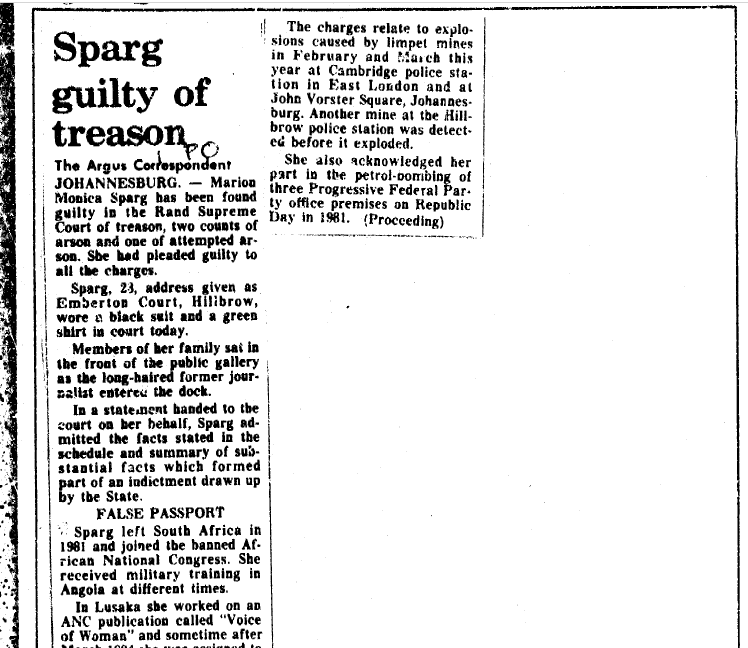
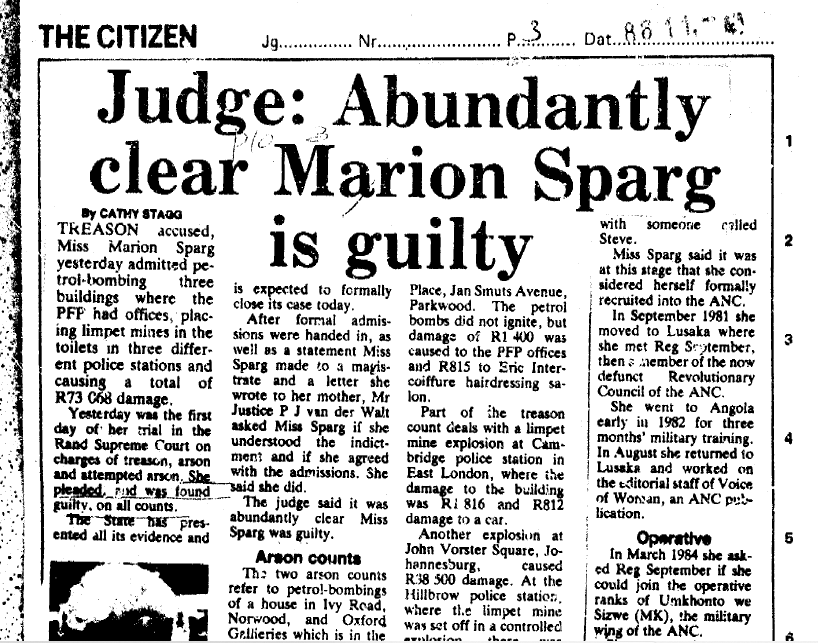
On Sunday, May 4,1986, Robert, his father Derrick, Matthew Lecordier, Antonio du Preez and Welela Khumalo were congregated at the McBrides' ‘Utility Services’ welding workshop at Factorama.
Although Greta was aware that Robert was planning something to get Gordon out of Edendale, she did not know that that very evening, they were going to attempt to undertake the operation. She arrived at the workshop expecting to meet Robert only.
"He did tell me that I must come down there at a certain time. They'd planned something. He didn't give me the details. I arranged such a nice lunch for him and I took the lunch there."
She did not expect to find McBride senior with his son.
Robert was outlining the rescue plan on a board on the wall, helped by Derrick.
Greta and Welela Khumalo would travel to Pietermaritzburg in Jeanette's Mazda 323; Robert, Derrick, Matthew, Antonio and Nazeem would be in the Ford bakkie.
Welela had now been staying at the McBrides' workshop for three days after running away from his home in Caluza.
He feared that the police were now looking for him after capturing his commander, Gordon Webster. He wanted Robert to help him "skip" the country.
"I'm sitting now, and they're planning positions," Greta relates. "You're there. You're there! It was quite mind-boggling for me, but I knew I couldn't back out. I knew too much already. I was going to be the driver. And at that time I was a hell driver. I could drive at any speed. And they needed someone who could drive fast if the need arose."
While they were at Bechet, Robert and Gordon had discussed daring operations like the Israeli's "raid on Entebbe" - to rescue the citizens of Israel who were kidnapped by Idi Amin's forces in Uganda.
They were very impressed by such daring-dos, and felt black people, too, could execute such operations.
Now Welela was considering going to the hospital to blow both himself and his commander up, rather than attempt to rescue him.
"For me it's like, there's a lot of things in people's minds at that stage that said black people can't do certain things," says Robert. "It's only Romans, Israelis or whites or Americans who can do these things in Vietnam or wherever; black people can't do operations like that. It's expected that they can't do it. He [Welela] wants to do a stupid thing and kill Gordon; blow the both of them up - and probably most of the patients in the ward too - with a limpet mine."
They were having tea or eating as they discussed the plan.
"We were explaining the situation. Why we had to do it. I was saying to people, 'if anybody doesn't want to come in now, it's fine, stay out. But you can't leave now. You have to stay at the workshop'. That's all I said to them. There would be no hard feelings if you don't want to come, but we won't allow you to leave now. We do the plan, and you'll be locked up there until after the mission."
The group had been in the workshop for a while now, but Nazeem had still not showed up.
"We wait for him till about quarter to four. He doesn't come. I phone his house; he's not there. We plan to go ahead without him. We start discussing. It's funny because everybody was very professional. We had no fear. It was almost - I can't explain it. I can't remember anyone looking scared."
Derrick took Doris into confidence about the plan.
"She knew before we went to the hospital. We told her. There was a trust in the family over things like that, in case anything happened. She would be aware of it. It would have been cruel if something went wrong and this whole thing comes as a shock."
Doris already knew that Gordon was at Edendale hospital.
"First I heard about Gordon's arrest because it was in the paper as well. When Robert came in, he said, 'Can you see what's in the paper? I'm sure this is Gordon they are talking about'. They didn't have the name. Then Robert says to me, 'I just can't leave him there because they are going to kill him in there. I have to fetch him'. I said to him, 'How are you going to do it?' Then I didn't know that he's been having meetings with so-and-so and the others."
She confirms that she knew where her husband, son and their comrades were going on that Sunday afternoon.
"Off they went. I just carried on as normal in the shop as if everything is running the same. We closed the shop at the normal time. I want to keep the shop so that if anybody comes and check us, they'll see that we are open for business as usual. We closed the shop at the normal time."
They then met up with Greta and Welela in Jeanette's car.
Robert took Greta to the bridge where she and Welela were supposed to wait for them as they went to fetch Gordon.
It is a few kilometres from the hospital.
Welela was supposed to dig up a hole in the bush near the bridge so that, as the men came with Gordon Webster in the bakkie, they can throw the weapons they used during the operation into the hole and cover them up.
In the event of the police chasing them, he was to detonate a limpet mine near the hole to distract them.
As it turned out, Welela was too nervous to dig that hole.
"Just before the operations starts, he says the hole is dug," says Robert. "But somehow we found out that the hole is not actually done. It might have been unfair to expect him to go dig a hole on his own, in a quiet area. The problem is anybody else who could help him would be sticking out like a sore thumb [because he was a Coloured in an African area]. He probably was very scared and panicky."
It was about seven o'clock when Robert and his comrades transferred weapons from the sedan into the bakkie, preparing to go to Edendale hospital.
"We've got five AKs, Makarov pistols, and a lot of hand grenades and a lot of ammunition. We could start a mini war."
In the boot of the sedan, there was a suit and another priest's dog collar, as well as religious pamphlets.
"Greta's job would be to dress Gordon when we take Gordon. She would change and dress him like a priest and she would sit him up and take him by car and drive him back to Wentworth. Welela would come with us."
The rendezvous of the groups would be the workshop at Factorama.
"We would take the van into 'Maritzburg, wipe off all the fingerprints, dump it there and take public transport. Before I left I think I gave everyone R100 each. You'd take your way, whether you got there the same day or the next day, it didn't matter. That's how it's supposed to be."
Robert had established that Gordon could walk, so they did not foresee much difficulty in getting him to the bakkie which would be waiting outside the hospital.
"We first had coffee. We had something to eat before we left. We stopped there in the main street [of Pietermaritzburg]. It's now called 'Church Street'. It was very cold, very windy."
He was behind the wheel when the four men travelled to the back of Edendale hospital via the dirt road.
There was a bush on the other side of the hospital, across the wire fence.
It was about half-past eight in the evening when they came to a halt near the fence.
"We stopped the car and parked. Opened the bonnet and pretend to be looking. I told Matthew to take cover in the bush behind. And Antonio there. I think I go and cut the fence a little bit to get in and tell Matthew to continue cutting the whole thing out. At some stage, I had taken Lexotan, which would help me to relax. My father uses it all the time because of the epilepsy."
Indeed, when Robert first broached the subject of attempting to rescue Gordon from the hospital to his father, Derrick had pointed out to him that he might have to carry two people from Edendale hospital - Gordon and Derrick himself.
Robert acknowledged the possibility that his father might suffer a fit during the mission, but felt that was a risk worth taking.
"What happens is, we come in," says Robert. "There is a big hole in the fence. We come down the stairs through the walk-way."
Derrick had opted to dispense of the dog collar.
His son was dressed in a white doctor's coat.
Meanwhile, in the ward, Gordon was expecting his rescuers to arrive at half-past seven.
When Robert first reconnoitred the ward, Gordon was lying in a bed in one corner.
Now he had been moved to the bed in the centre.
"I sat from twenty-past seven. It was exciting because they told me on Monday I was going to Wentworth hospital. I was put in the centre. [Previously] I was at the corner."
He was annoyed when the white policeman guarding him, Visagie, would not go and sit outside when he tried to get his doctor to get the him to do that.
"He didn't want to go outside. So, at half-past seven, I ask, 'What is the time?' They [the nurses] ask me why am I asking the time. 'Why are you so curious? Why do you want to know the time?' I say, 'No, I want to sleep at around nine o'clock'. 7.30 came. 7.45 came. I said let me sleep. I mean, if you had your hopes very high and things don't happen..."
"That's when I heard the gun-fire."
As father and son ascended the stairs leading to the ward where Gordon was, Derrick was in front, Robert behind.
There was a lift next to the flight of stairs.
Derrick was walking with a spring in his step which belied his fifty-eight years. He did not have a balaclava on. Robert had his in the pocket of his coat.
"As we were coming up, a doctor was coming down. I never had a chance to put my balaclava on. My father didn't have it. He forgot. I didn't have a chance to put it on. I tried to put it, and it fell down as the doctor was coming down. My father goes ahead. Somewhere near the entrance to the ward, on a bench outside, he sees a lot of these people. They are talking to the [two black] policemen. They were not supposed to be there."
Derrick came walking back towards Robert.
"He comes back. 'Let's abort. There's civilians.' He keeps walking past me. I get very angry because I think I know there's no civilians there. There is supposed to be no civilians. We've checked about three nights already. I am standing right on the corner, on the threshold of the entrance. He comes and says, 'abort. Civilians', and walks down. The idea initially was to capture, aim the gun at these guys, disarm them, take them to the back and lock them up in the laundry. Shooting was not in our interest because it would make a noise. That was the idea."
Momentary, Robert was frozen to that spot on the stairs.
Then he tried to go and confirm what his father had just told him.
"When I look up to see where the hell are these guys, the cop had seen my father and followed him. He somehow had turned to tell me there is civilians. Because I'm already prepared to move. Basically, he wanted to stop me. I am saying, 'Where is this?' The cop had followed him. Ngcobo. When I come near, look into Ngcobo's gun. I'm on a lower level than him. I'm on the first step, just below the level, and he's coming. So I look. He's there. He's got what they call an 'HMK' [hand machine carbine]. It's a sub-machine gun. He's pointing at me. I don't think he had cocked it yet. I've got an AK on my left side."
The AK was hidden under the white doctor's coat.
"I just drop it into my hand and pushed the safety, but now the AK is very funny because, when it's folded, you cannot push it to [a] single shot. You have to push a finger behind the handle that's blocking. It's folded, so it's automatic. I fire. I just fire because I can see there's shit here. Of course there's a moment - probably like micro-seconds -, where we look at each other, and he knows it's 'shandis' ["hell"], and I can see, 'Oh my God, there's trouble here!' He looks at me and I look at him. I just know I have to go through with this thing. I'm thinking to myself, 'The mission is fucked. There's no way we gonna win this. We're in shit now'."
Robert realised there was turning back now.
"So I fired at him. In my mind, I hit him. I hit him because he falls into the other ward. But not being an experienced fighter with an automatic, the gun lifts up, and some shots go up on the wall of the ceiling. Anyway, I manage to control it. I stop firing. He falls through the plastic doors [leading into the adjoining ward]. He falls in there. I keep moving forward. What happens is, when I shoot at him, these guys - the people that my father thought were civilians; they dive onto the floor. Straight away in my mind I know they are policemen. The way they moved so fast. I'm shooting at this guy, and I turn and look, and these guys are taking cover. I just fire across them. At that stage fortunately I already had control of the gun. Or unfortunately. They go down. None of them moves after that. I come back and I see there's a guy, next to the stairs. He's got - I have to pull him out of the way to walk past him. Later on, I come back. He's in the way. I have to pull him out of the way to push the trolley past."
When he got to Gordon's ward, Robert expected him to be lying in the bed in the corner. He came in shouting Gordon's other MK name, "Humphrey".
"I come in fast through the flap doors. When I came in and shouted - I don't know what made me go down on my knees; standing there, less than five metres away, was a cop."
The cop was Visagie, the white policeman who earlier on had resist[ed] Gordon's subtle attempts to get him to leave the ward.
"What I do, I don't hear a bullet, but a big explosion. I turn around and see him still pointing [a gun] at me. In my mind, it looks like a smile. I see the empty cartridge. It's still being ejected. That's how fast it is. He's grimacing. To me, it's a smile. He kind of makes me angry, and I just fire at him. I hit him, but somewhere there, something goes wrong in my mind. I forget I shot him and he's run away."
Visage ran into the sluice room, and would now and again open the swinging door to shoot at Robert.
"I can see Gordon. He's aiming at me from behind."
The people in the ward - nurses, patients and other hospital staff members - reacted differently to the unfolding drama.
"Others are smiling, others are almost bemused," says Robert. "Others are shocked. There's a male nurse who is trying to be as invisible as possible. He's standing amongst the beds. He gets to the window. I'm saying to Gordon, 'Stand up! Fucken move!'; I'm saying to him. I'm slightly mad now - the smell of gunpowder, the bullets; there's smoke all over. Gordon says, 'No, I can't move!'. I say, 'Why not?' He says, 'The policeman is going to shoot us'. I say, 'Which policeman?' He points to the sluice room. It comes back to me now. It's Visagie."
He ran towards the sluice room, opened the swinging leading into it.
"I just lose control. I come there. I see he is underneath a table or something. Now I just peep and come back because I'm scared. He fires again, just close to where my head is, and I fire at him again. I don't think I hit him. He kicks the door [of the sluice room] closed. Now I can move. I come to Gordon."
It was then that Robert found out that there was another reason why Gordon could not move when he asked him to do that.
Although Robert was told Gordon could walk, he was actually too weak to do that.
"When Pam came and spoke to me, I told her that I could walk. I knew I couldn't walk, but I mean, I couldn't say I can't walk because then they won't come for me," Gordon chuckles when he is asked about the misleading information he sent out.
"SBs came on Wednesday, and the doctor said, 'You can't interrogate this man because he's going for an operation. They came again on Friday, and I was not co-operative. [They] slapped me a few times. They then said they are coming on Monday."
As Robert came running into the ward and shouted out his other MK name, Gordon could not shout back.
"He [Robert] just looked. You know, in the direction of the position I was in the previous day. He was shouting for me. I couldn't answer because the tubes would hurt me. This policeman fired three times, and he missed Robert. And Robert couldn't see that he's being shot at. He came to me, and then I said, 'There's a policeman in one of the cubicles'. And then eventually he went in. And the policeman shouted through the door. He opened the door and he shot."
Robert was more interested in getting his comrade out than in shooting the white policeman dead.
"He came to me and said, 'Let's go', Gordon remembers. That's when the drama started. There was a trolley, and he was just screaming: 'Hey - give [me] the fucken trolley!'"
Robert tried to lift Gordon from his bed.
"I pick him up. He can't even stand. He's got a drip on him. I pull the drip out. He can't walk. Usually, I'm scared of drips and stuff like that. I pull the whole thing out. He can't walk. I don't know what to do now, but it's like quick."
The rescuer noticed a nurse close by. She was wailing loudly.
"I tell the nurse, 'Bring the trolley!'. I shout at her. She brings the trolley and she screams. I say, 'Shut up!'. She brings it to me."
This was actually not the usual trolley used to transport patients in hospitals. Rather, it was a three-wheeled, circular trolley which had a sack hanging from the round steel frame. A laundry trolley.
Now Robert was trying to wheel Gordon to freedom in the laundry trolley.
"I lift Gordon up and put him in the trolley. It's got a sack inside. He's sitting in that sack. I give him the gun."
He struggled with the injured MK cadre.
"We try to go down the stairs. At that stage, this is like maximum three minutes. My father is outside. Ngcobo can't come outside [out of the adjoining ward he ran into] because my father is there. My father is waiting so that no-one can come out again."
Besides Derrick, there was another obstacle to stop Ngcobo from coming out.
"From where the lifts are to where Ngcobo is, there's people standing in front of him, smiling," says Robert. "They are blocking his way. He cannot come out. I think when I came out, my father has a balaclava on. I'm pushing Gordon out. I try and push him out. He starts slipping off because this damn lift is taking its time. Then I have to drag him down. My father had noticed the trolley at the bottom, when we were getting in, which I didn't notice. He also had some papers. He pushes the paper on the trolley and puts it there. I lift Gordon and put him up there."
The trolley this time was the one used to transport patients. A proper stretcher with wheels.
"My father goes up again, to see if these fellows are coming out, to hold them back. Of course things are going wrong now; every step of the way. I'm starting to panic. I'm getting tight. I am tired. Emotionally, it makes you very exhausted. Like, too much. I'm pushing him out. Then my father comes in. By the time I reach there, my father joins. There's people singing in this section and up there, at the nurse's residence, they are all singing from the windows. How they know what's going on, I don't know. People are standing in the way and singing. We had to fire shots in the air to go through. No one is scared. Everyone is smiling. This is a wonderful thing that is happening."
Gordon shared the sentiments of the crowd of nurses, patients and other onlookers who were cheering father and son on as they wheeled him to freedom.
"I mean, you are scared, at the same time you're excited. It's unbelievable. It was very hysterical and a lot of noise. In fact, they were blocking the passage. The old man [Derrick] was trying to clear the passage. Even in the townships around there, they were celebrating and singing."
Robert was now feeling tired and weak.
"I'm really trying my best to do it. We keep going. There's a lot of noise. People are singing. I can't remember the songs, but they were celebratory songs. Freedom songs."
As they approached the hole in the fence at the back of the hospital, Robert shouted out to Matthew Lecordier and Antonio du Preez for support.
"Antonio comes out of the grass. He's got like an olive green cap. He pushes the gun through the fence. I almost go for him."
Robert was mistaking Antonio's cap for that of a member of the South African Defence Force.
"Something like, just happiness descends because I see everything there. We're almost there. I'm so weak! I go to the front and put down the bonnet. I tell the guys to take him out and put him at the back. They put him at the back. I close the bonnet and we go."
Robert drove for a while without lights on.
Gordon was with Matthew and Antonio at the back, he with his father in front. Matthew and Antonio covered Gordon's naked body with their jackets.
"I am driving. I drive the first hundred metres very fast. It's bumpy."
Meanwhile, at about the time Robert and his father were going through the hole in the fence of the hospital to go and fetch Gordon, at the bridge nearby, Greta had to contend with Welela's yellow streak.
"My instructions were very clear," says Greta. "I'm going to go [to] the bridge. They would take him from the hospital - it was only a few kilometres from the bridge; bring him there. They would quickly change over, putting him in my car, and I would just drive off."
Welela's instructions were that he should dig a hole in the bush near the bridge so that the men coming from the hospital could throw their weapons in there and bury them.
"I knew he had to be there. [But] he didn't want to get out of the car. I understood he was supposed to in the bush digging that hole. He said to me that he doesn't think it's the right thing to do, and I said whatever he was supposed to do, he must go and do. He didn't go."
Instead, Welela was fidgeting nervously with the hand grenade in his hand, irritating Greta no end.
"He was behaving so strangely, and I kept on begging him."
Welela's nerves were frayed even further when a traffic policeman on a motorbike stopped about a hundred metres in front of their car.
The policeman was stopping some cars. He insisted to Greta that they leave the spot where their car was parked.
"He was telling me that Gordon told him that if ever he sees a policeman around, he must change his tactics. I said to him, 'There's no need to change your tactic[s]. That policeman has no idea what I'm doing here. And I'm a woman. If he comes here and sees a woman around, he won't suspect anything'."
Welela, however, was unrelenting. Greta feared that he might end up accidentally detonating the grenade as he fidgeted with it.
In attempt to calm him down, she drove off.
They went to make a turn at the train station in the city of Pietermaritzburg. When they came back, the traffic policeman was still there. Still, Welela would not let Greta stop at the bridge. Nor would he agree to go out of the car to go and dig the hole he had been instructed to dig.
"He was talking about Gordon without stopping. 'Gordon and I are very close'; 'Gordon trained me'; 'I dropped out of school and I had nothing to do' etcetera. I'm hardly listening to him, actually. I'm worried about the fact that now they might be at the bridge."
After Matthew and Antonio had put Gordon in the back of the bakkie, Robert drove for some distance on the dirt road.
Without lights.
"We are facing the opposite direction," says Robert. "In fact, when we come out of the main road, I still continue about two or three kilometres towards Richmond, not towards where the car is parked. I know we gonna get into the dark where it's not lit up. Then I make a U-turn and come back. We come back. We're going to 'Maritzburg. We reach the main road only when we pass the hospital. There's a few more bumps. There's a curve to the left, and it straightens to the right again."
Gordon's rescuers were lucky. A few minutes after they left the hospital, an ambulance also left.
"Everyone thought it was like a taxi," says Robert. "[That] this is the escape car. It was good that we got out at the back. People were still wondering what the hell is going on, and we were gone already. We could not have been longer than five minutes - five minutes from the time we left there to the time we came back. It was very quick."
Now they were approaching the bridge where Greta was supposed to be waiting for them.
"We can see [where] the car should be from about two kilometres back. The hazards should be on. No hazards."
The driver discussed what should now be done with his comrades.
"I'm clear-headed about this. Of course the people say we have to go through. Gordon asks for an AK while he's lying there. We go. I want to turn right as we enter 'Maritzburg. There's another road towards Richmond. As I'm about to turn, they're putting a roadblock."
He thought if he went ahead and turned as further on along the road the police were setting up a roadblock, the police would think he is taking a detour to avoid them.
"I decided to go through. We go. There's two Casspirs and two vans. No blue light. I go through. When we enter 'Maritzburg, I turn right by the first prison. I'm driving very slow when going out there - 60 km/h. Looking as relaxed as possible. I forget about Greta. But I know something has gone wrong there. There's not much one can do now."
Eventually, Greta decided to put her foot down, disregarding Welela's nervousness. They had come to a stop outside the railway station.
"I said to him, 'I'm sorry my friend, we are going back to the bridge'. We got there, and we waited for the people. It must have been fifteen or twenty minutes, and they hadn't come around. I was sure in my heart that they had already gone past. Or they had some problem. While I was getting worried, two police cars drove past at top speed up the road."
The police cars were driving in the direction of the hospital. The cars' sirens were blaring.
"I thought, 'These guys have done the job and the police are involved'. I was so determined that I'm not leaving until I've done my job. I must take the wounded man. Then I said to him, 'You must know where the hospital is. You are taking me there. We are going there!'. I said to him, 'You are taking me to the side of the hospital because I understand they're going to enter through the side'. He takes me there."
Robert and his comrades were now travelling on the freeway.
At the back of the bakkie, Matthew and Antonio were rubbing Gordon's naked body to improve the circulation. Gordon was freezing.
"We're travelling," says Robert. "Just before we reach the Lion Park (just outside Pietemaritzburg), I see like a blue flash. I think someone is shooting at us, the way it is. I say to them, 'We are fucken under fire here!' The old man says, 'I think it's cops. Just take it easy'. I take it easy."
Derrick was having difficulty putting the magazine in the AK.
Robert helped him.
"I'm holding the steering wheel in my legs, and I just do it quickly. Then he puts it and leans it over on the seat, behind my neck. To face the window. We're quite relaxed. Of course Gordon is coaching the guys in the back: 'Don't do this, do that'. The cops are coming fast. Dramatically fast. You just see the thing (the reflection of the blue light) getting bigger in the rear view mirror."
As the police vehicle approached, Gordon told Matthew and Antonio not to shoot first.
"You shoot after," he explains. "You don't shoot first. If they shoot you, then you shoot back. You shoot first those guys would finish you. Definitely."
He told Matthew and Antonio that if they acted suspiciously, the police would stop them.
"Actually, they wouldn't stop you," he corrects himself. "They will shoot first."
Gordon felt that "the mere fact that they are not shooting means you can carry on."
Then the police vehicle decelerated, changing lanes on the freeway.
"Suddenly, they look at us," Robert recalls. "They are two white cops - one of those 10111s (police emergency vehicles, bearing the emergency number). They pulled up behind us. I'm not sure what's going on. Then they pulled a [mini-bus] taxi over. There's a taxi on the left hand side."
The MK cadres counted their blessings. It was just as well that ambulance left the hospital at about the same time they were leaving. The police were on the look-out for a get-away vehicle which was a mini-bus.
When Greta asked Welela to take her to Edendale hospital, he was still playing with the hand grenade in his hand.
"I said to him, 'Don't put it in the pocket. Put it under the seat. Stop playing with it!'."
The only time Greta had met Welela Khumalo was when he joined Robert and Gordon when the two were going to bomb the Jacobs sub-station for the second time.
Greta also took the dirt road to the back of the hospital.
When they came to the fence, they found a number of police cars there.
"The police are driving up and down; the nurses are excited," says Greta.
She persuaded Welela to leave the hand grenade in the car as he went out to find out what was going on.
"He came back and said, 'The job is done a long time ago. They took him and they are gone'."
It was about quarter to ten at night when they reached the "Utility Services".
"We take turns massaging him," says Robert. "Of course, now we have a chance to think about where's Greta. About half an hour later, the phone rings. I shouted at her and said, 'Where the hell are you? Come right here now! Come to the workshop!' I did explain to her everything is okay. She said, 'Thank God! I've been praying'. She came back. I'm still angry because I don't know what the hell happened. I don't even give her a chance to explain. It was very wrong of me to do that, but I thought they had fucked up somewhere and did not obey instructions."
When Greta and Welela were on the freeway to Durban, Welela's adrenaline suddenly stopped propelling him to want to take a flight away from action because of fright.
He now wanted to fight.
"On the way back, he's so excited. Now he wants to do something. He says to me, 'don't you think I should throw this grenade at these passing cars with white people?'"
Greta quickly swung to the extreme left lane, drove to the edge of the freeway, and commanded Welela to throw the grenade into the bush.
At the McBrides' workshop in Wentworth, Robert was now concerned about his friend's state of health.
"I contact Pam, and she comes to the factory. The very same night. She looks at him. I think she gives him an injection. I stayed there the whole night. Everybody else goes. I tell my father also, I think it's best to go home now. He then drops off all the other guys. Someone takes the van, leaves it at Ogle flats (in Wentworth); wipes it off [the fingerprints] and just leaves it there after everybody was dropped off."
Gordon was sprung from Edendale hospital on a Sunday 4 May, 1986.
Pam Cele, his brother's partner, was the one who was expected to take care of him so that he does not die on his rescuers.
The problem was that in four days' time - on Thursday, 8 May - Pam was leaving for London on a six months' scholarship.
On Saturday, she had gone to the hospital to inform Gordon that a plan to rescue him was indeed in place.
"In the meantime I asked Norman (their doctor contact at the hospital) what has to be prepared," Pam explains. "He found out - antibiotics and drips were required."
When Pam got the workshop on Sunday night, she was shocked when she examined Gordon.
"I got in there. There was a big stack of AKs. AKs only! I looked at him and his abdomen was very distended. He had a drain on the side, and he was groaning in pain. He was obviously taken with a lot of force. He did not have a drip on. He was pale."
Trevor says he had mixed feelings about his brother's new freedom.
"I was happy that he was out of hospital," he says. "But the newspaper had described his condition as being critical. So we were not sure whether he would be able to survive or would he get worse."
Pam asked Robert to drive him to King Edward VIII hospital immediately.
"I had a friend who was working in the theatre there, Dolly Ntini. I told her what I needed, including 'Ringer's lactate' [a drip solution], dressings, antibiotics and catheters. I was worried about him."
Pam was coming to the workshop to monitor Gordon's progress a number of times in one day. By Tuesday, she was impressed with his progress.
Then another problem developed.
Robert felt he needed to move Gordon away from the workshop.
His comrade's face came on TV during the news.
In the news, he was referred to by his real name, "Gordon Webster".
"I see the news. I'm watching the news a lot, and I'm not spending too much time with him 'cause I'm doing things. Thinking I must have a way to get him out [of the country]. If he could walk it would be okay. The new development of his face coming on TV - of course I know in my mind: all the people at college are looking at it and saying, 'That's Gordon, and where's Robert?' That's how they must be saying it. I decide I must take him away from here and be cool and just act normal."
He even prepared a response should anyone who knew how close he was to Gordon at Bechet meet up with him.
"I would just get ready and say, Jja, well, that was bad, man'. I saw someone from a distance, Jurina Fredericks. She was coming from college, walking. I was driving, and I waved at her. She looked at me for a long time, then waved back. I could see that obviously everyone knew I was with Gordon. The fact that no-one informed the police made me believe that maybe there's some hope for them."
He asked the Webster brothers to help him move Gordon away from the workshop.
Trevor spoke to a friend of his, Majola. from Umlazi, an African township near Wentworth. Majola was working at the medical students' residence in Wentworth, Alan Taylor Residence.
"I went to Victor and told him that I had spoken. He lives in 'AA' section (in Umlazi). We used both cars - Victor's [Toyota] Cressida and my [Toyota] Sprinter. [The] Cressida being bigger, we lowered the front seat and Gordon sat there. Imagine driving through Ogle Road [in Wentworth] to the garage there to put in petrol in the cars. It was the van - Robert was in the van, Greta as well, Victor, Gordon and myself."
They took Gordon to Umlazi in the middle of the night.
"The place we take him to is at the top of the road," says Robert. "There's a very steep bend, no steps. We have to put him on a door as a stretcher and tie him up and carry him down. It's very cold. I remember it being cold."
He spent the night with his friend at Majola's house.
For the first time in many days, he did not feel under pressure.
The following day, it was very calm and warm outside, but Robert was careful not to venture too far away.
At the time, he was thinking about crossing the border with Gordon on foot. In preparation for that, he was taking him through simple, light exercises.
"I get him to stand up there, he must stand on his legs. I'm getting an idea that if he can exercise, the better for him, and the quicker he'd get strong. I remember making him pull his legs one at a time. Simple exercises."
Gordon told Trevor how Robert had been taking care of him when he was at Majola's house.
"This emerged later on," says Trevor. "Gordon said to me, 'There isn't a man in this world who can do what Robert was doing for me. He is more than a friend', I remember him saying. 'I was a baby, and Robert was wiping my backside. Imagine Robert wiping my arse! No man would do that for another man'. Robert and Gordon, as far as I'm concerned, were one. You couldn't separate them."
Then Majola got panicky. He would not let them keep Gordon at his house any longer.
"Majola started becoming worried because he also felt the neighbours were asking, 'who was that guy who was brought there at night?'" Trevor explains. "We then moved Gordon from Majola's house at section 'AA' to 'B' section in Umlazi. To another place of Pam's friend now, Baby Ngubane."
Baby Ngubane was a social worker.
The social workers in Umlazi had single quarters next to the local campus of the University of Zululand. The quarters were called "the green house".
When the Webster brothers and Pam moved Gordon to "the green house", Robert was not there. He was engrossed in the plan to take Gordon across the border.
Because Gordon still could not walk properly, he would have to be taken out by car, going through customs.
Robert had bought a big "V8" Ford bakkie, and had asked Greta to rent a caravan. He began preparing a place where he could hide Gordon in he caravan.
"What I had done was prepare cover. He would go into the back in the space near where the wheel is - very similar to what we used to bring weapons back for one of the caravans. Very similar, but then he would be put in there, and he'd be covered, and this cover lid would be put on top. On top of the lid there would be a carpet. It doesn't look like it opens. It would look like it's for the wheels. It would give that impression."
He was planning to cover Gordon's hiding place in the caravan with canvas and bolts, and then close it.
"There'll be a lot of beer, biscuits and filth around. Nobody would go and search in there. Of course it was a shot in the dark. It was not a foolproof thing, but that was the idea at that stage."
While at "the green house" in Umlazi, Gordon asked Trevor to go and call Anne, his Xhosa girlfriend.
He wished to say [goodbye] for the last time as he would be leaving the country for good.
Gordon, however, had misgivings about his impending exile from his fatherland.
"I thought that maybe if I can get some medical treatment, I could see some progress in me. Then I could get better. But they felt that I was better off outside the country."
One of the factors which was compelling Robert and the Webster brothers to insist that Gordon leave the country was the fact that, at the time, the police had placed a large reward for anyone who could help them re-arrest him.
He was the most wanted man in the country.
Police were offering a R2 000 reward for information leading to his arrest.
Anne came to see her lover at the hiding place provided by Pam's friend, Baby Ngubane.
"I said to her, 'Look, maybe I may not see you again'. I had this premonition that, once I'm outside the country, I will never return. So I said to her, 'This is our last meeting. Goodbye'. I loved her very much. To leave behind someone you love - because I didn't know how long I will go for treatment. That's the end of my road."
Anne started crying helplessly. She did not want to part with Gordon. George Webster says, during Gordon's first period of exile, she would often come to his law office to enquire about her boyfriend.
Now she felt, if he had to go into exile again, she must leave with him. Gordon was pleased that she wanted to come with.
He says he reckoned, "If that's the end, let me have some satisfaction. Let me gain something. Without any notice, she left (with me)."
Pam left for her six-months' study programme in London on Thursday; a day before Gordon's departure for exile.
By then, she was satisfied with his health.
"He was okay," she says of her final medical assessment of her partner's youngest guerrilla brother. "The wounds are okay."
When she left, her son by Trevor - Keith - was about seven. Keith was doing grade 2.
The following day, Trevor, George and Victor took their brother and his girlfriend to the McBrides' workshop at Factorama. Robert was surprised to see Anne. He had been under the impression that it was just Gordon that they were taking out of the country.
"I tell Gordon no, she can't come. She starts crying. Then I say, ‘All right, she can come’."
He then had to quickly construct a second hiding place in the caravan.
"Anne's thing [hiding place] was not perfect. She just got into the thing. What we did is, we never put them there the whole day. We left them in the caravan, curtains drawn, but on the floor, with the mattress. Anne was given a torch. She would sign the torch at me in case something is wrong; onto my mirror through the window. That's how I'd know something is wrong."
Greta was with her boyfriend in the large Ford that was towing the caravan. Half-way to Johannesburg, they pulled over into a filling station and parked to rest. Robert and Greta slept in the truck, Gordon and Anne in the caravan.
"We wake up at five in the morning, and then we travel again," says Robert. "We go to Nigel. I went looking for my uncle in Nigel, and he was not there. I needed to get to the border late, so I needed to delay."
The uncle whom Robert was looking for was Leslie, his father's elder brother. Leslie McBride was one of the few family with whom an embittered Derrick had retained contact when he left his home for Durban just over [three] decades before.
"We stop at my uncle's place," says Robert. "We're looking for these people. They are not there, and we carry on."
He was driving deliberately slow so that they should arrive late at the Ramatlabama border.
On the way, near Lichtenburg, they stopped to have a braai next to the road.
"At some stage when I was trying to put the fire out, a coal rolled and started a fire, and the fire just moved fast. I just had to get away from there quickly."
Robert was worried about Gordon.
"Greta is her usual 'stony' self. Maybe I am the one who's most anxious. Anne is too innocent to be anxious. Somehow she thinks it's gonna be a walk-over. Gordon went down. He was very weak."
When Gordon was at Majola's place at Umlazi, he made him do simple, light exercises to get him to walk. Then he was impressed with the progress his friend was making.
"He was much weaker than (when he was at) Umlazi. He couldn't stand in the caravan. I don't [know] why, it was almost like a relapse or something."
There might have been a psychological component to Gordon's weakness. His heart was not in the trip. He was not looking forward to life in exile.
"It took me nearly two years to come back," Gordon explains. "Going there, finishing my training - why must a person take so long? The problem is there [in exile] you are controlled. They tell you 'next week'; 'this weekend' is next year. They keep on postponing."
The escaped prisoner felt there was absolutely no chance of coming back into the country as a guerrilla because his role in the Edendale rescue mission had robbed him of his anonymity.
"I knew very well that my life and my future won't be in my hands anymore."
At about quarter past seven in the evening, they started moving towards the border.
"About five kilometres from the border," says Robert. "I stopped the car and got out. Nineteen twenty (hours). The border closes at eight (o'clock)."
He put Gordon and Anne in their respective "secret compartments", then closed [them]. Gordon found it stuffy inside the compartment. The sound of Robert hammering the nails onto the floor to close him inside with a lid was like a nail in the coffin.
"I put a mat inside to cover them up and sprinkled chips and biscuit crumbs," says Robert. "I spilled beer on the carpets, closed them up, and then we went."
Greta remembers that Robert made sure that the whole caravan was "topsy-turvy".
"For anyone to look properly inside, they would have to unpack all that junk."
The mood at the border gate was very tense.
"But of course we had been there so many times," says Robert. "Greta would touch my arm or make a joke or put her arm around me as part of the cover. No-one would be able to pick up what we were doing. We went on like that. BophuthaTswana side [of the border], no problem. They [the customs officers] were rushing to the casino probably. We go through 'no man's land'. The road used to go to the right. Passed a train line, and then Botswana. In Botswana we must pay tax because I have a lot of milk in the van. They ask us, 'Have you got anything to declare?' I say we're bringing milk into the country. We're going on holiday. I have to pay tax for the milk. "
Robert was purposefully carrying a number of bottles of sterilised milk to make it seem as if they were going on a camping trip for a long time.
"About six bottles. There was a few other things - beer or something."
Then the Botswana customs officer almost made his heart stop.
"She wanted to check the back. Oh my God! She goes and opens [the caravan]. It's dark. She says, 'Do you have a light?' Then I say, 'No, I haven't put the battery on yet'. I didn't even know caravans had batteries, but I just said that. I just stand. She goes in and gets the smell of the beer. I can see her turn her nose up. Of course this time I'm shitting myself."
He [Robert] was standing near the entrance to the caravan, on the passenger's side of the vehicle. He could see Greta in the side mirror. She was her usual "stony" self.
"A lot things are going through my mind. Anyway, she goes. She smells, turns her nose, then turns around and comes out."
Rather than leave immediately, Robert delayed purposefully, lest the customs officer think he is too relieved than she has not searched the caravan thoroughly.
"I'm sure I opened the bonnet and looked in the bonnet. Then we go and travel. I take it slowly, about eighty kilometres per hour. After I'm out of sight, I travel very fast for about five kilometres. Then I stopped to take them out. They both start screaming, Gordon and Anne. I am tense now because I know that anything can happen. The Boers can come after us. It's a major defeat for them".
The two couples booked at Mphatlhalatsane hotel so that they could get a parking place for their caravan.
The following day, their MK comrades came to the hotel. The Botswana-based cadres were cautious as they approached the room where the two couples had booked. From their room, Robert could see the activists walk in.
"I was sitting on the bed, and the curtain was open. I saw the fellow walking across. You could see he's South African. He stood at the corner and looked towards where we were."
Hassim Ebrahim, alias "Georgie", was the first to walk into the room.
"Oupa stood out, which is very abnormal, but I had seen the other guy already and just didn't want to do anything suspicious. I just relax, because I know the guys are coming. These guys came very quickly. About five minutes later. The other one doesn't come in first, Oupa. I think he hears my voice and then comes to the door. Hassim comes in. Oupa moves that way and looks in."
When Gordon saw Oupa, he called him in.
"Now he's talking; he's cheerful," says Robert. "The guys are still hesitant. They asked me - because somehow the van was not parked there, it moved to the front, under the tree, 'Is that the getaway car?' I said no. They ask a lot of questions; security stuff: ‘Who else is there?' 'Anybody else injured?' Stuff like that. They sit for about ten to fifteen minutes. I think they give me money also, because I'm out of bucks. They say they gonna go and come back."
Georgie and the other Botswana-based MK activist found it incredible that they had managed to pull off the rescue mission.
"They said, 'We saw this on TV,'" Robert relates. "'We read the newspapers, and we thought it must be you. When we saw the photo’ we knew it was you'. All the excitement."
The MK men came to fetch Gordon and Anne the following day, on Sunday.
Robert and Greta bought the "Sunday Times" and saw that the Edendale rescue operation was on the front-page.
The report was headlined, "Neighbours keep mum on escaped terrorist".
Seemingly, the belief was that Gordon was still in the country.
"If escaped ANC terrorist Gordon Webster has gone to ground in his home territory, nobody is telling," read the report. "Members of the close-knit community in which he lives this week refused to talk about the 23-year old man who was shot by police while transporting a cache of arms and later daringly sprung from Edendale hospital by his comrades".
The report was illustrated with a sketch of the hospital, showing how the rescue operation was carried out.
When the MK commanders came for Gordon and Anne, they took away Robert's van to hide it and gave them another, a red Toyota.
They organised Robert and Greta a room at the University of Botswana.
"It's a tiny small place," says Robert. "I remember roaming around the whole day. Greta is so proud: 'We did it'; 'It's a major victory'; 'With all their resources and helicopters, they couldn't catch us'; 'No matter what happens to us, we've done it'. We stayed for a while in the hostel of the university."
Then the couple was taken to the home of a Coloured man, Allen, who was running the ANC's disco in Mogoditshane. Allen, whose real name was Garnet Gordon, was supposed to organise weapons for them for self-protection.
"He doesn't do that," says Robert. "I think he's jolling [courting] a woman or something. The fridge is well-stocked. He told us to help ourselves."
The next day, on a Tuesday, they were moved again for security reasons. Their big van was returned to them, and they were given enough money to travel deep into Botswana for a few days' holiday. They would only be needed on the coming Sunday.
The couple went to Francistown.
"We go to this place, it's like a holiday resort," says Robert. "There's a big river, but all around there's these Afrikaner Boers on this holiday resort. We only go out of the room occasionally because these guys; the accent is there. The language is there. Of course, only now we know they actually used those trips to spy on us. Then we were just feeling uneasy."
At the time, the relationship between Robert and Greta was strained. In fact, fissures had began to form in the affair earlier.
"From the time Gordon was arrested, things didn't work well after that," says Robert. "She was also under strain. Probably there was too much pressure on me; being young and immature. There's a lot of mixture of emotions."
The couple crossed into South Africa on the night of 18 May, 1986.
"The morning of the nineteenth, the Boers raid the disco and the area where the hut was," says Robert. "The South African army. They hit three places. They hit Lusaka, Harare and Gaborone."
They [the fugitives] learnt of the casualties during the cross-border raids into the three neighbouring states to South Africa in the press.
"It's very low," Robert recalls. "They kill a Botswana ambulance driver, a refugee in a Swapo camp (in Lusaka) and nobody in Zimbabwe. The editorial is saying that [PW] Botha is trying to scuttle the peace initiatives of the Eminent Persons Group."
Because of the cross-border raids, Gordon and Anne had to leave Botswana illegally.
"They [the South African soldiers] attacked the same house that Chris and Oupa were staying in," says Gordon. "They had shifted in the morning. So there was pressure now. From the Botswana side. And also from the South African side."
He, Anne and other refugees crossed a river in a dingy to get to Zambia.
"Eight of us," says Gordon. "It was a big one. From Livingston up to Lusaka."
In Lusaka, he was met by the top leaders of the ANC.
They were all proud of what he and his comrades had achieved. "The first one is Chris Hani. He was the man. The only one hero in my life."
Hani, now deceased, was at the time the chief of staff of MK.
"[Hani] was saying, 'Joseph (another MK name of Gordon), you must tell us the story over and over again'. I'm trying to tell the story from Botswana, then they are shaving my hair. Rashid was there. Joe Modise [MK's commander] came later on. He must have been in Zimbabwe at the time."
On their return to South Africa, Greta found Robert difficult to live with. He was irritable, brooding over Gordon's fate in exile.
"In my mind I thought maybe he was dead," Robert explains. "The only thing that gave me hope was that I had seen him before we parted. He was walking, able to stand up. He had a nice tracksuit on, and he walked."
He says Greta coped remarkably with him during this time.
"She was much more mature than I was. I was very immature still. I remember at some stage things got tense after Gordon was taken out. Our relationship was not very good. The fault was mine because I could not cope very much with the fact that he was almost killed. This was almost like my blood. I became quite withdrawn."
Then he placed what looked like an explosive device in a heavily-guarded parking garage in Durban.
The Pine Street Parkade garage was a six-storey building located in Pine street. It was owned by Anglo-American corporation.
Jeanette, Greta's younger sister, drove him there.
The operation was carried out after the cross-border raids of the South African Defence Force into the neighbouring states of Botswana, Zambia and Zimbabwe.
Although there were no ANC casualties, the Prime Minister of South Africa, PW Botha had justified the raids as "pre-emptive strikes" on ANC bases in those countries.
Botha’s government had then snubbed an "Eminent Persons Group" [EPG] which had tried to facilitate negotiations between his government and the liberation movement.
Robert says the thinking behind the Pine Arcade incident was two-fold: to "test" Jeanette Apelgren, and to prove to the Nationalist Party government that the ANC could reach any place it wanted to reach in the country.
"I could have used anybody. It was an ideal situation to test Jeanette. What happens, when recruiting somebody, you need immediate follow up after that. So that they can see it's for real. He [PW Botha] rejects the peace option and opts for the military thing. He believes he can suppress the ANC. My intention is to show him: 'don't be silly old man, because we are here. And in a big way. We can get in anywhere'. Every floor (of Pine street Parkade), you had a few guys with 'walkie-talkies' and stuff. So we went in there and left this funny-looking bomb there."
The "funny-looking bomb" was two SZ6 demolition charges tied together, then joined to an SZ3 charge by epoxy glue. Then a hand-grenade was stuck to the components. He then tied the contraption with wire and "sellotape" before painting it white with a spray.It was bound to seem a novel explosive, even to the most experienced bomb expert in the South African Police.
He says this was exactly the intention.
"It was about thirteen kilograms. It was a number of different charges put together. No detonators."
He explains that, because the bomb had no detonators, it was not going to explode.
Rather, it was going to cause a sensation among the police when they found it.
The following day, the car with the unexploded bomb underneath it was on the front page of Daily News.
Greta says that the possibility that Jeanette might have got unwittingly involved in causing much damage to property - and probably, even human life - made her usually bubbly younger sister crack. She thinks the roots of Jeanette's subsequent decision to give evidence against her and Robert are to be found in this incident. Her younger sister was very unlike her, she says.
Robert nicknamed Greta "The Stone" because of her unflappable demeanour.
But Jeanette was different.
"I don't cry easily. I don't get angry. I just keep calm [says Greta]. But Jeanette would always give you the impression she's courageous, but not violent. Underneath she's actually a very timid person."
On his last visit to Botswana - when he and Greta smuggled Gordon and Anne across the border - Robert was instructed to return later so that he could get briefing from Rashid.
He had also been told to come in a vehicle which could carry a substantial number of weapons. He modified the new Ford "F250" van he had bought when he took Gordon and Anne out, creating a secret compartment for weapons in it. The van had a powerful "V8" engine. He then contacted upholsterers who were operating from the same building where his father's welding workshop and his mother's tea-room was located, at Factorama. He commissioned them to construct a "sexy", gold-coloured leather couch which he was going to install in the van, giving them the relevant measurements.
"It can be lifted up only from the bottom. It goes through from the top through the back of the van, and you screw it from under[neath]. No-one would think of tearing it. It's like cute, you know. It's gold in colour - the mat is gold, the carpets and the curtains are yellowish. It was kind of posh."
When he and Greta drove up to Botswana to meet Rashid, he had a fairly good idea of the nature of the briefing he was going to get from his commander in Special Ops.
"It was quite clear. I can't remember exactly who told me, but I was coming back to collect the material (for the car bomb). Rashid wasn't in the country when I brought Gordon. The only reason I went back was to get the car bomb material. I went for training on car bombs by Oupa."
Before Gordon's capture, Gordon had mooted the idea of attacking the Natal Command of the SADF to the head of Special Ops. The Command was located in Durban.
"Gordon came up with the idea of putting mortars on the beach," Robert remembers. "Shooting with a high angle just to drop into Natal Command. But prior to that, you'd set up some anti-personnel mines behind. So, if you're lobbing the mortars from the beach to the front areas of the Natal Command, they would retreat, retreat towards the mines."
But now the picture had changed, Gordon was captured.
"He was trained in mortars, and I wasn't."
When he bought the big Ford van, he already knew he had to get a vehicle large enough to be able to transport a lot of weapons, including SZ6 charges.
"I was told [that] the last time when I left [Botswana]. At one stage I was actually given money to buy this big van to bring in equipment. Sometimes before this. It could be the visit with the caravan. The visit where Rashid met with the girls and spoke to them."
Besides Gordon's incapacitation, there were other difficulties with the plan to attack the Natal Command military headquarters.
"When we reported to Rashid that this thing cannot go on because you can't really hit Natal Command or any police station - you couldn't park next to a police station undetected during those days, they said, 'Hit a place where cops frequent'. We looked for a place."
When he and Greta crossed the Ramatlabama border gate to enter Botswana during the second week of June 1986, he had found two such places.
These were two popular bars: the "Why Not" and "The Barn". Robert and other members of his unit had established that policemen and soldiers were in the habit of patronising the bars.
In Botswana, the couple booked at one of the two hotels they often used on their trips, the Oasis.
At the time, Chris had been arrested by the Botswana police and deported out of the country.
"Oupa comes to the Oasis," Robert relates. "He sleeps there in the night."
The next evening, Rashid came to the hotel to give Robert his instructions. Greta remembers the meeting between Robert and Rashid before the fateful car bomb outside the 'Magoo'/'Why Not' bars.
Rashid and Robert had long been in conversation in one room in the hotel, with the door closed. Greta was taking them something to drink.
"I didn't knock, I just go in," she says. "Not that I was inquisitive - I knew I was not entitled to that information, but I had now realised it's supper time. I don't know what they could have been speaking about other than the 'Magoo's' (car bomb). I really can't imagine what they could have been talking about."
The two men immediately kept quiet as she walked into the room.
"I don't know what they had on the table - they hid something quickly. I said, 'I just brought you people juice'. They say, 'Okay, put it down and leave'. I just put it down. Rashid did not utter a word. In fact, both of them - until I have finally gone out and closed the door."
After she had closed the door to the room where he was getting briefing from Rashid, the two men continued.
" I go over the issue with Rashid again," says Robert. "These are the two targets we have. We can't hit Natal Command because it's so open. Police go to 'The Barn' and 'Why Not bar'. These are the two bars, and people can get hurt. 'What is the policy of the movement on this?' That I asked specifically."
Rashid was reportedly a little impatient with him when he asked what was the policy of the ANC on placing car bombs outside places like the "Why Not Bar".
At the time, all adult white males were from time to time conscripted into the army to bolster the system of apartheid.
"He is saying, 'Look, there is a war. These guys go after us whether we are armed or not armed; whether we are combatants or non-combatants. Then he mentions the whole thing of conscription. 'All white men are soldiers. If they can hit us in Botswana and say they have killed ANC collaborators' - whoever was in the vicinity is a collaborator -, 'then we can kill all the collaborators - who are real collaborators'."
Robert had joined the ANC's armed wing after the organisation's conference at Kabwe, Zambia. The conference took place in the aftermath of an SADF cross-border raid into Gaborone, Botswana on 14 June, 1985.
During the raid, twelve people were killed. The casualties might actually have been higher, were it not for the Kabwe conference. Many ANC refugees who were targets of the raid had left for Kabwe when it occurred.
The conference became a turning point in the history of the ANC, when the organisation decided to intensify its armed struggle against the Nationalist Party government and to relax its policy of avoiding "soft targets" when it carried out its missions.
Up to that time, the ANC had striven to avoid operations which may have led to such casualties.
In a press conference afterwards, then ANC president O.R. Tambo said, "We characterised the conference as the council of war for the obvious reasons that even as we opened our meeting, the continued massacre of our people loomed in our minds, highlighted by the criminal invasion of Botswana and the murder of innocent people in Gaborone. Whether we wanted war or not, the Pretoria regime was telling us in action that the only way we can stop the blood letting was to go to war."
In his briefing to Robert before the mooted operation in Durban, Rashid cited the resolution taken at the Kabwe conference.
"'In any event', he says to me, 'why should you be concerned [if]adult whites should get hurt? What are you saying now?'. He got quite irritated. Basically, he said, from the Kabwe conference, anything goes - with the exception of not killing children."
The operation had to be done on Saturday the fourteenth, a year after the Botswana massacre.
"Remember, the targets of 14 June 1985 were Special Ops. They were the targets, and only innocent people were killed. They - the Special Ops - were the ones to hit back. I was told not to use all the SZ6s, but to keep one in case they [the SADF] hit again."
Rashid's reasoning was that, detonating the car bomb on June, 14 would stop the SADF's cross-border raids, "because they would pay ten times worse. Each year we would commemorate. So that'll make them stop.
"He says to me, 'Any car bomb in itself will always injure civilians. It's the nature of the weapon'. If the civilians get injured, it's acceptable. By their very nature car bombs injure people other than the intended target.’ Once I'm given the go-ahead, I'm passed over to Victor."
Once Robert had received briefing and an explanation of what was considered a legitimate target from Rashid, he had no compunction in carrying out the operation.
"I never had a moral problem with it. My moral problems were sorted out when I joined the ANC."
But Greta suggests that Robert's emotional state on their way back indicates that he was more troubled by the imminent mission that he is prepared to acknowledge.
"This time he was very tense. Nothing got to him. Nothing excited him, even when we went past the border post. There were lots of road-blocks - at least two or three - that you drive through from there to Johannesburg."
They travelled for a long distance in silence.
"We came down, all the way we were not talking. He was very intense; very drawn to himself."
Along the way, they stopped at a filling station. Greta went to the public phone booth to call home.
Her parents informed her that her younger sister Jeanette, brother Eric and many other activists in Wentworth had been picked up in a massive swoop by the South African Police.
"I phoned my parents from a garage, and my parents said that they are all arrested and whatever. That tensed him up more. It had to, because it was hell. There were people who'd worked with us on the Edendale mission - they'd come with us at certain times. He was afraid that that group of them could have cracked and the police would be looking for us."
*
Normally, Greta would have countenanced Robert's silence as they drove back from Botswana.
However, this time the silence was getting unbearable.
"Then I had now to ask him because he was in his own world," says Greta. "I was talking to him about other things, but he was not responding. If he did, he would be irritable."
Eventually, Robert opened up to Greta - albeit just slightly.
"I can't remember the exact words, but he was telling me that Rashid wanted him to do something that weekend. He's got to do that, and he also has got to show the South African security forces that we can do anything. He's saying in like in a riddle. He didn't come clear at that moment."
She got the impression that Robert was intimating that he could not do whatever Rashid wanted him to do. The inability, she explains, was not technical.
"It was like psychological - emotionally beyond him. Robert is an intellectual, essentially. He was becoming a teacher, and those things were very important to him. He could read for hours on end. He was a person who could rationalise things intellectually."
She was worried about getting detained.
"When we came down, I was chatting all the way saying, 'I've got to think where I'm gonna live now. I can't go back home. I can't go to any of my friends. I can't go back to my job. I can't do anything now. I'll have to go straight into hiding, and I think the safest place is with my granny because in other places, I couldn't trust other people' - I can trust her because she understood the struggle and can help quite a bid there. Because it was a no-go area."
Her grandmother stayed in a rough section of Wentworth called Woodville. The section was a "no-go" area to the policemen because they feared the resident gangsters, who belonged to a group called "Young Vultures".
Robert dropped her at her grandmother's house on Friday morning, 13 June 1986.
He then took a bus to Clairwood, just outside the city of Durban. In Clairwood, he went to "Gateway Motors", a second hand motor dealer. He was interested in a 1978 powder blue automatic Ford Cortina. The car's price was about one thousand rands.
Back in Wentworth, he went to Matthew's home to tell him that he would be picking him up later that evening; they have to undertake some operation.
Then he went back to Greta's grandmother's house.
"He came to say that the thing that he had to do, he has to do tonight," Greta remembers. "He came late in the afternoon. I thought, 'How am I gonna come with you? I can't move. I can't be seen. If I move anywhere in the township, you know I'm high profiled in the eyes of the people'. I was their social worker. I was their civic worker. They would know me. He didn't know what to do now. So he says, 'I'll pick you up as if we are going to a drive-in. I'll only come here at night to fetch you when it's very dark, and we'll come back after that'."
Robert's mind seemed to be elsewhere as he spoke to her, she says. He appeared "physically and mentally drained".
"It's only the body. The mind has gone somewhere else. 'What time will you pick up?' I ask. He says he'll come after seven o'clock. As usual, we'd always appear to be fashionable. So we would go with bright colours. We wouldn't be thinking the police or people will remember us if we wear bright colours. We thought the other way round - that we have to wear bright colours to look like your normal good-timers."
Robert told her they would be dropping a car off for someone in town.
"We had to have two cars. He says to me, 'whatever we are going to do, I'm going to take the one car. I'm going to park it in town and someone else will come and fetch it. You will have to have your sister's car to come with'. I said, 'no problem'.
"When we got to the workshop, there was this blue Cortina standing there, and then Matthew was standing there. He didn't tell me that Matthew was coming - of course he didn't tell me the whole story."
In the evening, she followed Robert and Matthew in her sister's Mazda 323 as the three MK activists made their way to town.
Robert was behind the wheel of the Ford Cortina, Matthew beside him in front.
It the Cortina's boot, there were over sixty kilograms of lethal explosives.
During the day, Robert had welded the car's engine number off. He had also attached a length of black electric cord to the safety pin of the SPM limpet mine in the boot and insinuated the cord through into the rear seat. He merely had lean over, move the rear seat, then tug at the cord to pull the safety pin, activating the car bomb.
Somewhere on the freeway to town, the Ford Cortina hit a bump.
It was then that he informed Matthew that the car was a moving bomb.
"Then I tell him that what's in the back is like over sixty kilograms of explosives. That's when he knows what's happening at that stage. He just smiles. He starts laughing. It was like that - in a light-hearted way because we were in danger all the time."
The plan was not to go directly to the intended target.
"Then we stop somewhere because I want to reconnoitre. Leave the other car behind, do the reconnaissance, then go back to the car, pick it up, bring it closer again, go again, reconnoitre."
One of the places where the three operatives stopped was outside a tall glass building in West Street: Hyperama House & Home.
Later on, during his trial, McBride claimed the building was actually the intended target. Matthew had by then turned state witness, and was giving the evidence which would nail his former comrade.
However, Robert McBride's evidence that it was Matthew himself who insisted that they go and detonate the car bomb at Durban's Marine Parade - and not outside Hyperama House & Home - was accepted by the court.
Robert explains that then he was deliberately misleading the court to cast Matthew as the bad guy, hoping that by so doing, the court would find extenuating factors in his favour.
After stopping outside Hyperama House & Home, they went to park in Marine Parade, a few street away from the "Why Not" and "Magoo" bars.
Robert and Matthew went to join Greta in the Mazda.
The three went to find a parking space in front of the bars which Robert had established were being frequented by policemen and soldiers.
"We decided that we would not be able to find parking by both cars driving around on the beach-front," Greta explains. "The better thing to do was that we were going to take this car (with the bomb) and park it in Pine street - which is now the top end of Pine street close to the beach-front. We were gonna park the car somewhere wherever we can find parking there, and then Matthew would stay and keep the car."
Robert was on edge, shouting at Greta whenever she made the slightest of mistakes. He says she still did not know that they were about to detonate a car bomb. At least, he still had not told her that much.
It took about fifteen minutes before a car moved out of the spot Robert wanted to occupy in front of the "Why Not bar".
"There's only one place we need to hit at," Robert explains. "It was at a corner - only one spot, and there's no parking space. So I tell her, 'Okay, stop there and reverse'. She's arguing with me. She says, Iit's not a parking space'. I say to her, 'Just park for me. I need that place. And don't move from there.' Once she parks, I leave her and walk to Matthew (in the Cortina) and I bring Matthew."
Before alighting from the Mazda, Robert told Greta to move out when he gives her a sign with the Cortina's lights.
"I give her the light sign and move in front of her. She pulls the car out and I bring the other car in. Pull the wire, pull the pin, and the thing is moving."
Matthew was armed with a Makarov pistol.
"Matthew gets out. I walk ahead and Matthew comes behind, walking slowly. We walk very slowly. We're looking around. Then we get into the car and I say, 'Go'. There's lots of robots on the way. It's taking time to get out of town, and I know (the car bomb's timer) is five to fifteen. It's five if it's hot, but if it's cold is like maximum fifteen."
Robert looked at his watch and realised that it seven minutes had expired since he had initiated the mechanism. He also realised that they had not filled the car with petrol before the operation.
"I fill in petrol. Gordon always said, 'Before an operation, make sure petrol is in so you never run out of petrol in an operation'."
Then they took Musgrave road out of the city of Durban.
"We go up the hill. This cop car comes past. One goes up. Nothing. Instead of going out to Field Street, we go through Umbilo Road."
Along the way, Greta understood what was exactly going on when Robert started talking to Matthew.
"I was speaking to Matthew, and we're talking about something," Robert remembers. "I say something about the thing has already gone off. She must know what is going on."
The three MK operatives were supposed to go to a drive-in after leaving the Ford Cortina in town, but Robert suggested that they drive straight home.
First, they filled in petrol at a garage in Beatrice Street.
Then Robert told Greta to take Sydenham Road.
The road was going up a steep.
"I would have entered just going around Beatrice Street - I was gonna go that way and come down, I think it would be Grey Street," Greta reports. "(Robert) wouldn't say why (she must take Sydenham road). I just took it. He didn't want to take the usual route home because of the police or whatever."
Along the road, after passing under a bridge, there is a cemetery. When Robert told Greta to stop next to the cemetery, she was aghast. Robert and Matthew's minds seemed to be elsewhere.
"All I'm interested in is this graveyard," she recalls. "It is dark at night. We have done something quite different, and we park next to a cemetery!"
She decided to take over.
"I say to them, 'Hey guys, we must go! We're parked next to a graveyard. I am not feeling comfortable'. But Robert again had that long look, sitting like he's drained. I don't know what Matthew was jabbering about. Then I heard - I don't know what he [Matthew] was saying - something like, 'It must have gone off now', and then Robert says, 'We should be able to see the flames from here'. I am looking in all directions - because from the top, you could see the beach-front."
They could not see anything.
"I don't know why they thought they would hear the explosions or they would see flames. By then I had to take over the situation. These two men were really in a state. I think Robert was relieved that he had done whatever he had to do and it is now finished. That's why his body was like that."
Matthew appeared excited, and Robert was sweating.
"I think this guy's excitement wasn't to say he was pleased with it. I think it was his way of dealing with this horrible situation. Because he must known if they're telling me that it's past time to explode - I think they said, 'Ten or fifteen minutes ago'; by now it's quarter past ten. It's done, and people are running around. And it's chaos and people are bleeding. Robert must have had those images because he was soaking a lot. After that, I drove. I was happy to go home. He just sat back in numbness. He didn't utter a word."
They dropped Matthew at his home.
Then Greta dropped off Robert at his parents' house in Hardy Road before going to sleep at her grandmother's place at Woodville.
Greta Apelgren was at her grandmother's house on Sunday morning - June 15, 1986 - when she learnt of the fatalities and casualties caused by the car bomb. Her grandmother was listening to the news over the radio.
"They said many people were injured, but didn't say how many," she remembers. "'Two died, and one was critical - the person was in such a bad condition'. My granny now is responding to this, and I'm just quiet."
As Greta took in the calamity caused by the car bomb she had helped plant, she was experiencing a delayed reaction.
"I'm pondering and thinking about it. I'm not sure what to do now. So then, my sisters then came in - my sisters and my mother; a whole lot of women. There was about four or five of them, and it was on the front-page news. And all those gory pictures. They gave it to me, and I'm reading the newspaper."
The reaction of her mother, sisters and grandmother to the 'Magoo'/'Why Not' car bomb surprised her. It was clear to her that they did not identify with the incident.
"They all talking about the incident. They heard it on the news, plus they read about it. They are flabbergasted, and they say, 'Oh, this time the ANC has really gone far!'; 'Now the ANC has done something they should never have done!'; 'Now the ANC is in big trouble!'.
"They did not see it as a time of turmoil. Even though the SADF had been riding around the township - there were so many people arrested. Their own brother and sister were in prison."
What worried her more about the women's reaction was the fact that they were not apolitical.
"They were all politicised, each and every one of them. They were dedicated to the ANC. Okay, the ANC was banned, but they were dedicated to the UDF and stuff. I wondered, 'How come this group here cannot rationalise this event in a purely political sense and on the side of the ANC? They are identifying with all these white victims as just victims. They are forgetting the colour of the people's skin'. What came to my mind, 'They are forgetting the black casualties (of the Nationalist Party's violence). They don't see it as balancing out or retribution. Or they don't see it as power of the ANC to do something like that'. I was badly affected."
She was then forced to do a volte face.
"Prior to that, I was quite prepared to do anything that had to be done. I had made my decision, and I was a freedom fighter. I was uMkhonto We Sizwe (a member of the ANC's armed wing) then. I understand the ANC's changed policy on 'soft' and 'hard' targets."
Now she was disturbed that her female relatives could not identify with the bomb attack.
"People who have been identifying with every act of the ANC so far; and they've expressed disgust and anger with everything that the Defence Force did. I imagined all of South Africa, with the entire world, not identifying. This is a very politicised group of women."
On Sunday evening, before the couple left for Johannesburg, she put up with Robert at his home.
"Greta had never slept by my place before. So that must have been an unusual experience. They must have been asking questions why she was sleeping over."
When she experienced her metamorphosis at her grandmother's house at Woodville, Greta had decided to leave town.
"I decided I have to get out of here. Suddenly the place is claustrophobic," says Greta.
That evening, she met Robert at her sister Patricia's house.
"When he came, we went to the room and I said, 'Robert, I'm sorry, this is the last thing you and I do. We are not doing bombs again. We are not blowing up human beings'. I don't know if I was being afraid, but I think a part of me also couldn't handle the impact of it - emotionally or spiritually. It was mind-blowing."
Robert did not argue with her when she suggested that they leave town.
"He felt he's in my hands now. I must decide. He will do anything I say. Though I knew he was the commander. But he was a commander who felt, for a temporary moment, he was weak. Physically, mentally, he was not himself."
There is some dissonance between the accounts of Greta and Robert of why they decided to leave Durban. Also, about Greta's response to the deaths and injuries caused by the 'Magoo'/'Why Not' car bomb.
"Greta was a radical person," says Robert. "If I remember correctly, she was not particularly worried about it. She comes from the '76 school. Hard-core people. She was not overly concerned about it."
They left town mainly because Greta was wanted by the police for her overt political activities, he states.
"I'm not particularly worried about it because it's State of Emergency. No ways they can suspect me (of the car bomb). It was Sunday, and Monday we've arranged we're leaving - we're going to Jo'burg just to get out of the area for a while."
In Johannesburg, they were accommodated for a week by friend of Greta's. Then they got a room at "Wonder Heights" flats in Claim Street, Hillbrow. They registered under her MK name, Denise Jacobs.
The two are agreed upon one thing in so far as the aftermath of the car bomb they had planted together is concerned: the picture of a young girl in the Sunday Times of 22 June 1986.
The girl, Candice van der Linde, was then eight.
Her mother, Julie van der Linde, was one of the three victims of the 'Magoo'/'Why Not' car bomb.
On the Sunday after the bomb, there was a report on the funeral of Candice's mother in the paper. The report was accompanied by a touching picture of Candice, carrying a "Barbie doll" her in hands.
"They died that Saturday and the funeral was the following Thursday or Friday," says Greta. "Him and I were already in Johannesburg, and we used to buy the paper everyday to read about the police on our track or whatever. We used to buy quite a few: The Citizen, the Weekly Mail etcetera. We used to buy several papers. At the end of the week, when the funeral had taken place, there was a report on it. It had a big picture of this girl."
Robert agrees that it was quite a shock for him to see the picture of young Candice.
"I just felt sorry. I was very emotional seeing the child's face and thinking its mother was dead because of my actions. It was quite a problem to deal with. It wasn't very easy."
However, the MK cadre felt the struggle had to go on.
"Of course you can't sort of get weak because of your conscience or feelings or whatever. The child's face did have an effect on me."
Greta reports how Robert tried to avoid her seeing the effect the picture and the other casualties of the car bomb had on him.
"He used to get up at night and used to cry a great deal and not let me know about it. He would buy all the newspapers. And he would look at the pictures, read all the stories. He wouldn't comment on them. But I could put two and two together, so to speak; that he was going into a state of remorse or depression."
According to her, Robert was also very security conscious.
"When we were in Hillbrow for a month in that flat, whenever we see a comrade he would duck and dive. He never wanted to see them or talk to them. He avoided anyone who was from Wentworth or Coloured people who knew we're in the struggle."
Their relationship, she says, started deteriorating after the car bomb. On the other hand, Robert dates the worsening of their affair to the period of Gordon's capture by the South African Police.
"The relationship started to decline after the 'Magoo' thing, and we were now living on the run," Greta insists. "Normally, I would be very submissive because he was this tough commander, but now he was no longer the tough commander. I was taking control."
Robert would vacillate between being a "tough commander" and "then he withdraws into his private world and I have to be in control".
They argued a lot, fighting over things like her cooking.
"Sometimes he wouldn't want to eat. All that I could rationalise was it was because of his tense state. I don't know why I was less tense. It took me too long to identify with the bombing."
Robert agrees that his relationship with Greta when they were on the run in Johannesburg was very tense.
"We spent most of the time on the run. We knew they were looking for us now. We stayed indoors most of the time. We used to go to three movies in the same day. If you stay in a movie place, no one looks for you in a movie house. We could stay the whole day."
They often went to a movie house in Plein Street, near where the ANC headquarters are now located. Greta could not help Robert whenever he was in a depressive mood because of the casualties of the car bomb they had planted. By her account, he used to leave her in the bedroom and go to the kitchen to cry at night.
"He would sob. I couldn't comfort him. I couldn't help him because he wouldn't ask for help. The fact that he was crying secretly, I couldn't go to him and say, 'Why are you crying?'"
Robert disputes that, after the 'Magoo'/'Why Not' car bomb, Greta gave him a stern talking to that they would not plant any more bombs which might lead to loss of life. He also says he does not recall crying often at night because of remorse over the fatalities caused by the bomb. Her version of their response to the car bomb was initially published in the book 'Till Babylon Falls' ('Coronet Books'.)
The book, by Bryan Rostron, came out when Robert was still fighting for his life on death row.
"There were times when I read the book about Greta explaining that I was crying and stuff like that," he says. "I don't really remember one occasion when that happened. I don't know if that was made to sort of complement the evidence we had given (in court) for this extenuating circumstances or what. The times when that was mentioned I didn't make it an issue because I thought it was helpful for me."
He says Greta was not too affected by the car bomb, either.
"She was saying - it's some kind of Catholic kind of thing - that is like sacrifice: blood must be spilled before there's change. And those people (the bomb victims) must be seen as heroes themselves."
At the time Greta was a devout Catholic. She has now converted to Islam and has changed her name to Zahrah Markedien.
"There was no this thing that we've done a terrible, wrong thing," Robert continues. "We never felt like, 'Yes! yes! It's good we killed people'. We never felt like that. But we never felt like we were terrible animals either."
He says his reaction to the picture of the young child to one of the victims of their car bomb was emotional.
"It was not a political-ideological-revolutionary reaction to it. It was a human reaction - here is this child who's so small; I've killed it's mother. And I was disturbed by that. But I consciously made myself not to be too bogged down by it because it was a disturbing thing for me."
Robert has a theory to explain the difference in their versions of events after the 'Magoo'/'Why Not' car bomb.
"Sometimes the things we did to complement the fight for (a finding of the existence of) extenuating circumstances, we start believing them now. That is what happened. Because there wasn't anything like tension or anxiety. "
A week after arriving in Johannesburg, he was itching for more action.
The two went back to Wentworth to reconnect with Matthew and Antonio. Then, on Saturday evening and Monday morning, he, Matthew and Antonio carried out what he calls a "three-in-one" operation.
They sabotaged, respectively, an oil pipeline in Umlaas Canal, immediately south of Wentworth; a container of vegetable oil (which they mistook for an oil storage depot) in Hime Street, near the Chamberlain Road sub-station that Robert and Gordon had hit twice before, and a gift and a curio shop.
The next time Robert and Greta drove down to Durban again for an operation, he saw a number of sub-stations along the way.
He then had an idea for a spectacular swansong before leaving the country for exile.
"We were coming down and we were looking at the sub-stations. We had seen them a number of times, of course. Coming up to Jo'burg. Basically, there were a lot of them along the railway lines. We then decided that maybe it would be a good idea before we leave, we do one big operation and hit all of them in one night."
He was planning to hit the sub-stations back-forwards.
"Hitting all of them - hitting about twenty to thirty of them, but hitting them backwards. The one you place first will go last and the one you place last will go first. They (the police) wouldn't know which direction you were going. So the railway system would be out because those supplied the main railway line between Jo'burg and Durban."
He thought the sabotage would not just hurt the country economically. It would also be a major propaganda coup for his organisation.
"At that stage they were saying the ANC has been 'hit for a six'. In 1986, around June, they captured a lot of people, killing a lot of people. The [newspaper headlines] were saying, 'ANC hit for six'. That was the language they were using."
As they drove down to Durban, he instructed Greta to note the location of the sub-stations on the back of an envelope. However, when they got to Durban, he had to shelve his grandiose scheme.
The police were now hot on his trails.
All along, he had been convinced that the police were only interested in Greta because of her overt activities in the UDF and the Wentworth Improvement Project [WIP].
"The reason to go to Jo'burg was because Greta was scared to be arrested, not for MK activities," he explains. "Because of the State of Emergency. That was the reason. It was only later apparent that these guys are on to us - they raided my house and told my father his son is a terrorist. That is when we knew that they are on to us, we must bugger off."
Robert phoned his father soon after the police raid on Derrick's workshop and his family home. He was calling from a public telephone at Durban's post office, having just arrived in the city from Johannesburg.
"I just got to the workshop and Robert phoned," Derrick remembers. "It was like two minutes. I just told him what's happening. I said, 'They are getting on to us'. He then asked, 'What do you suggest I do?' I said, 'Just sit tight'."
Then Robert phoned a few minutes later and told his father, "Get ready".
When Derrick came home to take his clothes, passport and other belongings, Bonnie had the sense that that was going to be a long haul.
"It was in the evening. I remember my father and mother having something to say to each other. Quietly. That was the last time I saw my father before he came out of prison. Then I knew, even though I was young; 'This is it!'. It's gonna be a long time. It's gonna be a long thing."
While in Johannesburg, Derrick and Robert kept contact with the family in Wentworth by phone. Derrick slept in the balcony of the flat Robert and Greta were renting, "Wonder Heights".
"There was a kitchen, you enter by the kitchen and, on the room on the left side, adjacent to the kitchen was the toilet," says Robert. "The entrance would be a little passage. As you go to the end of the kitchen, it opened up into the passage and into the entrance of the bedroom. It was almost like all in one. There was a partition - I think there was a glass partition with a curtain, and then the bedroom. There was a small door leading to the balcony, but the balcony itself was closed off completely from the outside by glass window panes. My father slept in the balcony when he came."
One would have expected the three to leave for exile immediately once Derrick had joined up with them. But they stuck around Johannesburg for weeks until they were arrested. Robert says Greta was reluctant to leave for exile.
"Greta was saying the men abuse the women there [in exile]. ‘You will leave me' (when they got to exile). Me, so full of love and all that, I was saying, 'Me, I will never leave you. I won't leave you'. That's why she actually decided to stay."
Though a number of activists who knew of her involvement in MK like her own younger sister Jeanette and Nazeem Cassiem were in detention, Greta reportedly felt she could not be linked with him.
"I think we had discussed it. We said Jeanette and Nazeem would not speak. In our stupid brains, we thought they won't speak. 'They are good comrades'. But me, because they had raided our house and the fact that they went and fetched my father (from the workshop), it was clear to us that they knew about me."
So the couple agreed that Robert had to go.
"Greta seemingly believed they wouldn't be able to trace her to anything. And I also believed it at that stage. I didn't think those guys would speak. I didn't know how it was inside. I had no experience. I'd never been detained before - I had been caught and arrested for a few hours only."
One of causes of the delay in leaving was the difficulties Robert encountered when he tried to connect with his MK contacts in Botswana. Although Greta was still receiving her salary from her place of work, they were running out of funds.
"I'd asked to come out (to Botswana) earlier, but these guys were not available for me to come out," he explains. "What I should have done was just to go because we were running out of money."
Eventually, they agreed that father and son would leave for exile while Greta remained behind.
"The plan was Greta would take us and drop us on the border and we'd go across on foot," says Robert. "We wouldn't go with our passports though. That was the plan."
A spanner was thrown in the works when, the night before their departure, their car was broken into and the radio was stolen.
They decided to attend to the broken window before leaving.
Then Derrick wished to go and say goodbye to his brother Leslie; one of the few relatives he had retained contact with when he left for Durban in the sixties.
Robert had previously been to Leslie's house in Alra Park, Nigel with Greta.
This was when they were taking Gordon and Anne to Botswana in the caravan.
When the three got to Nigel, Leslie was with his wife Lucky; Maxi, a step-brother to Derrick and Leslie, as well as another youth whom Robert did not know.
"Maxi is the same age as Uncle Les," says Robert. "Maybe four or five years older than my father. Maxi and Les were born almost days apart."
He knew that Maxi was connected to the underworld.
"I knew Maxi was a gangster. He killed people."
It was about half-past five in the evening when the three got to Alra Park.
Since it was winter time, it was already getting dark.
While over there, Robert, Derrick and Greta phoned their homes in Wentworth.
When they wanted to leave, Leslie McBride suggested that they sleep over; they would leave in the morning.
Robert and Greta slept in the lounge. Robert recalls that on TV, there was a re-broadcast of the Steve Cruz-Barry McGuigan fight which had taken place a few weeks before.
The police swooped on the house on the morning of 17 July, 1986; at around five o'clock.
"I was in a very deep sleep; very deep sleep," Robert remembers. "I'm not sure if I heard a shot first. I don't think there was a shot. I think it was a loud shot which sounded like a bang."
Greta slept on a couch, Robert on the floor.
"A very narrow bed on the floor," she recounts. "When the police came, they didn't knock. Robert opened the door. He just got up. He just opened the door. Here he is looking at this police Captain. He has a huge rifle."
When he opened the door, the first thing he saw was a hand holding a gun.
"It's like, I can see him but his hand is - you know how they go in the movies - and I wanted to grab the hand so that I can take the gun away. Then I looked at the concrete fence. I don't know what made me look outside. There were lots of [police] cars - Land Rovers, Jeeps, these vans, some private cars. But lots. Kombis. Some guys were at the gate, pointing guns. I'm thinking to myself - I'm still thinking, 'What the hell is going on?'; so they shout at me, 'Get down! Get fucking down!' All this fucking madness."
He shut the door before the policeman could get in.
Greta went into the passage where the other occupants of the house were and looked out of the window.
"I don't know why I did it. I moved the curtain and there was two of them there. I thought they were waiting for us to open the window or what - they all looked through the windows. That's when I realised this house is surrounded. I'm sure there were thirty to forty of them. What we did was we had to open because now they [were] banging on every window and door. The uncle went to open the door."
Leslie's house was small, with two bedrooms.
"They opened the door and these men just invaded the house," she continues. "There were several of them. They searched the house, screaming and swearing at us."
The police ordered Robert, Derrick, Greta, Maxi and Maxi's acquaintance to lie on the grass in the yard.
"So okay, we go out now," says Greta. "Some of them [the police] I could see they were full in the yard. It's a small yard. They were also on top of the roof of the other house. As we stepped out, they had all their rifles. They cocked them. There was just 'click, click, click everywhere."
She then realised there was no way of escaping.
"If we were going to run, they were just gonna kill us because they knew [we] were a terrorist group or whatever. They said, 'Lie down and face down!'"
The grass on which the five were expected to lie was wet.
"I remember it was so wet, because someone came to tramp on me - my head wasn't fully down," she says. "I couldn't breath properly. They wanted to search the house before they could get us to stand."
The five were taken to Nigel police station.
"Myself, my father, Greta, Maxi and the other fellow," Robert relates. "There were no handcuffs or anything on us. We were arrested in terms of the [State of] Emergency regulations."
From Nigel, they were taken to Springs police station.
"It's all okay until we get to Springs," says Robert. "They take a photo’ of me, and then they send it to Durban. They took it with a camera. They sent it - I think it was with something called 'a landline'; it's like a fax. Someone there identified me. That this is Robert McBride; he's the one who's involved in the ANC. When that happened, they jumped - when the message came back. They put shackles on me; chains on my father also."