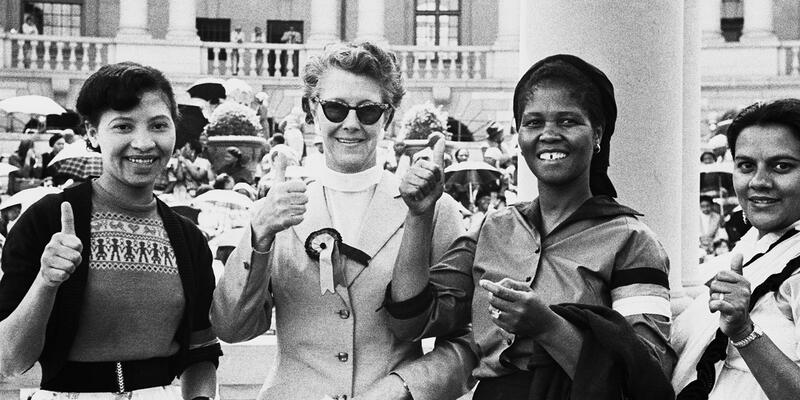
Fatima Meer and Geraldine Fraser-Moleketi
Geraldine Fraser-Moleketi
Geraldine Fraser was born in 1960 at Landsdown in Cape Town. While at high school she took part in student politics and was elected to the Student Representative Council. In 1980 she decided to abandon her studies at the University of the Western Cape and left the country to join the African National Congress (ANC) in exile in Zimbabwe. After working under the leadership of Joe Gqabi (who was later assassinated) Fraser-Moleketi was drawn into the military structures of the ANC and she joined its military wing Umkhonto we Sizwe . As an MK cadre, Fraser-Moleketi began basics in Angola, received officer training at the Military Institute of the former USSR and specialised military training in Cuba. It was during her time in exile that she became a member of the SACP. At this time she served in the Regional leadership of the SACP based in Zimbabwe.
She returned to South Africa in 1990 during the initial talks between the ANC and the National Party government. Her return, supported by the SACP, was to prepare for the relaunch of the party after it was unbanned. From 1990 to 1992 she filled various party positions, first as National Administrator and then as Personal Assistant to Joe Slovo and Chris Hani , successive SACP General Secretaries.
Fraser-Moleketi began her work in the South African government in 1995 when she was appointed Deputy Minister for Welfare and Population Development. In June 1996 she became the Minister. In 1999 she was appointed Minister of Public Service and Administration, a post she currently holds (2006). She is a member of the Central Committee and Politbureau of the South African Communist Party (SACP). SAHO biography
Fatima Meer

Fatima Meer. ©
Fatima Meer was born in Durban in 1928. She was brought up in a family that was highly conscious of racial discrimination and became a tireless defender of the oppressed. She went to the University of Natal where she completed a Masters degree in Sociology. Fatima, who joined the 1946 passive resistance campaign, later helped establish the Durban districts Women's League to build alliances between Africans and Indians. Her activities led to her banning in 1952.
In the 1970s when the Black Consciousness Movement was at its height and Fatima Meer was the president of the Black Women's Federation (BWF) she was again banned and was subsequently detained for trying to organise a rally with Steve Biko . Shortly after her release in 1976, Fatima survived an assassination attempt, when her house was petrol bombed. From the 1980s to the 1990s she fought tirelessly for the rights of shack-dwellers and rural migrants. She also headed the Natal Education Trust, which built schools in Umlazi, Port Shepstone and Inanda; established the Tembalihle Tutorial College in Phoenix and a Crafts Centre.
Fatima has published more than forty books on a wide variety of subjects and has received many awards. She continues to work with non-governmental welfare bodies and has served in advisory positions for the new democratic government. SAHO biography