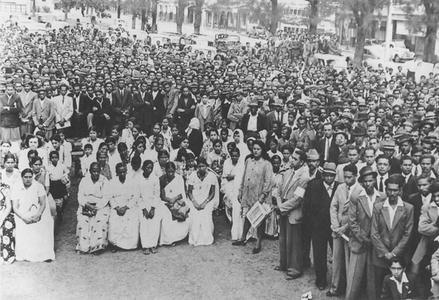
Historical Overview of Black Resistance, 1932-1952
Introduction
Nelson Mandela, delivering his presidential address to the ANC Youth League in December 1951, raised a number of issues, which are crucial to historians developing a fuller understanding of the Congress movement in the 1950s. In responding to Africanists who claimed that there were "brands" of African nationalism, Mandela asserted:
... in any case the very nature of the national movement to which we belong makes it impossible to expect (an) absolutely identical approach. The very nature of the national struggle and the manner of its organisation make it impossible to achieve what is possible to achieve in a party. African nationalism has to my mind been sufficiently concretised and its aims are, for the present historical stage, clear. Any attempt to go beyond this might well be unconstructive and will merely (delay) the consideration of what our answer should be to the immediate crises facing our people... Expressed in what is perhaps an oversimplification, the problems of the Youth League and the Congress today is the maintenance of full dynamic contact with the masses... We have a powerful ideology capable of capturing the imagination of the masses. Our duty is now... to carry that ideology to the masses. (my emphasis)
Mandela's frank remarks reveal, firstly, that the ideological terms and concepts that the ANC and the Youth League had used and their long-term political goals were still undefined, although they were adequate for the "present historical stage". Secondly, that any attempt to place undue emphasis on the ideological divisions within the ANC was counter-productive. Thirdly, that the foremost question confronting the two organisations was how to transform them into mass movements. The priority, according to Mandela, was to be the building of a mass political movement. Ideological questions and long-term goals were of secondary importance.
Most historians have correctly attributed this emphasis on mass action to the Programme of Action adopted by the ANC in 1949, and they have tended to focus attention on campaigns in which this was most dramatically displayed, such as the Defiance Campaign of 1952. It is widely acknowledged that the protest actions organised by the ANC and the South African Indian Congress (SAIC) in the period 1950-1953 had served to transform the former into a mass movement of some sort. The readiness and enthusiasm with which the African masses responded to calls for action from Congress leaders was inspiring, and vindicated the arguments about the political potential of the masses advanced by African militants. Historians, in highlighting these displays of mass action, have unfortunately underplayed the significance of the campaign for the Congress of the People and Freedom Charter.
Any struggle for national liberation is a complex and dynamic process, which often brings to fore with new urgency 'old' questions about its ideological content and perspectives, its long-term goals and its vision of the alternative social order. This is exactly what happened to the Congress movement in the 1950s. No sooner had the Defiance Campaign been brought to an end by state action than the ANC, in alliance with the SAIC, SACOD, SACPO, SACTU and FSAW, launched the campaign for the Congress of the People and Freedom Charter, seemingly going beyond the "historical stage" that Mandela spoke about.
The failure of historians to make a detailed study of this vital campaign is inexplicable. Even more recently, the debates have revolved around the content of the Freedom Charter as a political programme, the degree to which it advances or subordinates working class interests and needs, and whether it acts as a brake to the spread of a socialist society. These debates are important, but they tend to screen the nature and political significance of the COP campaign to the Congress Alliance in the mid-1950s.
The COP campaign was more than just a campaign for a programmatic document, as has been presented in the literature on the topic. On the one hand, it symbolised the closing of a phase in the national liberation struggle. On the other hand, it opened a new phase revealing a major realignment of political forces in the resistance movement.
The Congress Alliance that was forged in the course of the COP campaign emerged as a nationally coordinated, multiracial (non-racial) movement, armed with a more sophisticated analysis of the political conjuncture and a more refined strategy based on the concept of the united front, so as to advance the struggle for the realisation of the goals enshrined in the Freedom Charter. In a sense, the campaign was a unique and creative effort at political and organisational consolidation and building unity among the different forces for national liberation, viz., the ANC, SAIC SACOD, SACTU, FSAW and the reconstituted SACP. For the first time, the interests and weight of these varied forces-notwithstanding the ideological and organisational differences and variations — were brought together in a distinctive way.
In order for one to understand how and why this was possible it is necessary to trace the historical development of each component of the Congress Alliance, to locate them within a changing economy and to examine how each responded and adapted to ever-increasing repressive state initiatives. What follows, therefore, is an examination over the period 1932-52 of the growth and development of the African trade union, the strategic and ideological changes that occurred within the established political movements of the time, viz., the ANC, the CPSA and the Indian Congresses and the relationships between various political organisations, trade unions and women's organisations.
In assence, the chapter argues that while the objective and material conditions that confronted the growing urban African constituency were mature for launching effective militant mass actions, it was slow in expressing itself. The weakness and explanation lay largely at the subjective level—at the level of weak political organisation, the lack of a dynamic leadership and the absence of an adequate conception of the nature, content and strategy of the national liberation struggle. Consequently, political movements in the 1930s and, to a lesser extent, in the 1940s were not intimately in touch with me new and pressing needs of a rapidly expanding urban constituency. They failed to harness and direct the growing sense of frustration and anger among the African working class. It was only in the 1940s, after a wave of wildcat strike activity, a series of boycott campaigns and spontaneous squatter movements, that political movements began paying greater attention to the question of organising the political potential of these new social forces, and making the required adaptations at the level of strategy and organisation.
In many respects the leadership of political organisations, particularly the older and moderate leadership within the ANC and Indian Congresses, cautiously and reluctantly accepted the changes and in many respects they were inadequate. Nevertheless, these organisational changes, accompanied by the advent of a directly racist political party to power in 1948, were necessary, and served as a 'launching pad' for the mass popular democratic struggles of the early 1950s. These struggles were to be a vital prelude to the Campaign for the Congress of the People and the Freedom Charter.
Economic Development and the Expansion of the African Working Class
<BACK TO TOP>
With the termination of the Great Depression in 1932 and the withdrawal of South Africa from the gold standard a different period in South African economic, political and social history began. At the parliamentary level the National Party and the South African Party fused to form the United Party. Essentially, this party [political alliance reflected a new, fragile alliance between mining capitalists, Afrikaner agricultural and industrial capital and] a significant proportion of the white working class. Obviously, the forging of such an alliance required careful management and was not without problems and contradictions, but it generally demonstrated the consolidation of the ruling bloc.
Following the inauguration of the Fusion Government the economy expanded rapidly and important changes occurred in the structure of production. In particular, the period witnessed a phenomenal growth of the industrial/manufacturing sector. This development really had its 'kick-off' during and immediately after the First World War, when the international capitalist order experienced its first major disruption. The process of industrial expansion in South Africa progressed steadily throughout the 1920s, mainly because the Pact Ministry was dedicated to a thorough protection of local industries, and the development of the state-controlled Iron and Steel Corporation . The systematic development of the manufacturing sector proved to be the policy of successive governments. Consequently, the number of manufacturing establishments increased from 6,009 in 1924-5 to 13,725 by 1945-6.
South Africa's almost total dependence upon agriculture and mineral exports as a means of maintaining high rates of economic growth was transformed as the contribution of manufacturing to national income surpassed agriculture in 1930 and outstripped mining in 1943. This process of urbanisation and economic development was accompanied by important qualitative changes in the nature of the manufacturing industry. Manufacturing capital gradually introduced labour-saving machinery and inaugurated scientific management techniques, which resulted in altering, over a period of time, the skilled-unskilled labour ratio and increasing the overall productivity of labour. White skilled workers naturally felt threatened by this reorganisation of production and stood firm in defence of their interests, even if it meant accepting co-option by capital. But for unskilled workers (predominantly black), the restructuring of the labour process presented possibilities for permanent employment and the exercising of a greater leverage against employers.
This economic growth led to a concomitant increase in the size of the urban black working class. For instance, in the thirty years after 1924, the African labour force increased sharply from 74,000 to 469,000. During 1933-39 and 1940-46, 240,000 and 115,000 Africans respectively joined the urban labour force. However; this dramatic process of industrialisation and urbanisation should not blind us to the fact that by far the majority of the African population still lived on the land.
On the eve of the Second World War, 80 per cent of the African population in South Africa were rural dwellers either in the reserves or as agricultural labourers on white farms. They eked out a living in the increasingly impoverished reserves, supplementing their resources with the wages earned by migrant relatives. The enlarged African workforce needed for the manufacturing industries had been "recruited" and secured precisely from the ranks of the newly proletarianised, both black and white, who had been forced off the land and into … towns by economic hardship, governmental policy and the increasing domination of largely capitalist agriculture." By the 1930s there was a growing pressure on the land in the African reserves. Africans were confronted with the difficult problems of overpopulation, overstocking, soil erosion, pasture denudation and soil exhaustion which made the reserves unable to support their population.
The Fagan Commission (1948) found that in the Ciskei Reserve, 30 per cent of families were landless, and over 60 per cent owned five or fewer cattle, and 29 per cent owned none. The resultant decline in productivity and impoverishment left many African peasants and rural dwellers with no alternative but to search for new sources of livelihood and survival. Under the constant threat of starvation, thousands migrated to the urban areas, creating a labour shortage for agricultural capital. These, and their womenfolk, were rapidly absorbed into the expanding industrial/manufacturing sector. "When South Africa emerged from the Great Depression of 1929-32, the burgeoning economy pulled thousands of African workers into commerce and industry. The number of Africans employed in commerce, industry and construction rose from 66,757 to 134,233 during 1932-36." The major upsurge occurred on the Rand where the increase in that period was from 36,153 to 80,7227.
This period was also characterised by large-scale employment of Indians in the manufacturing industry and other sectors of employment. For example, after 1935 approximately 80 per cent of Indians in Natal were engaged as non-agricultural workers by the sugar-milling, secondary manufacturing industries and local municipalities. Padayachee, Vawda and Tichman argue that by 1936, two-thirds of the Indian population was urbanised, largely as a result of increasing land shortage, poor housing and working conditions on sugar estates, and the substitution of cheap African labour on sugar plantations. Indians were quickly absorbed as semi-skilled workers into the expanding industrial economy, particularly in the sub-sectors of food, doming, textiles, metal, furniture, paper and, to a lesser extent, the public service sector and mining.
Black urbanisation was not a planned process unfolding under the control and supervision of a sympathetic government. The state was remote from its black subjects and insensitive to their problems, except in so far as they immediately threatened major capitalists' interests. In Johannesburg, for example, one City Council house existed for an estimated 28 Africans living in the city. The rest were living in shacks and squatter camps, without water or sanitation. The newly urbanised Africans filled the lowest paid positions in industry. They received starvation wages - between 16/- and 18/- and for a 44-hour week in the 1930s, with small increases every two years or so. The conditions of employment were deplorable, yet they accepted the terms of employment out of sheer desperation.
The high rate of black labour turnover in industries made the organisation of workers extremely difficult. Even in more stable industries the percentage of workers that stayed on the job for over three years or more was under 15 per cent. Most industries had an average 8 per cent rate of stable employment. The turnover rate of the workforce, excluding departure due to ill health or death, was 157 per cent in transport, 155 per cent in the building sector, 101 per cent in the steel industry, 94 per cent in commerce and 90 per cent in the food, chemical, rubber and timber industries." This mobility of labour imposed constraints upon the capacity of trade unionists to organise effectively. Indeed, a collective and powerful union can only emerge where there is some permanency of labour in industries. This 'transience of labour' also affected the nature of demands and issues put forward by workers - these tended to be narrow in scope and immediate in character.
A further impediment to the unionisation of black workers was state strategy. Essentially this amounted to an attempt at the co-option of increasing sections of the white working class, and, to a lesser extent Indian and coloured workers, and repression for the vast majority of African unskilled workers. African workers were officially excluded from the Industrial Conciliation Act of 1924, and, thereby, from the collective bargaining machinery. The Act guaranteed for white, coloured and Indian workers the right to establish racial unions, to organise, to bargain and eventually to strike in support of their demands. Having guaranteed these sections the right to unionisation, it created the necessary mechanisms of control, and ensured that collective bargaining would take place within the limits defined by the state. For the unskilled and the growing layer of semi-skilled African workers, the state offered nothing except the threat of severe repression, a tightening of influx control and empty promises of larger land allocations in the reserves.
The black working class, finding itself against me background described thus far, seemed powerless and defenceless. Its organisation, mobilisation and politicisation seemed to be a difficult and unenviable task. Yet by 1945,158 000, black workers were trade union members. These and other unorganised workers were involved in intensive strike activity in the 1940s, demonstrating a visible militancy in defence of their interests and needs. Similarly, political movements, after an unduly long period of disorganisation, were undergoing changes and becoming more receptive to organising the expanded urban black population. It is to these developments that I now turn my attention.
The Quiescence of Political Organisation in the 1930s
<BACK TO TOP>
From its inception the Communist Party of South Africa was confronted with the task of formulating a theory, which adequately explained the relationship between the national question and the class struggle, and developing an appropriate political strategy, which could ensure a fundamental transformation of the social order. This proved to be a difficult and complex task and its application in practice generated new considerations and difficulties, which were often left, unresolved until later in its history.
Within a few months of its formation on 30 July 1921 the Party found itself in the midst of the Rand strike by white miners, which took the form of a partial insurrection. The organised white miners were striking against the introduction of 'unqualified' African workers into certain skilled jobs, which they had up to then monopolised. This had placed the Party leadership in a complicated position, as it had, in principle at least, called for the unity of the African and white working classes. Its leadership was actively involved in the white labour movement and had to participate in the interests and struggle of the white striking miners; at the same time, the miners adopted a narrow, racist outlook which prevented an effective non-racial unity of workers. This was a dilemma for the CPSA that stretched on for the better part of its legal existence. "The strike found the CPSA theoretically ill-equipped to sort out the tangled issues of principle, but it was at the same time a powerful educator which brought the Party face to face with the need to formulate a clearer line on the issues of race and class."
Out of this experience grew a tendency, led notably by Bunting, which called for greater Party activity amongst and mobilisation of the African sector, and the opening of its ranks to blacks. This conception paved the way for closer collaboration and cooperation with the ICU and the ANC in mid to the late 1920s.
This shift of emphasis had brought a substantial African membership into the Party and transformed its composition. From a minority in 1924, African communists, by 1928, comprised the great majority ~ 1,600 out of 1,750 members. But this development was not adequately reflected in the Party's leadership, policies and perspectives, despite the participation of the African communists (G. Makabeni, E. Khaile and Thibede) in the Central Committee. Moreover, the adoption of the "Native Republic" slogan by the CPSA in 1928 opened up a period of increasing dissent and division within the organisation, rendering it virtually ineffective and crippled. This slogan was advanced on the basis of the "Thesis on the Revolutionary Movement in the Colonial and Semi-colonial Countries" adopted at the Communist International's Sixth Congress in 1928.
Although the South African delegation to the Congress emphasised the class content of the struggle in South Africa and the primary role of the CPSA in this regard, the Congress upheld the view "that the national question, based on the agrarian question, lies at the foundation of the revolution in South Africa." A section of the thesis discussed the position of the Union of South Africa as follows:
The Africans, who constitute the majority of the population, are being expropriated from the land by white colonists and by the state, are being deprived of political rights and freedom of movement, are subjected to the most brutal forces of racial and class oppression, and suffer simultaneously from pre-capitalist and capitalist methods of exploitation and oppression.
The Executive Committee of the Communist International finally adopted a resolution entitled "The South African Question" which called for a fundamental ideological and strategic reorientation of the CPSA. The statement, arguing that South Africa was still very much a colony under British economic control, noted the complete landlessness of the majority of the black population, the proletarianisation of the black people earning wages substantially lower than white workers, the denial of basic political rights and freedoms (except in the Cape Province), the monopolisation of state power by the white bourgeoisie, the growing collaboration of the South African bourgeoisie with British finance and industrial capital, and outlined the tasks of the CPSA. The following recommendations were made:
- the party must orientate itself towards the African masses, establish mass support and integrate the black communists into leadership roles;
-
the party must fight against all anti-native laws with the general political slogan in the fight against British domination, of an independent native South African Republic, as a stage towards a workers' and peasants' republic with full equal rights for all races, black, coloured or white;
-
the party must pay increasing attention to the black peasantry, "the basic moving force of the revolution" and ensure that it forges an alliance with and under the leadership of the working class/the party must "influence the embryonic crvstalising national movements among the native in order to develop these movements into national agrarian movements against the white bourgeoisie and British imperialism";
-
the party must place greater emphasis on the national and agrarian questions as only by the "correct understanding of the importance of the national question in South Africa will the Communist Party of South Africa be able to combat effectively the effort of the bourgeoisie to divide the black and white workers by playing on race chauvinism, and transform the embryonic national movement into a revolutionary struggle against the white bourgeoisie and foreign imperialists";
-
the party should pay particular attention to the embryonic national organisations among the natives, such as the ANC. The party, while retaining its full independence, should participate in these organisations, should seek to broaden and extend their activity and aim to transform the ANC into a fighting national revolutionary organisation; and finally, that the party should continue in its effort to organise black workers into trade unions.
This resolution brought to the fore the centrality of the contradiction of national oppression in the South African struggle and it called for a strategic alliance with the nationalist organisation of the time (ANC), provided that this did not place undue constraints on the capacity of the CPSA to organise fully and independently. Moreover, it cautioned that any alliance should not preclude or limit the possibilities of mass organisation and should work in a "genuinely revolutionary direction as opposed to reformism". The formation of the League of African Rights by the CPSA in 1929 was the first active attempt to implement the ECCI resolution and it represented a distinctive response to the growing repression unleashed against the CPSA by the Nationalist government.
It linked together a wide range of nationalist leaders from the ICU, the ANC and the Federation of Non-European Trade Unions to the CPSA, but it underwent a surprising 'abortion' when the CPSA was instructed by the Communist International to dissolve it, the latter arguing mat it propagated a reformist conception of the struggle which would result in the CPSA losing its distinctive character and identity, and its political independence.
The adoption of the 'Native Republic' slogan by the CPSA introduced a period of theoretical confusion, bitter internal and sectarian struggles, expulsions and an undemocratic imposition of a leadership. The end result was that the party was unable to play any significant role in broader political mobilisation and organisation. Michael Harmel described the Party's position as follows:
"The 1930s saw the emergence of an 'ultra-left', sectarian tendency at the head of the party's administration... The results were particularly unfortunate for me CPSA; a wave of highly undemocratic and arbitrary expulsions took place, whose victims included two of the veteran founders; S.P. Bunting and Bill Andrews . Moses Kotane was removed from the editorship of Umsebenzi".
These actions left the party weaker. In April 1932, party membership was reduced to 53, compared to 1,000 plus in 1931. Ideologically, the new leadership propagated an "ultra-left" line, which contradicted and did not conform to the guidelines set out by the Executive Committee of the Communist International. Their May Day Manifesto (1932) called for the "overthrow of British and Boer imperialism, the confiscation of the land, animals and implements of the landlords, the redivision of the land amongst the peasants and farm workers, the confiscation of the mines, factories and all undertakings of the imperialist capitalist robbers and the creation of a workers' and peasants' government." This was tantamount to a virtual rejection of ECCI policy.
When Kotane returned from the Soviet Union in 1933 he was shocked to find that the party had dwindled to almost nothing. The membership, divided and paralysed by the 1931 expulsions and the confusion over the interpretation of new policies, was making almost no impact on the political scene. "The Wolton-line, far from producing an Africanist leadership, had resulted in the concentration of party power in the hands of Wolton, his wife Molly, plus Lazar Bach." Kotane's instincts rebelled against the whole Wolton-Bach approach to politics. He maintained that the party was too Europeanised and out of touch with the reality of national oppression and class exploitation. In his letter to the Central Committee, dated 23 March 1934, he made the following comments, which are worth reproducing in full:
The Party is too Europeanised... We are simply theoretical and our theory is less connected with practice. Our Party members are ideologically not South Africans; they are foreigners who know nothing about and are not interested in the country they are living in at present... Their hobbies are the German situation and the Comintern, Stalin and Trotsky and the errors of various communist parties... The independent native republic has different premises, language and attitudes to that of the proletarian dictatorship and the socialist revolution; . . . The Party must become more Africanised, pay special attention to South Africa, study the conditions in this country and concretise the demands of the toiling masses from first-hand experience. We must speak the language of the native masses and know their demands...
Kotane called for the formation of a united front of all African radicals and the organisations they worked in, including the CPSA. For him this was strategically necessary and vital, more important than the ideological debates that rendered the CPSA ineffective. His main concern was the revitalising of the ANC and ensuring that it played a constructive and active role in the political mobilisation of Africans.
For the remaining years of the 1930s the party's membership remained relatively small and split, despite the re-entry of Kotane and others into the central leadership. Its strategy aimed at the formation of a broad united front of Black Nationalist organisations, trade unions and white bodies opposed to the growing 'threat of fascism' in South Africa. The National Liberation League, the Farmers Labour Party, the All African Convention and the Non-European United Front were examples of the party's attempts at initiating and participating in United Front movements.
These were not altogether successful initiatives. The party failed to recognise that, in practice, the formation of a United Front implied the necessity of political compromises and the nurturing of the 'backward nationalist leadership' into a more radical outlook. This required organisational skill and refinement. The scathing attacks that the party leadership launched against the leadership of black nationalist organisations led to personality tensions, breach of trust and suspicion...
The possibilities of forging meaningful alliances on this basis were unrealistic. Secondly, the party leadership equated the concept of political hegemony within a united front with total control of every aspect of the front. This obviously brought to fore questions of internal democracy. Kotane criticised the leadership of nationalist organisations for their narrow political outlook but, at the same time, he was sharply critical of the practice of party leaders and members. According to Kotane, "the Party tended to destroy every united mass organising by blatantly controlling and dictating its policy. A united front to be successful must be a genuine united front in which Africans could feel that they had some power and control." This lack of organic interaction between various components of a front severely restricted its capacity to function, to organise and mobilise effectively; and ultimately generated internal contradictions, which assumed an antagonistic character.
Thirdly, the strategy of establishing non-racial or multi-racial fronts and the attempts to secure a broad alliance on an antifascist/anti-Nazi basis in South Africa led to problems, which had no solutions. On the one hand, the party had to cooperate with all-white organisations (white trade unions, the Labour Party and white radical societies), in the offensive against fascism and war, and, on the other, it aimed to broaden its black support layer and membership and cooperate with black nationalist organisations with the view towards obtaining full democratic rights for all.
The League against Fascism and War, for example, collapsed when the Trades and Labour Council decided not to affiliate. Similarly, in October 1938, the CPSA cooperated to form an all-white united front movement. Despite the fact mat all references to black political aspirations were deleted, the Labour Party disassociated itself from the exercise.
Attempts to enter into an alliance with the Labour Party to fight municipal elections also ended in difficulties, partly because white groups were suspicious of the party's motives, and did not desire to collaborate with an organisation that opposed the colour bar on principle. Hirson argues that the gulf between white political interests and black political needs and aspirations was "unbridgeable and demonstrated the impossibility of building a Popular Front in South Africa." In effect, the CPSA overestimated the "revolutionary potential' of the white working class and failed to perceive its limitations as a result of its successful co-option by the ruling class.
Not with standing these weaknesses in the CPSA's structure, strategy and tactics, and theoretical outlook, it took the lead on the women's question. In 1931 it had already established a separate women's department composed of a small core of female activists, like Josie Palmer and Ray Alexander, who were to play a prominent role in the growth and development of the women's movement in the next two decades.
The need to politically organise and educate the large and growing numbers of newly urbanised females had become more than a theoretical preoccupation to activists in the party, and they formulated the following guidelines for the task of politicising women:
-
the women's movement had to work closely with the national political organisations and must subordinate itself to the political struggles waged by all black people in South Africa secondly,
-
the incipient women's movement must espouse and propagate the principle of non-racialism; and finally, that,
-
it must address itself primarily to the bread and butter issues facing female workers and black women in the urban slums, rather than feminist conceptions of male-female equality. "Throughout the 1930s, the overriding concern of the CPSA in organising women, whether against passes, rising food costs or discriminatory legislation, was to mobilise them for a common struggle with men against the white supremacist state."
In the final analysis, then, the Communist Party of South; Africa in the 1930s was weak. Its membership was small, and its leadership divided on ideological grounds and on questions of strategy and tactics. It was unable to deepen its roots in the white trade union movement nor did it begin the process of rebuilding the African trade union movement under its broad leadership and guidance; and therefore was not able to use the working class for political action. Its inability consistently to intervene on issues confronting the working class can only be explained by the general disorganisation of the party, more particularly the Johannesburg section. And although it had taken the lead on the women's question, it had yet to create a broad-based women's organisation that could confront the burning issues facing newly proletarianised females. It was really in the 1940s, after the creation by CPSA initiative of the African Mine Workers' Union , that the party established a dominant position within the trade union movement, and, indeed, within the political sphere as well.
The African National Congress in the 1930s proved to be a moribund organisation. It organised little or no mass activities aimed at the mobilisation of its African constituency. Apart from its initiative in convening the All-African Convention, (which was an impressive and remarkable demonstration of African unity) it failed to launch an effective campaign against Hertzog's Native Trust Land Bill and Representations of Natives Bill. Its leadership was drawn mainly from the African petty-bourgeoisie. Eighty nine per cent of its leadership was composed of entrepreneurs, clergy, professionals, public officials, doctors, and lawyers, 8 per cent were employed in the industrial and service sectors and 3 per cent indirectly (through tribal chiefs) represented the peasantry. O'Meara has described the ANC as having rejected "radical leadership at the outset of the 1930s, cut its links with African trade unions, and functioned almost exclusively as a disorganised organ of petty-bourgeois protest during this decade."
The ANC's ideological orientation can best be described as a form of "parliamentary nationalism" and reflected the class aspirations of the dominant component of its leadership. The ANC leadership equated the goal of the national liberation of the African people with the establishment of African control over South Africa's economic resources and political institutions. This, they saw, would be the automatic consequence of the creation of equality of economic opportunity and political rights for all Africans. The leadership maintained that complete economic and political freedom would be restored with the reformation of the legal and political systems through the scrapping of laws which differentiated between the Africans' and Europeans' civil and political status. The leadership assumed that the lifting of racially discriminatory legislation would automatically allow for the development of all class sections of the African people.
Strategically, the leadership had an elitist conception of the struggle for political freedom. The leadership believed that their political and economic goals could be achieved without abandoning the parliamentary process, as their long-term interests were not totally irreconcilable with those of white people. They aimed at using the existing parliamentary framework and mode of representation specific to Africans, such as the Native Representative Council to obtain the repeal of discriminatory laws. They relied heavily on the tactic of deputations and delegations, appeals and petitions which called for the repeal of laws denying African representation in the South African parliament, the 1913 Land Act and subsequent legislation restricting African property rights, the pass laws, job reservation and the Master and Servants law. Structurally, the organisation did not allow for wider popular participation and the leadership was reluctant to engage the "African masses" in active opposition and resistance to white domination and discrimination. Such broad-based protests as were organised by the ANC did not have as their objective the overturning of the government in power/ but aimed at demonstrating to the government that the ANC was actually "the medium of expression of representative (African) opinion". Finally, the leadership believed that the force for change in the South African political system were the educated professional and business sectors of the African people.
In its limited propaganda the ANC leadership viewed the South African parliament as an undemocratic organ, which acted solely as the representative of one segment of the population. They demanded full citizenship because they were the indigenous people of the country, paid taxes to the government and participated in the same economic system. The leadership did not conceive that there was any connection between the capitalist economic system and the African people's subordinate economic and political position, and hence they did not seek to alter the capitalist basis of the South African social order. Arising out of this conceptualisation of the nature and content of the political struggle the ANC leadership did not consider it crucial to forge strong links with the African working class, to develop African trade unions and inject political content into its economic struggles.
Consequently, this elite leadership remained distant from the growing mass of urban workers and was not in touch with the day-to-day needs, problems and issues of this new constituency. Its relationship with the CPSA was strained and tenuous; and the ANC, on more than one occasion, rebuffed attempts at establishing a united front with the CPSA, by simply not responding to party initiatives and suggestions. It was only after 1937, when Kotane moved to Cape Town, that increasing efforts were made by black communists to revitalise and activate the ANC, and inject within it a more militant attitude that aimed at mobilisation of African people on a larger scale against police raids, arrests and prosecution of tax defaulters and, more generally, political oppression. It was Kotane, more than any other political figure, that revamped the ANC organisation in Cape Town and by the closing months of the 1930s, there were functioning ANC branches in Langa, Blaauvlei, Cape Flats, Simonstown, Paarl, Worcester and Stellenbosch.
With regards to the organisation of women, despite the formation of the Bantu Women's League under the leadership of Charlotte Maxeke in 1913-14 and the impressive resistance of women to the extension of passes in the Orange Free State and Potchefstroom in 1919 and 1928, respectively, the ANC remained a male-dominated organisation, with no political role denned for women. Those few women who actually participated at an organisational level concerned themselves with catering and politics was very much a male domain.
It was against this background that Max Gordon, a member of the Workers' Party of South Africa and a Trotskyite, became secretary in 1935 of the almost defunct African Laundry Workers' Union in Johannesburg, one of the few African unions to have weathered the repression and the Great Depression. By 1940, Gordon was the Secretary of the Joint Committee of African Trade Unions, consisting of seven unions with an approximate membership of 20,000. This comprised 6/7 the of me total number of organised black workers on the Witwatersrand. Without a doubt, Gordon filled the vacuum not seriously considered by the political organisations of the time.
Shortly after he began his trade union activities, Gordon led the African laundry workers into an illegal strike. The repression, which followed —involving the arrest of thirteen strike leaders -, threatened the very existence of his union. This, together with his observation of the reaction of capital and state in September 1937 against a strike by the African Cement, Stone and Building Workers' Union led by Gauer Radebe (personally associated with the CPSA and ANC), taught him important lessons. Clearly, strike action was not a feasible tactic to be employed by African workers in the pre-war era, particularly under conditions of organisational weakness and repression. From 1937-40 Gordon was able to build his unions without employing the strike tactic, and it was he who initiated the new unions. The procedures built from 1937-40 and the methods used by him to organise African workers became the pattern for all unions, including those belonging to Gana Makabeni's Coordinating Committee of African Trade Unions, which, by 1940, claimed a membership of 4,000. The combination he put together seemed to meet the needs of the time and they were taken over by all the unions that followed in his wake.
Gordon picked up his organisational approach from his association and experiences with the South African Institute of Race Relations. In the early months of 1937 he worked closely with Ballinger and later received financial assistance from the SAIRR . Individuals like Ballinger and Lyn Saffery from the SAIRR and an associated organisation called the Society of Friends of Africa had for some time taken up the cause of the newly urbanised African workforce through a pattern of representation to the Wage Board. Essentially, they drew up African family budgets, compared these to wage rates and made representations for improvements on behalf of unskilled African workers. Their simple motive was to prevent the politicisation and radicalisation of this constituency and their liberal outlook spurred them on.
Gordon was to successfully employ this approach. The first step was to establish an office, which provided the union with a central focus. He saw the absolute need to win wage increases in order to convince workers of the value of trade unionism. He monitored the wage rates in various industries and ensured that employers and where there were no such agreements, his unions aimed to secure a Wage Board enquiry, honoured the existing wage agreements. In June 1938, Gordon saw the first fruit of his Wage Board Strategy when the Bakers' Union won large wage increases:
unskilled workers had their wages increased from 16/6 to 29/3 — a considerable amount for the time. Another covering the laundry workers in May 1939 and the Commercial and Distributive workers in December 1939 followed this victory. Workers recovered large sums of money as back pay after investigations. These immediate victories stimulated African worker interest in trade unionism and it was at one of his public rallies where Gordon explained the victory that Naboth Mokgatle met his and undertook to establish a branch of the African Commercial and Distributive Workers' Union in Pretoria.
In the closing years of the 1930s another group of unions, led by Gana Makabeni, made their appearance. Makabeni adopted Gordon's strategy, but, being an ANC and ex-CPSA member, worked independently. He established the Co-ordinating Committee of African Trade Unions, which claimed a membership of 4,000. Attempts to merge the two coordinating trade union bodies and establish a single federation failed as these were bedevilled by ideological differences, factionalism and differences arising out of the tactics employed by the established political movements and tendencies.
The 1930s then was a decade, which witnessed the consolidation of the alliance between capital and a significant proportion of the white working class, and the strengthening of the ruling bloc's position on the basis of the political subordination of the black majority. In the black communities, on the other hand, there was a political lull and a weak African trade union movement. The political organisations of the time were ineffective and failed to provide political leadership and direction to a rapidly changing urban African constituency experiencing the pangs of proletarianisation under conditions of political domination. The African trade movement was in its infancy, grappling with the basic problems of building organisation and recruiting membership on the basis of narrow economic issues.
Mass Spontaneity and the Radicalism of African Political Organisations in the 1940s
<BACK TO TOP>
In sharp contrast, the outbreak of the Second World War ushered in a decade of political division in the ranks of the ruling classes, growing political ferment and dissatisfaction among the black working class and rural dwellers, an unprecedented wave of strike action, a significant and noticeable strengthening of the CPSA and to a lesser extent the ANC, the outburst of spontaneous popular movements and action in African locations around the politics of subsistence and survival, and the formation of a militant nationalist Youth Front within the ANC.
The 1940s was a decade of stresses and strains for the ruling classes, which ultimately swept the carpet from under the feet of the United Party and installed the National Party, representing the political alliance of the Afrikaner commercial and industrial capital, petty bourgeoisie and the white working class, into political power in 1948. In general, this intensification of the political struggle and conflict was the product of mass spontaneity, the growing capacity of the political and trade union movements to make interventions, the development of a clearer theoretical and strategic conceptions within the political organisations and the birth of a militant African nationalist youth wing within the ANC.
The outbreak of the Second World War altered the fortunes of almost all political parties, organisations and movements in South Africa. When the South African parliament voted on the war issue on 4 September 1939, the pro-war faction led by Smuts won a clear majority over Hertzog's 'anti-war group'. The split in parliament over the war issue mirrored divisions in the ranks of the ruling bloc. The faction that opposed South Africa's participation in the war actively resisted such moves. The action of some groups bordered on open insurrection and subversion. This placed constraints on the capacity of the state to adequately defend the conflicting interests of capital.
The disruption in the world capitalist order precipitated by the Second World War opened new opportunities for the expansion of the South African economy, particularly its manufacturing sector. It led to an extension and acceleration of industrial development already under way since the 1920s; only this time the state was prepared to play a directly interventionist role in promoting the process of economic development.
The state's concern began with the establishment of the Van Eck Commission, the Social and Economic Planning Council and the Board of Trade and Industries. It paid systematic attention to the development of the economy, in particular the development of a competitive secondary industrial sector, which would replace the gold mining industry as the principal motor of the economy. This is clearly enunciated in Smuts's speech delivered in Johannesburg in 1940:
It is generally recognised that a great opportunity has arrived for us to push forward industrial development in this country. The great world crisis now upon us may prove a unique opportunity for forwarding our industrial development. The war must inevitably throw us back on our own resources. Much that has been imported will now have to be manufactured locally.... It is for this reason that the Government has decided to ask Parliament to establish an Industrial Development Corporation, which will be able to finance and guide our industrial development and prove for industry the sort of boom that the Land Bank has provided for agriculture.
The initial phase of this development concentrated on the war effort with the ISCOR playing a central role. Simultaneously, the growing urban working class had to be controlled if industry was to benefit at all from its labour. The early war years brought with them rapid inflation, increases in rents and transport fares and a corresponding intensification of the black workers' demands for wage increases and better living conditions. Through a combination of concessions and repression, the former symptomatic of the early years of the war and the latter of the later war years, the state sought to maintain 'public order'' contain demands and restrict the rise of militancy among black workers. This dual response can best be understood against the state's vulnerability at a time of developing polarisation within white politics and its firm determination of maintaining high levels of industrial production.
During 1939-45 there was an unprecedented spurt of trade union organisation and growth in membership, consolidated in a single federation called Council of Non-European Trade Unions. On the Rand alone the number of unions rose from 20 with 23,000 members in 1940 to 50 unions with a membership of 80,000 by 1946. The level of strike activity was also much higher than in any previous decade. A total of 304 strikes involving 58,000 Africans, coloureds and Indians and 6,000 whites occurred in the war years. Black workers showed an increasing inclination to act independently of trade union leadership elements, political activists and employers, and walkout. In Natal a remarkable growth in Indian trade unionism had occurred and there existed 43 unions with Indian membership in the Durban area, organised along non-racial lines or in racial-parallel unions.
The extensive use of the strike weapon by the working class, at a time when the CPSA and other African political organisations supported the war effort and called for the exercising of restraint in respect of militant action, was the unique and distinguishing feature of the early 1940s. And by the end of 1942, with the threat of a possible German victory having diminished, strike action by black workers intensified.
A contributing factor, however, was that during the Second World War there was a "perceptible relaxation of controls on the African working class." There occurred a massive influx of Africans into urban areas, precipitated by the rural pressures described earlier on and exacerbated by the outbreak of a severe drought in early 1940.
The reactions of black political organisations to the war were contradictory, and in the case of the CPSA, inconsistent. The African National Congress, the All-African Convention and the Native Representative Council publicly supported the war effort. The Communist Party of South Africa initially opposed South African participation in the "imperialist war for raw materials, markets, capitalist domination and the power to exploit colonial peoples in Africa and Asia" and called upon blacks not to support the war. The CPSA endeavoured to rally the people against the government that claimed to defend democracy abroad/ yet enforced a vicious system of racial discrimination at home. After the attack on the Soviet Union by Germany in 1941, it radically altered its position and called for "conditional support" for the war effort. It supported participation but consistently demanded an extension of democracy to black people and equality in the armed forces. Whatever the positions adopted by political formations, it appears from the level of industrial, and of rural protest, of strike action, of transport boycotts, of demonstrations and campaigns (that) little consideration was given (by ordinary black people) to the country's war effort in the planning of protest action. Amongst the vast majority of black subjects there was a mood of indifference to the violent international conflict. Their concerns revolved around their immediate grievances and needs:
low wages, high rents, transport fare increases, inadequate housing, me high cost of living and inflation. If the war years were boom years for manufacturing capital, they were equally exciting and dramatic for the black working class and black political organisations.
A number of explanations can be advanced for this significant development in the trade union movement. Firstly, there emerged a "new grouping" of politically independent trade unionists, like Daniel Koza, who encouraged strike action. Harris argues that the strike by black workers led by Koza in 1940 persuaded many workers of the worth of unions.
"The fact that workers could hope to back their demands by strike action, and actually win, sent a wave of hope through the working class and resistance to organisation melted away." Secondly, the policy of the Wage Board unintentionally provoked strike action in 1942. Wage Board investigations into the wages of unskilled labour on the Witwatersrand and Pretoria began in mid-1941. The scope of the investigation covered 47,000 workers in 34 industries. Its outcome was Wage Determination 105, which fixed a minimum wage of 25/- per week to be introduced as from November 1942 and to be increased to 27/- rands over two years. This was a substantial increase compared to average wages and reflected a perception that the Wage Board officially recognised the existence of permanently urbanised workers; but it fell far below the Poverty Datum Line of 37/6 per week calculated by the Smit Report in late 1942. Wage Determination 105 raised expectations among all sections of the working class and as it became evident that it applied to several industries, but excluded the mining, power, waterworks, brick and tile and timber industries, a mixed sense of disappointment and anger was generated. This was fuelled by a suspension of increases by the Johannesburg and Pretoria municipalities as they faced a financial crunch. By the end of 1942 and early 1943 there was a wave of wildcat strikes in numerous industries and sectors.
At a more fundamental level me explanation for this upsurge in working class militancy lay in the high levels of inflation and cost of living. The African working class lived under extremely difficult conditions, which became more pronounced during the war years. Essential food items showed price rises of 50 per cent or more. Moreover, with the massive influx of newly proletarianised African families into urban areas there was growing pressure on the use of limited social welfare services and a consequent decline in services like health. The housing shortage had reached crisis proportions. A survey conducted by the Department of Native Affairs in 1947 showed that the immediate requirements in African housing stood at 154/000 family dwellings and single accommodation (for hostel dwellers) for 106/900 people. In Johannesburg alone 40,000 units were needed to resolve the housing crisis. In an area like Alexandra, commuters faced transport hikes in 1939, 1942, 1943 and 1944. These factors, together with the exclusion of migrants from the cost of living allowances and the drought which placed greater strains on the diminishing African rural economies, gave a new momentum to the community struggles for subsistence and survival, and strike action by black workers.
This growing militancy of African urban workers in the war years presented difficulties for the state and representatives of capital. Often they adopted opposing or contradictory approaches regarding the handling of industrial disputes. Some like Douglas Smit from the Labour Department proposed a generally forward-looking strategy which called for either a formal or unofficial recognition of African trade unions; others like Colonel Stallard, Minister of Mines, and the Chamber of Mines opposed any notion of African trade union recognition and proposed a firm strategy which aimed at suppressing militancy, by force, if necessary. The latter were principally opposed to any suggestion or attempt aiming at the co-option of black workers. Ultimately, the state predictably responded to the increasing wave of strike activity with War Measure 145 by which all strikes by Africans were outlawed and all disputes were to be submitted to compulsory arbitration at the discretion of me Minister of Labour. Contraventions of these regulations entailed a 500-pound fine or three years imprisonment.
However, War Measure 145 did not effectively suppress worker militancy, and strike activity continued until the end of the Second World War. Of crucial importance, however, is that working class action did not remain within the confines of the factory only—it took shape and form in the sprawling overcrowded African townships and in illegally occupied areas. During 1940-44 and 1944-47 one witnessed the spontaneous outburst of determined communal struggles, which took the form of bus boycotts in Alexandra Township and squatter movements in Orlando. These have been sensitively documented and examined by Alt Stadler and its precise development need not be outlined here. Suffice it to say that these popular struggles around questions of subsistence generated development in the political organisations of urban African communities, and were significant in shaping the direction of the African National Congress, and, to a lesser extent, the CPSA in later years.
The Communist Party of South Africa underwent a profound transformation during the war years. With the massive growth of an African industrial working class in all the major urban centres of South Africa, the CPSA transferred its attention to the mobilisation and organisation of black people. With the adoption of a pro-war position the Party unconsciously earned itself significant legal space to operate more freely without the heavy threat of state repression and open condemnation from the white sector. In fact, once it launched the "Defend South Africa" campaign and called for a restraint of militant worker action, it received tacit support in some official quarters. Its strength and success cannot be attributed solely to a less antagonistic approach of the state. The fact is that the Party underwent a major reorganisation and was infused with a new membership who was to play key roles in the 1940s and 1950s.
In 1939, the Party membership stood at 300; by 1945 it had increased to 5,000, the majority being African. The Guardian, the organ of the CPSA, increased its weekly circulation to 50,000. Under Kotane and Andrews, a new spirit of unity was generated and the Party's administrative capability was substantially improved. In Johannesburg also, the election in 1940 of a new District Committee composed of younger members who had not been involved in internal squabbling succeeded in uniting party members and rallying them behind a political and organisational plan of activity.
Consistent with its united front strategy, the CPSA adopted a policy of democratic unity with all anti-segregationist forces, which proved to be more successful in the 1940s than in the previous decades. At one level this implied a strengthening of its relationship with the existing political organisations like the ANC and the Indian Congresses. Through a more refined approach, communists like Marks, Kotane, Mofutsanyana, Radebe and Dadoo, 'entered' the national political organs of the Indian and African sectors on a more systematic basis. This was not simply a strategy of infiltration or "entryism". The communist members became less critical of the moderate and politically conservative leadership within the ANC, which helped to foster a healthier working relationship. In the case of the Indian Congresses, communists and non-communists militants, constituted as the "nationalist bloc" aimed to capture the reins of leadership of the TIC and NIC on the basis of the tactic of passive resistance and a radical ideology. In this entire process sincere efforts were made to build the ANC, the TIC and the NIC into stronger political organs and lead them into political action.
In its report to the January 1944 Conference in Johannesburg, the Central Committee of the CPSA carefully restated its policy towards and relationship with the national political movements:
The movements of the African, coloured and Indian peoples for national liberation are bound to play a great and increasing part in this struggle (for the abolition of all colour bars that keep the non-Europeans in a position of inferiority). Their national organisations take in all sections of their separate communities: traders, ministers of religion, teachers, clerks as well as trade union leaders and industrial workers. Among them are people with a middle class outlook, as well as militant trade unionists and communists. These national organisations do not accept socialism as their objective.
But the Central Committee added that the "demands of the national organisations for the abolition of race discrimination and the creation of a free and progressive sodal order must be supported by the working class movement, which, if it was not to deny the reasons for its existence, must identify itself completely with the struggles of the Non-European peoples." The report emphasised the importance of building and strengthening the CPSA, arguing that a "strong CP, working in alliance with the rest of the labour movement and the national organisations of the Non-Europeans, will create the sodal forces that are needed to enable South Africa to play her full part in the war, and create the conditions for a free and full life for all her people."
The Conference finally adopted the following resolution:
Conference is of the opinion that the strengthening and uniting of the national organisations of the African, coloured and Indian peoples is an indispensable step towards removing these restrictions and winning their further rights... and {therefore calls upon CPSA members} to take an active part in building these organisations, particularly by the establishment of strong local branches in every centre, and by securing the affiliation of trade unions.
At another level the CPSA initiated an Anti-Pass Campaign and secured the participation of a range of African organisations and a large number of ordinary African people. Here the objective was obviously to oppose the vigorous reinforcement of the pass laws by the Witwatersrand police, but the campaign was important in the sense that it established a much stronger CPSA presence and assertion in African political life than had hitherto been the case. Present at the Anti-Pass Conference in 1943 were 153 delegates from 112 organisations (tenants' associations, vigilance bodies, trade unions and political organisations) representing, as it claimed, 80,796 people. This gathering resolved to establish an Anti-Pass Council and to pressurise the government to scrap this "badge of slavery " The campaign involved the selling of anti-pass badges and mass rallies. A petition drive appears to have been highly effective in politicising Africans.
In the course of 1944 it spread to Brakpan, Roodepoort, Randfontein, Middleburg, Witbank, Springs, Vereeniging, Meyerton, Klerksdorp, Ermelo, Pretoria, Pietersburg and Sibasa. Similar activities were organised in Cape Town. At the inaugural conference of the Anti-Pass Council in May 1944 there were 540 delegates, and the launch climaxed with a public demonstration, on a Sunday, of 20,000 people through the streets of Johannesburg. By 1945, however, the campaign petered out with the final presentation of 100,000 signatures, calling for the scrapping of the pass laws, by 5,000 people to the Deputy Prime Minister, Hofmeyr , who refused to meet the delegation. That the campaign had shortcomings is evident, but it had generated popular enthusiasm and participation on a political issue, and allowed for the massive organisational expansion of the CPSA. The CPSA also related, with varying degrees of success and effectiveness, to local community struggles. The areas in which they were prominent were Orlando and Alexandra Township, and in the East Rand areas of Brakpan, Germiston and Benoni.
In Orlando, from 1934, the CPSA through its candidates had dominated the Advisory Board and directed the affairs of the township. However, it had underestimated the nature and extent of the housing crisis and seriously miscalculated the potential and significance of James Mpanza's squatter movement initiative under the banner of his Sofasonke Party. As the squatter movement grew the CPSA had to concede that Mpanza led a powerful movement, and their belated involvement was ultimately peripheral. In Alexandra the CPSA had control over the Alexander Health Committee, which exercised a "governing function" over the township, and it assisted in the bus boycotts. The food buying cooperatives developed by the communists and "food raids" against black marketers in Johannesburg, Pretoria and Durban in 1943-44 were imaginative responses to the growing deprivation of the urban poor and projected the CPSA as a political organ deeply sensitive to the needs of African people.
Sapire has researched the impact of the 1944 worker stay-away in the Brakpan Location in protest against the dismissal of David Bopape from his teaching post and poor living conditions.
She suggests that the CPSA played a central role in the mobilisation process and in providing leadership to the location dwellers. According to Sapire, the Communist Party, "by involving itself in the bread and butter politics and everyday struggles of the working class of Brakpan, rather than espousing abstruse political principles, (was) able to gain genuine popularity". It was out of this support that the CPSA candidates were able to capture all the "seats" on the Advisory Board in 1945 and, in this instance, employ it as a leftwing organisational platform in relation to the community issues affecting the residents of the location. Hence, by the end of the war, the CPSA had an organisational presence and influence, which extended to almost all the African urban townships and locations in the Witwatersrand area and helped it to establish it as a popular force in urban African politics.
In the war years mere was another thrust to the CPSA's strategy, which did not confine its influence to the extra-parliamentary terrain. Nine white communists entered the field in the parliamentary elections of 1943; four on the Rand, three in Cape Town, one each in Durban and East London. Although they suffered defeat, they succeeded in propagating CPSA policies to an all-white constituency. Members of the party successfully stood for municipal elections. "The Communist candidate, Sam Kahn, was elected as African representative of the Cape Western Constituency to parliament and his colleague, Fred Carneson, to the Provincial Council, as were several party candidates to the Cape Town City Council, where Coloured men still had a share of the vote." Hilda Watts was elected, in an all-white election, as a Communist Party representative onto the Johannesburg City Council; so was Archie Muller to the East London Council in 1943. The CPSA also had a strong influence over the Springbok Legion, which was joined by thousands of serving and returning soldiers. A more consistent effort was made to mobilise Afrikaner working class support for the party and an Afrikaans medium journal Die Ware Republikein was launched.
The CPSA's organised entry into the African trade union movement was a rather belated one. That it did so in the 1940s is important and it soon won a commanding position within the Council of Non-European Trade Unions established in 1941. The CPSA held four out of seven positions on the CNETU's executive committee. Part of the success of the CPSA in the trade union field stemmed from the fortuitous internment of Max Gordon, and thereafter, although some African trade unionists remained independent, others readily joined the CPSA and contributed towards rooting the party within the trade unions. The CPSA also pioneered trade unionism amongst Indian and coloured workers in Natal and the Cape Boland, and extended its activity in the service sector, light industry, and, on a more limited scale, in the power, metal and mining industries. The CPSA's real strength in the trade union field ultimately emerged from its creation and control of the African Mine Workers' Union in 1941.
A number of writers are critical of the CPSA's restraining attitude to strike action during the war years. In some instances this did have a dampening effect on the militancy of workers, which prevented the emergence of grassroots worker leadership and initiative. Rowing from this, critics have also brought into question the degree of democratic practice and procedure in the trade union movement and the extent to which workers themselves were engaged and encouraged to participate in the decision-making process. Padayachee, Vawda and Tichman, examining the growth and development of Indian trade unionism in Natal under the auspices of the CPSA, argue mat the Natal unions lacked adequate democratic constitutional structures, organisers failed to incorporate shop stewards into union structures and decision-making, and that the leadership tended to be concentrated and centralised at the top with no effective method of accountability to and direct consultation with the worker membership. These inadequacies, they argue, militated against independent working class action.
On the women's front, through the initiative of the CPSA there emerged a wider range of women who began participation in local, grassroots struggles than was the case previously. Women were actively involved in the Alexandra bus boycotts, the squatter movement in Bleauvlei (Cape) and the Anti-Pass campaign. CPSA female activists like Ray Alexander , Bettie du Toit, Joey Fourie, Hetty du Preez and Johanah Cornelius, played a pivotal role in the unionisation of black and white women. But it was in their creative attempt to deal with the "food crisis" in the early 1940s that they made a profound impact on ordinary women.
The activities of the People's Food Council (Transvaal) and the Women's Food Committee (Cape Town), both backed and initiated by the CPSA, and the unique participation of about 300 Indian women in the 1946 Passive Resistance Campaign in Transvaal and Natal, had a distinctive politicising effect on many black women and brought them into contact with the political network of the various national political organisations. It is evident that a definite attempt was made by the CPSA to broaden its base among women. The nomination of woman candidates for municipal and national elections and their election to the Central Committee reflected the enhancement of women's status within the organisation. In 1947, CPSA woman members took the lead in establishing the Transvaal All-Women's Union. According to Walker, "it seems clear that the role of the CPSA women in nurturing and spreading ideas of political organisations among women was a particularly large one at that time - and they were thus performing a major task in preparing the ground for the subsequent establishment of a national women's organisation within the national liberation movement."
This short description of the CPSA's activities in the 1940s may present a picture of unproblematic development and achievement. What emerges is that the CPSA reaffirmed and endorsed the basic tenets expounded by the Executive Committee of the Communist International in 1928 and gave concrete expression to the organisational guidelines, outlined in its report. Consequently, in the post-war period, the CPSA emerged as the most powerful extra parliamentary political force in South Africa with a broadening support base, a large membership organised in functioning district committees and branches, a more united and energetic leadership, and a comparatively healthier alliance with the ANC and the Indian Congresses. However, apart from isolated incidents of militant action, the party was characterised by a lack of militancy - a product of the party's pro-war policy —, which, though consistent with its international political relations, quite clearly prevented it from taking more decisive action in leading black working class struggles.
The election of Dr. Xuma as president of the African National Congress in December 1940 marked the beginning of a transitional period in the organisation. Broadly, this entailed a reorganisation of its structure, a somewhat dearer definition of its broad aims, a gradual shift in strategy and tactics and the emergence and articulation of different ideological strands—the militant African nationalism of the Youth leaguers and the radical nationalism of African communists—which generally contributed to the radicalisation of the organisation.
From the time of his election, Xuma appreciated the importance of drawing in far greater numbers of ordinary Africans into the ANC, and he took constructive steps to unify the organisation's structure. He transformed the ANC from a loosely bound federal movement into a more tightly functioning and centralised national organisation, with a sound financial footing, that would attract a larger number of the African intelligentsia.
Xuma also facilitated the integration of women in the process of me ANC's reorganisation. In 1941, a resolution was adopted by the ANC Annual Conference calling for the revival of the women's section, and it identified women as a sector of potential support and membership. This reflected recognition on the part of the leadership that the position of African women in society had undergone a radical change.
Following this, in 1943, women were granted full membership and voting rights and an ANC Women's League was established with the wife of Dr. Xuma, Madie-Hall Xuma, as it first president. The establishment of the ANC Women's League was a significant event. For the first time there was established "a body aiming to represent the interests of the majority of South African women.... within the premier African political organisation. The ANC had finally come to incorporate women, one half of the people it claimed to represent, into its frame of reference. A structure was created whereby African women could be channeled into the national liberation movement on a footing that was, at least theoretically, equal to that of men."
With the formation of the ANC Youth League in April 1944 the ideological struggle within the ANC, and indeed all-political organisations of the time, assumed fresh significance. Whilst it is difficult to assess the precise strength of various "factions" and their impact at a mass level, one can definitely conclude that the conservatism characteristic of the previous decade gradually washed away. However, in the war years one can identify three different ideological tendencies operating within the ANC.
The old guard and established leadership of the organisation expressed the first tendency. They collectively constituted a political elite with no intimate contact with the growing numbers of African workers; and were completely out of touch with the mood and aspirations of the nascent African working class.
They were culturally rooted in the liberal and Christian presumptions entrenched in missionary boarding schools and continued to believe in "the white man's sense of fair play, which explains their tactical options of representations through resolutions, deputations and meetings." Xuma himself can be placed in this category, although he was more susceptible to working, albeit guardedly, with organisations like the Indian Congresses and the CPSA. Despite his chairmanship of the Anti-Pass Council and cooperation with the CPSA, he and the political elite had no inclination to organise and lead militant actions and they consistently played an unimportant role in the African trade union movement and the spontaneous popular/community struggles of the early 1940s. It was this lack of interaction and participation by the ANC leadership in the Alexandra Bus Boycotts that precipitated the formation of the African Democratic Party by disillusioned elements like Paul Mosaka and Dan Koza. Not surprisingly, this elite placed faith in the capacity of white liberals to propagate their creed and educate the rest of white South Africa, and it de-emphasised all forms of radicalism and popular political mobilisation.
Ideologically, this grouping continued to adhere to a basically liberal conception of social and political goals and anticipated an evolutionary process of reforms and change. They wished to be accommodated and assimilated into the existing political and social framework. However, the adoption of Africans' Claims by the ANC in 1943, which interestingly enough was drawn up by a committee appointed by Xuma and included two communists, did mark a distinct shift in the ideological content of the ANC. It demanded full citizenship rights on the basis of one-man-one-vote. It asserted that the Africans had the "inalienable right to choose the form of government under which they will live" through "the extension to all adults, regardless of race, the right to vote and be elected to parliament, provincial councils and other representative institutions." The Congress pledged itself to "attain the freedom of the African people from all discriminatory laws". In propounding such a policy Xuma had hastened the reorientation of the Congress away from Seme's concern with chieftaincy and economic self-help.
The second grouping represented the CPSA. Highly disciplined and dedicated African communists began to pay increasing attention to the reactivation and revamping of the ANC. African communists held senior positions in the organisation in a number of regions and began to adopt a less hostile attitude towards the old-guard with a view to influencing their thinking on broad political questions. They wished to establish the ANC as a strong vehicle for the political mobilisation of the African people against racially discriminatory and oppressive legislation and to forge a closer and organic relationship between the CPSA and the ANC. Through their direct participation at all levels of the ANC, they were able to feed into it a more radical outlook and, in some respects, narrowed the gap between the political leadership of the ANC and the mass of African people. Unlike the elitist, moderate faction, they solicited the direct participation of ordinary Africans in branch activities and functions.
However, it was amongst the African youth intelligentsia that the most dramatic and interesting ideological reorientation took place. A small core of young organisers coalesced in 1944 in the Congress Youth League, with Anton Lembede as its intellectual leader and president. It was Lembede, together with Peter Mda, Walter Sisulu , Nelson Mandela and Oliver Tambo , who began articulating a militant ideology of African nationalism or Africanism, as a specific response to the dynamic and changing social, economic and political realities of the 1940s. In its intellectual form and practical considerations it represented a sharp break with earlier approaches and served as a basis for the development of African nationalism."
The youthful Africanists saw the primary need to develop an ideology that would confront that of Afrikaner nationalism and white domination. In ideology, Lembede and his associates saw the antidote for the psychological oppression of the African people. They advanced an assertive ideology aimed at psychological liberation and the restoration of a positive self-image of the African people. According to Lembede, "Africans became a derelict nation, uncertain of their cultural identity, their rights, or their place in relation to the rest of mankind. There could be no cure for these evils except African freedom, and no means to the achievement of freedom other than a ruthless struggle grounded in the inspiration of a well-devised ideology, a credo addressed to the deepest strivings and needs of the African spirit."
Africanists argued that Africans should be proud of being black and should consciously strive to shake off any feelings of inferiority. They called for the unity of all Africans so as to lay the foundation for taking their rightful place in the world family of nations. There existed a distinct element calling for continental African unity—a Pan-Africanist vision in which nationalism would act as cement. This, they argued, could only be realised, interpreted and experienced by Africans.
In South Africa, Africanists were committed to burying tribal parochialism and professed a sense of a single African nation. For them, Africans only, by virtue of their indigenous origins and preponderant numbers, constituted the nation and could claim the right to rule South Africa. In this context, they saw an assertive African nationalist ideology letting loose and generating political energy, in the form of mobilisation and action, which had to be harnessed and challenged by the leadership for the achievement of African rights and African majority rule.
By advancing the slogan "Africa for the Africans" there emerged conflicting assertions about the exact role of whites in the future society. There was a general mistrust of all whites, and consequently, they were to be excluded from participation in the struggle in order that Africans could take up their rightful place and assume the mantle of leadership. The question of "good whites", or sympathetic Indians or coloureds for that matter, became more than just a theoretical consideration when it came to inter-racial organisation, interaction and joint campaigning. The Africanists maintained that inter-racial cooperation was conditional upon Africans having reached a higher degree of self-confidence and self-reliance. As Mandela has also vividly revealed in his recent autobiography. Long Walk to Freedom, political cooperation in the 1940s was premature and not in the best interests of the culturally, politically and psychologically oppressed African community.
Despite the lack of a coherent ideology the Africanists were unanimous and clear about the immediate organisational and tactical questions of the struggle. Inspired by the display of militancy in the urban centres and factories, they vigorously called for a shift in tactics and held the tactics of the "elder statesmen" of the ANC in contempt. Mda remarked, "Conditions were ripe for the rise of powerful, mass people's movements. Granted a new clear outlook, a clear programme of struggle, and the development of new methods of struggle, the African nationalist movement could make unprecedented steps forward." The Africanists rejected the gradualist approach of the older ANC leadership and called for courageous and direct action in the form of boycotts, strikes, demonstrations and civil disobedience. They were impatient with the tactics of protest by petitions and suspicious of Xuma's apparent readiness to enter into alliance with Indian and white Communist Party leaders. The Youth League promoted a militant nationalism and self-reliance and pressurised the ANC to adopt a new strategy of direct mass action.
As these different ideological perspectives were competing for greater influence within the ANC, it was the strike of 70,000 African mine-workers at the Witwatersrand Gold Mines on 12 August 1946 and its brutal and violent suppression over five days, together with the living example of an intensive Passive Resistance Campaign against the "Ghetto Act" launched by the Transvaal and Natal Indian Congresses under the new and radical leadership of Drs. Dadoo and Naicker , that precipitated a realignment of political forces and strategic shifts in the sphere of black political organisation in South Africa. It is difficult wholly to accept Dan O'Meara's viewpoint that the strike "profoundly affected the direction and thrust of African opposition; patient constitutional protest by an elite rapidly gave way to mass political action and passive resistance," and his comment later in the same article that "patient expression of grievances by an elite in dignified and constitutional councils gave way to mass action and possible resistance" as this suggests that the strike itself had a direct effect on the immediate course of political struggles at the time.
But in correcting what might be an overestimation of the objective political significance of the strike, we must not underestimate the impact it had on black political development. The 1946 mineworkers' strike was a watershed in South Africa's resistance history and it fulfilled two distinct 'functions'. On the one hand, it once and for all exposed the economic contradictions that were sharpening during the war years; on the other hand, it destroyed hopes of a gradual reformation of the political and sodal order in South Africa. It became abundantly dear to all 'factions' within the ANC and other black political groupings that significant change could only be secured through intensified pressure on me white government. Z.K. Matthews , a prominent moderate element in the ANC National Executive, Deputy Chairman of the African Caucus of the Native Representative Council and President of the Federation of African Teachers' Association, makes the following comment in his autobiography:
"The year 1946 was a momentous year in the history of race relations in South Africa. The Second World War had ended and the mood of the African public was one of hope.... In the Native Representative Council the expectation was that the Africans who had played such a noble part in the world conflict would not be forgotten... But the soldiers found on their return that South Africa had remained the same. The colour bar was rigid as ever; the pass laws and the poll tax were enforced just as stringently. There was no sudden rise in wages. ... All this engendered a mood of dissatisfaction. ... It was not surprising that in 1946 a general strike of African workers took place on gold mines. Intensive organisation of mineworkers into unregistered trade unions had taken place, and by the middle of 1946 the leaders thought that the time had come for them to strike for better wages.
The strike began on 14 August 1946 and soon 70,000 labourers on the Reef were out and mining was brought to a standstill. Police and soldiers were called out and firearms were used. ... By the end of the week the strike had been broken by armed force with some loss of life.... During that same week relations between the government and the natives Representatives Council, which had long been strained, reached breaking point. The strike acted as a catalyst to a long mild conflict, which led to an indefinite adjournment of the Native Representative Council. The members of the Council were disappointed [with Hofmeyr's response]. They were shocked that a man of such liberal attitudes and one on whom Africans had pinned their hopes for the future could allow himself to be used to make such an ineffective statement was bitterly disappointing."
The Native Representative Council henceforth suspended its sittings and demanded the abolition of the pass laws, the recognition of African trade unions, the repeal of the Urban Areas Act and direct representation at all levels of government.
The suspension of the NRC was an unprecedented step taken by the African petty-bourgeoisie which participated in it, and it concretised the growing dissatisfaction of this social group with the oppressive social, economic and political realities of life in South Africa. The strike illustrated the futility of constitutional protests to the African petty-bourgeoisie, which until then had adopted an ambiguous political position in relation to the racist government. The denial of effective political rights and the shutting off of that possibility in 1936 when Africans were removed from the common voters roll in the Cape, the intensified application of the pass laws, the decline in the living standards of the African people generally, the closing up of avenues of sodal mobility as in the case of Baloyi in Alexandra, and the futility of the NRC at a critical moment of conflict forced the African petty-bourgeoisie to reconsider its political aspirations and gradually saw them turning towards a class alliance with the African working class.
This did not occur in an organisational vacuum. The Congress Youth League exerted strong pressure for a closer alliance with the "mass of African people", articulated a militant nationalist ideology and made calls for decisive action and a total boycott of state institutions.
The League was the first section in the mainstream of Congress for whom the ideals of liberation lay in the future, with new, African-inspired initiatives, rather than a return to a, previous condition under white domination. As the influenced the Congress Youth League slowly moved the petty-bourgeois politicians in the ANC into a more radical posture, the ideological and strategic emphasis shifted from the conditions for individual participation in the system to the liberation of the masses. The miners' strike and the government's reaction was the vital catalyst in changing the attitudes of the established ANC and NRC leadership."
The strike also contributed to the forging of closer working relations among the various national political organisations. The trial of 53 trade union, ANC and CPSA officials and leaders for aiding and abetting an illegal strike, and the enthusiastic public support for the strikers by the Passive Resistance Councils of the Indian Congresses solidified relationship among the leaderships of the various political groupings. This development laid the basis for the development of the Dadoo-Xuma-Naicker Pact—a six-point agreement by the Presidents of the ANC, the TIC and the NIC to work together for a universal franchise, the abolition of all forms of racial discrimination and symbolised the growing unity of me national organisations of the Indian and African peoples.
If the 1946 miners' strike precipitated these political developments, it also marked me beginning of a period of decline of the African trade union movement. The Industrial Legislation Commission reported in 1950 that the African trade unions had become defunct and trade union membership had shrunk to 38,000. It is not possible to provide a detailed explanation for the substantial weakening of the African trade union movement here except for a few comments.
In the closing years of 1940, after a few years of unparalleled growth and widening worker interest in trade unionism, the African trade union movement showed signs of disintegration. "The rise and subsidence of this movement can be located in part in the fact that it was built on the presupposition, that the institutions of the state could be used to improve working class conditions; and the failure to secure further improvements led to disillusionment and the withdrawal of [worker] support." It appears that to ordinary workers, trade unions and Wage Boards were compressed into an inseparable conceptual entity, and as long as they secured better working conditions, trade union membership grew; but once the government called a halt to these wage increases, trade unions started folding up and many collapsed completely. There were also other contributing factors relating to structures, leadership and organisation.
Although attempts were made by some unions at setting up structures aimed at eliciting democratic worker participation, it appeared that in many unions' democratic practices and strong worker participation did not prevail. This lack of democratic procedure resulted in a high degree of centralisation and control by the leadership, composed mainly of union officials who were non-workers. On the one hand, this resulted in the leadership becoming distanced from union membership; on the other, it prevented the emergence of leadership from the ranks of ordinary workers. This had its shortcomings:
State repression against trade union leaders and officials and restrictions on gatherings had a powerful weakening effect on trade unions. Moreover, as the struggle assumed an increasingly political character, as evidenced in the late 1940s, many trade unionists (being leading members of political organisations) shifted their focus and neglected trade union work, to the obvious detriment of the African trade union movement.
At another level, the political direction and orientation of trade unions were unclear and undefined, with the exception of those under the influence of militants such as Daniel Koza. The relationship between the political organs and trade unions were unstructured and loose. Often it only existed through leading officials belonging to one political group or another. Their capacity to stamp a distinct political orientation onto the trade unions remained limited and restricted, with the result that trade union activity remained politically uncoordinated and undirected, and they adopted a narrow, economistic posture in relation to the state and capital. The reason for this appears to be the relatively late entry of political organisations like the ANC and the CPSA into the trade union field, by which time the shape and character of trade union is appear to have assumed a fixed pattern. With the 'penetration' of the CPSA into the trade union field during the war years, it acted as a restraining force on the trade union movement and held back, where it could, the use of militant tactics. Its involvement sharpened ideological conflicts between the various groups involved in African trade unionism (Friends of Africa, South African Institute of Race Relations, CPSA, ANC and Trotskyists), which left the trade union movement weaker.
In this regard Baruch Hirson has drawn attention to the reasons for the demise of the CNETU, and traced these back to the late 1930s. The trade unions led by Gordon (later by Daniel Koza) and by Makabeni were divided along ideological lines and over questions of strategy and tactics, which persisted throughout the war years, resulting in the eventual split in the CNETU. Hirson asserts:
The factors dividing the organisation are not easily delineated, because of differences on personal levels, of political philosophies, and on trade union tactics. Gordon was a Trotskyist, and the antagonisms that split the left in warring factions were transferred to the trade union movement. In the Transvaal the situation was made even more fissiparous by the nationalism of Makabeni, and others. It was a matter of black versus white, of Trotskyists versus Stalinists; and of reformism versus militancy, and these ingredients appeared in endless permutations (in CNETU)!
Moreover, the growing influence of the Workers' International League (WIL) and the Progressive Trade Union Group (PTU), led by the Trotskyists, united the ANC and the CPSA in opposition to them. Both condemned the WIL and the PTU for their anti-war stance and for advocating strike action, thereby obscuring, in part, the conflict between factions within the ANC, such as the Africanists, and the CPSA. These tensions within the trade union movement reached a climax in 1945, leading to the expulsion from the CNETU of Koza and C.R. Phoffu, Secretary of the Timber Workers' Union and a leading PTU member. These persistent divisions within the CNETU left it ill prepared for the timber workers', Vereeniging steel workers' and miners' strikes in 1945-46, with disastrous consequences for the trade union movement as a whole.
The Transition to a National Mass Movement, 1949-1952
<BACK TO TOP>
In 1948 the National Party was unexpectedly voted into power, and immediately precipitated a fundamental reorientation in parliamentary politics and extra-parliamentary opposition forces. The election of the Nationalists to power represented a narrow victory for the alliance of Afrikaans-speaking white working class, farmers, intelligentsia and commercial and industrial capital. These groups reacted to the structural changes occurring in the economy and in the organisation of me production process, and to the intensification of the popular (democratic and worker) struggles in black communities. The Nationalists capitalised on the fears of the white working class, which increasingly felt threatened by the penetration of black workers into semi-skilled occupations and on the dissatisfaction of white farmers and Afrikaner capitalists who were unable to break me dominant hold of English-speaking mining, industrial and finance capital and who were experiencing a progressive shortage of African labour. It mobilised these sections of the population through the intense manipulation of cultural symbols and strong emphasis on the racial question.
(The farmers and white working class threw their) weight behind the Nationalists with its advocacy of an intensification of political and social racial segregation, an increased degree of coercion of black workers, and the retention, elaboration and sophistication of the migrant labour system in the interests of a more rational allocation of labour between different sectors of employment.
The central objective of the state in the post-1948 period was to find a way of advancing the development of the manufacturing industry under the less favourable conditions of increased black worker militancy and a resumption of competition from industrial corporations abroad, without undermining the specific needs of its political support base. Those who adopted a 'practical' standpoint as opposed to me 'purist' in the Nationalist government resolved the question by accepting that they had to ensure a "legitimate" supply of black labour to industry and commerce, without allowing a surplus to reside or develop in black urban townships. The labour bureaux were intended to perform this function of allocating labour to urban areas (on a flexible and pragmatic basis in many instances) according to the prevailing 'legitimate demand', (and) redistributing any potential urban surplus to other areas experiencing a shortfall. Essentially, Verwoerd's Native Affairs Department (NAD) aimed to place a "ceiling" on the labour, which urban employers could demand so as to check the rate of growth of the black urban workforce and reduce the ratio of black to white workers by legally defining the rights of urbanised, resident black workers as opposed to migrants. Whilst it appeared that there was a fundamental conflict of interests between the government and industry on the labour question, in practice, however, the pragmatic application of government policy by NAD officials, the inability of the labour bureaux to control fully the 'illegal' entry of workers into urban areas, and the circumventing of labour bureaux altogether by a large number of employers all ensured that there was a regular supply of cheap black labour for the development of the mining and the manufacturing industries."
Politically, the Nationalists worked towards the abolition of the NRC, the removal of the last vestiges of African and other forms of Black representation in parliament and instituting a social pattern of rigid racial and ethnic separation, which effectively denied that Africans were a distinct national group in South Africa.
The apartheid policy of the Nationalist government was not simply a small scale sodal rearrangement and an extension of administrative controls, but a process of massive social restructuring and the denial of political representation and participation of Black people at the central level of the government, which affected all sections [African, coloured and Indian] and all classes [working class, peasantry and petty-bourgeoisie] within the Black communities. It was this that provided a context for the mounting tide of popular democratic resistance to the apartheid state in the 1950s.
Within the ANC, the Nationalists' victory highlighted the futility of traditional lobbying tactics and set loose a more dynamic conception of the struggle advocated by the Africanists and the Communists. Although the ideological divisions between these two groups were sharp and bitter, the Nationalists' victory brought the Congress Youth League and African Communists into a "common radicalism of method" involving a willingness to cooperate in the development of mass action. At the December 1949 Conference, the ANC, after a year of internal consultations and deliberations, committed itself to a strategy of mass action and participation by Africans in the struggle. It adopted a Programme of Action, which represented a militant statement of principles [it called for national freedom, political independence and self-determination for Africans]. It explicitly rejected white leadership and all forms of segregation and segregated political institutions, and accepted, as logical the coordinated use of tactics such as boycotts, civil disobedience, strikes and mass stay-aways.
These tactics were seen as a means of securing mass participation in the Congress and pressuring the government to reconsider its political direction. At the same time, the leadership of the ANC passed over to Dr. Moroka, Sisulu, Mandela, Tambo, Mda, Kotane, Marks and Z.K. Mathews. With them all three ideological strands discussed earlier gained uneven expression in the ANC. The Communist Party's position had also changed dramatically in the time after the ascension to power of the Nationalist Party . It had to re-examine its theory of the South African revolution and ideological discourse in the context of an administration which propagated an aggressive Afrikaner nationalism and instituted new, racially oppressive legislation, which in turn generated a countervailing assertive national consciousness amongst the black people, obscured class divisions and consequently blunted the development of class consciousness. In early 1950 the Central Committee of the CP warned against adopting a "dogmatic hostility to nationalism" and called for an organic alliance with the national movement. Its report outlined the following strategic direction:
From the analysis here presented, the conclusion must be drawn that the national organisations can develop into powerful mass movements only to the extent that their contents and aims are determined by me interests of workers and peasants. The national organisations, to be effective, must be transformed into a revolutionary party of workers, peasants, and intellectuals and petty-bourgeoisie, linked together in a firm organisation, subject to a strict discipline, and guided by a definite programme of struggle against all forms of racial discrimination in alliance with class-conscious European workers and intellectuals. Such a party would be distinguished from the Communist Party in that its objective is national liberation, that is, the abolition of race discrimination, but it would cooperate closely with the Communist Party. In this party the class-conscious workers and peasants of the national group concerned would constitute the main leadership. It would be their task to develop an adequate organisational apparatus, to conduct mass struggles against race discrimination, to combat chauvinism and racialism in the national movement, to develop class-consciousness in the people, and to forge unity in action between the oppressed people and between them and the European working class.
The party also had to contend with the direct threat of intensified repression emanating from the Nationalist government and possible proscription. It henceforth described its strategic goal as national liberation — the creation of a national democratic state - as the first phase of the revolutionary process towards socialism. Walshe makes the point that this was not simply a tactic in the face of a re-invigorated offensive on the part of the state, "but resulted from the pursuit of twin objectives rooted in the Marxist dialectic - the national liberation of non-Europeans and the spread of class consciousness in preparation for the establishment of a socialist republic."
With the enactment of the Unlawful Organisations Bill the CPSA was forced into dissolution in June 1950. It was ill prepared to operate illegally and, henceforth, its leadership and membership devoted its energy to building, strengthening and 'guiding' the nationalist movement. This was by no means a smooth and unproblematic process.
Just prior to its disbandment the party reacted to the banning of Dr. Dadoo and Sam Kahn and the introduction of the Unlawful Organisations Bill by launching the Defend Free Speech Convention. Initially it secured the participation of Dr. Moroka and ANC branches in me Transvaal. Approximately 500 delegates had gathered, but when the Convention passed a resolution for 'Freedom Day' mass action in the form of a stay-away on 1 May 1950, the Transvaal ANC, in particular its Africanist faction and reduced conservative element, dissociated themselves from the call. The Africanists saw this as an independent CP initiative, which prevented the implementation of the Programme of Action under ANC auspices and leadership.
Despite their opposition, the stay away call evoked a significant response from the working class in me Transvaal, 75 per cent of them heeded the call. Workers in most areas in the Witwatersrand withheld their labour and in the course of the day trouble flared in the Benoni, Sophiatown, Orlando, Alexandra and Brakpan townships which left 18 black people dead and 38 injured. The success of the first political strike in South African history was marred by the violent reaction of the police force. In all four areas strikers defended themselves spontaneously and independently of the leadership, which reflected not only their frustration and anger, but also a higher level of political consciousness and determination.
Shortly after the May Day events the National Working Committee of the ANC took the initiative and called for a national political strike. An emergency conference was convened on 14 May, which was supported by the ANC, ANCYL, Indian Congresses, APO, CPSA and CNETU, to discuss a common strategy against the Unlawful Organisations Bill and "take steps to mobilise all sections of the South African people to offer concrete mass opposition to this vicious bill with the aim of defeating it." On 21 May 1950 the National Executive Committee of the ANC took a firm decision to launch "a campaign for a national day of protest, and to mark their general dissatisfaction with their position in this country, the African people were asked to refrain from going to work, and regard this day as a day of mourning for all those Africans who lost their lives in the struggle for liberation." A coordinating committee representing the various national political organisations and the CPSA was established with Walter Sisulu and Yusuf Cachalia serving as joint secretaries.
The mass response to the call was uneven. There was a highly effective mass stay-away in Port Elizabeth. This was largely the result of the strength of the trade union movement there and its close working relationship with the political organisations, viz., the ANC and the CPSA. In Natal the African working class response was very poor which reflected the low level of trade unionism and the disorganisation of the ANC there. However, the Indian working class's reaction to the call was dramatic in the wider Durban area and significant in that it indicated that me Natal Indian Congress had assumed a mass character with a predominantly working class base and a sound organisation. In part it highlighted the value of the wartime trade union activity conducted by party members. The response on the Witwatersrand was below expectations and disappointing. Apart from mass support for me call in Evaton and Alexandra, there was a low percentage stay-away elsewhere. It appears that the national leadership of the ANC had miscalculated the mood in the region and underestimated the negative impact that state violence and employer victimisation had on the working class.
What was the significance of all this? The stay-away initiatives of 1950 represented the first national attempt by the ANC, despite the misgivings of the Africanist Youth Leaguers in the case of May Day actions, to implement, in practice, the Programme of Action endorsed at its Annual Conference the year before. They also marked the successful implementation of the political strike tactic or stay-away. It is true that these events marked a turning point in the history of the African people "and indicated a new political outlook". At the same time it revealed the strengths and weaknesses of the national political organisations in various regions.
Of significance also was the close cooperation that had emerged between the political organs and the African trade unions. In the case of the May Day stay-away the Transvaal CNETU conducted crucial organisational and preparatory work amongst workers. J.B. Marks (CNETU President), Makabeni, Dan Tloome, David Nkosana, James Phillips (one-time head of the 1946 African mine workers' strike committee) and other trade unionists played an active role in the joint committee set up to a organise the stayaway.
James Phillips explained the involvement of the trade unions in a political strike in the following terms:
"[this] was possible because CNETU had come to understand that its role was not only to ask for daily bread, but to widen our interests and our activity in the political sphere... we were a great instrument in supporting anything related to all spheres." Indeed, there was now a clearer recognition, at least in the leadership of the African trade union movement, of the linkages between economic and political power, and therefore the need to participate in broader political struggles outside the factory floor. This development undoubtedly strengthened the political movements and was an important forerunner to the decision taken by the South African Congress of Trade Unions (SACTU) to participate in the Congress of the People and to adopt the Freedom Charter as its political programme. The CNETU's decision to support the May Day strike is also significant in that it agreed to do so in the face of an organisational weakening— by that time 21 African trade unions had collapsed, and only 27 functioned with varying degrees of efficiency.
Thirdly, these events accelerated the pace towards non-racial cooperation, particularly in the case of the African National Congress and the Indian Congresses, and laid the basis for joint actions and struggles in the future, viz., the Defiance Campaign and the Campaign for the Congress of the People and Freedom Charter. The participation in me national strike of large numbers from the Indian sector demonstrated the possibilities of launching joint campaigns and forging non-racial units in practical terms, as apart from symbolic statements and gestures from the leadership. This unity was crystallised in much closer organisational unity between the ANC and the SAIC, and also the CPSA. These developments did generate tensions within the ANC and raised questions relating to ideology and the role of Indians and Communists in the national struggle.
In the final analysis the ANC had to resolve two basic questions: in which direction was the leadership to channel this display of new militancy in the African sector, and what was the ideological content of its political work? Only out of an understanding of these questions would there emerge a clearer conception of its strategic direction and the role of other sectors and forces in the struggle for national liberation. The answers were not easy to find - here was a political organisation in a moment of transition — and they were only partially resolved with the adoption of the Freedom Charter and the formation of the Congress Alliance in 1955. In the intervening period they continued to brew within the organisation, and at times threatened to boil over and rupture the fragile unity that had been forged.
In the period between 26 June 1950 and the launching of the Defiance Campaign in June 1952 there was little organised political activity except in the Western Cape, where the coloureds, under the leadership of the Franchise Action Committee (FRAC) set up to organise mass protest against their removal from the common roll, launched a highly successful political strike on 7 May 1951 which had a considerable impact upon industry in Cape Town. The other notable exception was the significant stay-away by African workers in Durban and Port Elizabeth in response to the call by the ANC to commemorate 26 June 1951 by remaining "quietly at home thinking seriously about me plight of their people".
On 26 June 1952, the ANC and the SAIC launched the Defiance Campaign against six unjust laws, which involved some 8,500 people who voluntarily courted imprisonment by breaking racially discriminatory laws and regulations. The course and extent of the campaign, and the reasons for its success in the Eastern Cape particularly, are adequately dealt with by Tom Lodge in his Black Politics in South Africa since 1945, and in other writings on the subject, and need not be discussed here. It would be sufficient to state that the Defiance Campaign undoubtedly marked a significant political development within the ANC and its allied organisations. Being a qualitative campaign — one that involved the participation of selected cores of Congress volunteers/members - its quantitative impact at a mass level if difficult to measure precisely. Although the major proportion of defiers came from the Eastern Cape, "it would not be inaccurate to say that it captured the imagination of the mass of urban Africans and Blacks more generally. It enhanced the political prestige and credibility of the two Congresses. This is evident by me substantial increase in membership of the ANC -100/000 shortly after the campaign. The Joint Secretaries of the SAZC, Cachalia and Mistry, claimed that the Defiance Campaign had "succeeded in arousing the political consciousness of me non-white people as never before ... and compelled all sections of the South Africa to focus their attention on the basic problems of the country." They contended that the campaign had "revolutionised the outlook of the non-white people on a mass scale and instilled a spirit of defiance in them.” Furthermore, the Defiance Campaign translated the principle of non-racialism into practical demonstrations. Of particular importance was the formation of the South African Coloured People's Organisation (SACPO) composed of the remaining members of FRAC, and the South African Congress of Democrats (SACOD).
During the course of the Defiance Campaign, Oliver Tambo and Yusuf Cachalia, at a meeting held in Johannesburg's Darragh Hall in November 1952, called upon white South Africans to join in the struggle against racial discrimination and apartheid. It was immediately in response to this call that a few whites, notably Patrick Duncan, engaged in acts of defiance in December that year. More importantly in the long term was the regrouping of the white left. Two developments followed in 1953 — the establishment of the Liberal Party based on the 'traditional liberalism' of the Cape and the Congress of Democrats. The latter grew out of a provisional committee led by Ruth First, Helen Joseph, Father Trevor Huddleston and 'Rusty' Bernstein and the 'merger' of the Springbok Legion, former white members of the CPSA, the Transvaal Peace Movement and the Democratic League (Cape Town). Although there was no racial provision in its constitution, the SACOD developed as a specifically white organisation integral to and working within the Congress movement in the 1950s.
The sudden and dramatic growth in membership and influence of the Congresses, particularly the ANC, after the Defiance Campaign has prompted writers such as Walshe, Simons and Simons and Karis and Carter to characterise the ANC as a mass movement. The key problem in the literature on the subject is that the organisation is presented as one mat had undergone a transformation between 1950 and 1952 and remaining static for the rest of the decade until it launched the armed struggle in 1962. Lodge has substantially corrected this bland generalisation by suggesting that a mass movement was in the process of being created subsequent to the historical events of 1950. This is an important lead. It enables one to conceptualise the development of a mass movement as a process — one that is not necessarily unilinear and inherently progressive - in which it is constantly engaged in a struggle against its own internal contradictions and subjective inadequacies, as it is against the state. At the same time it makes it possible to delineate phases of development, which are not only quantitative but also qualitative in their nature. Hence, if one is to accurately understand this development process that had occurred in the ANC, one needs to go beyond just the level of the size of membership and description of mass displays and expressions of support and solidarity during specific campaigns or at public rallies, and examine the development of the subjective level of the newly created mass movement. This suggests that we examine questions of organisation, ideology and strategic direction.
What level of development had the ANC reached at the end of the Defiance Campaign? A careful study of primary source material will indicate that the ANC was far from being a nationally based mass, popular democratic movement. In fact, it was principally a popular urban-based movement that was able to organise black workers who had been urbanised for a long time. Its sphere of operation had not penetrated, with the exception of some areas in the Eastern Cape and the Transvaal, into the rural areas where a significant proportion of the African population resided either permanently or temporarily. An examination of the areas where the defiers were most active during the Defiance Campaign will show the predominantly urban basis of the organisation:
Eastern Cape: Port Elizabeth, East London, Uitenhage, Queenstown, King Williamstown, Jansenville, Grahamstown, Port Alfred, Alice, Stutterheim, Cradock, Kirkwood, Aliwal North, Fort Beaufort, Peddie.
Western Cape: Cape Town, Stellenbosch, Paarl, Ceres, and Worcester.
Transvaal: Johannesburg, Pretoria, Springs, Brakpan, Benoni, Bethal, Germiston, Roodepoort, Krugersdorp, Witbank, Vereeniging.
OFS: Bloemfontein and Kimberley / Mafikeng.
Tambo warned against this urban bias when he remarked that there was "a danger of the ANC becoming an urban based and urban oriented organisation. It may tend to forget and ignore the vast potential represented by the peasants and farm labourers. . . This contact (with the rural areas in the Eastern Cape) has not, however, been sufficiently strengthened by concretely and actively taking up the demands of the people in those areas by incorporating into the Programme of the Congress the immediate demands of me peasants and farm labourers."
Moreover, neither the ANC, nor the SAIC, despite their brief spell of closer cooperation and joint action, could claim to represent the broad cross-section of the South African population. In a situation where, as a result of a longstanding social practices and the enactment of the Group Areas Act of 1950, racial groups resided in racially exclusive areas (with a few exceptions, e.g., Sophiatown) the development of non-racially representative political organisations was difficult. Although the ANC, the TIC and the NIC all had undergone a transformation with a degree of mass support, political mobilisation in the coloured and white sectors had generally lagged behind. This meant that there were no political formations with a long tradition of work based in these sectors.
Secondly, the strategic goals and political objectives of the ANC were ill defined and incoherent. Goals such as "national self-determination", "attainment of political independence" and "freedom from white domination" in themselves were vague. They lacked definite content and were open to widely differing interpretations. This pointed to the absence of a commonly accepted political programme for which all 'democratic forces' could struggle. In addition, whilst both the ANC and the SAIC had come to embrace a strategy of mass action aimed at the mobilisation of all sections of their respective communities- workers, peasants, farm labourers, businessmen, intellectuals, professionals, women and youth the primary and secondary roles of various social forces had not been clearly asserted and corroborated with changes in its leadership structures. During 1950 - 55, 77 per cent of the ANC's leadership had come from the African petty-bourgeoisie, 22 per cent from the industrial working class and 2 per cent represented the peasantry. This absence of clarity stemmed from the absence of a cohesive ideology — the one to which its entire leadership and membership could firmly subscribe. As discussed earlier, there existed an internal struggle for ideological supremacy within the ANC between Africanists, communists, liberal Christians and a few conservatives.
These ideological divisions generated internal tensions and contradictions, which had a debilitating, effect on organisation. They resulted in ideological feuding and factionalism and influenced the choice of tactical options and the nature of political practice. The lack of a unified ideology was seen as a major weakness by, the leadership of the ANC. The following point was made in a theoretical journal of the time:
The organisational problems are part of the political problems. They are due to a lack of unified ideology and theory, and also due to the social backgrounds of its members. There is a complete lack of theory, not aimless or abstract theory, but a theory which can give confidence and understanding of issues which the people in the liberatory movement are faced with; and a lack of appreciation of unity of theory and practice, which would enable us to understand not only how and in what direction the liberatory movement is moving at the present time but also how and in what direction it will move in the near future.
Structurally, the ANC was not suited to integrate and politically discipline and educate its newly found membership. The basic structure at a local level of the ANC hitherto had been the branch, which was composed of a small core of members. With the massive expansion of membership many branches now had several hundred and, in some cases, a few thousand members. This new membership needed to be integrated and drawn into the organisation. That involved developing their level of political understanding, education and discipline and engaging them in regular political activity. The existing structures, operating within the context of ideological antagonisms and a degree of disunity at leadership levels, did not facilitate this process. The National Action Committee, in I report to the National Executive of the ANC and the SAIC in 1953, dealt with these matters extensively. Having made reference to the "disquieting lull which had descended over the mass activities of the Congresses" in the wake of the Public Safety and Criminal Law Amendment Acts and harassment of leader it went on to analyse the reasons for this period of passivity which point to the organisational incapacity of the ANC and the SAIC. The National Action Committee argued that the Congresses were unable effectively to "combat the offensive of the government" as it relied too heavily on "outdated" methods of mobilisation through public rallies and leaflet distribution. Moreover, the Congresses failed to "arm the members and particularly the volunteers with a proper theoretic understanding of the objectives of the Congresses and the purpose of the campaign" and were unable to "create a prop organisational machinery to fit the units of Congress for the basic work of consolidating its membership." It further not that this period of inactivity had "given ample opportunity for the growth of confusion, vacillation, misunderstanding disagreements and diversionary tactics" which had resulted "factionalism and opportunism.... throwing the whole Congress work and activity out of gear."
The crucial point to note is that the Congresses were too centralised to allow, not only for large-scale mobilisation, but widespread direct popular participation. These emerged fro two related problems. Firstly, the ANC had not designed developed a grassroots organisational network which allow for direct political participation at the mass level. Secondly, and this was noted by the National Action Committee, its mode mobilisation was not appropriate and suitable under the new conditions of intensified repression, aimed primarily immobilising and 'de-activating' the leadership stratum of the organisations. Certainly, new, decentralised structures and methods of mobilisation needed to be developed to widen the organisational basis and sphere of operation of the Congresses These points were presented for discussion at the SACOD's Annual Conference in 1954 and are worth reproducing in full:
There are weaknesses in the work of the Congress Movement which need to be corrected urgently, for every error committed as a result of the weaknesses makes it more 'difficult for us once again to bring the people into action. (These weaknesses) are of two kinds: (a) political, (b) organisational.... To some extent, organisationally, our Congresses have become isolated from the people; we do not pay enough attention to me types of work which brings us closely in contact with the people ~ to knocking on doors and talking to people, to canvassing people's opinion, to working from house to house, to holding small meetings at which we not only talk, but also listen. We allow our activities to go on in our branches, amongst our own members, losing our contact with the people and accordingly losing touch with their feelings, their doubts, their readiness to act... Political understanding must go hand in hand with this organisational work . . .. Without organisational work, designed to give us close contact with the people, political understanding itself will go wrong.... We have seen both wrong directions in recent months — the over-optimism which ignores the real difficulties and the extent of intimidation and the weakness of organisation, and presses boldly on to completely unreal objectives. And also undue pessimism which exaggerates the difficulties, underestimates the political consciousness and courage of ordinary people, and hesitates and retreats when the stage is set for advance. What is suggested by the analysis thus far is that the ANC and its allies did not mechanically transform themselves into a mass, popular democratic movement. Although important strides had been taken in that direction, in the sense that at a mass level in the major urban centres and internationally their support and prestige had grown substantially, mere were numerous questions and contradictions at an internal level that needed to be addressed and resolved if — as it can best be described — this embryonic national popular democratic movement was to mature and develop further. The Congresses were in a phase of transition with notable strengths. But they were also confronted with noticeable weaknesses, i.e., the absence of a unified ideology, no clearly defined set of political objectives encapsulated in a single political programme and the non-existence of democratic structures at grassroots level to facilitate mass political participation, as opposed to mobilisation only on a national scale.
That these matters did receive the attention of the national organisation, in the face of continued harassment and repression, is itself significant. This was not an embryonic nationally based movement gripped by a stasis. Unlike the 1930s, very real attempts were made to grapple with these complex problems; Professor Z. K. Matthews captured the essence of this process (significantly at the same time that he mooted the idea of the Congress of the People) in his Presidential address to the Conference of the Cape ANC in 1953 when he remarked:
But we cannot afford to rest on our laurels. One phase of the struggle has come and gone, but contrary to popular belief in some quarters, the struggle is by no means at an end. Depending upon surrounding circumstances, the struggle may assume one form at one period and another at a different period, but as long as our main objectives have not been fully achieved, how can there be an end to the struggle?
In its attempts to tackle the subjective weaknesses of the organisation the ANC responded with a two-pronged initiative. The first was the 'M-Plan', an organisational design aimed at the development of political structures and leadership at street level. The second, which is of concern to this project, viz., the Campaign for the Congress of the People and the Freedom Charter, which aimed to clarify and codify the long-term objectives, policies and principles of the Congress forces operative in the 1950, and, indeed, even presently. This was a unique, creative, non-reactive campaign to tackle new challenges that emerged out of a substantially altered objective, political, economic and social reality and to correct internal inadequacies. Its distinctive feature, however, was that rather than this process occurring in the upper echelons of the organisations and 'above the heads of the masses', like the English Chartist Movement, it attempted to elicit mass popular participation, revitalise strategic initiative on the part of the ANC and laid the political foundation for the Congress Alliance.
[BACK TO MENU]
|