Bonani Africa 2010 Festival of Photography
Bonani Africa Online Exhibition 2010
Bonani Africa 2010 photographers:
Click on a photographer's name to view essay.
Cedric Nunn
In camera


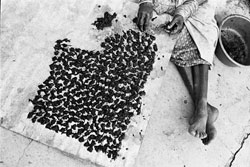
These photographs were commissioned for the Apartheid Archive Study Project and are a contemporary exploration of a society once subjected to racialised discrimination and inequitable development. Fifteen years after the birth of South Africa's democracy, the effects of apartheid still run deep, and the gap that exists between rich and poor, which is racially biased, continues to widen.
South Africa re-entered a world in which the economies of the wealthy nations were increasingly penetrating and affecting the localized economies of 'developing' nations; less powerful nations found themselves disadvantaged in the race for scarce resources and unable to counter the rapacious needs of the larger, more powerful ones, even while having no option but to engage with them.
It is in this context that the attempts to re-engineer the once divided state have taken place. The attempt at engaging global capital has resulted in very little `trickle down' for those at the lower end of the spectrum in the economy. This, however, has not necessarily spelt a worsened situation for the poor, as their freedom now allows them to participate in improving their lot, unlike in the past, when innumerable barriers were placed in the way of their progress.
The wealthy find themselves in a country no longer a pariah of the world, and in which they are able to continue to exploit cheap labour and abundant resources, so advancing their entrepreneurial projects. The middle classes and the poor are subjected to conditions in which the competition for scarce resources result in rising prices and stagnating incomes, as well as rising unemployment. Overwhelmingly, the black poor find themselves disadvantaged by the past discrimination to which they were subjected, and face many difficulties in integrating into the new economy. Little, apart from BEE, has been done to rectify the skewed nature of access to resources and skills, which still abounds, and which encourages the perpetuation of the myth that people with paler skins are more endowed with ability than those with a higher proportion of melanin.
About Cedric Nunn
'I am committed through my photographs, to contributing to societal change that will leave a positive legacy for the children of Africa'. Born in 1957 in Nongoma, KwaZulu, and raised in Hluriluwe, Mangete and Baynesfield. I began photography in Durban in the early eighties, my initial impetus being to document the realities of apartheid that I thought were being ignored by the mainstream media. I soon moved to Johannesburg and joined the Afrapix collective and agency. Working largely with NGO's, my focus throughout has been on documenting social change, and in particular rural issues. I continued to work independently after the demise of Afrapix in the early '90's.
Extensive work experience was gained in media such as newspapers, wire agencies, magazines, public relation companies through to corporate. Throughout my career I have exhibited extensively, both locally and abroad. Conducting photography education projects, from workshops for the churches and the labour unions, to being the director of the Market Photography Workshop as well as mentoring and supervising Market Photography students as well as teaching in the Wits University School of the Arts, New York University Tisch School of the Arts exchange programme and The School for International Training, "have also been a consistent feature of my career.
As a contribution to the professionalism of the industry of photography I have been on the national executive of the Professional Photographers of Southern Africa, a body representing photographers. I have been both judge and convener of the Fuji Press Photo Awards and judge on the Vodacom Awards.