Bonani Africa 2010 Festival of Photography

Bonani Africa Online Exhibition 2010

Juan Orrantia

Fragments of a Receding Past

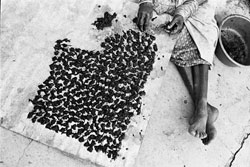
This essay is made up of fragments of everyday life in the receding shadow of war. I focus on the subtle and sometimes silent presence of the past in the contemporary landscape of Mozambique. I’m interested in places that are associated with the civil war and in how people make their lives there today. These images document traces, feelings and memories of years of destruction and reconstruction that exist as part of the everyday.

As a journey, this essay is concerned with the traces of years of destruction and reconstruction that exist as part of the everyday in contemporary Mozambique. From Maputo to Beira, through landscapes of apparent desolation to urban structures that have been reoccupied at different moments, this is a portrait of lives in the receding, shadow of war. But it is not about registering visible scars or obvious effects. Rather, I was concerned with the subtle and sometimes silent presence of the past in the everyday. From conversations with people who lived the war, I chose places that would constantly come up as markers of the conflict. I then went to these places and made photographs there, documenting their present form.

Roughly ten years after independence, when Mozambique was beginning to come to terms with the legacies of years of colonialism, cultural difference and a political identity in formation, the country found itself amidst civil war. This conflict directly affected at least half of the entire 16 million inhabitants. One-quarter of Mozambique's population fled their homes, many to South Africa, and the country's infrastructure, its roads, schools and clinics were destroyed or closed, while the market economy collapsed countrywide. After the war Mozambique received foreign aid and funding, embarking in a process of reconstruction that is still underway. Today, as public memory of this conflict fades, the documentation of the traces of its lingering presence thus recognizes the subtle, ongoing wreckage, partial healing and resilience that war produces.

These images speak about the feelings and memories of the legacies of history in contemporary Mozambique. For many people who lived through war, despite the time that has passed since its ending, there are feelings that do not simply dissipate with time. People move on but they also carry with them memories into the future. They sometimes look back at ruins or remains, and they make life in the present out of the old and the new. Looking at my photographs, a South African woman who is married to a Mozambican man and living in Johannesburg for 15 years told me how this was a way for her to see what has now become her second home. I have therefore wanted to document these traces, whether material or imaginary, that fill present landscapes, that speak to the paths and trajectories that make up the everyday for many. Or maybe simply acknowledge their silent presence in our dreams and nightmares.

About Juan Orrantia

Born 1975 (Columbia). Juan Orrantia is a visual anthropologist whose photographic work explores themes of intimacy and banality in relation to aftermath, war and migration.  Recent exhibits are: ?Dialogues on Aftermath?: Selected works with Jo Ratcliffe, Substation Gallery; ?Resides, Of time and Imagination? Market Photo Gallery; ?Intimate Memories? Alliance Francaise, Barranquilla, Columbia.  He is currently a fellow at the Wits School of Arts.