
In 1908, Gottlieb Redecker was the official builder of the German Colonial Government’s Works Department, drew up plans for a new Post Office building in Keetmanshoop. Although Keetmanshoop already had a Post Office at that stage, it was no longer able to serve its purpose effectively because the Village was expanding very quickly with its new status as a Railway Junction and the Military and Administrative Capital, for the South. Consequently, the need for a larger Post Office which supplied not only more office space, but also accommodation for the post office personnel as well as a telegraphic antenna, had by then increased significantly! The Building was erected by the firm Seebach & Bach and completed in 1910. It was commissioned on 1 August of that Year. Like a number of Buildings in Keetmanshoop, it is made of granite due to the stone’s durability and low maintenance. Air-dried bricks were only used for the interior. Building wood and corrugated iron were obtained from Cape Town. The doors and windows were imported from Germany. The Building consisted of an anteroom, a spacious hall with reception counters, two telegraphic service offices, a storeroom, an office for the postmaster, and living quarters for two Post Office, officials. All of these rooms can still be seen in the Building. The Building also features two verandas alongside the central tract, through which the former accommodations of the post office personnel could be reached. The aesthetic façade features a high, pointed gable topped by a broad, rectangular tower. A telegraphic antenna was originally fixed to the top of the tower. Stepped gables, which are smaller than the centre gable, continue the façade in respect of Hampie Plichta and Sixth Avenues. It was officially proclaimed a National Monument on 2 February 1987.
Rhenish Mission Society played an important part in the development of Keetmanshoop, where NamaKaptein, Tseib and his followers had settled in 1866. The name of the Settlement was then still: 'Swartmodder' or 'Zwartmorast' (which respectively mean 'black mud' and 'black marsh'). The missionary Dr Carl Hugo Hahn had requested the Society to establish a Mission Station here. The erection of the first Church was made possible by a private donation of 1,000 gold Marks, from the chairman of the Rhenish Mission Society in Germany. This was a certain Mr Johann Keetman, in 1866. Since Keetman had invested a considerable amount, not only of money, but also of hope in the project, the village was named Keetmanshoop (literally, “Keetman’s hope”) after him. This was the first Church was built by Rev. Tobias Fenchel. It was situated near the original spring in theAiab River from which Swartmodder had received its name. The Church was washed away when the River came down in flood after a heavy rain in 1890, since nobody new that the shallow ground on which it stood was actually a dry river bed. The wooden pulpit and the altar Bible were later recovered downstream. It was then decided that a stone Church should be built. The site on which the Church was to be erected was donated to the Rhenish Mission Society by Captain Tseib. The building materials were transported from Lüderitz, by ox wagon. Rev. Tobias Fenchel, supervised the construction. He chose the church in his home town in Germany, namely: 'Gambach'. (This was used for the example for this one!) The Nama members of the congregation helped to construct the church, which was consecrated on 8 May 1895. It was situated on higher ground than the first Church, and was spacious enough to accommodate up to 1,000 people. This Church still stands today, and is the oldest Building in Keetmanshoop. The Rhenish Mission Church is situated in Sam Nujoma Avenue, in Keetmanshoop. It was proclaimed a National Monument on 9 June 1978.
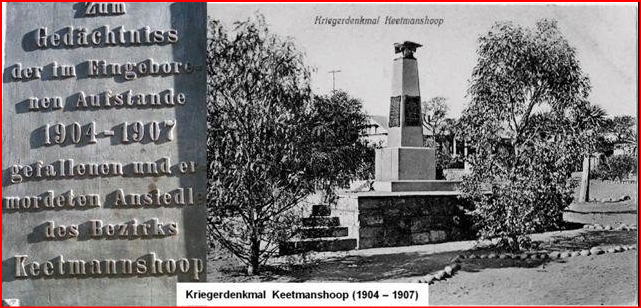
The “Eagle Monument” in Keetmanshoop commemorates the German soldiers who were killed in the Herero and Nama wars in 1897, 1903 and 1906-1907 respectively. It is shaped in the form of an obelisk and topped with the German Imperial eagle in bronze.
Another memorial at the same site commemorates those who fell during the course of WWII. The latter, however, is not part of the National Monument! In the past, commemorative services were held at this memorial in November each year, at which the fallen of both World Wars were remembered. Occasionally, music was provided in the adjacent bandstand by a brass band from the Nama community.
The Monument and Bandstand are situated in the center of Keetmanshoop, in the little park adjacent to the Post Office in Keetmanshoop. Keetmanshoop is the Capital of the South of Namibia.(LINK PROVIDE IN FURTHER READING)