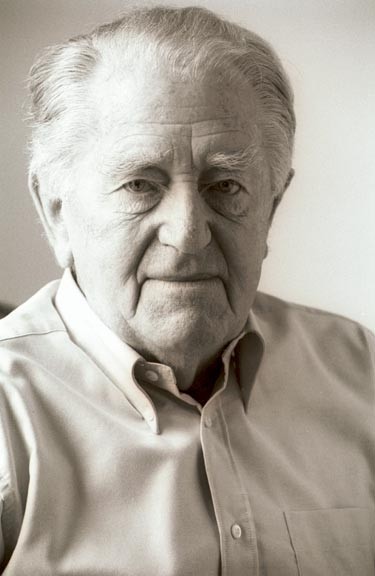
Lionel Rusty Bernstein

Names: Bernstein, Lionel Rusty
Born: 1920, Durban, South Africa
Died: 23 June 2002, Kidlington, Oxfordshire, England
In summary: Writer, Political Activist, Architect, SACP and MK member, For his political activism, abandoning privilege and dedicating his adult life to the struggle for liberation, democracy, human
Lionel “Rusty” Bernstein was born on 3 March 1920 in Durban, Natal (now KwaZulu-Natal) of European Jewish immigrants. He was the youngest of four children. Orphaned at eight years, he was brought up by relatives. He was educated at Hilton College in Natal. After matriculating, he returned to Johannesburg where he started work at an architect’s office, while studying architecture part-time at the University of the Witwatersrand. After qualifying in 1936, he worked full-time as an architect from 1937 to 1941.
In the late 1930s he was secretary of the Labour Party League of Youth and an ex officio member of the Labour Party's national executive committee. He joined the Communist Party in 1939, while he was a student at the University of the Witwatersrand. For one year he forsook architecture to work as a full-time Party official and Secretary of the Johannesburg District of the Communist Party.
A skilful writer, from 1940 he was in charge of propaganda in the Communist Party of South Africa (CPSA) Johannesburg office and a member of the Johannesburg committee. In March 1941, he married Hilda Watts, an émigré from Britain, whom he had met in the Labour League of Youth.
He served as a gunner in World War II with the Sixth South African Artillery Division in the Italian Campaign in the Second World War. During the War he had become a member of the Springbok Legion and later served on the editorial board of its journal, Fighting Talk. He continued to be associated with the journal when it became independent, until it ceased publication in 1963.
He and his wife, Hilda, were involved in the African mineworkers' strike of 1946. After the strike both he and his wife were arrested together with others and charged with sedition. They were ultimately convicted of aiding an illegal strike and received suspended sentences. Bernstein was also a founder member and leader of the Congress of the Democrats in 1953. By 1953, both he and Hilda were subjected to various bans and restrictions, including being barred from joining non-political bodies such as parent teacher associations
In 1950, the Communist Party was banned. All those listed as its members were subject to various restrictions, including a ban on being published. Sometime later, Bernstein and others formed an underground Communist Party.
Although banned from all political activity by the mid-1950s, he played an important role in drafting the Freedom Charter in 1955. He was a defendant in the 1956 Treason Trial but was acquitted later.
In 1960, the Sharpeville Massacre took place, and he and his wife were both among those arrested and detained under the State of Emergency that followed. He was not released until five months later when the state of emergency was lifted. In 1962, he was placed under house arrest and allowed out only on weekdays between 6:00am and 6:00pm but had to report to the police every day.
During this time, he also wrote extensively for many journals, including Liberation, Guardian, Sechaba, the African Communist and Fighting Talk and continued to write under pseudonyms even after being banned.
On 11 July 1963, Bernstein was arrested with other leaders at Liliesleaf Farm, in the Rivonia raid, the headquarters of the high command of Umkonto We Sizwe (MK), the liberation army of the African National Congress (ANC).
He was alleged to have been a member of the central committee of the underground Communist Party at the time. With little evidence against him, however - he had been present at Rivonia at the time of raid, apparently to erect a radio mast - he denied being a member of Umkhonto We Sizwe (MK) and was acquitted. This was after Bernstein had served 90 days of detention. While most of his co-accused were sentenced to life imprisonment following the notorious Rivonia Trial, he was released.
He was immediately re-arrested while leaving the dock and later released on bail. Shortly after his release, the police came to arrest Hilda, but she managed to escape from their home and went into hiding. They then decided to leave South Africa for the sake of their children, who would be orphaned for a very long time if both of them were sent to jail. Also, their activities were now so circumscribed; they felt they had become a danger to all who associated with them.
They left their children in the care of their eldest daughter Toni and her husband, and crossed the border to Botswana on foot. Their flight across the border and subsequent journey is described in Hilda’s book “The World That Was Ours.”
Rusty and Hilda eventually made their way into Zambia. Despite Zambia being well on the way to independence and the ANC being well respected by the new incoming authorities, they were declared prohibited immigrants by the British authorities. They then travelled overland to Tanzania and eventually to England, where their children joined them one by one.
Despite leaving the country of his birth, he continued to work tirelessly for the abolition of apartheid without drawing a salary from the ANC, preferring to earn his living independently working as an architect in London.
In 1987, he conducted a series of seminars for the ANC, in Moscow, on the history of South Africa’s liberation struggles. This was to “men and women of the Soweto generation, training to be guerrilla fighters.” In 1989, he and Hilda spent a year at the ANC’s Solomon Mahlangu Freedom College in Tanzania helping to establish a school of politics. During his term in Tanzania, he taught history to South African political exiles, encouraging critical thinking that occasionally challenged the ANC itself.
Bernstein worked as an architect in London for 17 years before retiring to Oxfordshire. He continued to work for the anti-apartheid movement and wrote many articles during this period until his death. Until 1994, when the first free elections took place, he was still working towards the liberation of South Africa, never renouncing his principles or beliefs.
He returned to the country in 1994 for four months for the first post-apartheid elections and worked in the ANC press office during this time, responsible for ensuring mass white participation in the first non-racial elections in South Africa.
In 1995, he travelled to Italy to celebrate the 50th anniversary of the liberation of an area of Italy from Nazi occupation and represented the South African regiment that fought there.
In 1998, Rusty and Hilda Bernstein were awarded honorary degrees by the University of Natal for their role in helping to bring democracy to South Africa. This followed the publication of Bernstein’s acclaimed personal account of the unwritten history of South African politics between 1938 and 1964.
He died in Kidlington, Oxfordshire, on June 23, 2002, aged 82. On 27 April 2011, the State President, Jacob G Zuma honoured Lionel “Rusty” Bernstein, posthumously, with the Order of Luthuli in Silver for his excellent contribution to the fight against apartheid, working within the ambit of the Alliance.
References
- Anon, Lionel (Rusty) Bernstein from South African History Online, [online] Available at www.sahistory.org.za [Accessed on 27 May 2011]
- Anon, (2011), Presentation Of National Orders, Lionel “Rusty” Bernstein, from The Presidency, [online] Available at www.thepresidency.gov.za [Accessed 25 May 2011]
- Anon, Lionel "Rusty" Bernstein Profile, [online] Available at www.rusty-bernstein.com [Accessed on 27 May 2011]


