

With colonialism, which began in South Africa in 1652, came the Slavery and Forced Labour Model. This was the original model of colonialism brought by the Dutch in 1652, and subsequently exported from the Western Cape to the Afrikaner Republics of the Orange Free State and the Zuid-Afrikaansche Republiek. Many South Africans are the descendents of slaves brought to the Cape Colony from 1653 until 1822.
The changes wrought on African societies by the imposition of European colonial rule occurred in quick succession. In fact, it was the speed with which change occurred that set the colonial era apart from earlier periods in South Africa. Of course, not all societies were equally transformed. Some resisted the forces of colonial intrusion, slavery and forced labour for extended periods. Others, however, such as the Khoikhoi communities of the south-western Cape, disintegrated within a matter of decades.
Initially, a colonial contact was a two-way process. However, Africans were far from helpless victims in the initial encounter. Colonial contact was not simply a matter of Europeans imposing themselves upon African societies. For their part, African rulers saw many benefits to be had from maintaining relations with Europeans, and for a considerable period of time they engaged with Europeans voluntarily and on their own terms.
Most importantly, trade with Europeans gave African rulers access to a crucial aspect of European technology, namely firearms. More than anything else, those who had ownership and control over firearms were able to gather around themselves larger and larger groups of people. In short, the ownership of firearms turned into a status symbol and a means to gain political power.
Sadly, the article of trade in which Europeans showed the greatest interest, and which Africans were prepared to sacrifice, were slaves. The Atlantic slave trade stands at the centre of a long history of European contact with Africa. This was the era of the African Diaspora, an all embracing term historians have used to describe the consequences of the slave trade. Estimates of the number of slaves transported from their African homes to European colonial possession in the Americas range from 9 to 15 million people. Although a great deal of violence accompanied the trade in slaves, the sheer scale of operations involved a high degree of organisation, on the part of both Europeans and Africans. In other words, the Atlantic slave trade could not have taken place without the cooperation, or complicity, of many Africans.
As the number of transported slaves increased, African societies could not avoid transformation, and 400 years of slave trading took their toll. Of course, not all African societies were equally affected, but countries such as Angola and Senegal suffered heavily.
The most important consequences of the Atlantic slave trade were demographic, economic, and political. There can be no doubt that the Atlantic slave trade greatly retarded African demographic development, a fact that was to have lasting consequences for the history of the continent. At best, African populations remained stagnant. The export of the most economically active men and women led to the disintegration of entire societies. The trade in slaves also led to new political formations. In some cases, as people sought protection from the violence and warfare that went with the slave trade, large centralised states came into being.
Slavery at the Cape
Jan van Riebeeck, who founded the first colony at Cape Town in 1652, was an official of the Dutch East India Company. The Dutch marked their permanence by building a five-pointed stone castle on the shores of the bay, a structure that continues to dominate the city centre of Cape Town. From within the walls of the Castle, the VOC administered and governed the expanding colony.
At first, the Dutch were primarily concerned with supplying their ships with fresh produce as they rounded the Cape en route to the spice-producing islands of the Indonesian archipelago. This is because the Dutch had their most important colonial interests in Indonesia, which included the growing of crops and spices that could not be produced in Europe. In Indonesia, the Dutch enslaved entire populations, ruling them by force and coercing them to produce crops. In the Cape, Van Riebeeck first attempted to get cattle and labour through negotiation, but as soon as these negotiations broke down slavery was implemented.
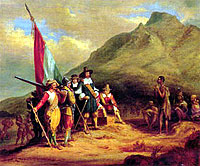 An image of Jan Van Riebeeck and the local San people. Source: cybercapetown.com
Even with slavery, the Dutch did not have sufficient labour power to provide for their ships. In 1657, some Company officials were released from their contracts and were allocated land along the Liesbeeck River. These officials became known as the Free Burghers (Farmers), and formed the nucleus of the white South African population that came to be known as Boers or Afrikaners.
It soon became apparent that if the free burghers were to be successful as agricultural producers, they would need access to substantial labour. The indigenous peoples with whom the Dutch first came into contact, the Khoikhoi, had been settled in the region for at least a thousand years before the Dutch arrived, and were an unwilling labour force. This is because the Khoikhoi were a pastoral people, and as long as they had their lands, flocks of sheep and herds of cattle, they could not be pressed into service for the Dutch settlers. The settlers also practiced a form of settled agriculture that came into direct conflict with the pastoral economy of the Khoikhoi, and involved regular and structured seasonal migration.
Therefore, as the Dutch settlement expanded, independent Khoikhoi communities were placed under unbearable pressure. Within 50 years of the establishment of the Dutch settlement, the indigenous communities near Table Bay, despite heroic struggles on their part, had been dispossessed of their lands and their independent means of existence had come to an end.
Individual Khoikhoi men and women became incorporated into colonial society as low-status servants. Beyond the mountains of Table Valley, communities of Khoisan (as the Khoikhoi and the indigenous hunter-gatherer San are collectively called) survived until the end of the eighteenth century, but there can be little doubt that for the indigenous populations of the Cape the arrival of the Dutch settlers proved to be a major turning point.
The Dutch settlers were therefore forced to look elsewhere for their labour needs. In 1658, a year after the first free burghers had been granted their plots of land, the first slaves were imported into South Africa, specifically for agricultural work. These slaves arrived at the Cape on 28 March 1658 on board the Amersfoort and had been captured by the Dutch from a Portuguese slaver en route to Brazil. Of the 250 slaves captured, only 170 survived the journey to the Cape. Most of these slaves were originally captured by the Portuguese in present-day Angola. On 6 May 1658, 228 slaves from another group of slaves arrived at the Cape on board the Hassalt, from Ghana. From 1710 onwards, the adult slave population outnumbered the adult colonial population by as much as three to one.
Another source of slaves was the VOC’s return fleets from Batavia and other places in the east which sailed around the Cape on their way to Europe. VOC officials could not take their slaves with them when they returned home, as slavery was illegal in the Netherlands. Therefore, many of these officials sold their slaves at the Cape because they could get a better price for their slaves there than in the East Indies. Foreign ships on their way to the Americas from Madagascar also sold slaves at the Cape.
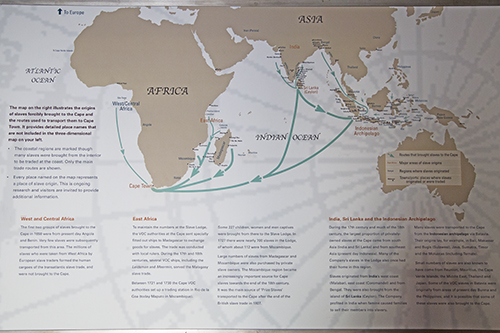 The Indian Ocean Slave Routes © museums.org.za/iziko
The Indian subcontinent was the main source of slaves during the early part of the 18th century, and approximately 80% of slaves came from India during this period. A slaving station was established in Delagoa Bay (present-day Maputo) in 1721, but was abandoned in 1731. Between 1731 and 1765 more and more slaves were bought from Madagascar.
In 1795, the Cape Colony became a British colony, before it was returned to the Dutch in 1802. During this first period of British rule, South-East Africa became the main source of slaves. This trend continued with the return of the Dutch who continued to buy slaves from slave traders operating in present-day Mozambique.
When in control of the Cape, the VOC sent slavers to Mozambique and Madagascar. The main purpose of these expeditions was to trade slaves. In those days, travelling by ship was very uncomfortable and unhygienic for ordinary people, but especially for slaves who had to be kept confined.
Between 1720 and 1790, slave numbers increased from 2 500 to 14 500. At the time of the final ending of slavery in 1838, the slave population stood at around 38 000. However, unlike the European population, which doubled in number with each generation through natural increase, the harsh living conditions of the Cape's slave population meant that their numbers could only be sustained through continued importation. Between 1652 and the ending of the slave trade in 1807, about 60 000 slaves were imported into the Colony.
Thus the Cape became not just a society in which some people were slaves, but a fully-fledged slave society. In slave societies, the institution of slavery touched all aspects of life, as slavery was central to the social, economic and legal institutions. As the boundaries of the Cape Colony expanded beyond the immediate vicinity of Table Bay, slaves were put to work on the wine and wheat farms of the south-western Cape. Quite simply, the colonial economy could not function without the use of slave labour, and therefore slave-ownership was widespread. Although most of the European settlers of the south-western Cape owned fewer than ten slaves, almost all of them owned at least some slaves.
The most important social feature of slave societies is that they were polarised between people who were slaves and those who were not. Slaves were also defined by their race, and although the VOC did not institute a codified form of racial classification, the fact is that slaves were black and slave owners were white. There were a few slaves who had been freed, who were called “free blacks”. These “free blacks” had managed to acquire slaves of their own, but these slave owners were a tiny minority of the slave-owning population. Thus, colonial South Africa was from the very start a society structured along racial lines, in which black people occupied a subordinate position.
Slavery was fully supported by the Roman-Dutch legal system that the VOC brought to the Cape. In terms of Roman-Dutch law, slaves were defined, first and foremost, as property. This form of slavery, known as chattel slavery, meant that one human being was the legal belonging of another human being. Slaves could be bought and sold, bequeathed or used as security for loans. Since slaves were kept in a state of slavery against their will, the slave owners and the VOC needed a system of laws to ensure that slaves were kept in their subordinate position.
Therefore, slaves in the Cape were strictly controlled, and according to law, slaves could be severely punished for acts such as running away or failing to obey their owners’ orders. Slave owners were allowed to use harsh punishment like whipping, withholding food, and making slaves work more hours. Slaves who tried to run away were put in chains to prevent them from running away again, because many slaves from West and East Africa believed that if they ran away they could find their way back home. Slaves could even be put to death for attacking their owners.
The food given to the slaves was terrible. It was only after the slave trade in Cape Town was banned that slave owners began to treat their slaves better. Better treatment of slaves was due to the fact that slaves were no longer easily available and therefore more expensive. Slaves were also treated better because slave owners did not want them to run away or die while they were still young. This was in contrast to the treatment of slaves before banning, as then it was cheaper for slave owners to buy new slaves instead of providing good care for them.
How could slaves limit the power of slavery?
The single largest limitation that the slave owners faced was that they were compelled to acknowledge that their slaves were not merely property, but also human beings with human values, desires and emotions. On farms and households in the Cape, slaves and slave owners lived very near each other and came into daily contact.
The culture that grew out of these regular interactions was one of domination, but it was also one that was based on acknowledging the humanity of the other party. From the very first day when a slave was acquired by a settler and given a new name, slaves and owners became involved in a constant struggle to see how much each could impose their will on the other.
We see this clearly in the records of the trial of the slave, Reijnier, a runaway who was caught and tried 22 years later. The story of Reijnier is based on the records of a criminal trial. We can tell much about the slave society of the Cape by examining the legal records that have been left behind by the VOC and are now held by the Cape Archives in Cape Town.
In the first few decades of the eighteenth century, Reijnier lived in the district of Drakenstein in the south-western Cape. Reijnier, who had come from Madagascar, was the property of the free burgher, Matthijs Krugel. On Krugel's farm, Simonsvalleij, Reijnier had built a long-standing relationship with Manika, a female slave who had been imported from India. They had a number of children together, including a daughter named Sabina.
It is clear that Manika and Reijnier's situation was unusual in the context of the Cape, as few slaves were able to build and sustain such longstanding relationships. Since the colonists preferred to import male rather than female slaves, the slave population suffered from great sexual imbalance. Until the end of the eighteenth century male slaves outnumbered female slaves by as much as four to one, although this ratio could vary significantly from district to district.
The children born to Manika were born into slavery, for slave women passed this status onto their children. Manika's children would have been among only a small proportion of slaves who were born at the Cape in the course of the eighteenth century, as mentioned earlier, the slave population grew as a result of continued importation.
We can only speculate as to the nature of the relationship that existed between Reijnier and Manika and the kind of life they would have been able to lead. Since they came from such different places of origin, they would probably have communicated with each other in a type of pidgin. Their owners would have spoken to them in Dutch, and out of this mixture of languages grew Afrikaans, as the slaves contributed their share to the development of this dialect.
It is clear that Reijnier and Manika's owners, Krugel and his wife, whom they would have called Mijnheer and Mevrou, dominated their lives. Their roles as parents were also greatly inhibited by their status as slaves. For some reason, Krugel's wife had taken to regularly beating Reijnier and Manika's daughter, Sabina. Possibly this was a result of sexual jealousy, or perhaps Sabina did not perform her duties to the satisfaction of Mevrou Krugel. As parents, Reijnier and Manika had little control over the maltreatment that Sabina suffered and which they were forced to witness. It is a sad testimony to his lack of power that Reijnier, in an attempt to put an end to the abuse of his daughter, was prepared to ask Krugel to sell Sabina and possibly be separated from her for life.
However, to say that Reijnier lacked power is not to say that he was absolutely powerless. There were clear limits to the level of domination that slave owners could exercise over their slaves. On one occasion, on a Saturday in a year around 1737, Mevrou Krugel had gone too far in her maltreatment of Sabina. She had clearly overstepped the boundaries that maintained the delicate balance of power between masters and slaves. On this occasion Krugel's wife stripped Sabina naked, tied her to a post and beat her mercilessly with a sjambok. Afterwards, to accentuate the pain, she rubbed salt into the wounds, a tactic commonly employed by Cape slave owners.
The event obviously scarred Manika deeply, as she was able to tell the story clearly when she appeared before the law courts 22 years later. When Reijnier returned to the homestead after having worked in the fields he did not hesitate to vent his anger at the maltreatment of his daughter. His wife, Manika, was the unfortunate victim of his wrath. These were human actions and emotions, not the actions of people who could be defined simply as property.
By now, Krugel and his wife had lost control over the slaves on Simonsvalleij. In an attempt to restore his authority, Krugel beat all the slaves on the farm. This was to no avail, for, as Manika testified, Reijnier turned on his master and assaulted him, although she did not witness the assault herself. As a consequence, Reijnier had to flee the farm.
The mountains and valleys of the south-western Cape provided many hiding places for slaves who had deserted their owners. For more than two decades Reijnier lived in the mountains around the Berg River as a droster, as runaway slaves were called. For all this time Krugel had lost the labour of his slave, and therefore Reijnier had turned out to be a poor investment. It seemed that Krugel and his wife could not control their slaves, and resorted to physical violence as a means to maintain authority over their labour force, as many slave owners did. However, if such violence was allowed to spiral out of control, it could be counterproductive. Through his actions, Reijnier had shown the limitations of the use of slave labour in a colonial society.
To read more about ‘the world that slaves lived in, slave names and lifestyles, visit the Iziko online slavery heritage project
The Story of Dina
Another anecdote of slave life concerns a slave woman by the name of Dina, who was owned by Roelof Petrus Johannes Campher, a cattle farmer in the district of George, Cape Colony. In October 1837, Dina was working in her master’s cattle kraal, loading cattle dung onto the wagon. The cattle dung would be taken to the farm garden to be used as a fertiliser. When the wagon was full, she stopped loading the wagon and instead piled up the dung for the next load.
Her master asked her why she was doing this but he was not pleased with her explanation. Roelof then beat her twice with an ox strap. Dina tried to run to Mrs Campher to ask her to stop Roelof from beating her. However, Roelof removed her clothes from the back, tied her to a ladder and continued to beat her with an ox strap. He gave her twenty-one lashes, and before beating her, Roelof said to Dina that he did not care about the law. After the beating Dina was forced to go back to work.
The story of Dina shows that severe beatings like these were very common even though the laws were written to avoid them. The story of Dina can be told because she reported it to the council of justice. Cases like these occurred regularly, but were not reported, as many slaves were still used to being whipped by their masters. Dina did not complain that she was being beaten. Instead, she complained that she was beaten without doing anything wrong. This shows that the reforms were not fully implemented in the Cape Colony.
What was the impact of runaway slaves on the Cape slave society?
Almost from the start, slaves began to runaway, because of ill treatment, overwork and the natural desire to live as a free person.
Reijnier was one of many slave runaways. He never ventured too far from the settler farms, and it is probably this that led to his eventual capture. Manika may not have been entirely truthful when she testified that she had not seen him in all the years after he had fled. Runaway slaves were frequently supplied with foodstuffs from surrounding farms, since they often lacked the knowledge that would allow them to feed themselves from the natural environment.
Individual runaways were thus very vulnerable. It made sense for them to join bands and find strength in numbers. Thus there existed throughout the eighteenth century, and until the ending of slavery, a community of runaway slaves in the caves of the Hottentots Holland Mountains overlooking False Bay. This was the maroon community of Hangklip.
This community survived as long as it did because of the protected physical environment. The series of caves in which the runaways lived had only two entrances. On the one side, they were protected by the ocean, which made entry difficult and very dangerous. The other entrance, from the mountain, could be easily defended.
The maroon community at Hangklip was never able to cut itself off from the rest of colonial society and for this reason they were vulnerable. If they attacked wagons crossing the Hottentots Holland Mountains, they exposed themselves to the possibility of recapture. Although they could to some extent live off fish caught from the ocean, mostly they were dependent for their survival on goods obtained from slaves who lived on surrounding farms, and from other runaways who lived as far away as Table Mountain across the Cape Flats.
The Hangklip maroons were not as successful as the maroon communities of slaves that existed in Brazil, for example, where colonial authorities were compelled to recognise their independence. However, the fact remains that the Dutch authorities were never able to wipe out the community, and the Hangklip maroons continued to live on the margins of colonial society.
It became clear to the colonial authorities at the Cape, especially after the British took over political power from the Dutch, that the use of slave labour had severe limitations. Two minor rebellions of slaves in 1808 and 1825, in which a number of white settlers were killed, made the continued use of slave labour even less appealing. Moreover, by the second decade of the nineteenth century the use of slave labour was no longer as profitable as it had been in earlier decades. Thus, when the British government finally ended slavery in 1838, the Cape ceased to be a slave society. It remained a colonial society, but the ending of slavery was another significant turning point in the history of South Africa.
Slavery moves towards South Africa’s interior
It soon became apparent to the Boers that beyond the Western Cape and Boland regions, the terrain of South Africa was unsuitable for intensive agriculture but very suitable for cattle farming. The majority of them lacked the financial means to buy slaves imported all the way from Indonesia, but since they were already in the process of dispossessing the indigenous population of their land, it seemed logical to take both the land and the people by force.
In the wars which they fought against the Khoi and the San, the Boers frequently followed a policy of exterminating the mature adults, but capturing the children and raising them on the farms. These children were taught to speak Dutch and to practice the Christian religion. This system was hypocritically known as “apprenticeship”, but in fact it was nothing better than slavery because normal human and family rights were not respected, and children were bought and sold separately from their parents.
During the period of the Napoleonic Wars in Europe, the British captured the Cape from the Dutch who were allied to Napoleon. From 1828 onwards the British introduced a number of administrative changes, known collectively as “the Revolution in Government”. These changes imposed British laws and the English language on the reluctant Boers, and limited the amount of land and labour that could be claimed by an individual.
In response, the Boers set out on an epic quest (see Great Trek) to establish themselves as a free people in their own country, where they could govern themselves according to their own tastes and habits. After an unsuccessful attempt to establish themselves in what is today KwaZulu-Natal, they settled on the highveld. There they founded two republics, the Orange Free State (1854) and the Zuid-Afrikaansche Republiek (ZAR), better known as the Transvaal (1858).
The Abolition of Slavery at the Cape
The British occupied the Cape again in 1806, and in 1814 the Cape officially became a British colony. The growing influence of the concept of human rights at the beginning of the 19th century, and the effects of a changing economic system in Western Europe during the same period both contributed to the questioning of the practice of slavery.
Therefore from 1806, the British introduced laws (Amelioration laws) aimed at improving the welfare of slaves in the Cape. The slave guardian appointed by the British government was responsible for enforcing these laws. As a result, the lives of some slaves improved after 1807. Even though there were reforms and laws to protect slaves, some masters continued to ill-treat their slaves by administering cruel punishment and ignoring these reform laws. Slaves were expected to report any ill treatment to the slave protector appointed by the colonial government.
Amelioration laws
Slaves were allowed to make legal marriages after 1824.
Families were allowed to live together: wives and husbands could not be separated and their children could not be sold before a certain age.
Slaves were now taught Christianity, and the baptism of slaves was encouraged. Sunday became a day of rest.
Slaves had to receive a reasonable amount of food, shelter and clothing.
The number of hours the slaves could be made to work was limited.
The punishment of slaves was more strictly controlled.
Slaves were granted property rights. Slaves who worked in their free time could save what they earned, and buy freedom for themselves and their families - even against the wishes of the owner.
Some slaves in Cape Town were given a basic education.
The government appointed slave guardians to ensure that these laws were obeyed. There is evidence that the slaves knew about their rights and made use of them. Some brought complaints against their owners in the courts or to the Guardian of Slaves. Both slave uprisings happened during this period, and in both cases the slaves demanded immediate freedom.
The end of slavery at the Cape was not due to internal pressure, but from a decision from outside. In 1807 the British government banned the slave trade to all her colonies, including the Cape. This meant that no more slaves (from any destination) could be sent to work in the Cape. However, those who were already in the Cape continued to work as slaves until 1834 when all slaves in the British Empire were to be set free (emancipated). Many of the slaves chose to remain on with their owners while some started a new life in and around Cape Town working as tradesmen. Gradually these people became absorbed into the Cape community.
To read more about the process of ‘Emancipation’ and the Cape after emancipation visit the Iziko online slavery heritage project
Does slavery still exist today?
Today, the term slavery is used to indicate a wide range of human rights abuses and exploitative labour practices. The United Nations defines contemporary slavery as consisting of:
...a variety of human rights violations. In addition to traditional slavery and the slave trade, these abuses include the sale of children, child prostitution, child pornography, the exploitation of child labour, the sexual mutilation of female children, the use of children in armed conflicts, debt bondage, the traffic in persons and in the sale of human organs, the exploitation of prostitution, and certain practices under apartheid and colonial regimes.
The term “slavery” therefore has a much broader use than chattel slavery. As recently as May 2002, the Anti-Slavery Society reported that “Millions of children are in slavery. Girls as young as six work as maids in the Philippines, children break rocks in Ghana’s quarries, young boys are abducted from their homes in South Asia and forced to be camel jockeys in the United Arab Emirates and girls are forced into prostitution in the United Kingdom”.