
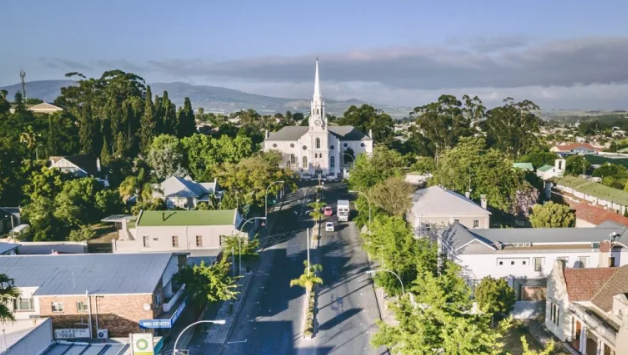
The picturesque town of Wellington is a scenic 45-minute drive from Cape Town.
The train station is built on land donated to the Town Council in 1863, as part of the British Government’s first railway line to the North. A condition of the donation was that every passenger train using the line would have to stop in Wellington. It was the terminus at which the early locomotives turned, allowing fresh produce from the interior to be brought into Wellington by wagon to meet buyers from Cape Town who had traveled by train.
Originally known as: 'Limiet Vallei' (border or frontier valley), the area became known as: Val du Charron or 'Wagenmakersvallei' (Valley of the Wagon Maker) towards the end of the 17th Century when the French Huguenots settled here. After the eventual establishment of the town in 1840, the name was changed to 'Wellington' in honor of the renowned soldier and conqueror of Napoleon at the battle of Waterloo.
Human occupation dates back to Stone Age groups like the Khoikhoi and the San, to the settlement of Free Burghers and Huguenot refugees. The first title deeds were signed by Willem Adriaan van der Stel in 1699. Pioneers, such as Andrew Geddes Bain, build the first road to the interior across the Limiet Mountains and Andrew Murray revolutionizes education for girls by the establishment of the Huguenot Seminary.
In the 1840's Andrew Geddes Bain was working on Michell’s Pass, when he began to contemplate a pass through Wellington’s mountains. At the time there was only a bridle path through the mountains. He asked Johannes Retief to act as his guide through the mountains. Other members of the group were the sons of Daniel Malan and Stephanus du Toit. Horses were provided by Field Cornet Rousseau. They followed a cattle track, then left their horses at the neck (now Bainskloof or Eerste Tol), and then walked eastwards down into the kloof.
Bainskloof Pass was opened in September 1853 and is still in use today – with a few minor improvements like getting a tarred surface in 1934. It became a national monument in 1980. There are wonderful walks and mountain streams to enjoy.
Many of The old farms remain: 'Olyvenhoudt'; Kromme Rivier, Versailles, Groenfontein,'Vrugbaar', Onverwagt, and Doolhof. (All of these are of the Afrikaans or Dutch language). As recorded in Title Deeds dating back to 1700 hundreds. The Bosmans still own the eight-generation of family farms, Groenfontein and Lelienfontein, still owned by the Bosman family, is the home of Bosman Family Vineyards wines.
The second-oldest co-operative wine cellar in the country, Bovlei Cellar was founded in 1907 and Sedgwick’s Distillery, established in 1886.
The South African Dried Fruit industry was founded here in 1890, and still has its headquarters in the town. The South African Dried Fruit Board (co-operative) was started in 1908, by a group of prune farmers for the selling of their dried fruits.
The house Breytenbach grew up in is today a cultural centre, The Breytenbach Centre, that opened in 2007 after extensive restoration work. The house was built roughly 150 years ago and was first a hotel, Commercial Hotel before it was sold in the late 1890s as a student boarding house. It was later used as a hospital and today serves as a vibrant cultural centre for the town, hosting exhibitions, plays and musical concerts.
Wellingtoner's generally have a lively interest in the arts. Amateur theatre, music productions, and art exhibitions are held regularly. Until recently, Wellington had the only piano factory in the Southern Hemisphere. Quite astonishing, as the founder, Mr. Dietman, a German immigrant, was a mere piano tuner. Another successful enterprise established by a foreigner in the last century is the Western Tanning Company. Mr. J.H.Coaten, a Yorkshireman, began the leather Tannery in 1871. The tannery is the second oldest in the country and still situated on the same spot. It is now a popular wedding venue,
15-minutes’ from neighbouring Paarl and 30 minutes’ scenic drive through the Winelands, to Historic Stellenbosch. Wellington’s agriculturaleconomy is centered on its award-winning wines, table grapes, deciduous fruit and fine brandy, and it is also home to South Africa’s sole whisky producer. The Region is renowned for beautiful Cape Dutch homesteads, picturesque environment, gardens and wineries. The Historic Bain’s Kloof Pass, with unsurpassed vistas, indigenous flora and fauna and crystal-clear streams and rivers, is the perfect spot for hikers and fly-fishermen. Closer to Town, guided wine-walks and horse-trails through rich farmland and flowering fynbos offer the opportunity to see and experience Mother Nature at her finest. In the beginning of Town, perched up on a Hill is the rather Large and looming NG Kerk of Wellington! The Berg River flows along the western border with two smaller Streams, the Spruit and Kromme and the towering Hawequa Mountains stand guard on the eastern side. The Bainskloof Pass built by the famous Scot, Andrew Geddes Bain, was the sole gateway to the north, before Du Toitskloof Pass was built. Wellington is surrounded by fruit orchards, wine estates, buchu plantations and olive groves. In addition, its vine-cutting nurseries produce approximately 85% of the country’s vine root stock for the wine industry. The region is the recipient of an impressive array of national and international accolades for their wines. The Wellington wine and brandy route boasts an array of fine producers. Hiking trails, bird and wildlife viewing, Unimog expeditions, mountain biking, 4×4 routes and abseiling are just some of the Outdoor Activities to be enjoyed in the mountainous terrain and scenic surrounds. More French Huguenots settled here than anywhere else in the Cape and the valley was formerly known as Val du Charron. Visit the Wellington Museum with its diverse cultural exhibits, and learn more about the region’s History. The town was renowned as an important academic centre for theological studies and the Seminary gave rise to present-day Huguenot High School and the Huguenot Teachers Training College. Other educational institutions include Boland College and the Cape Peninsula University of Technology. Wellington boasts two leather factories producing hand-crafted, quality leather products and a variety of locally produced arts and crafts.


