APPENDIX 1


INTERVIEW WITH ZAPIRO (25/7/1989)

M.P. When and where were you born?

J.S. In Cape Town on the 27th of October 1959.

M.P. Where were you schooled?

J.S. At Rondebosch Boys' Junior and High.

M.P. Have you traveled?

J.S. Yes, I have. I went on a trip as a child to Europe to see my mother's family, which was a fantastic experience. Some people negate those kinds of experience but it was an amazing one - to Britain and a little bit to Italy. Six weeks, then I travelled in 1978 again, on a table tennis tour a bit of a pawn of the Taiwan/South African relationship that was being set up. We were the first sports tour there. I was in Taiwan for three weeks and in a couple of other really interesting places. Then, in 1981, I travelled on my Architectural fourth year all over Europe. Among other things, I met some interesting cartoonists. At the end of 1987 I travelled to Israel, about which I learned a lot, and to Turkey.

M.P. Where have you lived?

J.S. Always in Cape Town except for a few months spent "up north" when I was in the army - which is another whole story.

M.P. When and where did you begin to do satirical drawings?

J.S. It's difficult to say exactly at what point they would start to be called satirical. I started drawing when I was really young. I had been having some nightmares. My mother gave me pen and paper and said, "Start to draw these things and then see what comes up". It really helped. That was my first experience with drawing imaginary things as opposed to drawing from

I suppose satirical drawings really started a few years later at school when I was quite young (about ten or eleven, perhaps). I used to draw teachers whom I felt worthy of a bit of lampooning. I also did a weekly cartoon spot in a school magazine which sometimes caused a few hackles to be raised.

M.P. How were they received by most people?

J.S. I felt that tremendous sense of response that people give to incisive cartoon drawing which gave me quite a kick. I suppose that it was the beginning of some sort of anti-establishment, maverick feeling. That is what a cartoonist often is - a kind of maverick, and obviously it gave me a tremendous kick from that point of view as well.

M.P. What is the extent of your -formal training?

J.S. Very little, in terms of cartooning. I didn't take art at school: I was taking academic subjects at the time and was somewhat discouraged from taking art. At university I did a Bachelor of Architecture which was later changed to Bachelor of Architectural Studies, which is also, not, related to cartooning. I then went to Michael is. I was there for less than half a year, doing graphic design. I had to pull out of that to go to the army; they wouldn't give me deferment any more. I had weekly classes with Andre van Zyl doing life drawing and a bit of painting.

M.P. Do you, or have you, worked in the commercial art sector?

J.S. Yes, I have. After I finished with the army I decided not to study further because I felt quite frustrated having to be inactive in fields where I wanted to be involved. I decided to do things by myself. In order to make money, to work in organisations which interested me, I got the odd commercial job. So I started off with the balance more in the commercial sector and doing only the odd political job.

M.P. Have you taught, or do you teach, art of any kind?

J.S. Not formally, but I've been involved fairly often in workshops with school pupils and I've done the odd workshop at university. I did a workshop with SIG (Social Issues Group). I did one with PAAG (Pupils' Awareness Action Group). I've done a little course with CAP (Community Arts Project) where I was teaching three people; two from the Eastern Cape, organisationally based in Eastern Cape, and one from the Domestic workers' Union.

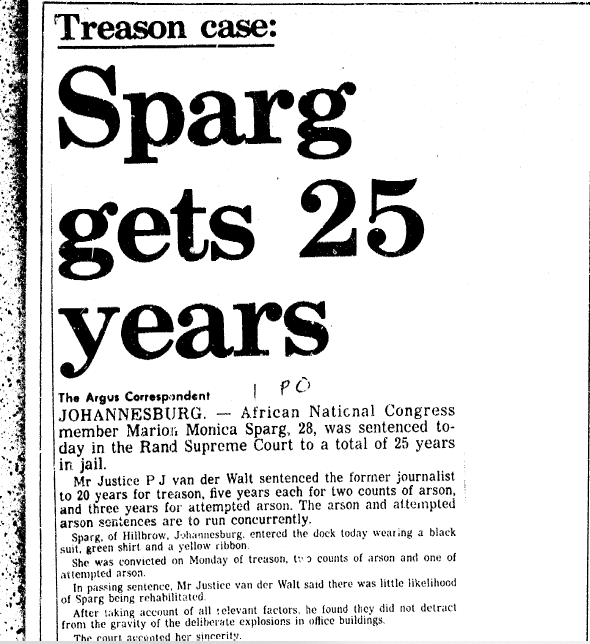
Another interesting thing I did was teaching a township cartoonist for a while. Something really heavy came out of that experience. I was teaching a guy that I had been put onto by an organisation I had been involved with and then he just disappeared and I never heard anything more. Because I was busy I didn't keep contact. A couple of months later I heard that he was one of the seven people who was killed in that shoot-out in Guguletu. The police alleged that they were all trained guerillas. In fact I knew him to be - well, I can't say that with 100% certainty, but as far as I was concerned he was just a young, developing cartoonist. I had been at the funeral and had stood in the guard of honour over the coffins. I suddenly realized that he was one of the people who was in the coffin. It was really quite an experience.

M.P. Where do you publish your work?

J.S. I've had a large number of drawings published in South. I was on retainer for South last year and into this year. I've had a few drawings published in the Weekly Mail , in Grassroots, in Die Suid Afrikaan, in the Save the Press Campaign and of course in the commercial publications that I mentioned earlier: woolworth's in-house stuff, and a few agencies - that sort of thing. Then, more recently, quite a number of my drawings have been published by magazines and newspapers in features that they've run on work that I've done.

M.P. Have you had any options for publications which you've refused or declined?

J.S. Yes, I have. One example that immediately springs to mind is something I was doing for an agency where they asked me to draw the then Minister of Transport Schoeman in a car holding up an object which was not specified. I refused to do it because, first of all I did not want my stuff to become some sort of plug for the Nats, which is quite possible because it was an Afrikaans agency, and secondly not knowing what the stuff was, I felt dicey about the whole thing.

M.P. Have you exhibited your work in group or in one-person shows?

J.S. The first time I put anything on exhibition was at the EEC exhibition at the end of 1985, at the Baxter. I had two drawings that I did and considered worth putting up were published in the Weekly Mail after the exhibition. The next time I put any work up was the [UDF] calendar, at the end of 1986 in the Towards the People culture festival. The art exhibition component was called About Time. The whole festival was banned so the exhibition was taken down very quickly before many people had a chance to see it. Another year and a half passed before I exhibited again. This was my first one-person show at the Baxter, Laughter in the Belly of the Beast, which was work that I had been doing - odd bits and pieces since those two Weekly Mail drawings - but most of the work I had done in the last 18 months for South and other publications.

M.P. Why did you choose the Baxter as a venue?

J.S. Very, very difficult decision. I'm still not 100% sure about the Baxter. This is partly because the sort of spin-off that I'm getting is that I'm being pushed as a young and up-and-coming careerist in some circles (and that worries me immensely) and partly because the Baxter is "fairly "white". I did try and get St. George's Cathedral, but I found that I would have to censor the drawings, which I was not prepared to do. I said I was not prepared to take out even one drawing or even tamper with them for exhibition, but came against Church Councils and church wardens, although I have to put on record that Dean King was very supportive of the whole thing. I feel Cape Town doesn't have a perfect venue and that's a very big problem. I intended to get at least one set of drawings which would circulate in the townships. My detention actually prevented me from doing that. I'm hoping still to do it because I feel that is very important to get a travelling exhibition that would travel from venue to venue. It wouldn't necessarily have to be the originals because I feel the most important part for the people would be the political content, the "message". I've exhibited quite a couple of times in a very ad hoc way at events put on by organisations, such as the COSATU event. I've sent drawings of mine to Johannesburg as well for another COSATU event and I've had some exhibited at other ECC events. A recent exhibition of my work was put up at UWC under the auspices of the Save the Press campaign.

M.P. How many of your prints were sold at the Baxter?

J.S. I'm not quite sure; I haven't worked it out yet. I was intending to work all that stuff out when I was detained two days after the exhibition was closed so I don't know how many prints or posters were sold.

M.P. What materials do you use?

J.S. For publications in newspapers I used flexible nibs and black Indian ink, also with the odd spatter which I use with a toothbrush and frisket, not possessing enough money for an airbrush. I suppose I could get one some time, but I haven't as yet got one. I love working in colour as well when I get the opportunity. Then I use Dr. Martin's inks, which are fantastic.

M.P. when and where do you usually draw?

J.S. I draw a lot in all sorts of places and circumstances. I do contact drawing for my work all over the place. When I'm sitting in meetings, when I'm Just mooching around at home, before I go to sleep or whenever an idea comes to me. I have very irregular working hours, so again there's no specified time for that. I try as best I can, especially recently, to work during normal working hours but it just doesn't work out like that though. Other kinds of drawings, just doodles and sketches of people and things - sort of letting my mind wander - that happens all the time. The finished work I do in the studio because I've got all my equipment there.

M.P. How long does it usually take you to accomplish a drawing?

J.S. That's quite a difficult one. They vary tremendously. The conceptual part of it is the part that varies far more greatly than the finished product part of it. The concept may come to me within the first thirty seconds or it may come after three or four hours of grappling; which obviously makes an enormous difference to the entire time taken for the drawing. Then the actual finished product part it would also depend on the complexity of the drawing. Perhaps a day for a complex one, say a cartoon that would go in a newspaper, perhaps half a day. Say anything from about three hours or so.

M.P. And when you draw specific characters - Faried Essack, Chris Heunis, say - or just the heads of the characters?

J.S. Characters without any sort of specific political content take, I should say, half an-hour to an hour, depending on how much I put into them.

M.P. Do you consider there to be any loss of quality in transferring the work from the original to the printed form?

J.S. It depends on the degree of reduction and it depends on the process used. Very often the degree of reduction and the process used are both not satisfactory, in which case there is a big loss in quality. If it's not reduced too much and if they are using a good bromide [camera] and all is well when it is put on the page it often looks crisper and nicer even in the reduction and on the page.

M.P. What status do you accord the original? How and where is it kept?

J.S. I haven't made my mind up about this. I usually have the originals lying about in a cardboard folder, which sort of gets things put on top of it and I sometimes forget about them. At some point, then, I've got to take cognisance of the fact that they are originals and that I'm going to do something with them, like exhibit - which is what happened to me recently. The status question that you asked is again a very dicey one. I feel tremendous reluctance to put them up as art objects to the point where they are going to be bought for a lot of money and would land up in some rich person's lounge. I haven't made my mind up about that yet.

M.P. Are most of your drawings the result of direct observations and experience , or are themes sometimes suggested to you? If so, by whom?

J.S. Most of my drawings are from my own observations and experiences, yes. But I do like to work very much with whoever the client is, be that an organisation in which case I would meet with the people involved - or a newspaper or magazine. Occasionally I've taken an idea in toto from one of those kinds of groups and used it and done my own.... (tape ends)

M.P. Do you usually work from a preconceived idea?

J.S. I work very much on a conceptual basis. I divide concept and technique of drawing into two very separate categories. I have one book where I only draw concepts. They can be verbal or graphic or both. I start by working from an issue. I examine it and find a whole lot of different conceptual ways to illustrate that issue. Once I've got that then I start expanding on that graphically and build up the cartoon from there.

M.P. How clear is the idea before you begin? Do you clarify the idea as you work?

J.S. very seldom. Very, very seldom. I think the method that I've just outlined illustrates that I very seldom let a lot of the idea evolve whilst I'm doing it. There are obviously nuances that change, satiric things, graphic things, expressive things, and perhaps emotional things that start coming out in the way that I draw, but the basic concept is almost always preconceived.

M.P. Do you depict particular persons and circumstances or do you attempt to portray a broader human condition?

J.S. I've often thought about that one. I try to do both in the same drawing as often as possible. There are some drawings which are one and some that are the other. But generally what I try to do sis have a few levels working at the same time so that if I have a particular issue or set of circumstances to illustrate, I'll try and put that in the broader context in South Africa and perhaps even in the still broader global or historical con text.

M.P. Do you ever work from photographs?

J.S. Almost always when it comes to political cartooning because the photograph is very accessible to me. Not only that, the photograph and the television image -which is something else I work -from - are the images that the viewer invariably has as their source of reference too, so it works from me to them in quite an easy way.

M.P. What advantages or disadvantages does your chosen medium have in relation to other media, such as photography?

J.S. I think that the greatest advantage that my medium has is, perhaps more than almost any other "art" medium that I can think of. I can put everything that I have in my head down on paper as near as I can represent it. I think it allows one to do more than photography does. Although we can want to manipulate images, one can certainly use a tremendous amount of conceptual manipulation in photography.

M.P. Which cartoonists have affected or influenced your style and your attitude?

J.S. The first ones were not political cartoonists. I sort of fell in love with Herge's Tintin when I was about six and I've always loved them even though I don't always agree with much of the ideology of Tintin any more: there's a tremendous amount in it that really offends me, but I still love it. It's one of those love-hate relationships now. The next thing was again not political but a more philosophical thing: Peanuts. When I was about nine or ten, before it became a massive, massive craze, I latched onto that and I fell in love with it. Then after that was Asterix - still sort of non-political - and then came a whole bunch: Dave Marais, here in South Africa; Ronald Searle, not really political, but very incisive. After that, a whole series: Gary Trudeau of Doonesbury, Gerald Scarfe and Ralph Steadman, who have more recently influenced my work tremendously. At home, Derek Bauer. Now Derek Bauer, Gerald Scarfe and Ralph Steadman I see very much as anarchist cartoonists, some more than others, but the body of their work is more the kind of incisive looking around, poking fun and actually taking pot shots in a fairly widespread sort of way without really jumping off the fence and stating a clear political position. So I get a lot out of those three artists graphically but I get very little out of their political insights. Then the other cartoonists I'm influenced by to a certain extent are George Gròsz, whose work I love. And Saul Steinberg even though it is difficult to see their influence necessarily in my work. There are one or two others whom I look at a lot and I feel that, like Carry Trudeau of Doonesbury, their work is going to start manifesting itself in my work when I get into more comic strip stuff, Clare Bretecher, Jules Feiffer, Steve Bell, who does If in the Guardian, those sort of people.

M.P. Have any 'high art' sources affected your style and your attitude?

J.S. I suppose not as much as cartoonists have affected me. I'm always interested in high art and I'm emotionally affected by those things but I certainly don't think that you could call them influences to the same extent that cartoonists have affected me.

M.P. Do you produce painting or sculpture in addition to cartoons?

J.S. Not at the moment I don't. I have done a little bit of painting in those weekly classes I mentioned earlier but nothing really that expressed what I would like to paint. I will definitely do it in future. As for sculpture, I worked a bit in plasticine, not in the 'high' art sense at all - I worked for a clay animation company for a short while and I really enjoyed making three-dimensional things in Plasticine.

M.P. Would this work differ in any way substantially from your satirical drawings?

J.S. Very much indeed. In some particular instance I was mainly doing some illustrations for the way a children's book could appear if made in an animated form, so it would differ tremendously in content and mood from the political stuff.

M.P. You have mentioned the calendar. Have you produced work in other popular media, such as T-shirts, posters, cards and so on?

J.S. Yes, very often, through my work in organisations. That is how my work started. I didn't even specify earlier on but those are, in fact, how I got into doing a greater amount of political cartooning. The first thing I started doing was cards followed by posters, then banners, T-shirts, stickers, logos, the works. Only the odd political cartoon, so-called, which would illustrate things in magazines or pamphlets put out by these organisations.

M.P. what is your attitude to film as an artistic media?

J.S. I love film: I see a tremendous connection between film and cartooning. The greatest connection I can think of there is Fellini, who is a cartoonist and I think he may have been a cartoonist before he was a film-maker. But the whole method of evolving a movie as a kind of cartoon that happens in someone's mind is something that Fellini particularly has perfected. The other very strong connection is story boarding which evolves really from the Disney studios where they perfected that particular way of setting out an animated cartoon movie as a story board. It got taken up by many other sorts and forms of film making.

M.P. Is your emphasis visual or verbal or is it a combination?

J.S. I think in many of my drawings I would have to say "both", but sometimes I enjoy making a very punchy graphic with little or no verbal content.

M.P. Are your drawings always accompanied by text?

J.S. Not always, but mostly, I would say, even if the text is a one line, one or two or three word caption. Very often I combine graphic and verbal comment.

M.P. Do you read or write poetry?

J.S. Not so much poetry. I have done. I used to be interested in rhyming couplets and funny stuff a la Ogden Nash or that sort of person, I did a fair amount of that at one stage. On very infrequent occasions I've written some more emotional kind of poetry, just off the cuff.

M.P. Is humour a necessary constituent of your work?

J.S. Not at all. Humour is just one possible catalyst for releasing a certain sort of reaction in the viewer. Other kinds of catalysts could be anger, sadness or a purely intellectual connection of two ideas. I see humour as an expression of divergent thinking: it's making connections that might not otherwise be made. I do not think, however, that humour is the only form of divergent thinking - in other words, you can make connections with other mechanisms. I would use the particular emotion, if you want to call it that, which most suits the particular issue, that's what I would use.

M.P. Do you consider yourself to be a serious person?

J.S. Yes, I do. I'm actually a very serious person although I get quite manic sometimes, but I think I am a serious person - too serious.

M.P. Do you read comics?

J.S. Yes I do. Recently I got into Judge Dread, which I love. I like underground comics: The Fabulous Freak Brothers, Fritz the Cat. I read Doonesbury of course, I read Steve Bell, I read all the ones that I've mentioned.

M.P. Which newspapers do you read?

J.S. The Weekly Mail; the New Nation - not enough, I'm afraid, although I think it is a very good source of information; South, with reservations; the Cape Times and Argus with tremendous reservations. In fact the Cape Times slightly more than the Argus although I don't know if there is any special reason for reading the Argus any more. Occasionally, very occasionally, the overseas papers: bits and pieces from overseas papers.

M.P. So you never look at the Afrikaans press?

J.S. I'm afraid that it is so occasional that I could hardly put it down. It's obviously a gap in my knowledge of what certain people will be thinking. I've been doing things for the Suid Afrikaan and I should really know more about what those people are thinking, especially if one is courting the kind of liberal-to-left wing Afrikaners who are amenable to some sort of change.

M.P. Do you read novels?

J.S. Not very often. I love certain novels that I do get to read. I'm not very interested in spy thrillers or whatever: I'm more interested in novels about meaningful contemporary lives, if I can sound as grand as that. For example, I just read a novel called Brother of the More Famous Jack by Barbara Trapido. I thought that was a great novel. If I get to read four or five a year, that's about it.

M.P. Non-fiction?

J.S. A bit more than I read novels. I will read, say, a book like Tom Wolfe's The New Journalism or Dispatches by Michael Herr; that kind of book, probably six or seven a year.

M.P. Find academic journals?

J.S. Oh, this is an embarrassing question, very, very little. Perhaps WIP - that is the only one that would fall into that category.

M.P. Do you read or look at art books?

J.S. Yes, I do that all the time, in a very piecemeal sort of way but continuously, so I'll read a chapter here and a chapter there. (I'll look at reference stuff.) I'll take stuff out of the library every few weeks. I've got a large library of my own which I look at all the time.

M.P. Do you read political theory?

J.S. Again, not enough. I feel a tremendous lack of education in that department. In the five years or so that I've been involved with organisations I've tried to pick up things through the workshops I've attended and through the readings I'm forced to do for the different seminars I've attended.

M.P. What is the effect of censorship on your work?

J.S. It's quite a multi-faceted effect. It starts with the knowledge that I can't work with certain subject matter or that I can't show things in a certain way. I'm already inhibited when I put pen to paper, knowing that the authorities will be waiting to prosecute or confiscate or ban or whatever. Further, the intermediaries that I have to get past - the editors and the legal advisers, many of whom I disagree with when I feel that they are being too conservative in their understanding of the censorship that is being applied, or when I feel that they are being too cautious about the regulations and not using all the loopholes that exist. Perhaps that is also part of the slightly headstrong "give it a full go" mentality that I work with. So it's a very inhibiting thing.

M.P. How much of your work has been censored or banned?

J.S. Only one major drawing that I did, the UDF calendar for 1987, has been banned as an object on its own. There was a fair outcry about that and it also affected my own personal safety at the time. Other drawings of mine have been in publications that have been banned, so I don't know to what extent, if any, some of them have contributed to the banning of the publication.

M.P. But, for example, when you changed a S.A.P. badge on a sleeve, or removed Mandela's name from a cartoon?

J.S. Sorry, you are actually reminding me of something that I should have said. I am aware at all times of the authorities and of the intermediaries in terms of what I do and what I put down. I try to make political ideas fairly explicit and so, if I want something to say "S.A.P." I may well do it graphically with the force's badge or I may actually write "S.A.P." not in the old-fashioned style of writing it right across somebody's face or across a field or the sea or something like that - that is the old-fashioned concept - but I rather try and incorporate it in the graphic. What I didn't say before is that on many occasions what I try to push through is changed either through the editors pushing for a change or through the legal people interpreting a particular clause or regulation and telling me that it is not possible. In which case I've got to change it physically on a copy of the drawing or, on occasion, the original has got to be changed. On occasion, too, I've not seen the changes at all and it has gone through behind my back, on a copy usually, but on the original sometimes.

M.P. How much harassment do you get from people who are antagonistic towards your cartoons?

J.S. I've had antagonism from the police, especially after the publication of the calendar. It was not only the fact that they were doing their job - to come and look for me and look for this calendar - but they had taken tremendous umbrage to the way they were shown on the calendar as pigs. That has now come up again during interrogation in my period of detention - the fact that they are very offended by this representation which, I assured them was not something that I had started up but merely a tradition that I had continued. But they are antagonistic. Not all of them, some of them actually think it is quite funny, but most of them are very offended. Other than that I get the odd comment from people about the fact that they think I am over the top, or that they think I am unfunny. I've had that a couple of times in the press. James Ambrose Brown, being a notable, described me as a cartoonist with his pen dipped in vitriol. At the exhibition there were comments about my work being one-sided, which would be a fairly typical white South African view of my work, seeing as they get a sort of hundred percent proof "other side" every night on the SABC and in much of what they see in the papers.

M.P. How responsible do you think your activity as a political cartoonist was for your detention?

J.S. It is difficult to say how much that was responsible and how much was due to the crossed wires that happened when the police informers give haywire information. I couldn't work out the exact sort of balance of that but it was a bit of both.

M.P. To what or whom do you consider yourself responsible or Accountable?

J.S. I consider myself [to be] accountable to and responsible to the struggle for liberation in South

Africa. That does sound a bit grandiose so if you bring that down to a slightly more pedantic thing, I consider myself to be responsible to organisations with whom I have worked and do work - the organisations that are non-racial, democratic and, I suppose progressive (in the broad sense of the word).

M.P. Can you make a living in South Africa producing political and social satire?

J.S. I think you can make a living doing those things. I think it would be best for your financial security to do the odd commercial job just to add to your finances. I think it would be a bit thin if you were to do only political and social satire.

M.P. Do you consider that you could make a living as a satirist in another country?

J.S. Yes, I think one could definitely make a living as a satirist. I haven't really thought about moving to other places or made any investigations but I would say without hesitation that one would make a living as a satirist in many Western countries. I would like to investigate some of the other countries that I would be keen to live in, but I can't really say until I have investigated them.

M.P. In what way, if any, would you anticipate a change in your subject matter and your approach if you had to leave this country for a substantial period of time?

J.S. I am leaving this country for one year at least, two years possibly, and the kinds of changes I anticipate are that I will get a global perspective in a far greater way than I get here. We often have a narrow focus because of the intense issues that we're concerned with and because of the cutting off from the rest of the world that we are experiencing. Without being preconceived about it, I don't anticipate changing my basic views about this country.

M.P. The following terms have or could be used to describe your work. How do you feel about the following terms: Cartoonist?

J.S. Fine, although I quite like the epithet "political cartoonist"

M.P. Artist?

J.S. I don't mind being described as an artist but again I prefer something a little more directed towards something political.

M.P. Satirist?

J.S. Yes, I like that term.

M.P. Political cartoonist?

J.S. Probably my favourite.

M.P. Social commentator?

J.S. Also, but there again I have that hesitation; I mean, even an all-out anarchist who is not directed can be described as a social commentator. I don't want to be an armchair critic or a fence sitter.

M.P. Cultural worker?

J.S. Very nice. In fact that one goes hand in hand with "political cartoonist". If I were described as a political cartoonist and cultural worker that would probably cover it.

M.P. Political activist?

J.S. Okay, you can add that one as well I'd be happy with that.

M.P. Media terrorist?

J.S. Obviously an epithet that is pure propaganda on the part of the right.

M.P. Is there anything that I've neglected asking you that you consider important?

J.S. Yes, I think there are one or two things. The first one that springs to mind - I don't know what sort of question it would answer - is that I feel that it would be an omission on my part if I didn't mention the way I see cartoons. Cartooning, for me, is a way of expression through archetypes. The way of finding archetypes that reflect situations and that reflect issues. You can have archetypes for situations and you can have archetypes for people and those archetypes are things that are sometimes just below the surface and people perhaps simply don't make those connections. But as a cartoonist, one's constantly looking for them. If you scratch just below the surface of your own mind, sort of brainstorming on a piece of paper, you suddenly pick up connections between things that are floating around in your brain and the issues that you are dealing with every day and sometimes those are quite startling connections, when you then make those connections with your graphic you have a tremendously powerful emotional reaction that can occur for you and for your viewer. It is certainly one of the things that I am looking for all the time. They can be literary things; they can be graphic things from other artists; they can be things from very crass things like television and they can be things that spring up overnight. For example, let's take a character like J.R. from Dallas or a very literary thing like Don Quixote, whom I've used before; you could personify someone sorry; you could liken someone to the Devil, which is an old one; you could liken it to God or whatever; you could set a whole series of characters in Caesar's time. That's the sort of stuff of cartooning for me.

M.P. Is that a way of transcending limitations of time and circumstance - your work is specific, you refer to particular cabinet ministers and issues - is this a way of making an issue more universal?

J.S. That's one thing - trying to make the issue more universal. The other thing is trying to make the issue more intelligible to people who may be quite confused about the complexity of some of the things going on around them. There's another thing that one's trying to do, actually - it is trying to make them see something in the way that you see it. In a sense there is a lot of propaganda content to that but I certainly don't shy away "from the propagandistic element of cartooning. If I feel something strongly then, even if it is going to be contentious or offend people, I will do it. There is something else that I would add to that as well: some of the things I have alluded to are quite geared towards the literate person, are quite geared to the eurocentric view of things, and one can get a lot of pleasure out of seeing culturatti or the informed politicos responding to those things. When one has to go further than that and get archetypes that will be intelligible to people who don't have that sort of background, that's a very big challenge and it's an incredibly difficult thing to do. I'm struggling with that all the time. I think some of the drawings that I've done have managed to do that because I've seen them cause a response at, say, COSATU events where I've watched people who are obviously working class people -looking at things, analyzing them and understanding the message.

M.P. What would you say are the criteria that make a good or effective cartoon?

J.S. I think the basic message should be easily understood whether the cartoon has only graphic content or it has graphic and some verbal content. I think that if there is verbal content it shouldn't be so much that you have to read a tremendous amount before you understand. If there is a large verbal content it should be additive, it should add to your understanding of the issue. The basis should be understood after a very perfunctory scrutiny of the drawing. I think what makes a good cartoon also is something that works on different levels. I've already talked about that. Another aspect that ties up with what I've just been talking about is that Eurocentric arty paradigm and the way that more literate or educated people who have that sort of background can understand things. The actual sources of influence are in my case quite often fairly Eurocentric or American and I'm struggling with that. I would like to feel that a more African feeling could start showing in my drawings because I feel that it should be the whole nature of the work that starts to assert something about where we are. I feel that it is quite difficult in this country because I think that most cartoonists have been influenced by those very traditions and not by African tradition.

M.P. I think that is quite inevitable, though. African artistic tradition is more sculptural - although it depends how broadly you want to take the concept of art -. There is very little pictorial tradition and when there is, it is generally temporary and part of ritual so it's not as if there were a tradition of painting to draw upon.

J.S. This is what I have found out. There are things which I could do: I don't quite know yet, but I would try to assert something more of this place and that's something I'll be working towards.

M.P. Have you ever had any allegations of racism in your depictions of black people in your work?

J.S. No, I've never had that. It's something that I was thinking about earlier that should be examined: what the constraints are, your social, ethical restraints in terms of how you draw. I feel those constraints tremendously and therefore I'm hell of a careful about the way I draw people from different race groups. In this country it's particularly explosive and particularly problematic. Some of the black people I drew when I was still more influenced by the Gallic tradition, the Asterix/Tintin stuff, some of the black people I drew there, I would not like to show people now. There is a tremendously racist content to that tradition of drawing and I was still following that tradition on a fairly blind way and not realizing what I was doing in terms of showing prejudice. I haven't done anything like that since I've started publishing my own work.

M.P. Do you think Bauer is a part of that tradition?

J.S. Well, it's a little dicey, but yes I do. I think he certainly may not be overtly racist but I think he is definitely part of that kind of tradition where the graphic takes priority over everything. Certainly the graphic representation of black people as black objects with big, round, rubber lips and white eyes with dots in the middle is a very powerful graphic representation, but it's also hell of a racist. I think he tends to be very slack about being sensitive to those sort of things and I've heard a large number of allegations of racism from people in progressive organisations.

The other thing I find intimidating is knowing what sort of content of groups racial, sexual and other stereotypes to include in crowd scenes. I feel tremendously constrained about that sort of thing. I often feel that the most powerful representation would be one which showed the kind of prejudices I'm trying to avoid. It would be a most powerful representation graphically to show, say, two people confronting each other, but I feel constrained then to represent people in a way more suited to a banner or poster - something with a more popular appeal. It can weaken the immediate graphic impact of things unless one tries to resolve the relationships between poster-type images and cartoons. I feel that's one thing that I've been working on quite hard over the last year and I think I've achieved a certain degree of success in that.

M.P. Can you comment on the division of cartoonists into, say, "ideologues" and "anarchists"?

J.S. The "ideologue" category can include people who are left, far right or liberal - it includes all people who are pushing a political line whether they are political, party hacks or incisive thinking people pushing a particular kind of line. The anarchist bracket includes people who are either sitting on the fence or who like taking pot-shots at anything. Among the ideologies I find right-wing cartoonists and right-wing humour in general incredibly weak, incredibly forced - with a few exceptions, liberal cartoonists have a lot to play with because they are not hidebound by the constraints which hamper left-wing cartoonists or people tied to progressive groupings. They and the anarchists have the most scope because they are appreciated by the kind of person who likes intellectual playing around. Among the ideologues the left and progressive bunches are very constrained because they are constantly being brought up sharp by groupings that they deal with who feel that they are overstepping the mark in one particular direction or not attacking a certain issue with the degree of reverence that they should be, or whatever. There is quite a didactic quality that I feel sometimes pervades work that I start to do and there's a bit of constraint from that point of view. I feel that someone like Tony Grogan would fit far more into the ideologue category than Derek Bauer because Tony Grogan is a liberal ideologue, fairly PFP-oriented, who pushes a consistent political line based on the human rights and liberal issues in which the PFP is involved whereas Derek Bauer on the other hand will do cartoons that are far more vicious than Tony Grogan's - about the Nats, say, and about the right wing on occasion. On occasion he will also do drawings that are quite reactionary about world issues or world views about South Africa - far more than Tony Grogan would do - and then he will also do drawings that are incredibly satiric and don't have any relation to any political grouping whatsoever; they're purely inside the head of Derek Bauer. I must also put on record that I think Derek Bauer is superbly talented graphically and I think he is superbly talented in terms of cartoon concepts. I do have a big problem, though, with the fence-sitting and anarchism that he and some other people engage in. I don't feel that we can afford that kind of luxury. Some people would give their eye-teeth to have that sort of slot he has, to put a message across.

< BACK TO INDEX PAGE / APPENDIX 2