
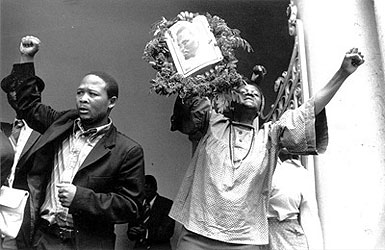
The landscape of Black political activity in the 1960s was different that of the previous decade. The apartheid government had banished the Black resistance movements, in particular the ANC and the PAC. Black leaders, who were not imprisoned by the state, fled into exile. A barrage of restrictive legislation effectively silenced Black opposition through bannings, arrests, and the imprisonment of leaders. South Africa's economy grew and benefited White South Africans. For Black South Africans, however, the suffering continued.
Ironically, the seeds of Black resistance in the 1960s could be found at the ‘bush campuses’, like those at the University of the North and Zululand University. These institutions, created under the Extension of the University Education Act, Act 45 of 1959, became the breeding ground of Black resistance that was to become a force in the 1970s. Influenced by the American Black Power movement, the likes of Malcolm X, and closer to home by Frantz Fanon, Kenneth Kaunda, Julius Nyere and Kwame Nkrumah, a new framework of student thinking emerged. In South Africa, it was the late Anthony Lembede's Africanism that was a crucial influence in these universities.
Biko’s ideas became the major rallying point behind a pressure group that became known in South Africa as the BCM. From 17 years of age, up until his death on 12 September 1977, Biko had an illustrious political career spanning about 14 years. He came into the political limelight in 1963, the year that witnessed a rise in the Poqo-led unrest in his home area. Poqo was the armed wing of the PAC, similar to the armed wing of the ANC, Umkhonto we Sizwe (MK, or “Spear of the Nation”).
Biko had just entered Lovedale College when his brother was arrested and jailed on suspicion of outlawed Poqo activity. He was interrogated by the police and subsequently expelled. This marked the beginning of Biko’s resentment against white authority. In 1964, he went to Marianhill in Natal (now KwaZulu-Natal) and attended a private Roman Catholic school, Saint Francis College. Although he found meaning in Christian principles, Biko, who was an articulate young man, resented the influence of whites thought on determining an African’s future.
As an advocate of the Black Consciousness (BC) philosophy - together with other literate Africans residing in the major urban centres - Biko developed into a highly respected intellectual in the 1960s. Biko began his search for self-identity, and hoped to build up the pride of Black culture - a culture that was scornfully viewed by the settler regime. Biko and his student colleagues had been receptive to the political ideas expressed by many Black intellectuals, and learned to use the emotional power of the message of Black Consciousness.
As a result, these ideas and slogans filtered down to a much broader group of socially underprivileged people, who were angry and impatient for meaningful action. This restructured consciousness emerged among students, beginning with those at Fort Hare and later the Durban Medical School (Natal University). These students constituted the new African petty bourgeoisie class.


