
Constructing Heritage and Heritage Resources
Heritage – our past, and where we come from – means different things to different people. Some people relate to the idea of heritage in a personal way, whilst others see it as having a broader historical and political significance.
In this section, we will explore a number of issues relating to heritage, namely:
- What is heritage?
- What are heritage resources?
- What are South Africa's World Heritage Sites?
- Investigating heritage resources from the past
- What are the issues involved in displaying people in museums?
What is heritage?
DNA is the material inside the cells that carry genetic information. It controls the development of qualities and characteristics that are passed from parents to their children. Each and every one of us has our own heritage and is unique.
Our heritage is everything that we inherit from our families and our society. It includes the DNA in our bodies, the language we speak, the culture that we are a part of, the beliefs we have, the food we eat, the music we listen to, the places we live in and the memories of our families, friends and community. Our heritage is what gives us our sense of identity and belonging.
Anything that has survived from the past forms part of the collective heritage of our society, from buildings, archaeological sites or the unspoilt natural environment to stories and music that have been handed down through oral tradition. It is our heritage that makes us different from other peoples in the world and gives us a sense of identity and belonging. South Africa's rich and diverse forms of heritage have made its people unique in the world.
The study of history and the past is never objective. The way the past is represented is always influenced by the ideology of the present. If you go to heritage places and museums, it is relatively easy to see how the early history of South Africa was distorted during the apartheid era. In fact, whenever you look at a piece of history, whether it is a photograph, a document, a building or a signpost, you need to be aware that it might have been changed or manipulated for political reasons.
Is the study of heritage important?
 Aerial view of the Voortrekker monument in Pretoria.
Milan Kundera, a writer from Czechoslovakia who openly criticised the government during the 1968 uprising in that country, recognised the importance of remembering the past. He said: "The struggle of [people] against power is the struggle of memory against forgetting."
What Kundera means is that the past is always in danger of being controlled and manipulated by those in power. In this way, what we remember in the past, and what we forget, can easily be controlled by those in power.
During the apartheid era, the histories and heritage of most ordinary South Africans were deliberately forgotten. South African museums focused on the heritage of white people, and in particular on the white ruling classes. Heritage sites such as the Voortrekker Monument and the Castle in Cape Town were established to uphold and glorify the history of the Afrikaner and the white colonial rulers. The experiences of the indigenous people of South Africa, such as the Khoisan, as well as the heritage of ordinary black people, was ignored.
What are heritage resources?
Heritage resources are places or things that have natural or cultural significance. Heritage resources are usually tangible (things we can touch and see), but they can also be intangible, such as belief systems.
Heritage places or sites
A heritage place is usually a specific area or site, which is valued by people because it means something to them. It may be a large area such as a whole region or landscape, or it may be a small area, which contains a significant feature or building.
A heritage place often contains elements of natural, cultural and indigenous heritage. For example, the vast landscape of the uKhahlamba-Drakensberg mountains contains important ecosystems, which are a vital part of our natural heritage. There are also ancient San rock art paintings in caves throughout the range which give us an insight into the San way of life. These are sites of great historical and spiritual significance as the art reflects the ancient religion of the early San hunter-gatherers. Understanding this complex heritage place means recognising and respecting all the different elements of significance.
Heritage objects
Heritage objects are any objects from the past that are important in the history or culture of people, including things like furniture, books, and art works.
Heritage museums
Museums are like any other historical source. They reflect the bias of the people who created them. They are never neutral and always offer a particular perspective on the past and its people. Images of people in museums can thus be portrayed positively or negatively, depending on what the aim of the exhibition is.
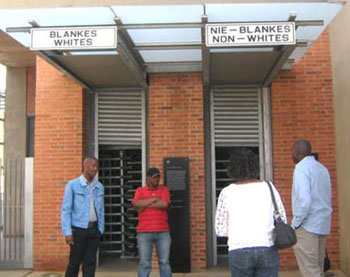
 The entrance to the Apartheid museum in Johannesburg.
Example A: The Voortrekker Monument
The Voortrekker Monument was established as a heritage site to the Voortrekkers of the Great Trek. Episodes of Afrikaner heroism are highlighted, as are the hardships that they experienced during the long trek towards the interior. Africans are shown as barbaric hordes, though the Zulus are shown as physically powerful and large in numbers. By highlighting the physical strength of the enemy, the heroism of the Trekkers is emphasised.
The Voortrekker Monument was not only about Afrikaner heritage. It also had political and ideological considerations. Whites were portrayed as heroes, whilst Africans were seen as the enemy. This was a way of justifying the policies of apartheid that were a part of South African history for much of the 20th century. It shows how heritage sites and resources have been used for political ends in the past.
Example B: The Apartheid Museum
Some commentators have criticised the Apartheid Museum for depicting whites as the oppressors and blacks as victims. They believe this fails to show that there were whites that resisted the system during the apartheid years and that not all blacks fought against apartheid. Some joined the system, whilst others were ordinary people who lived their lives and did not participate in the struggle.
Others say that the Apartheid Museum is there to remind us of the oppression that existed under apartheid rather than a reflection of the lives of people who lived through it.
Museums in the post-colonial or post-apartheid era have certainly tried to redress the silences that existed in the past. However, they are not free from both ideological and political considerations. There is also the danger that museums built today will come to reflect the ideology of the ruling classes to the exclusion of the ordinary people in society.
Example C: Something to consider
Post-colonial museums in Africa have failed to change significantly from the western type of museums. Today these museums are still inaccessible and not enjoyed by the majority as they are located in urban areas whilst their collections and displays still mirror western concepts. Thus museums in Africa have remained insensitive to the interests of the communities they claim to serve, since the static nature of displays and collections are more elitist and exotic than African.
Simon Makuvaza, Natural History Museum, Bulawayo, Zimbabwe
What are South Africa's World Heritage Sites?
There are five areas in South Africa that have been identified as World Heritage Sites, including the Cape Floral Kingdom, which covers the whole of the Western and Eastern Cape. The other four sites are:
- The Greater St Lucia Wetlands Park consists of 280 km of almost unspoilt coastline with a wide variety of ecosystems such as coral reefs and beaches, coastal forests, and salt and fresh water marshes.
- Robben Island was used as a prison for political prisoners for nearly 400 years. Nelson Mandela and other people who fought against apartheid spent many years of their lives on the island. It has come to represent the spirit of freedom and triumph over adversity and hardship.
- The Cradle of Humankind is a series of important archaeological sites in Gauteng which contain the remains of hominids from over 2 to 3.3 million years ago. It is full of evidence of the different stages of human prehistory.
- The uKhahlamba Drakensberg Park is home to a diverse range of animals and plants, including many endangered species. It is also one of the richest rock painting sites in the world.
Why preserve and protect heritage resources?
The United Nations Educational, Scientific and Cultural Organisation (UNESCO) protects what it considers 'important' parts of the Earth by making them World Heritage Sites. Once proclaimed, these sites are considered sacred and are protected from the threats of social and economic development and natural decay. World Heritage Sites are chosen for their natural or cultural significance. There are more than 700 sites around the world that have been recognised as World Heritage Sites by UNESCO.
We protect and conserve heritage resources because:
- they are naturally or culturally significant
- they help build and strengthen personal and community identity
- we want to pass them on to future generations
- there are social, spiritual and ethical obligations to respect the place or the object
Investigating heritage resources from the past
What can we tell from archaeological finds?
 The oldest known pieces of jewellery made by modern humans are shell beads that were found in Blombos Cave on the southern tip of South Africa. They have been dated as being 75,000 years old.
How do we find out about the past? How do we know if a site or an object is an important part of our heritage? If the place or the thing is not very old, we can use people's memories as well as written or audio-visual material to find out how valuable it is. However, it is much more difficult to work out the significance of something that existed thousands or even millions of years ago, when no written records were kept.
The role of archaeologists
Archaeology is the study of the past using objects and other excavated evidence as the main source of information. In this way, we can learn about peoples and societies that existed before written records were made.
Archaeologists investigate archaeological sites and look for clues about what life was like in the past. Sometimes an archaeological site is still standing, like the buildings of Great Zimbabwe or the pyramids of Giza. But more often than not, many of the remains are buried underground. Archaeologists have to sift through the soil to find things that people left behind.
Often they uncover different layers of the past. The top layer is the remains from the most recent past, whilst older remains are found deeper down. This helps us get a better understanding of how a community or society changed over time.
What can we tell from archaeological finds?
Archaeological finds are evidence that tells us how people lived long ago. All of the remains that people leave behind tell us something about how they survived, what they believed and so on. Buildings or the foundations of buildings can tell us what sorts of houses people lived in. They can also tell us about social status and even family structure. Artefacts such as tools, weapons, pots or implements can show us how people worked and let us know what level of technological development a particular society had achieved.
Animal bones and plant remains provide us with evidence of the food that people ate. This in turn, can tell us whether a society was pastoralist, hunter-gatherer or domestic farmers. Human remains or skeletons provide us with clues as to the physical aspects of people who lived before us, as well as of the evolutionary development of humankind.
Other traces, such as rock paintings, engravings or burial sites, can shed light on the lifestyle of a community, their belief system, their status and their identity.
If the same artefacts are found in two different places, this would suggest that the two different communities traded with one another.
How do we know how old things are?
Living things constantly absorb radioactive carbon from the atmosphere, including carbon-12 and carbon-14. Carbon-14 is unstable and, after death, decays. This means there is more carbon-12, which is stable and does not decay. When an artefact is excavated, scientists measure the amount of carbon-14 in relation to carbon-12. If there are similar amounts of each, the remains are not very old. If there is much more carbon-12 than carbon-14, it means the remains have been around for a long time. Using radio-carbon dating, archaeologists can work out how long people, animals or plants have been dead. In this way, they can date the artefacts found with them.
What is the role of anthropologists?
Archaeologists cannot tell us the names of the people in the past or how they lived their lives. They also cannot tell us what people in the distant past thought and believed. However, anthropologists can help us uncover these kinds of details. Anthropologists study living communities and examine their behaviour and interaction. Anthropologists are particularly concerned with culture. Culture refers to the complete way of life of a particular group of people. It includes the attitudes, values, goals and practices that the group shares, as well as their customs, art, literature and belief systems.
Anthropologists try to explain the culture of a particular community by examining its way of life, its traditions and customs, its language and belief systems. In order to do this, anthropologists usually spend a relatively long period of time living with a particular community in order to observe their behaviour and how they organise their society. This is called fieldwork.
When studying the culture of a community, anthropologists try to establish a link between how they live in the present and how their ancestors lived in the past. In many societies, traditions have been passed down from generation to generation. By observing how a society lives and behaves today, anthropologists are able to shed light on behaviour and beliefs in the past. However, culture is not something that is static. It shifts and changes over time. Anthropologists know that we cannot simply transpose the way a society acts and believes today to how they might have acted in the past.
In the 1950s, an American family of anthropologists called the Marshalls lived amongst the !Kung in the Nyae Nyae area. The !Kung still have elements of the lifestyle of the early San hunter-gatherers. By living with and observing and speaking to the members of the !Kung community, the Marshalls were able to shed light on the lifestyle of earlier hunter-gatherer societies.
What is the role of oral history?
In societies that did not have the written word, historians can uncover some of what happened in the past through oral history. Oral history uses oral sources or the spoken word as a form of historical evidence. These sources include oral testimony and oral tradition. Oral testimonies are the first-hand accounts that people tell about themselves and the things they have experienced in the past. This information is usually gathered by historians in interviews. Oral tradition is based on the stories and narratives which have been handed down from generation to generation by word of mouth.
Oral history is an important way of uncovering the history of ordinary people whose activities were not recorded in books, archives or libraries. Most official written sources tend to reflect the views of the dominant class in society. This was particularly true in South Africa in the apartheid years, when strict censorship, banning and other forms of repression silenced the voices of the majority of South Africans. Oral history gives us a sense of the history of ordinary people in a society.
South Africa is one of the first countries in the world to formally protect places associated with 'living heritage' or heritage based on stories passed down from generation to generation. One of the first projects in South Africa that looked at how we can protect such sites took place in Dukuza in KwaZulu-Natal. The town was the site of King Shaka's royal residence, and interviews with old people in the community revealed an amazing store of information passed down from generation to generation for over nearly 180 years. These included things such as from which spring the royal water was drawn, where the King swam and under which trees particular events and councils took place.
What is the role of Indigenous Knowledge Systems?
Indigenous knowledge systems refers to traditional knowledge that was developed by communities found in a particular geographical area. In the apartheid years, these forms of knowledge were ignored or suppressed. However, they give us an understanding of the way of life and thinking of people who lived in the past, as well as restoring the dignity of people's lives.
Indigenous knowledge systems cover a wide range of areas:
Traditional medicine and health:
South African societies in the past used herbs, plants and animal products to treat disease. A study of indigenous medicine not only sheds light on the nature of earlier societies, but also provides alternatives to help us fight diseases today.
Indigenous food systems:
Early South African societies developed indigenous methods and systems of dealing with food supply. These included the preservation, processing and production of food.
Socio-cultural systems:
Indigenous societies developed ethical and legal systems, education and learning systems, and systems for conflict management and conflict resolution, language, religion and culture.
Arts, crafts and materials:
Indigenous arts and crafts give us an insight into the emotional expression of a people, as well as their systems of belief and way of life.
At the Earth Summit in Johannesburg in 2002, the issue of indigenous knowledge was hotly debated. Indigenous knowledge systems clash with Western intellectual property rules (IPR) which see knowledge as the property of an individual or a company. Traditional knowledge, on the other hand, is collectively owned and handed down through generations. What is your view on the ownership of knowledge?
 Saartjie Baartman was put on display in exhibitions throughout Europe.
What are the issues involved in displaying people in museums?
Museums that depict people are like any other historical source. They reflect the bias of the people who created them. Images of people in museums can thus be portrayed positively or negatively, depending on what the aim of the exhibition is. Saartjie Baartman is an example of a person who was displayed in museums for negative purposes. She was born in 1789 and was working as a slave in Cape Town when she was persuaded by a ship's doctor, William Dunlop, to travel with him to England. Saartjie had unusually large buttocks (although these were common features of Khoisan women of the time). Dunlop put her on display in exhibitions throughout Europe as an example of a 'freak'. She was used to 'prove' to Europeans that black people were both inferior and different, thus fuelling Europeans' prejudices about blacks. After her death, Saartjie's remains continued to be exhibited in European museums for many years.
Saartjie Baartman's remains were finally returned to South Africa in 2003, and she was given a proper burial above the Gamtoos River in the Eastern Cape province. She is no longer displayed as a curiosity in a museum. Rather, the memory of Saartjie Baartman has found a new place and a new meaning.
A centre offering aid and an intervention programme for abused women and children was recently opened in Manenberg on the Cape Flats. It was named the Saartjie Baartman Centre for Women and Children as a reminder of the abuse that she endured.
Great Zimbabwe: A Case Study
What have archaeologists found out about Great Zimbabwe?
 The sculpted bust of Cecil J Rhodes, located at the Rhodes Memorial in Cape Town.
Great Zimbabwe is an archaeological site which is a very important heritage resource in southern Africa. The name of the country of Zimbabwe is even based on the Shona term dzimba dzembabwe, meaning 'house of stone'. The ruins of Great Zimbabwe provide evidence of an early and sophisticated civilisation.
In 1888, Cecil John Rhodes occupied the area of present-day Zimbabwe and it became a British colony. For nearly 100 years, until independence in 1980, the area was known as Rhodesia. During this period of colonial rule, the African people of the area were dispossessed of their land, their rights and their heritage. Although the evidence clearly showed that Great Zimbabwe had been built by Africans, the Rhodesian government did everything in its power to suppress this knowledge.
Cecil John Rhodes and other white settlers refused to believe that Great Zimbabwe was built by Africans. Rhodes employed a miner called Theodore Bent to dig up bits of Great Zimbabwe in order to prove that it had been built by either Arabs or Phoenicians.
Despite colonial attempts to suppress the heritage of the African people of the area, Great Zimbabwe became a potent symbol of African achievement and resistance. During the war years of the 1960s and 1970s, the African people held up Great Zimbabwe as a symbol of the African nationalist struggle for freedom.
However, it was only after independence that Zimbabwe was able to reclaim its history and heritage. The ruins of Great Zimbabwe have become a symbol of the new state and its freedom from colonial rule. Symbols of the ruins are used on Zimbabwe's banknotes, coat of arms and flag.
Evidence was deliberately suppressed in order to promote the policies and belief systems of the white colonial government in what was then known as Rhodesia.
Source A
The conclusions of Theodore Bent after excavating the ruins of Great Zimbabwe:
"A prehistoric race built the ruins ... a northern race coming from Arabia ... closely akin to the Phoenician and Egyptian ... and eventually developing into the more civilised races of the ancient world."
P Tyson, The Mystery of Great-Zimbabwe
Source B
The conclusion of Randall MacIver, an early archaeologist working on Great Zimbabwe:
The former mud dwellings within the stone enclosures "are unquestionably African in every detail and belong to a period which is fixed by foreign imports as, in general, medieval."
P Tyson, The Mystery of Great-Zimbabwe
Source C
Paul Sinclair, Curator of Archaeology at Great Zimbabwe, wrote:
"I was the archaeologist stationed at Great Zimbabwe. I was told by the then-director of the Museums and Monuments organisation to be extremely careful about talking to the press about the origins of the Zimbabwe state. I was told that the museum service was in a difficult situation, that the government was pressurising them to withhold the correct information. Censorship was a daily occurrence. Once a member of the Museum Board of Trustees threatened me with losing my job if I said publicly that blacks had built Zimbabwe".
The origins of Great Zimbabwe
 Map showing location of the 'Great Zimbabwe' Ruins.
Much of what we know about the history of Great Zimbabwe has been reconstructed by archaeologists and anthropologists working with non-written sources like the landscape, the buildings and artefacts excavated from the site.
The land itself can provide many clues about life in the past. Great Zimbabwe is situated on the edge of the Zimbabwe plateau just as it starts its descent to the lowlands in the East. Historians are able to provide a number of reasons that explain why Great Zimbabwe was established in that exact spot by examining the landscape:
- Tsetse flies, which cause a fatal disease called sleeping sickness, are not found on the highlands of the plateau.
- The settlement is on the south-eastern edge of the plateau where good rains and rivers meant the land was able to support the cattle and produce the large amounts of grain, sorghum and millet needed to sustain a large population.
- It was a trading centre. Gold was mined to the west of Great Zimbabwe and ivory passed through Zimbabwe on the way to Sofala on the Mozambique coast. From here, goods from India like cloth, jewellery and iron implements (hoes, axes and chisels) found their way back to Zimbabwe.
- The rounded granite hills that are within walking distance of the site provided the granite blocks that the settlement was built from.
The early occupants of Great Zimbabwe were cattle farmers, but they also grew crops like sorghum and millet. The evidence suggests that the early Shona were 'carnivorous pastoralists', which means that they kept cattle to eat rather than for their milk. Generally, carnivorous pastoralism takes place where the grazing is excellent and human populations are increasing. Milk pastoralism takes place where grazing is not so good and cannot sustain a growing population. Archaeologists found about 140 000 pieces of animal bones on the lower slopes around Great Zimbabwe. Almost all of these were cattle bones. Significantly, about 80 per cent of the bones of slaughtered cattle dug up in the Great Zimbabwe site came from animals between 24 and 36 months old – the age when beef cattle are in their prime. This tells us that they used cattle mostly as a source of beef rather than as a source of milk. It also suggests that Great Zimbabwe was a stable settlement. The people living there did not move around looking for grazing. They were able to stay in one area for centuries and become a wealthy community.
The buildings of Great Zimbabwe
Great Zimbabwe is one of the largest old stone-walled settlements ever found in southern Africa. Building started around the year AD 1280. At its height, it is believed that 18 000 people lived at Great Zimbabwe. The stone walls vary in height and size and create different spaces called enclosures. Each enclosure was home to people of a certain social status.
Archaeologists and anthropologists have used a number of sources in trying to reconstruct the systems of power and status that existed in Great Zimbabwe. These include:
- the physical remains of the site
- Portuguese documents: The Portuguese established a number of trading stations in the area in the 1560s. Although their observations about Great Zimbabwe refer to a later period, archaeologists believe that there is little difference between earlier settlement patterns and usage of space and the later descriptions of the Portuguese.
- Shona customs and oral tradition
- Venda customs and oral tradition: The Venda of South Africa were part of the Zimbabwe culture and had Shona origins.
 Aerial view of 'Great Zimbabwe'.
The Hill Complex was probably the palace of the king or mambo. It is the highest and most decorated structure and had spaces for religious ceremonies. In Shona and Venda culture, mountains are symbols of political authority. The mambo was supposed to be aloof and live separately from the rest of the people.
Archaeologists found objects like gold and bronze spearheads, which were all symbols of leadership, in the Hill Complex. The soapstone statues of birds were probably carved as a tribute to the ancestors of past kings.
According to Shona custom, all settlements had a meeting place or dare where people met to discuss political matters and resolve disputes through discussion and negotiation.
The dare at Great Zimbabwe was large, which means the mambo had a lot of political power. No objects that are used in everyday life were found at this site.
The lower homesteads probably belonged to the wives of the mambo. The Shona king had a number of wives, who lived in one area of the settlement under the control of the first wife or vahozi. It was her right and duty to keep the king's possessions.
The biggest collection of valuable items was found in the lower homestead including Persian bowls, Chinese dishes, ivory and gold beads. A number of the king's spears and axes were also found here, as well as a monolith with a soapstone bird. According to Shona custom, the bird was a symbol of protection during the birth of royal children.
The Great Enclosure is about 600 metres away from the hill. Some think this was the home of the vahozi. Others think that it was an initiation school known as a domba where initiates were taught about the rules and customs of the community.
No everyday utensils were found in the Enclosure but there is a speaker's platform. It also has a number of private and public spaces, which is consistent with other domba enclosures elsewhere. It contains a number of symbols which mean 'young man' and 'young woman' according to Shona custom.
The remains at Great Zimbabwe suggest that it was a highly stratified society in which there were sharp divisions between the rich and poor. The king or mambo lived in some luxury, as did the nobles. Food was plentiful but there appears to have been a big difference between the rich and the poor.
It is believed that the nobles lived in the terraces. The houses here were much larger than anywhere else, and were built with the best quality stonework. It is believed that the ordinary people, the commoners, lived in the hut mounds. They lived in fairly close proximity to each other in small huts around the inside and outer wall. These huts have broken down and all that exists today are the mounds.
Trade at Great Zimbabwe
Great Zimbabwe was a wealthy centre of cattle and cereal farming and a major link in the trade between the people inland and the Swahili kingdom at Sofala on the coast of Mozambique. Sofala had traded with much of East Africa as well as with India and China. Archaeologists have found a number of artefacts which show that Great Zimbabwe was a trading centre, including a glazed bowl from Persia (present-day Iran) with 13th century inscriptions, dishes from China, thousands of glass beads, coral and cowrie shells and a Portuguese coin that probably came from the trading city of Kilwa on the East African coast.
The Shona at Great Zimbabwe bought gold from people further inland and sold it to traders on the East coast. Gold mining was very widespread in traditional Shona society. It was estimated that by the time the industrial production of gold began in the area (1890), more than 1 200 reefs had been mined in the central plateau. Unlike the Egyptians, there is evidence to suggest that the Great Zimbabweans used gold more for trade than for ceremonies or ornaments.
Ivory from elephants also made its way from the interior to the coast via Great Zimbabwe. Cotton was grown widely in the region and weaving of local cloth took place. Finer cloth was imported by the wealthy via the East coast traders.
The kingdom of Zimbabwe came to an end in about 1450 AD and the settlement was deserted. No one is quite sure why this happened, but a possible explanation is that the resources of the area were exhausted as the population increased in size. With more and more people living in the area, there was not enough clean water and, as the trees were cut down, the daily journey for firewood became longer and longer. Most importantly, the grazing lands were used up. People were probably forced to move to other areas in search of fresh grazing.
Great Zimbabwe was declared a World Heritage Site in 1986. This means that it is now a protected area and the site may not be disturbed or damaged in any way.
Paul Sinclair, Curator of Archaeology at Great Zimbabwe, wrote:
"My favourite discovery was a piece of Ming china from Great Zimbabwe in southern Africa, when I was the resident archaeologist there in 1986. It was fabulous working at Great Zimbabwe. We excavated through a layer of ash, ... and [found] a little stone-lined tunnel ... Jammed inside this tunnel was a broken piece of Ming china. It was the most staggering thing I have ever come across ... It was dated to the very end of the 15th or early 16th century, showing that [Great Zimbabwe had] survived at least 50 years longer than was previously thought".


