
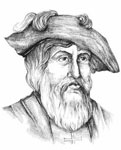
Vasco da Gama's Voyage of "Discovery"
The reason for putting "discovery" in inverted commas is because the land was not, as so many explorers argue, discovered by them. The land was already occupied and was being used by the inhabitants. The reason why groups often state their arrival on some foreign land as a "discovery" is because, according to the primitive 'finders keepers' rule, this lends support to any claim they make to "owning" the land. The Portuguese expedition set off from the Tagus River on 8 July 1497 with a crew of 148 men in a squadron of three square-riggers, the Sao Gabriel, the Sao Raphael, the Berrio, and a supply ship. The commander?in?chief embarked on the Sao Gabriel accompanied by his pilot, Pedro de Alenquer. Vasco's brother, Paulo, captained the Sao Raphael. For almost four months they sailed across the Atlantic without sight of land until, on 4 November 1497, they reached the bay of St Helena, where they had their first encounter with the Khoikhoi (Hottentots). A misunderstanding arose between them, and fearing attack, the Khoikhoi threw spears, wounding Da Gama in the thigh.
The Cape
In the teeth of a gale, the Portuguese squadron rounded the Cape on 22 November, and three days later, the battered little ships sailed into Santa Bras (Mossel Bay), sighting islands thick with noisy birds. They unloaded their damaged store ship and then burnt it, while Da Gama traded gifts with the Khoikhoi. However, they offended the Khoikhoi when they took fresh water without asking the chief's permission, and the Khoikhoi began to assemble in an armed mass. The sailors hurriedly took to their boats while a couple of cannon blasts dispersed the hostile inhabitants.
The east coast
By Christmas, the squadron was off the hazardous coast of Pondoland, which they named Natal. Three days later, they were enjoying good fishing off a point they called Ponta de Pescaria (Durban bluff). Head winds blew them out to sea and when they managed to reach the coast again, they anchored off Inharrime on the coast of Mozambique. They replenished their water barrels and, finding the iron-working ancestors of the Tsonga friendly and generous, they named the area Terra da Boa Gente ('land of the good people').
At Mozambique Island, they forcefully engaged two Arab pilots and when the Muslim inhabitants realized the explorers were Christians, they grew hostile. To keep them at bay, Da Gama bombarded the town and then sailed away. On 7 April, Da Gama anchored off Mombasa. The sultan generously sent them sheep, fresh vegetables and fruit; but when one of the Arab pilots jumped overboard as they were entering the harbour, the Portuguese became suspicious of the sultan's intentions. Da Gama forced some Muslims on board, tortured them with boiling oil, and learned of a plot to avenge the Portuguese attack on Mozambique. Thus forewarned, they were able to stave off an attack and continued on their way. Nearing Malindi (near Mombasa), they found the sultan much more friendly and helpful. He provided them with an expert pilot to steer them to India, thus laying the foundation of a long and mutually profitable alliance.
India From Malindi the ships sailed for Calicut in India and anchored on the Malabar Coast on 20 May 1498. There, Muslim traders swayed the Hindu ruler against the Christian explorers, who again narrowly escaped death. The Portuguese squadron sailed from India on 20 September 1498, but on the return voyage, disaster overtook them. First, they were becalmed for many days, and then, contrary winds and currents dragged out their crossing. Thirty men died. The survivors arrived at Malindi on 7 January 1499. Here, they erected a padrÁƒÂƒ£o (stone cross), which still exists. Lacking able-bodied men to sail all the ships, Da Gama burned the Sao Raphael.
On 20 March 1499, the two remaining ships rounded the Cape and sailed on for the Portuguese outpost on the Azores where Da Gama delayed sailing because his brother Paulo had died. The Berrio sailed on to Portugal, where it dropped anchor at the Tagus on 10 July 1499. When Da Gama arrived at Lisbon about three weeks later, the Portuguese gave him a hero's welcome. The king awarded him the grand title, 'Lord of the Conquest, Navigation and Commerce of Ethiopia, Arabia, Persia and India', and 'Admiral of the Indian Sea', with the rank of Dom, and many other rewards. Soon afterwards, he married Catherina de Ataide with whom he had six sons and a daughter.
The Second Expedition
In order to impose a monopoly on the spice trade, Da Gama sailed with a fleet from Portugal in 1502, bound for Mozambique and Sofala. There, he obtained some gold, established trading rights, and forced the new Sultan of Mozambique to pay homage to the King of Portugal with an annual tribute of gold. In India, Da Gama attacked Calicut, tortured his captives horribly - we are told he cut off their noses and ears and sent them to the Sultan of Calicut - and after preying on Moslem ships, returned to Portugal heavily laden with booty. From then onwards, the Portuguese made regular voyages using Mossel Bay and Mombasa as their main replenishing posts. Oriental silks, satins and spices, and African ivory and gold brought wealth to the Crown and led to Portugal's dominance of the Cape route. In 1524, Jono III commanded Da Gama to return to India as viceroy. He reached Goa on 11 September 1524, but died at Cochin three months later. His remains were eventually returned to Portugal and interred at St Jeronimos in 1880.
Sources:
Howcroft, P. (undated). South Africa Encyclopaedia: Prehistory to the year 2000, unpublished papers with SA History Online.
http://pwp.netcabo.pt/0150669101/CarlosAlberto (image source)