| 1970 |
|
|
|
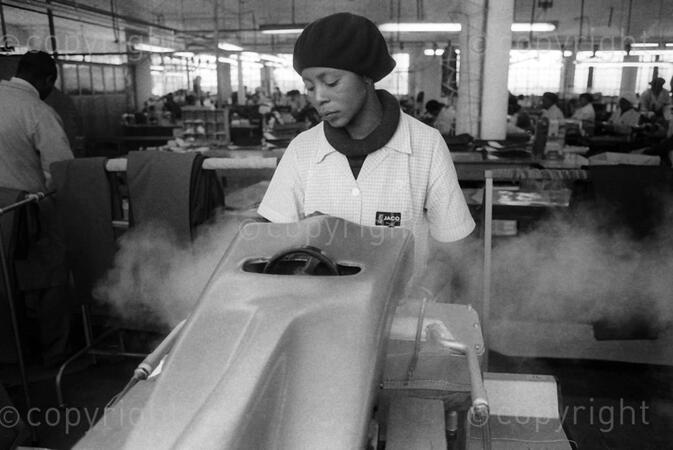
Prices begin to rise sharply, making it even more difficult for workers to survive on low wages. Spontaneous strikes resulted: workers walk out of the work places demanding wage increases. |
|
| 1970 |
|
|
|
The Bantu Homelands Citizenship Act strips blacks of their South African Citizenship. |
|
| 1970 |
|
|
|
Fietas, Johannesburg: Lenasia is incorporated into the Johannesburg Municipal Area. |
|
| 1970 |
|
|
|
Bantu Homelands Citizenship Act (National States Citizenship Act) No 26:
Required all black persons to become citizens of a self-governing territorial authority. As Minister Connie Mulder stated: ‘No black person will eventually qualify in terms of section 10 because they will all be aliens, and as such, will only be able to occupy the houses bequeathed to them by their fathers, in the urban areas, by special permission of the Minister,’ i.e. black people are forced by residence in designated ‘homelands’ areas to be citizens of that homeland and denied South African nationality, the right to work in South Africa etc.
Assent gained: 26 March 1970; commencement date not found
Repealed by the Constitution of the Republic of South Africa Act No 200 of 1993.
|
|
| 1970 |
|
|
|
Fatima Meer banned for planning mass rally with Steve Biko.
Winnie Mandela placed under house arrest. |
|
| 1970 |
|
|
|
Robert McBrid's sister Gwynneth is born. |
|
| 1970 |
|
|
|
Coloured and Indian players are purged from African clubs.
South Africa is expelled from the Olympic Movement.
|
|
| 1970 |
|
|
|
Thabo Mbeki is sent to Soviet Union for political training. Walter Sisulu and Abertina Sisuls son Max joins Thabo, and together they make their way to a remote military camp near a town called Sekhodia. |
|
| 1970 |
1 January |
|
|
The Weights and Measures Bill providing for the metrification of weights and measures, thereby introducing the metric system, comes into effect. |
|
| 1970 |
9 January |
|
|
The first week after the announcement of the agreement with the International Monetary Fund the price of gold falls below $35 per oz. |
|
| 1970 |
30 January |
|
|
The Prime Minister announces that the government is watching the situation in Lesotho following the elections and that necessary measures have been taken to ensure the safety of South Africans there. |
|
| 1970 |
6 February |
|
|
The Prime Minister announces that all Coloured people will be removed from the common voters’ roll. |
|
| 1970 |
11 February |
|
|
A delegation from Mauritius arrives in Cape Town to discuss ways of strengthening links between Mauritius and South Africa. |
|
| 1970 |
16 February |
|
|
Twenty-two Africans are acquitted of unlawful activities. Three are subsequently released, but the nineteen others are charged again under the Terrorism Act, and immediately taken into custody. They include Winnie Mandela. |
|
| 1970 |
18 February |
|
|
Minister of Defence Botha, appeals in the House of Assembly to the British government to uphold its honour in respect of the Simonstown Agreement, otherwise South Africa will have to explore other avenues to strengthen its maritime forces. |
|
| 1970 |
23 February |
|
|
The Bantu Laws Amendment Bill is passed. |
|
| 1970 |
26 February |
|
|
The Bantu Homelands Citizenship Bill is passed, whereby every African is issued with a certificate of citizenship of his respective ‘homeland’. |
|
| 1970 |
6 March |
|
|
The National Party manifesto reaffirms its belief in separate development programmes for the white, black, Coloured and Indian population. |
|
| 1970 |
10 March |
|
|
South Africa’s consular representation will not be withdrawn from Rhodesia and South Africa’s relations with the Republic of Rhodesia will remain unchanged. |
|
| 1970 |
13 March |
|
|
A total of 407 candidates are nominated for the 166 seats in the House of Assembly. Eight parties and five independents will contest 155 of the constituencies. |
|
| 1970 |
18 March |
|
|
The Deputy Leader of the Herstigte Nasionale Party (HNP), Jaap Marais, is committed for trial in the Pretoria Supreme Court on three charges under the Official Secrets Act. |
| |
| 1970 |
23 March |
|
|
South Africa is banned from competing in the Davis Cup, as a result of South Africa’s apartheid stand in sport. |
|
| 1970 |
26 March |
|
|
On this date all Africans become citizens of their ethnic ‘homelands’. However, they will not become foreigners in the Republic of South Africa.
South Africa:Signs treaty with Portugal (for Mozambique), amending Article XXXII of the Mozambique Convention. |
|
| 1970 |
April |
|
|
The Leader of the United Party reiterates his party’s proposal for a Federal Constitution.
The Herstigte Nasionaie Party publishes its manifesto describing its aim of a society dominated by Christian national concepts and Afrikaans as the only official language.
|
|
| 1970 |
2 April |
|
|
South Africa:Signs agreement with Australia relating to air services. |
|
| 1970 |
13 April |
|
|
B.J. Vorster states that he is prepared to meet demands that mixed sports should be allowed. |
|
| 1970 |
14 April |
|
|
The United Nations Special Committee on Apartheid urges a boycott of all South African racist sporting organizations and supports an African proposal to exclude the Republic from both the Munich Olympics and the Olympic Movement itself. |
|
| 1970 |
22 April |
|
|
The general election results in the return to power of the National Party for the sixth time since 1948, but with a reduced majority. There is an overall swing of two and a half percent to the United Party, and of five and a half percent away from the National Party with three percent going to the Herstigte Nasionale Party. The NP wins 117 seats with 820,968 votes cast. The UP wins forty-seven seats with 561,647 votes cast. The Progressive Party wins one seat with 51,760 votes cast. |
|
| 1970 |
24 April |
|
|
It is confirmed in London that thirteen African countries have threatened to withdraw from the Commonwealth Games in Edinburgh, if the South African cricket tour of Britain goes on. |
|
| 1970 |
27 April |
|
|
The Prime Minister announces that his newly re-elected government is to continue its outward looking foreign policy as well as its policy of separate development. |
|
| 1970 |
11 May |
|
|
The Prime Minister announces a Cabinet reshuffle. |
|
| 1970 |
13 May |
|
|
South Africa:Signs multilateral treaty on certain dairy products. |
|
| 1970 |
15 May |
|
|
The International Olympic Committee expels South Africa from the International Olympic Movement as a result of South Africans apartheid stand in sport. |
|
| 1970 |
18 May |
|
|
Following the results obtained in the general election held in April, a new cabinet is sworn in. |
|
| 1970 |
19 May - 21 May |
|
|
John Vorster visits Malawi and stresses the desire for continued contact and co-operation between South Africa and Malawi, despite existing differences in outlook. |
|
| 1970 |
21 May - 22 May |
|
|
Private talks are held between John Vorster and Rhodesian Prime Minister lan Smith. |
|
| 1970 |
22 May |
|
|
The English Cricket Council bows to British government pressure and calls off the all-white South African cricket tour. |
|
| 1970 |
29 May |
|
|
Minister of Justice, P.C. Pelser, announces that the Attorney-General of the Transvaal is to prosecute thirty of the 357 people arrested in Johannesburg after an illegal march in protest against the continued detention of the twenty-two Africans held under the Terrorism Act. |
|
| 1970 |
3 June - 7 June |
|
|
The Prime Minister, accompanied by Dr. Muller, visits Portugal, and holds several meetings with the Portuguese Prime Minister and senior ministers. The friendly talks cover a wide field and include the Cahora Bassa scheme. |
|
| 1970 |
9 June - 10 June |
|
|
The Prime Minister visits Spain and holds discussions with senior officials. A meeting is held with General Franco. |
|
| 1970 |
10 June |
|
|
John Vorster hold talks in Paris with the French Prime minister covering French investments in South Africa. |
|
| 1970 |
12 June |
|
|
The seventh ‘homeland’ is inaugurated with the installation of Chief Gatsha Buthelezi as Chief Executive Officer of the Zululand Territorial Authority (ZTA). |
|
| 1970 |
13 June |
|
|
P.W. Botha announces that South Africa is establishing a new submarine base at Simonstown at a cost of $7.7m. |
|
| 1970 |
14 June - 17 June |
|
|
Prime Minister Vorster and Dr. Muller arrive in Geneva. A meeting is held with twelve South African ambassadors to European countries, and with the head of the South African mission to the United Nations in Geneva, concerned with means of improving South Africa’s image in Europe. |
|
| 1970 |
24 June |
|
|
Exchange of notes with Portugal on the issue of copyright in maps. |
|
| 1970 |
July |
|
|
The first General Students' Council of South African Students' Organisation (SASO) is convened, where the organisation takes a bolder stance. The organisation encourages contact between SASO and other multi-racial organisations such as the United Christian Movement (UCM) and the Institute of Race Relations, but recognition of National Union of South African Students (NUSAS) as a "true" national union of students is withdrawn. SASO becomes identified with a well-articulated ideology of Black Consciousness. |
|
| 1970 |
1 July |
|
|
The question of the resumption of arms supplies by Britain to South Africa is discussed by the Foreign Minister, Dr. H. Muller and the new British Foreign Secretary, Sir Alec Douglas-Home, in London, in the context of the Simonstown Agreement. |
|
| 1970 |
6 July |
|
|
The British Conservative government’s intention to resume arms supplies is announced in the House of Commons. Other Commonwealth governments are formally informed of this intention on 10-11 July 1970. Hostile reactions follow. |
|
| 1970 |
11 July |
|
|
The United States Secretary of State reiterates America’s adherence to the policy of not supplying arms and military equipment to South Africa. |
|
| 1970 |
20 July |
|
|
The Prime Minister announces in the House of Assembly that South African scientists have succeeded in developing a new process for uranium enrichment, and are building a pilot plant for this process.
The British Foreign Secretary, Sir Alec Douglas-Home, makes a statement in the House of Commons on the question of arms for South Africa. Emphasizing the vital importance of the sea routes around South Africa. |
|
| 1970 |
23 July |
|
|
The United Nations Security Council condemns all violations of its embargo against South Africa. After five meetings on this question Resolution 281 (1970) is subsequently passed calling on all states to strengthen the arms embargo. It is adopted by twelve votes to none against, France, Great Britain and the United States abstaining.
The Minister of Defence tells Parliament that South Africa in fact spends less than 3 percent of her national income on defence. |
|
| 1970 |
23 July |
|
|
Security Council adopted resolution 282 (1970) calling on States to take a series of measures to strengthen the arms embargo against South Africa. The vote was 12 in favour and 3 abstentions (France, UK, USA). |
|
| 1970 |
27 July |
|
|
An Uranium Enrichment Bill is announced, establishing the Uranium Enrichment Corporation of South Africa. |
|
| 1970 |
29 July |
|
|
The International Court of Justice in the Hague unanimously condemns the continuing presence of South Africa in Namibia and defines the legal consequences. |
|
| 1970 |
August |
|
|
In an article published in the South African Students Organisation (SASO) newsletter Steve Biko writes: "The integration they (liberals) talk about...is artificial...one-way of course, with the Whites doing all the talking and the Blacks the listening" |
|
| 1970 |
3 August |
|
|
South Africa:Signs amendments with Portugal (for Mozainbique) an the Mozambique Convention. |
|
| 1970 |
15 August |
|
|
Several pamphlet bombs, scattering ANC pamphlets, explode in a number of cities. |
|
| 1970 |
19 August |
|
|
The Chinese community is granted official white’ status for the first time. but only for sport and leisure. Subsequently the leader of the HNP, Dr. Hertzog, accuses the government of betraying South Africa’s traditional principles of racial segregation. |
|
| 1970 |
24 August |
|
|
A second trial of the nineteen Africans, acquitted in February begins after they have been in detention for seventeen months. They are all acquitted and released on 14 September 1970 only to be served subsequently with orders by the Minister of Justice placing them under restriction. |
|
| 1970 |
September |
|
|
South Africa:Signs visa agreement with Spain. |
|
| 1970 |
September |
|
|
Speaking in the House of Assembly, Prime Minister Vorster said that South Africa was prepared to enter into a non-aggression pact with neighbouring States.
|
|
| 1970 |
28 September |
|
|
The Minister of Justice announces in the House of Assembly that as of 1 January 1970 there were 809 persons serving prison sentences imposed under security laws. |
|
| 1970 |
28 September |
|
|
The provincial elections continue to demonstrate the slight swing away from the National Party, with the United Party making a net gain of six seats. The result: National Party 118 seats, the United Party fifty-nine seats, others nil. |
|
| 1970 |
30 September |
|
|
B.S. Ramotse is sentenced to fifteen years imprisonment by Justice G. Viljoen in the Pretoria Supreme Court. He is found guilty of taking part in terrorist activities and plotting the violent overthrow of the state. |
|
| 1970 |
5 October |
|
|
South Africa:Signs multilateral Convention on the Conflict of Laws Relating to the Form of Testamentary Dispositions. |
|
| 1970 |
24 October |
|
|
In a Declaration on the 25th anniversary of the United Nations, the General Assembly described apartheid as "a crime against the conscience and dignity of mankind". (Resolution 2627 (XXV)) |
|
| 1970 |
4 November |
|
|
President Houphouet-Boigny of the Ivory Coast announces he is planning an African Summit Conference to urge a dialogue with South Africa. This initiative meets with very various reactions throughout the continent, but is welcomed in South Africa. |
|
| 1970 |
9 November |
|
|
South Africa:Signs agreement with Netherlands modifying existing agreement on air services |
|
| 1970 |
13 November - 1 December |
|
|
The Archbishop of Canterbury, Dr. Michael Ramsey, visits South Africa on the occasion of the 100th anniversary of the establishment of the Anglican Church in South Africa. He repeatedly expresses his views on political and social problems arising from the government’s apartheid policy. |
|
| 1970 |
13 November |
|
|
After a challenge of the credentials of the South African delegation by many Member States, the General Assembly approved the report of the Credentials Committee "except with regard to the credentials of the representatives of the Government of South Africa". [(Resolution 2636 (XXV))] |
|
| 1970 |
15 November |
|
|
At the twenty-fourth General Assembly of the United Nations, South Africa joined all the leading maritime powers in opposing a section of the Resolutions on Peaceful Uses of the Sea-Bed. |
|
| 1970 |
19 November |
|
|
John Vorster appoints Theo Gerdener as Minister of the Interior in succession to Marais Viljoen. The latter retains the Labour portfolio and takes over Posts and Telegraphs in addition. The South African Broadcasting Corporation will come under the direct control of the Ministry of National Education. |
|
| 1970 |
20 November |
|
|
The South African Foreign Minister signs an economic agreement with the Malagasy Republic, which provides for a financial loan from South Africa to help the Malagasy tourist industry. |
|
| 1970 |
21 November |
|
|
Six prominent members of the HNP resign, having lost all confidence in the leadership of the party. Resignations include that of Dr. Willie Lubbe, editor of the party’s newspaper ‘Die Afrikaner’. |
|
| 1970 |
5 December |
|
|
The government’s policy for the coloured people is restated by a Cabinet Minister. Any policy, or lack thereof, which can lead to integration on whatever basis between whites and coloureds is rejected; the idea of a specific homeland for the coloured people is impracticable; extended and consistent liaison between the coloureds and the white authorities is promised. The government remains firmly committed to the principle of parallel development. |
|
| 1970 |
11 December |
|
|
South Africa signs a customs agreement with Botswana, Lesotho and Swaziland. |
|
| 1970 |
16 December |
|
|
South Africa:Signs multilateral treaty on the suppression of unlawful seizure of aircraft. |
|
| 1970 |
24 December |
|
|
The Minister of Bantu Administration and Development leaves Malawi after a four-day visit during which cooperation between nations of Southern Africa is endorsed. |
|
| 1971 |
|
|
|
The natal Indian Congress is revived. |
|
| 1971 |
|
|
|
The Voice of Women magazine is launched. |
|
| 1971 |
|
|
|
Despite the formative influence of a highly politicised father, one of Robert McBride's first personal experiences of racism is at Zoo Lake, Johannesburg. He joins some White children playing with a fish in a bucket, recently caught by a White youth of about 18 who, kicks Robert (of mixed race) in the crotch. This becomes an incident that his younger sister uses to taunt him. |
|
| 1971 |
|
|
|
South African Students' Organisation (SASO) helps launch the Black Community Programme.
Strini Moodley and Saths Cooper, members of the Natal Indian Congress (NIC) urge other Indian activists to embrace the Black Consciousness ideology. Although there is sympathy among NIC members, they view South African Students Organisations ideas of Black consciousness as potentially leading to Black racism. |
|
| 1971 |
|
|
|
The National Professional Soccer League (NPSL) launches the Keg League (later renamed Castle League), sponsored by South African Breweries.
Kaizer Motaungs All-Star XI is renamed Kaizer Chiefs.
|
|
| 1971 |
|
|
|
Thabo Mbeki is transferred to Lusaka, Zambia. |
|
| 1971 |
14 January - 21 January |
|
|
A conference of Heads of Government from the Commonwealth is held in Singapore at which Britain’s proposed sale of arms to South Africa is extensively debated. A study group is set up to consider the question in the context of the security of maritime trade routes in the South Atlantic and Indian Oceans. |
|
| 1971 |
20 January |
|
|
The Anglican Dean of Johannesburg, the Very Rev. Gonville Aubie ffrench-Beytagh, is detained by the police, accused of subversive activities. |
|
| 1971 |
1 February |
|
|
South Africa:Signs an amendment with Malawi on the provisions of the trade agreement of 13 March 1967. |
|
| 1971 |
2 February |
|
|
South Africa:Signs the Convention of Wetlands and Water Fowl.
The Minister of Justice says, in Parliament, that for as long as the present government is in power the Immorality Act will not be repealed. |
|
| 1971 |
8 February |
|
|
The text of a letter from South Africa to the International Court of Justice at The Hague, officially requesting it to cooperate in supervising a plebiscite in Namibia, is released. The Court is considering a request by the United Nations Security Council for an opinion on the legal consequences of South Africa’s continued presence in the territory in defiance of United Nations resolutions.
Minister of Labour Marais Viljoen announces total exemption for Coloureds from job reservation in the building industry on the Reef and in Pretoria. |
|
| 1971 |
11 February |
|
|
South Africa:Signs treaty with Israel on the reciprocal recognition of air worthiness certificates between South Africa and Israel.
South Africa:Signs multilateral treaty pertaining to nuclear weapons on the seabed. |
|
| 1971 |
16 February - 22 February |
|
|
A number of religious ministers and lay workers from Europe and America are told to leave the country. |
|
| 1971 |
19 February |
|
|
It is reported that the Security Police have detained about twenty Africans, Coloureds and Asians. The detainees are said to be members of the Unity Movement of South Africa, founded in 1943 by Coloured schoolteachers.
The South African arms question is discussed in a closed session of the Singapore Commonwealth Conference. |
|
| 1971 |
20 February |
|
|
The British Prime Minister reiterates his government’s attitude to the sale of arms in South Africa, at the Commonwealth Conference in Singapore. Accordingly the South African government has assured Britain that it had no aggressive intentions and that maritime arms would be used only to secure the sea routes. |
|
| 1971 |
22 February |
|
|
The South African Defence Ministry announces that the British government, following its obligations as per the Simonstown Agreement, is willing to give an export licence for Wasp helicopters as requested by South Africa. |
|
| 1971 |
25 February |
|
|
The Chief of the Security Police announces that raids undertaken on this date at offices of Christian and student organizations in the country’s main cities have revealed quantities of documents concerning ffrench-Beytagh’s activities. The Dean is consequently remanded until 28 May 1971 and again until 30 June 1971. The original charges are withdrawn: a new indictment is drawn up under the Terrorism Act.
The OAU publishes a statement condemning Britain’s proposed sale of helicopters to South Africa.
|
|
| 1971 |
March |
|
|
The Bantu Homelands Constitution Bill is enacted in the last week of March. 3 Mar. 1971 A Constitution Amendment Bill, empowering the government to proclaim any African language an official language in any self-governing territory, when considered fit passes its second reading at a joint sitting of both Houses of Parliament. Seven different African languages will thus be given official recognition. |
|
| 1971 |
11 March |
|
|
A resolution is passed at a student body meeting for the establishment of a student Wages Commission. David Hemson, Halton Cheadle, David Davis, Karel Tip and Charles Nupen together with political scientist Rick Turner lead the collective thinking on the establishment of the Commission. |
|
| 1971 |
15 March |
|
|
South Africa:Signs treaty with Netherlands for the avoidance of double taxation and the prevention of fiscal evasion with respect to taxes on income. |
|
| 1971 |
19 March |
|
|
Prime Minister Vorster says that his government is prepared to engage in dialogue, without preconditions, with other African countries prepared to talk. His offer meets with mixed reactions throughout the continent. |
|
| 1971 |
22 March |
|
|
A statement by Ghana’s Minister of Foreign Affairs in the Ghanal. National Assembly indicates a readiness to visit South Africa. |
|
| 1971 |
26 March |
|
|
The Prime Minister of Swaziland visits Cape Town for talks with John Vorster and confirms that a policy of friendship and cooperation towards the Republic is being maintained. |
|
| 1971 |
29 March |
|
|
South Africa:Signs Wheat Trade Convention. |
|
| 1971 |
30 March |
|
|
Prime Minister Vorster holds his first-ever international press conference and asserts that discussion of separate development with Africa’s black leaders will be welcomed. A policy of external dialogue is to be pursued.
Referring to allegations that a vendetta is being conducted against churches and religious workers in South Africa. Prime Minister Vorster says that of 1,440 religious workers only six have been deported in the last ten years, seventeen were refused extensions of permits and two were refused visas.
End-March:The Bantu Homelands Constitution Bill is enacted. It empowers the government to grant self-government, on an equal footing with that of the Transkei, to any area with a Territorial Authority, upon the latter’s request, at any time, by simple proclamation, after consultation with the Territorial Authority concerned, but without parliamentary enactment. |
|
| 1971 |
31 March |
|
|
Bantu Homelands Constitution Act (National States Constitutional Act) No 21:
Provided for the granting of increased powers to homeland governments, thus facilitating their eventual ‘independence’.
Commenced: 31 March 1971
Repealed by Sch 7 of the Constitution of the Republic of South Africa Act No 200 of 1993.
|
|
| 1971 |
1 April |
|
|
Accepts the accession of Ireland to the General Agreement on Tariffs and Trade. |
|
| 1971 |
13 April |
|
|
The Chief Minister of Transkei demands full control of all departments of state. |
|
| 1971 |
16 April |
|
|
The Minister of Bantu Administration and Development, MC. Botha, replies to Paramount Chief Kaiser Matanzima’s demands for increased control and for the transference to the Transkei of certain lands technically within its boundaries, from the Republic. Certain police stations will be transferred to Transkeian jurisdiction. |
|
| 1971 |
21 April |
|
|
The Prime Minister refers to the Chief Minister of Transkei’s demands of 13 April and points out that Defence could not be transferred as it would mean changing the Constitution of the Transkei Act of 1963.
Prime Minister Vorster makes a lengthy statement on South Africa’s relations with Zambia. |
|
| 1971 |
22 April |
|
|
The Ciskei Territorial Authority elects a twenty-member select committee to draft a Constitution for an independent Ciskei.
Speaking in the House of Assembly the Prime Minister lays down guidelines for international sports meetings in South Africa. He makes it clear, however, that there has been no change in sports policy on the club, provincial and national levels. |
|
| 1971 |
23 April - 26 April |
|
|
Prime Minister Vorster denies that he has broken any confidence in disclosing exchanges with Zambia and he added that it was fallacious that he indicated that he was willing to discuss Rhodesia’s future with President Kaunda. |
|
| 1971 |
28 April |
|
|
The President of the Ivory Coast reiterates his initiative for opening a dialogue with South Africa. While Swaziland approves the dialogue, Tanzania and Mauritius refuse to participate and many member states of the OAU strongly oppose it. |
|
| 1971 |
1 May |
|
|
The Tswana Legislative Assembly comes into being. |
|
| 1971 |
3 May |
|
|
Chief Kaiser Matanzima denies in the Transkei Legislative Assembly that he is agitating for independence at this state, but he will continue to make certain legitimate land claims.
Signs treaty with Malawi on the avoidance of double taxation and the prevention of fiscal evasion with respect to taxes on income. |
|
| 1971 |
5 May |
|
|
A wide-ranging bill providing severe penalties for dealing in or using dangerous drugs is published. |
|
| 1971 |
6 May |
|
|
Minister of Defence P.W. Botha announces in the House of Assembly that South Africa has reached such a degree of self-sufficiency that it does not need any arms from the outside world for internal security. |
|
| 1971 |
12 May |
|
|
Extension of University Education Amendment Act No 29:
In order to prevent students from changing courses after admission, the Minister would give consent only in respect of a specific university and a specified qualification. He could withdraw his consent if the student concerned changed her/his course of study (SRR 1971:288).
Commenced: 12 May 1971
Repealed by s 21 of the Tertiary Education Act No 66 of 1988.
|
|
| 1971 |
14 May |
|
|
The International Court of Justice at The Hague rejects the government’s application that a plebiscite be organized in Namibia and rejects the offer of additional documentation about the situation there. |
|
| 1971 |
16 May |
|
|
Prime Minister Vorster declares that if the positive signs of cooperation with the rest of Africa are interpreted correctly, South Africa could become the leading state of Southern Africa. |
|
| 1971 |
21 May |
|
|
South Africa:Joins the International Telecommunications Satellite Organisation (lntelsat). |
|
| 1971 |
26 May |
|
|
South Africa:Signs multilateral articles of agreement on the Southern African Regional Tourism Council. |
|
| 1971 |
1 June |
|
|
The Venda and Ciskei territorial authorities are replaced by legislative assemblies. |
|
| 1971 |
8 June |
|
|
The first meeting of the student Wages Commission is held at the Bolton hall at the University of Natal, Durban (UND). Beforehand, thousands of pamphlets announcing the meeting and explaining the Poverty Datum Line (PDL) were printed and distributed by the students to workers in industrial areas, outside factory gates and at taxi ranks. 400 workers attend, and all sign an objection to the Wage Board’s latest ruling on the minimum wage, and demand a minimum wage of R20 per week. The petition is ignored by the government Wages Board which sets down a minimum of R 8,50. |
|
| 1971 |
9 June |
|
|
The Minister of Coloured Affairs pledges himself to strive for equal pay for equal work for Coloureds. |
|
| 1971 |
9 June |
|
|
An unintended consequence of the first meeting of the Wages Commission is seen the following day, when a group of workers at the McWillaw Iron and Steel Foundry in Isipingo stop work. Waving the Wages Commission pamphlets, the workers quote R 16,50 as a minimum weekly income. The police were called in and an agreement with management is reached, with no pay increase. |
|
| 1971 |
11 June |
|
|
Minister of the Interior Theo Gerdener, indicates that the Public Service Commission will make a comprehensive study to create a more satisfactory ratio between white and non-white salaries in government service. |
|
| 1971 |
14 June |
|
|
The World Council of Churches cancels a special consultation in South Africa because of unacceptable conditions imposed on it by Prime Minister Vorster. |
|
| 1971 |
15 June |
|
|
South Africa:Signs amendment of Article 50(A) of the Convention on International Civil Aviation. |
|
| 1971 |
20 June |
|
|
At the meetings of Council of Ministers of the OAU, dialogue with South Africa is firmly rejected. |
|
| 1971 |
21 June |
|
|
The International Court of Justice at The Hague declares that South Africa is under obligation to withdraw its administration from Namibia immediately and thus put an end to its occupation of the territory. John Vorster reacts by indicating that as the judgment is only advisory, it can not be considered binding, and South Africa will act as it sees fit. |
|