

The Great Trek was a movement of Dutch-speaking colonists up into the interior of southern Africa in search of land where they could establish their own homeland, independent of British rule. The determination and courage of these pioneers has become the single most important element in the folk memory of Afrikaner Nationalism. However, far from being the peaceful and God-fearing process which many would like to believe it was, the Great Trek caused a tremendous upheaval in the interior for at least half a century.
The Voortrekkers
The Great Trek was a landmark in an era of expansionism and bloodshed, of land seizure and labour coercion. Taking the form of a mass migration into the interior of southern Africa, this was a search by dissatisfied Dutch-speaking colonists for a promised land where they would be 'free and independent people' in a 'free and independent state'.
The men, women and children who set out from the eastern frontier towns of Grahamstown, Uitenhage and Graaff-Reinet represented only a fraction of the Dutch-speaking inhabitants of the colony, and yet their determination and courage has become the single most important element in the folk memory of Afrikaner nationalism. However, far from being the peaceful and God-fearing process which many would like to believe it was, the Great Trek caused a tremendous social upheaval in the interior of southern Africa, rupturing the lives of hundreds of thousands of indigenous people. But this time the reports that reached the chiefs of the Sotho clans on the northern bank were more alarming: the white men were coming in their hundreds.
Threatened by the 'liberalism' of the new colonial administration, insecure about conflict on the eastern frontier and 'squeezed out' by their own burgeoning population, the Voortrekkers hoped to restore economic, cultural and political unity independent of British power. The only way they saw open to them was to leave the colony. In the decade following 1835, thousands migrated into the interior, organised in a number of trek parties under various leaders. Many of the Voortrekkers were trekboers (semi-nomadic pastoral farmers) and their mode of life made it relatively easy for them to pack their worldly possessions in ox-wagons and leave the colony forever.
After crossing the Orange River the trekkers were still not totally out of reach of the Cape judiciary - in terms of the Cape of Good Hope Punishment Act (1836), they were liable for all crimes committed south of 25 deg latitude (which falls just below the present-day Warmbaths in northern Transvaal).
The trekkers had a strong Calvinist faith. But when the time came for them to leave they found that no Dutch Reformed Church minister from the Cape was prepared to accompany the expedition, for the church synod opposed the emigration, saying it would lead to 'godlessness and a decline of civilisation'. So the trekkers were forced to rely on the ministrations of the American Daniel Lindley, the Wesleyan missionary James Archbell, and a non-ordained minister, Erasmus Smit.
The trekkers, dressed in traditional dopper coats (short coats buttoned from top to bottom), kappies (bonnets) and hand-made riempieskoene (leather thong shoes), set out in wagons which they called kakebeenwoens (literally, jawbone wagons, because the shape and sides of a typical trek wagon resembled the jawbone of an animal).
These wagons could carry a startling weight of household goods, clothes, bedding, furniture, agricultural implements, fruit trees and weapons. They were ingeniously designed and surprisingly light, so as not to strain the oxen, and to make it easier to negotiate the veld, narrow ravines and steep precipices which lay ahead. Travelling down the 3500 metre slope of the Drakensberg, no brake shoe or changing of wheels could have saved a wagon from hurtling down the mountain were it not for a simple and creative solution: the hindwheels of wagons were removed and heavy branches were tied securely underneath. So the axles were protected, and a new form of brake was invented.
The interior represented for the trekkers a foreboding enigma. The barren Kalahari Desert to the west of the highveld, and the tsetse fly belt which stretched from the Limpopo River south-eastwards, could not have been a very inviting prospect. Little did they realise that neither man nor animal would escape the fatal malarial mosquito. Yet the Voortrekkers ploughed on through treacherous terrain, eliminating all obstacles in their path, and intent on gaining access to ports beyond the sphere of British control, such as Delagoa Bay, Inhambane and Sofala. In order for their new settlement to be viable, it was crucial that they make independent links with the economies of Europe.
Trek and the 'empty lands'
The Empty Land Myth
The Empty or Vacant Land Theory is a theory was propagated by European settlers in nineteenth century South Africa to support their claims to land. Today this theory is described as a myth, the Empty Land Myth, because there is no historical or archaeological evidence to support this theory. Despite evidence to the contrary a number of parties in South Africa, particularly right-wing nationalists of European descent, maintain that the theory still holds true in order to support their claims to land-ownership in the country. Read article
Reconnaissance expeditions in 1834 and 1835 reported that Natal south of the Thukela and the central highveld on either side of the Vaal River, were fertile and largely uninhabited, much of the interior having been unsettled by the ravages of the Mfecane (or Difaqane as it is called in Sotho). The truth of these reports - many of them from missionaries - has long been a source of argument among historians, and recent research indicates that the so-called 'depopulation theory' is unreliable - the devastation and carnage by African warriors is exaggerated with every account, the number of Mfecane casualties ranging between half a million and 5-million.
This kind of historical inaccuracy strengthens the trekkers' claim that the land which they occupied was 'uninhabited and belonged to no-one', that the survivors of the Mfecane were conveniently spread out in a horseshoe shape around empty land. Probably in an attempt to justify their land seizure, the trekkers also claimed to have actually saved the smaller clans in the interior from annihilation, and defeated the 'barbarous' Ndebele and Zulu warriors.
Africans did indeed move temporarily into other areas, but were soon to reoccupy their land, only to find themselves ousted by Boer intruders. For example, in Natal the African population, estimated at 11000 in 1838, was increased by 'several thousand refugees' after Dingane's defeat at the hands of his half-brother Mpande two years later. In 1843, when the Republic of Natalia was annexed by the British, the official African population was put at 'between 80 000 and 10 0000 people'. But even this may have been an underestimation.
Trekker communities and technology
Military prowess was of paramount importance to the trekker expedition. It had to be, for they were invading and conquering lands to which African societies themselves lay claim. Bound by a common purpose, the trekkers were a people's army in the true sense of the word, with the whole family being drawn into military defence and attack. For instance, the loading of the sanna (the name they gave to the muzzle-loading rifles they used) was a complicated procedure and so the Boers used more than one gun at a time - while aiming and firing at the enemy with one, their wives and children would be loading another.
Armed with rifles on their backs and a kruithoring (powder horn) and bandolier (a bullet container made of hartebeest, kudu or ox-hide) strapped to their belts, formidable groups of trekkers would ride into battle. Bullets were often sawn nearly through to make them split and fly in different directions, and buckshot was prepared by casting lead into reeds and then chopping it up. Part of every man's gear was his knife, with a blade about 20 centimetres in length. When approaching the battlefield, the wagons would be drawn into a circle and the openings between the wheels filled with branches to fire through and hide behind. When they eventually settled down, the structure of many of the houses they built - square, with thick walls and tiny windows - resembled small fortresses.
The distinction between hunting and raiding parties was often blurred in trekker society. Killing and looting were their business, land and labour their spoils. When the trekkers arrived in the Transvaal they experienced an acute labour shortage. They did not work their own fields themselves and instead used Pedi who sold their labour mainly to buy arms and ammunition.
During commando onslaughts, particularly in the eastern Transvaal, thousands of young children were captured to become inboekselings ('indentured people'). These children were indentured to their masters until adulthood (the age of 21 in the case of women and 25 in the case of men), but many remained bound to their masters for much longer. This system was akin to child slavery, and a more vicious application of the apprenticeship laws promulgated at the Cape in 1775 and 1812.
Child slavery was even more prevalent in the northern Soutpansberg area of the Transvaal. It has been suggested that when these northern Boers could no longer secure white ivory for trade at Delagoa Bay, 'black ivory' (a euphemism widely used for African children) began to replace it as a lucrative item of trade. Children were more amenable to new ways of life, and it was hoped that the inboekselings would assimilate Boer cultural patterns and create a 'buffer class' against increasing African resistance.
Dispossession and land seizure
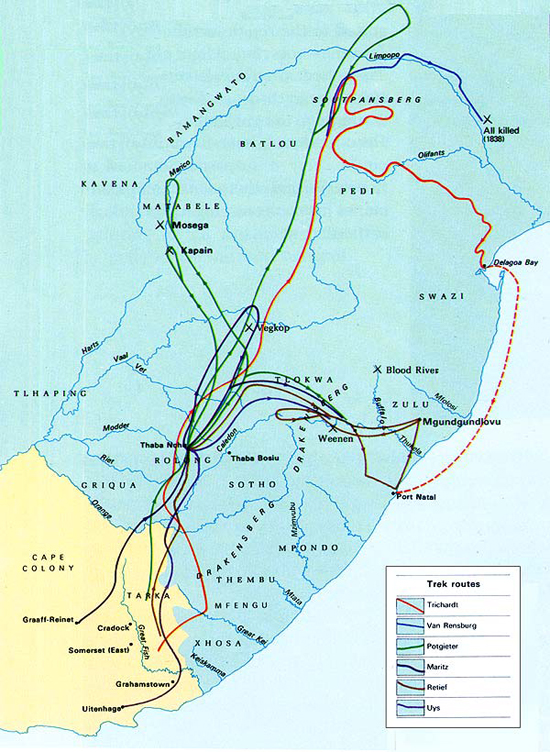
The trekkers' first major confrontation was with Mzilikazi, founder and king of the Ndebele. After leaving the Cape, the trekkers made their first base near Thaba Nchu, the great place of Moroka, the Rolong chief. In 1836 the Ndebele were in the path of a trekker expedition heading northwards and led by Andries Hendrik Potgieter. The Ndebele were attacked by a Boer commando led by Potgieter, but Mzilikazi retaliated and the Boers retreated to their main laager at Vegkop. There in October, in a short and fierce battle which lasted half an hour, 40 trekkers succeeded in beating off an attack by 6000 Ndebele warriors. Both sides suffered heavy losses - 430 Ndebele were killed, and the trekkers lost thousands of sheep and cattle as well as their trek oxen. But a few days later, Moroka and the missionary Archbell rescued them with food and oxen.
Gert Maritz and his party joined these trekkers in Transorangia (later the Orange Free State) and in January 1837, with the help of a small force of Griqua, Kora, Rolong and Tlokwa, they captured Mzilikazi 's stronghold at Mosega and drove the Ndebele further north. The trekkers then concluded treaties of friendship with Moroka and Sekonyela (chief of the Tlokwa).
When Piet Retief and his followers split away and moved eastwards to Natal, both Potgieter and Piet Uys remained determined to break the Ndebele. At the end of 1837, 135 trekkers besieged Mzilikazi 's forces in the Marico valley, and Mzilikazi fled across the Limpopo River to present-day Zimbabwe. He died there, to be succeeded by Lobengula, who led a rather precarious life in the area until he was eventually defeated by the forces of the British South Africa Company in the 1890s.
Meanwhile, Retief and his followers continued marching towards Port Natal (later Durban). After Retief's fateful encounter with Dingane, chief of the Zulu, and the ensuing Battle of Blood River, the trekkers declared the short-lived Republic of Natalia (1838). They formed a simple system of goveming, with Pretorius as President, assisted by a volksraad (people's assembly) of 24 members, and local government officials based on the traditional landdrost and heemraden system. In 1841, an adjunct council was established at Potchefstroom, with Potgieter as Chief-Commandant. The trekkers believed that at last they had found a place in the sun....
But the British would not recognise their independence. In December 1838, the Governor, Sir George Napier, a determined military man who had not allowed the loss of his right arm in battle to ruin his career, sent his military secretary, Major Samuel Charters, to occupy Port Natal, which effectively controlled Voortrekker use of the harbour. Three years later, when the Natal Volksraad resolved to drive all Africans not working for the whites southwards beyond the Mtamvuna River (later the border between Natal and the Transkei), Napier again intervened. He was concerned that this would threaten the eastern frontier of the Cape, and so instructed Captain Thomas Charlton Smith to march to Port Natal with 250 men. Smith, who had joined the Royal Navy at the age of nine and was a veteran of the Battle of Waterloo, tried to negotiate with Pretorius, but to no avail.
On the moonlit night of 23 May 1842, Smith attacked the Boer camp at Congella but Pretorius, who had been alerted, fought back. The trekkers proceeded to besiege the British camp. One of their number, Dick King. who became known as the 'saviour of Natal', evaded the siege and rode some 1000 kilometres on horseback to seek reinforcements in Grahamstown. In June a British relief force under Lieutenant-Colonel Abraham Cloete arrived on the scene and Boer resistance was crushed. On 15 July the volksraad at Pietermaritzburg signed the conditions of submission.
Although most trekkers had travelled into Natal or into the far north with the main expeditions, some had remained on the fertile land above the junction of the Caledon and Orange rivers, and gradually began to move north-eastward.
The trekkers' pioneer in this area was Jan de Winnaar, who settled in the Matlakeng area in May-June 1838. As more farmers were moving into the area they tried to colonise the land between the two rivers, even north of the Caledon, claiming that it had been abandoned by the Sotho people. But although some of the independent communities who had lived there had been scattered, others remained in the kloofs and on the hillsides. Moshoeshoe, paramount chief of the Sotho, when hearing of the trekker settlement above the junction, stated that '... the ground on which they were belonged to me, but I had no objections to their flocks grazing there until such time as they were able to proceed further; on condition, however, that they remained in peace with my people and recognised my authority'.
The trekkers proceeded to build huts of clay (instead of reed), and began planting their own food crops (no longer trading with the Sotho). This indicated their resolve to settle down permanently. A French missionary, Eugene Casalis, later remarked that the trekkers had humbly asked for temporary rights while they were still few in number, but that when they felt 'strong enough to throw off the mask' they went back on their initial intention.
In October 1842 Jan Mocke, a fiery republican, and his followers erected a beacon at Alleman's drift on the banks of the Orange River and proclaimed a republic. Officials were appointed to preside over the whole area between the Caledon and Vaal rivers. Riding back from the drift, they informed Chief Lephoi, an independent chief at Bethulie, that the land was now Boer property and that he and his people were subject to Boer laws. They further decided that the crops which had been sown for the season would be reaped by the Boers, and they even uprooted one of the peach trees in the garden of a mission station as indication of their ownership. In the north-east, they began to drive Moshoeshoe's people away from the springs, their only source of water. Moshoeshoe appealed for protection to the Queen of England, but he soon discovered that he would have to organise his own resistance.
Land seizure and dispossession were also prevalent in the eastern Transvaal where Potgieter had founded the towns of Andries-Ohrigstad in 1845 and Soutpansberg (which was later renamed Schoemansdal) in 1848. A power struggle erupted between Potgieter and Pretorius, who had arrived with a new trekker party from Natal and seemed to have a better understanding of the political dynamics of southern Africa. Potgieter, still anxious to legitimise his settlement, concluded a vredenstraktaat (peace treaty) in 1845 with Sekwati, chief of the Pedi, who he claimed had ceded all rights to an undefined stretch of land. The precise terms of the treaty are unknown, but it seems certain that Sekwati never actually sold land to the Boers.
Often in order to ensure their own safety, chiefs would sign arbitrary treaties giving away sections of land to which they in fact had no right. Such was the case with Mswati, chief of the Swazi, who, intent on seeking support against the Zulu, in July 1846 granted all the land bounded by the Oliphants, Crocodile and Elands rivers to the Boers. This angered the Pedi, who pointed out that the land had not even been his to hand over.
There was no uniform legal system or concept of ownership to which all parties interested in the land subscribed. Private land ownership did not exist in these African societies, and for the most part the land which chiefs ceded to the Boers was communally owned. Any document 'signed' by the chiefs, and its implications, could not have been fully understood by them. Misunderstandings worked in the favour of the Boers.
Large tracts of land were purchased for next to nothing. For example, the northern half of Transorangia went to Andries Potgieter in early 1836 for a few cattle and a promise to protect the Taung chief, Makwana, from the Ndebele. The area between the Vet and Vaal rivers extended about 60 000 square kilometres. This means that Potgieter got 2000 square kilometres per head of livestock! Also the 'right of conquest' was extended over areas much larger than those that chiefs actually had authority over. After Mzilikazi 's flight north in November 1837, the trekkers immediately took over all the land between the Vet and Limpopo rivers - although Mzilikazi's area of control covered only the western Transvaal.
But it was only after the Sand River Convention (1852) and the Bloemfontein Convention (1854) that independent Boer republics were formally established north of the Vaal and Orange rivers respectively.


