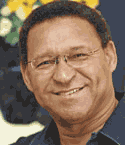
Allan Aubury Boesak was born at Kakamas, Northern Cape, one of eight children. His father, a schoolteacher, died when Boesak was six years old. He was raised in Somerset West. As a child he worked as a labourer to help support his family. At fourteen, he became a sexton in the separate Coloured congregation of the local Nederduitse Gereformeerde Sending-Kerk (Dutch Reformed Church).By his late teens, Boesak had expressed increasing dissatisfaction with South Africa's apartheid, a strict form of segregation, especially after the government cited racial reasons to force his family to relocate.
After graduating from Bellville Theological Seminary, in 1967,he worked as a pastor in Paarl.Boesak was ordained at age 23. He married Dorothy Rose Martin in 1969 with whom he had four children. From 1970 to 1976, he studied at theological institutions in Kampen, Holland, and New York, gaining a PhD, in ethics,in 1975. On his return to South Africa in 1976, to his parish in Cape Town's Bellville South. Boesak increased his political activities through the church. His appeal quickly spread beyond the 2.8 million "Coloured people" to both black and white opponents of apartheid.
In 1981, various black Reformed churches founded ABRECSA (the Alliance of Black Reformed Christians in Southern Africa) and elected Boesak as chairman. The alliance's statement reflected many of Boesak's beliefs. It rejected the use of religion as a cultural or racist ideology (as employed by the white Dutch Reformed Church according to the alliance). The alliance's statement furthermore rejected divorcing religion from political activism. Boesak and the alliance believed that the struggle against apartheid represented a struggle for Christianity's integrity.
Boesak first received international attention in August of 1982 when the World Alliance of Reformed Churches (WARC) met in Canada. The WARC represented about 150 churches of Calvinist tradition in 76 countries with a combined membership of over 50 million. Boesak introduced a motion requesting that WARC declare apartheid a heresy contrary to both the Gospel and the Reformed tradition. The alliance adopted the Declaration on Racism, suspended South Africa's white Dutch Reformed Church, and unanimously elected Boesak president of the alliance. His new position made him spiritual leader to over 50 million Christians. This base of international support subsequently protected him against some forms of governmental repression. He held the post until 1989.
In January 1983, Boesak's call for a united front resulted in the formation of the United Democratic Front (UDF), an umbrella organisation that swiftly became the main anti-apartheid group in South Africa.
Following Boesak's suggestion, a steering committee established the UDF. In August 1983, before some 20,000 supporters, Boesak helped launch the UDF at Mitchells Plain outside of Cape Town. Boesak was elected as patron. By early 1986, the UDF, an umbrella organization for some 700 organizations representing about two million white and black South Africans, was the largest and most powerful legal opposition force in South Africa. Its membership and especially its goals approximated those of the then-banned African National Congress (ANC).
Dr Boesak provided the first signature to the Front's `million signature' petition against the South African constitution of 1983, which introduced the Tricameral Parliament that provided separate chambers of Parliament with limited powers for Coloured and Indian minorities, but excluded the 24 million black majority. He described Coloureds and Indians who went along with the Tricameral Parliament as `the junior partners in apartheid'.
Denouncing South Africa's Whites as the `spiritual children of Adolf Hitler', he led demonstrations and preached at funerals for anti-apartheid riot victims. He was a conspicuous advocate of the boycott in 1984 of the Coloured and Indian Parliamentary elections, but after the South African government declared a state of emergency, he was one of only a few prominent anti-apartheid leaders who were not restricted. He was also not charged in the 1985 Pietermaritzburg treason proceedings, possibly because he did not hold an executive position in the UDF.
Boesak increasingly appeared at the forefront of opposition to the white government. He believed that "apartheid can never be modified," only "eradicated." While Boesak preferred nonviolent protest, he questioned its success in South Africa: "One cannot talk about violence if one is unable to do anything about it. In such a situation, nonviolence becomes an oppressive ideology. It aids and abets the oppressor."
In 1984, he was accused of having an extramarital affair with an employee of the South African Council of Churches. Boesak admitted to having a relationship, but later explained that it was a `unique and special relationship'. This was a double scandal in a country where apartheid laws banned inter-racial sex. These laws were repealed in 1985. Boesak was suspended from his church duties but reinstated a month later after the Ring van Gestig – the regional authority of his church – exonerated him. The Star [a newspaper] accused the Security Police of being behind a smear campaign against Boesak. Nevertheless, Boesak's voice was heard less at mass gatherings after details of his affair was made public. He resigned as president of the World Alliance of Reformed Churches and divorced his wife Dorothy in 1991 to marry journalist and television personality Elna Botha. In 1984, Yale University in America awarded him an honorary Doctor of Divinity degree in theological studies.
In 1985, Boesak organised a march on Pollsmoor Prison in Cape Town to demand the release of Nelson Mandela, who had been transferred there from Robben Island. Boesak was detained and interrogated and his passport was confiscated. Subversion charges were however dropped, but the security police kept him under constant surveillance in the hope of finding a reason to discredit him.
In October 1986, in his position as Moderator of the Nederduitse Gereformeerde Sendingkerk and president of the World Alliance of Reformed Churches, Boesak pleaded for unity at the NG Kerk Synod. He argued that `there could never be reunification on the basis of separateness'. He said it was a matter of urgency that they listened to his appeal for unity based on rejection of apartheid.
On the morning of 15 November 1988, an ex-policeman, Barend Hendrik Strydom, drove past Church Square in Pretoria looking for a black person to kill. Outside the Palace of Justice where ambassadors and church leaders, television crews and celebrities, lawyers and family members were gathering to hear the judge deliver his verdict on those accused in the Delmas [Treason] Trial, Church Square was full of policemen. Two blocks from the court, Strydom parked, then, laughing, he shot an eighty-eight year old woman, an Indian storekeeper, and another woman waiting in a hospital bus. He shot twenty-two people. Seven died.
At first, most people thought the rampage had nothing to do with the Delmas Trial, but at Strydoms trial, another picture emerged. Strydom had come to Church Square looking for friends of the Delmas defendants. He hoped to kill Allan Boesak, President of the World Alliance of Reformed Churches and a patron of the United Democratic Front, the organization the trial was designed to crush.
On 13 September 1989, Boesak, Archbishop Desmond Tutu, and Gordon Oliver, the mayor of Cape Town led 30,000 marchers in protest after 23 people had been killed by police in protests against the exclusion of blacks, colouredsand Indians from parliamentary elections earlier in the month. The police were determined to stop the peace march, but Mayor Oliver convinced the national government to allow the protest, the first ever-official permission granted in the thirty-year liberation struggle.
In 1990, he resigned from his ecumenical offices after allegations of an extra-marital relationship and became active in politics on a full-time basis. The Reverend Nic Appolis succeeded him as moderator of the NG Sendingkerk. Two years later in 1992, Boesak was appointed to the New Independent Commission on International Co-operation. In 1994, Boesak became president of the Association of Christian Students in South Africa, and founded the Foundation for Peace and Justice in Belleville. He also served as the head of economic affairs for the ANC in the Western Cape.
Boesak then moved from the pulpit to politics fulltime. He was elected as chairman of the ANC in the Western Cape. After the first democratic elections, Boesak became part of the new ANC led government. He was scheduled to become South Africa's ambassador to the United Nations in Geneva. However, two weeks before he was due to leave for Geneva, a corruption and fraud investigation was brought against him. He was accused of intercepting donations from Scandinavia intended for uplifting the poor. A Danish aid agency, Dan Church Aid, started the investigation into funds it had given Boesak's Foundation for Peace and Justice Agency in 1985. The agency claimed that they could not account for a large part of a $1 million donation. A Johannesburg law firm which carried out the investigation on behalf of Dan Church made public a report claiming that the Foundation for Peace and Justice had `diverted' $500,000 and that Boesak has `substantially enriched himself' with some of the funds. Later, questions were also raised about a donation of $50,000 Coca-Cola had made for a community project in the Cape and the alleged misuse of money from a children's trust started by a donation from US singer Paul Simon after his 1992 tour of South Africa.
In 1997 Boesak faced trial in Cape Town, charged with misappropriating more than half a million dollars in donations from international church and aid groups. Boesak continued to get support from members of the government who believed the allegations to be false. In March 1999, Boesak was convicted on three counts of theft and one of fraud and was sentenced to six years in prison. After serving only a year in Pollsmoor Prison in Cape Town, Boesak was granted a presidential pardon and released on 22 May 2001.
At its general synod of the Uniting Reformed Church in Southern Africa, on 2 October 2008, Boesak presented a lengthy report on homosexual to the members present. Boesak was the chair of a synodical committee appointed to clarify the theological and moral status of homosexual unions and to clarify the ordination of practicing homosexuals into ministry.Heinsisted that the church’s Belhar Confession demands the defence of the full rights of gay members. When the synod rejected this, he announced his intention to resign from all church offices and left the synod floor with his wife.
In 2008, Boesak joined the Congress of the People (COPE), the political party started by Mbhazima Shilowa and Mosiuoa ‘Terror’ Lekota, in theaftermath of former President Thabo Mbeki’s removal from then highest office of the land by the ANC. He resigned from the party in November 2009. That same year, the launch of Boesak’s autobiography was “postponed indefinitely” after former finance minister Trevor Manuel objected to claims that he and his family received “struggle accounting” money. Manuel sent Boesak a lawyer’s letter over claims made in the book, which was due to be launched. Manuel’s spokesperson said Manuel had been advised that the publisher, Joho, had put the printing of the book on hold. Boesak was also due to speak at the Cape Town Book Fair but was dropped from the programme. In the book, Boesak, alleges that the ANC “knows where the money went”
In an address to the staff of the U.S. Consulate in Cape Town during a special event honouring Black History Month on 25 February 2011, Boesak linked the United States Civil Rights Movement and the struggle against apartheid. According to Boesak in 1966, he heard a clandestine recording of a speech by Dr. Martin Luther King, Jr. in which King recounted the parable of Rip Van Winkle, who slept through the American Revolution. The speech crystallized in Boesak a determination not to sleep through the social change that he was convinced would come to South Africa. Instead, he devoted the next two decades of his life to a courageous fight against the apartheid system.
Publications by Allan Boesak.
A Farewell to Innocence (1976)
Coming in Out of the Wilderness (1976)
Black and Reformed (1984)
The Finger of God (1982) (a collection of sermons dealing with such matters as the ministry in a Black situation, the death of Steve Biko and the Information Scandal.)


