
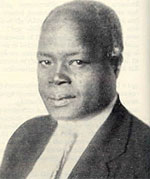
Josiah Tshangana Gumede was born on 9th October 1867 in Healdtown Village, Fort Beaufort in the Eastern Cape. His father, John Gumede, and his mother were Christians and, according to their grandson Archie Gumede, were only the third Ngwane couple to be married into the Christian (Wesleyan) faith. There is very little known information about Josiah’s mother and his early childhood. Josiah had a younger brother, William, and three or more sisters, two of them named Mina and Joyce. It seems they were all given Christian first names, while Josiah was given his father’s middle-name, Tshangana, in honour of their Zulu ancestry. Josiah Gumede’s ancestry can be traced back to Chief Khondlo.
Khondlo’s son Phakathwayo succeeded him, followed by Vezi, Makhunga and John Tshangana, Josiah’s father. Since not much is known of Josiah’s childhood years, he probably started his elementary schooling at the Healdtown Wesleyan Mission station at Fort Beaufort, where he was exposed to the British education system. The Wesleyan missionaries were leading the way in fighting for gender equality, with policies in place to educate and liberate African females. One of Josiah’s fellow-pupils was Charlotte Makanya, who later became the President of the ANC Womens Congress. Both Josiah and Charlotte came from Fort Beaufort and rose to greater heights as leaders in the ANC and in the politics that shaped South Africa.He was the fouth president of the ANC in the late 1920s.
On completion of his schooling, Gumede went on to attend what was called the ‘Kaffir Institute’ in Grahamstown, in either 1882 or 1883. During this time, Josiah’s parents and sisters had moved to Queenstown. Run by the Anglican Church, the institute was a sister school to the white St Andrew’s College. Josiah wanted to qualify as a teacher, and gaining admission to the institution was not easy: candidates had to be baptised, literate (in English as well as their native language), and older than 13 years of age. The institution attracted intellectually-inclined Black youth, many of whom later became prominent ANC members, among them Thomas Mapikela and Samuel Masabalala. The curriculum at the institution was was dominated by religious education, although industrial training – such as carpentry, wagon-making, blacksmithing, tailoring, shoemaking and printing – also featured prominently. Gumede’s intellectual development grew at the institute, as did his political consciousness.
Gumede began teaching at Somerset East in the Eastern Cape, where African interest in formal education was growing. He soon took up a new teaching post in Natal while his parents remained at Queenstown, and his interests turned to politics in Zululand. Together with another Wesleyan convert, Martin Luthuli, whom Gumede befriended, the pair acted as indunas (advisors) for the young Dinizulu. While Luthuli was fleeing from creditors in Durban and thus looking for sanctuary, it is not clear why Gumede opted to become involved in the ‘tumultuous almost no-win politics of a ravaged post-civil-war Zululand’. It is likely that Gumede was committed to the cause of the Zulu royal house, and that he was somewhat ambitious. Dinizulu was heir to the Zulu kingdom, and Luthuli and Gumede must have taken pride in their prestigious appointments.
Zululand was undergoing a period of historical transition. Following the death of Cetshwayo in 1883, the British High Commissioner in South Africa, Garnet Wolseley, divided Zululand into 13 independent chieftainships, each ruled by chiefs he appointed. Wolseley’s chiefs were perceived by many to have little legitimacy, causing tremendous turmoil. A period of civil wars proved disastrous for the political status of the Zulu royal family and the idea of Zulu national unity. Supporters of the Zulu royal house, the Usuthu, were dealt their heaviest blow by the appointment of two disaffected chiefs of royal lineage, Hamu and Zibhebhu, to rule as chiefs over Zululand’s northern regions. Hamu defected with his followers to the British side during the Anglo-Zulu war. His district included the personal homestead of the Buthelezi leader Mnyamana, who had been Cetshwayo’s principal adviser.To the east of Hamu, Zibhebhu was awarded a district that included the core of the Usuthu, including Cetshwayo’s son Dinizulu. In May 1884 Dinizulu, with the help of the Transvaal Boers, drove Zibhebhu out of his district.
Having assisted Dinizulu in defeating Zibhebhu in June 1884, the Boers claimed nearly 3 million acres of land in the upper belt of Zululand, stretching to the natural harbour of St. Lucia Bay. This was an exorbitant demand on Dinizulu’s land resources. More than 800 Boers were demanding compensation where only about 100 had assisted in the actual fight. Gumede with other Usuthu leaders protested the Boers’ demarcation of their so-called ‘New Republic’. They appealed to the British for support but this fell on deaf ears. Dinizulu tried desperately not to lose his head kraal of Ondini (today Ulundi) to the Boers and appointed Gumede to take charge of the tough negotiations with the Boers.
Eventually the British intervened and annexed the territory when they realised that the Boers would have access to St Lucia and a harbour. This resulted in Gumede’s services as Dinizulu’s induna coming to a close. However, Dinizulu and Gumede’s friendship would last until the former’s death in 1913. Gumede’s involvement in Zululand politics undoubtedly refined his political philosophy. His entry into Zululand politics at times endangered Gumede’s life as he gained firsthand experience of the reality of the Whites’ coercion and dispossession of the Zulu’s land. He experienced the frustrations and difficulties which confronted the Zulu royal house after the Boer occupation of nearly five-sixths of the Zulu territory. The experience instilled a sense of bitterness towards the Boers, but he also realised how little the British cared about the disintegration of the Zulu polity. Indeed, Britain’s unwillingness to intervene on behalf of the Zulus confirmed their determination to bring an end to the Zulu monarchy. Consequently, Gumede never approved of the British annexation of Zululand, claiming that it had opened up the territory to further White settlement. History has shown that Gumede’s fears were well-founded. The 1890s saw a marked increase in the pressure to open Zululand to White settlement, despite the continued protests and resistance of Zulu spokespersons such as Harriette Colenso and Gumede.
On his return to the Bergville/Klip River Division, Gumede was warmly received by his chief Ncwadi of the Ngwane. Towards the end of the 1880s Gumede accepted a temporary teaching post at the Amanzimtoti Institute (Adams College). At the time of Gumede’s appointment, the college had built up a good reputation with three teachers of high calibre: John Dube, Albert Luthuliand Mavuma Nembula. An event of significane for Gumede was the visit to Natal of a Black American troupe of Virginia Jubilee Singers in 1890. The group also visited Adams College. Inspired by the group’s performances and international success, Gumede, together with Saul Msane and a group of 12 singers, formed the ‘Zulu Choir’. His involvement in the choir ended Gumede’s teaching career at Adams College. The Zulu Choir became very successful locally, and they embarked on a tour of England. But this did not last as the choir split up after some disappointments. Gumede then returned to South Africa, settling in Rookdale with little, if any, finances.
On 30 June 1894, Gumede married Margareth Rachel Sithole, a teacher by profession and a devoted Wesleyan who also came from the Bergville district.In 1895, Gumede was employed by his chief Ncwadi as an induna. During this period the chief’s authority over his community was constantly being challenged by David Giles, a European magistrate. Gumede, convinced that Giles’s acts constituted a violation of the Shepstonian principles of African Administration, supported his chief. This led to a bitter struggle between Gumede and Giles.Ncwadi chose Gumede as his official spokesperson because of his formal schooling and teaching credentials and his involvement in Zulu Politics. This battle revealed his leadership skills and provided Gumede with a lesson in political and legal strategy which he would use again in the future. Some reports indicate that Gumede also spent a short period working on the gold mines on the Rand, and the Gumede family’s financial prospects appeared to improve. In 1898 and 1899, the first two of Josiah and Margareth’s five daughters, Edith Beatrice and Tabita Sarah, were born.
In 1900 Gumede joined the British military to fight in the war against the Boers. Gumede was one of the first Blacks to be recruited and trained by the Natal Intelligence Department even before the war started in October 1899. He was appointed Headmen over a group of Basotho scouts. Gumede’s hopes that the British victory in the Anglo-Boer war would result in the removal of the oppressive features of White rule in Natal, in particular the Pass Laws, was short-lived as the British failed to deliver on promises they made.At this point, Gumede, like many other missionary-educated Africans, were looking for outlets to voice their objections against oppressive new laws, resulting in the establishment of many European-style organisations. In 1888, Gumede aligned himself to the Funamalungelo (demand civil rights) Society headed by John Khumalo, but the organisation failed to develop into a strong political movement. Gumede, Martin Luthuli and other Black leaders in Natal then realised that there was an urgent need for a more effective organisation. With the assistance of Harriette Colenso, the Natal Native Congress (NNC) was officially inaugurated on 8 June 1900. With John Dube and others, Gumede was a founder member of the NNC, and for some time he served as its secretary and vice-president. The main aims of the Congress were to cultivate political awareness amongst Blacks by educating them about their rights under the prevailing system of government and laws, and most importantly, to act as a forum for airing grievances.
In 1905, Gumede took up a position as a land agent with the firm of Thackeray Allison and Albert Hime solicitors, a position he held for the next 14 years. During this time, Gumede assisted in the investigation of the land claims of two Sotho tribes, namely the Bakhulukwe and Batlokoa in the new Orange River Colony. Gumede played a significant role in their legal struggle and the drawing up of their petitions to the British government in London to regain land taken away from them before the war. Gumede supported Chiefs Lesisa, Moloi, and Lequila, and accompanied them on their deputation to England to petition the British government to support their land claim. Unfortunately, this deputation was not successful. To add to the insult, Gumede was arrested on his return home in May 1907, charged with wrongfully and unlawfully leaving the Colony of Natal without the pass or permit prescribed by one of the laws of the Colony of Natal. Gumede was found guilty and fined 10 pounds for this ‘crime’.
It was particularly apparent that Gumede saw the need to maintain Zulu culture and traditions by supporting the chiefs while at the same time understanding the political and social needs of the emerging kholwa. Many chiefs regarded Gumede as their spokesman and had a high regard for his intellectual abilities. According to Van Diemel, Gumede moved with ease between these two very different worlds. In 1907, Gumede involved himself in Iliso Lesizwe Esimnyama, an organisation formed by Wesleyan Methodist converts and chiefs from the Dundee and Newcastle areas in Natal. He served as secretary for the organisation during 1908. The aim of Iliso Lesizwe Esimnyama was to unite the Black people of Natal-Zululand and to advance their prosperity. The publication of the draft constitution of 1909 signalled to Gumede that Africans' interests were being ignored. Although the revised draft of the South Africa Act received the overwhelming approval of Whites, nearly all politically conscious Africans denounced it. Despite all the odds, Gumede was still determined to continue to press the issue that Africans' aspirations be addressed.
Throughout 1909 and 1910, the plight of the two Sotho tribes took up most of Gumede’s time. Unfortunately, following the failure of the African deputation to England in 1909, Iliso had ceased to meet on a regular basis and the organisation soon faded out of existence. In 1910, Gumede rejoined the Pietermartizburg branch of the NNC. Disappointingly, there was no working relationship between the Pietermaritzburg and Durban branches due to personal differences between Gumede and Dube, who was part of the Durban NNC branch. The two only unified when the South African Native National Congress(SANNC), the precursor of the African National Congress(ANC), was formed in 1912. Dube sought closer co-operation between the branches, realising the need for unity. In 1912 Gumede became a founder member of the SANNC (renamed the ANC in 1923) and contributed to the drafting of its 1919 constitution. He was also a member of the 1919 SANNC deputation to the Versailles Peace Conference – which was held after World War I (1914-1918) – and the British government. The deputation, however, failed to ensure a better dispensation for South African blacks.
Gumede was appointed to the newly-elected executive council and joined a deputation elected to present their grievances to the Inspector of African Schools in Pietermaritzburg on 15 April 1913. The delegates were against regulations placed on Black school learners and teachers in Natal which came into effect on 1 April 1913. These regulations placed new restrictions on the age limits of African pupils in the lower classes as well as on the employment of African teachers in the higher classes. Yet again the deputation was unable to persuade the inspector to amend the revised regulations. Even though the Native Land Act of 1913 signalled the end of any equality for Blacks in the union, Gumede remained optimistic that all was not lost. He believed the Act would strengthen the cause of the two Sotho chiefs to regain their land. Thus, when the call came for a deputation to be sent to England to protest the Bill and appeal for help against it, Gumede strongly opposed the move, believing that it would antagonise the new Parliament and alienate support from the missionaries and more liberal whites. Not surprisingly, the deputation was a failure. Gumede also failed in his attempts to secure the land of the Sotho tribes, deepening his antagonism towards the unsympathetic Union government on the issue of Black land claims.
The Native Administrative Bill of 1917 further deepened this antagonism. Taking a strong stand against it, Gumede understood that the Bill would enhance the powers of the Native Affairs Department. The victory of the allied forces during World War I brought about renewed hopes in the SANNC that an appeal to the British government would bring about the removal of the colour bar franchise. Gumede supported a proposed deputation to England to petition the Governor General to take their grievances directly to the king. Gumede’s change of heart regarding this deputation – compared to the 1914 deputation – came because he was convinced there was no way of securing any sympathy from the Union government for the plight of Black people. Before his departure, Gumede was summoned to testify in the trial of David Jones and H Greene, Bolsheviks charged with inciting the public by distributing a pamphlet in favour of Bolshevism. During his testimony, it was clear that Gumede held strong anti-communist sentiments.
Gumede’s visit to England together with Sol Plaatje was full of disappointments. The Colonial office in London received Gumede and Plaatje with much antagonism. Gumede addressed several audiences in England, including many of London’s Black organisations, in order to solicit support for the cause. Gumede and Plaatje presented their grievances to members of the House of Commons in July 1919 in the hope that they would be addressed at their next meeting The pair also addressed various other organisations sympathetic to their cause. One such organisation was the League of Universal Brotherhood led by Dr Charles Garnett. Much of this lobbying turned out to be in vain as the colonial office was sticking to its policy of non-interference in colonial affairs. Gumede went further by addressing a letter to the Archbishop of Canterbury for a meeting to address their grievances. This meeting also turned out to be disappointing as no concrete support was forthcoming. During this visit, Gumede was extremely disappointed to be present at a meeting of The International Brotherhood Congress, held from 13 to 17 September 1919, where Lloyd George praised the ‘noble character’ of General Louis Botha. These views were in direct contrast to those held by the SANNC delegates. Throughout his stay in England, Gumede tried to influence public opinion by means of meetings and newspaper coverage. Gumede also kept his constituency in Natal informed of all the deliberations abroad.
Towards the end of November 1919, the Gumede and Plaatje were finally able to secure a meeting with Prime Minister Lloyd George. An extensive account of African disabilities in South Africa was presented to him but the Prime Minister only promised to communicate with General Smuts to ascertain what could be done to address the grievances of the Black population of South Africa. George was still very reluctant to interfere in the affairs of the colony. Gumede made another appeal to the Prime Minister by way of a manifesto asking for the franchise for the Black people and for the reinstatement of land to the tribes and chiefs who had lost land to the Boers. But still nothing came of his appeals. Ironically, Gumede and Plaatje managed to secure the allegiance of two socialist organisations, the Independent Labour Party and the Union of Democratic Control. The pair travelled throughout Scotland trying to rally support and even though most of their meetings were held under the auspices of the two socialist organisations, Gumede remained loyal to the ideas of liberalism.
The next year went by with Gumede still in England, addressing meetings and seeking support for the cause of the SANNC. Gumede felt that returning home would be to accept the failure of his mission. In January 1921, Gumede had the opportunity to meet with Bankole Bright and other delegates from the National Congress of British West Africa (NCBWA). The aim of this delegation was to secure a greater share in constitutional government and administration for the African people in the British West African Colonies. Gumede realised that this delegation had a lot in common with the South African cause. Gumede and Plaatje returned to South Africa disillusioned over the lack of official British intervention in South Africa. Throughout the 1920s members of the Natal Natives' Congress found themselves in conflict with each other. Dube and Gumede disagreed over the former’s attempts to keep the congress as independent as possible from the national ANC. Instead Gumede founded the Natal African Congress, which officially affiliated with the ANC. In 1921 Gumede was appointed as full-time general organiser of the SANNC, with the task of touring the country in search of financial support.
Gumede continued to oppose John Dube and his two sympathisers in the NNC, W Ndlovu and William Bhulose, and the trio were not re-elected to the executive at the annual meeting in April 1924. Gumede was elected as the new president of the NCC, but he was excluded from the annual Native Conference in Pretoria on 27 October 1924. Instead, Dube was invited to Pretoria by the government. Following the failure of the deputation to the British government in 1919, Africans were forced to concede to the Natives (Urban Areas) Act of 1923, which further curtailed possession of land by Blacks. From 1924 Gumede openly lamented the increase in segregatory measures, and he became more militant as he questioned the Pact government about its racial and class legislation, and its limiting of education and employment opportunities for the Blacks. Gumede, accompanied by James la Gumaof the Communist Party of South Africa(CPSA), was elected to represent the ANC at the first international conference of the League Against Imperialism in Brussels, Belgium. The pair departed from Johannesburg on 12 January 1927. From Brussels he travelled to the Soviet Union (USSR). Gumede wanted to use this opportunity to address the plight of the Africans, but also to gain first-hand knowledge of Communism in Russia. At the Brussels Conference, Gumede met Communists, left-wing Socialists and radical nationalists, enlarging his political perspective.
After the Brussels Conference, Gumede was invited to Berlin, Germany, by the German Communist Party. On arrival there on 17 February 1927, Gumede was warmly greeted by some 10 000 German Communists. He attended the World congress of the “Friends of the Soviet Union” from 10 to 12 November 1927, in Moscow. The visit coincided with the 10-year celebrations of the Bolshevik revolution. Gumede was becoming more convinced and attracted to communism, and developed a more radical critique of British imperialism. He realised that communism could play a vital role in liberating Africa, and his new ideas helped give birth to the alliance between the ANC and CPSA. The highlight of his visit was his meeting with Joseph Stalin. On his return to South Africa on 17 February 1928, Gumede was given a hero’s welcome in Cape Town at a combined ANC-CPSA mass meeting held in Waterkant Street. He affirmed their alliance, as both parties had at the top of their agenda ‘African liberation’. Said Gumede: ‘When I left South Africa I was under the impression that in Russia people were not safe. But what I saw there surprised me. I saw a new Jerusalem. I found people happy, contented and prosperous. The Government of Russia is the Government of the working classes. Today in Russia the land belongs to the people.’
Referring to the position of the Church in Russia, Gumede repudiated claims common in South Africa to the effect that the Russian people were opposed to all forms of religion. Gumede praised the USSR as a country where racism was negligible, if at all existent. Contrary to his previous anti-Bolshevist stance, he now pronounced that the white communists in South Africa were the only group who fully supported Blacks in their struggle for equal rights. Gumede began to support an alliance with communists. Van Diemel puts forth the argument that Gumede’s initial hostility toward communism stemmed from his perception that it threatened Zulu traditions and the status of African property owners, of which he was one. His disappointment with Britain eventually disposed him to reach out to other potential allies, including communists. Finally, having once supported legal means of protest, Gumede began to push for mass action. He was ahead of his time in many ways, both because he realised the futility of constitutional protest and because he recognised the need to build a united front in the struggle against South Africa's system of racial segregation.
The CPSA increasingly turned its attention to Gumede – and to the ANC – after the communists were expelled from the Industrial and Commercial Workers Union(ICU). Besides his pro-communist inclination, Gumede’s support for Afro-American leader Marcus Garvey – who argued for racial separation and the emigration of Afro-Americans to Africa – was apparent in his speeches. It was probably under Gumede’s influence that a resolution to request the United States of America to release Marcus Garvey – who was imprisoned on charges of fraud – was passed during the July 1927 conference of the ANC. The ANC national executive and the Convention of Bantu Chiefs, held under the auspices of the ANC in April 1927, received these pro-communist pronouncements with little enthusiasm. Gumede, however, succeeded in having a proposal which condemned the ties between the CPSA and the ANC withdrawn. Despite ANC criticism of the pro-communist tendencies that often surfaced in Gumede’s public rhetoric at that stage, he was elected as president-general of the ANC during its annual congress in July 1927, succeeding Zaccheus Richard Mahabane.
In 1929 Gumede was elected as chairperson of the South African branch of the League Against Imperialism when it was founded by the CPSA. At the end of that year, when the CPSA launched the League of African Rights, he also became its president. Gumede’s three-year term as president-general of the ANC was characterised by disputes and dissension – although it did introduce new strains of radical thought into the ANC. It was an unhappy chapter in the history of the organisation. Gumede was accused of being more concerned with communism than the affairs of the Congress and of not improving the already weak financial position of the organisation, rendering him an ineffective administrator. Moreover, antipathy towards Gumede’s association with communism and his alleged neglect in circulating information increased sharply. Objections were also made against the ANC’s affiliation to the Communist-backed League Against Imperialism. This shattered Gumede’s dream of creating a closer union between the two parties.
Matters came to a head when the anti-communist faction of the national executive committee of the ANC took a majority decision to resign en bloc and Thomas Mapikela took over as acting president-general. At the annual ANC conference in April 1930, Gumede lost his position as president general and was succeeded by Pixley ka Seme. Gumede lost his Presidency largely because his alliance with communists had generated so much opposition within the Congress. The move ended his role as a prominent figure in South African politics, but it did not end Gumede’s passion for politics – he continued as editor of the ANC mouthpiece Abantu Batho, through which he circulated Garvey’s political ideas. Gumede also continued to participate in the activities of the Black trade unions, and in May 1930 he was elected as a delegate to the International Conference of Negro Workers, which was to take place in July 1930 in London – but he was refused a passport to travel to England. He continued to advocate defiance of the Pass Laws and addressed several meetings held by the ICU.
In March 1931, Gumede was called to give evidence before the Native Economic Commission on the condition of Africans in the country. His evidence spurred him on to become more involved with African politics in Natal. Gumede returned to Pietermaritzburg in 1932 and attempted to introduce a more militant approach in the NNC. In June 1932, it was decided that all future NNC meetings would be held under the auspices of the Natal African Congress (NAC), thereby aligning itself closer to the ANC. Gumede was appointed chairman and Dube was appointed President. At the next meeting, Gumede was elected president of the NAC. For a short period in 1933, Gumede became involved with the ICU but the relationship soon faded.
Gumede continued his political agitation when Barry Hertzog introduced his notorious African Bills in 1935. In his letters to Black newspapers, Gumede called upon Black people to reject the bills. He attended the All African Convention(AAC) in December 1935, where the call was made to reject the Bills. However, the AAC failed to halt the Bills and during its second congress, members decided to support the Native Representative Council (NRC) in the hope of improving the situation from within. Opposition to the Bills breathed new life into the ANC. Gumede, although nominated for a seat on the NRC, failed to secure a seat. This by no means signalled the end of the road for Gumede as he continued to assist chiefs in putting their land claims before the Native Affairs Commission. During 1942, Gumede again tried to secure a nomination to the NRC, but failed. Accepting defeat gracefully, Gumede continued to assist Black workers who were unfairly dismissed from their jobs. The highlight of Gumede’s career came in December 1943 when he was honoured as Life President of the ANC at the annual meeting of the ANC in Bloemfontein. At this very same meeting, the historic resolution was passed for the formation of the ANC Youth League. Resolutions passed in the October 1946 Congress calling for more militant methods of protest signalled the end to the peaceful and constitutional methods embarked upon thus far. For Gumede this signalled the long-awaited militant path that he hoped the Congress would follow. Fortunately, he lived to see these resolutions passed just before his death on 6 November 1946. Throughout his political career, Gumede spoke out against the intolerable policies against Black people. Described as a man seldom angered or harsh in judgement, who accepted criticism as the expression of opinion that people were entitled to, he believed in the power of the pen. His passion to serve his people surpassed his need to gain material wealth. The legacy of JT Gumede’s willingness to serve his people will remain an important part of South African history.


