
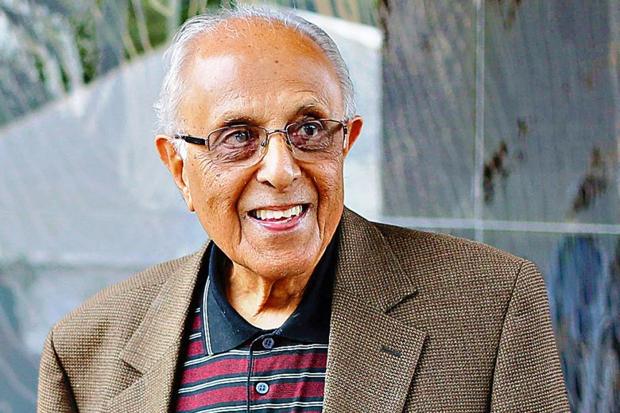
Ahmed Mohamed "Kathy" Kathrada was born on 21 August 1929, to Indian immigrant parents in Schweizer Reneke, a small town in Western Transvaal [now North West Province]. While he attended Johannesburg Indian High School, he came under the influence of Dr. Yusuf Dadoo and the Cachalia brothers, who were leaders of the freedom movement in the Transvaal. Kathrada’s political work began in 1941, at the early age of 12 when he joined the Young Communist League of South Africa, distributing leaflets at street corners for the League. During World War II, he was involved in the anti-war campaign of the Non-European United Front.
In the 1940s, Kathrada first met African National Congress (ANC) leaders, Walter Sisulu, Nelson Mandela, I.C. Meer and J.N. Singh. At the age of 17, he left school to work full-time in the offices of the Transvaal Passive Resistance Council. In 1946, the South African Indian Congress (SAIC) launched the Passive Resistance Movement against the Asiatic Land Tenure and Indian Representation Act, commonly referred to as the "Ghetto Act". The Act sought to give Indians limited political representation and defined the areas where Indians could live, trade and own land. The Act was vehemently opposed. Subsequently, Kathrada participated in the Passive Resistance Campaign of the South African Indian Congress.
Kathrada was one of the 2 000 volunteers imprisoned in that campaign and served a month in a Durban jail along with other ardent resisters such as Dr Monty Naicker, Dr. Yusuf Dadoo, Dr Goonam, George Singh, Mrs Cissie Gool, M.D. Naidoo and others. This was his first jail sentence for civil disobedience.Kathrada was a founding member of the Transvaal Indian Volunteer Corps and that of its successor, the Transvaal Indian Youth Congress. In 1951, he enrolled as a student at the University of the Witwatersrand (Wits) but later abandoned his studies to devote himself full-time to political activism. As chairperson of the Transvaal Indian Youth Congress, Kathrada attended the World Youth Festival in Berlin in 1951 and was elected leader of the large multi-racial South African delegation. He remained overseas to attend a Congress of the International Union Students in Warsaw, Poland.It was during this period that he visited the concentration camps at Auschwitz, which impressed upon him the urgent need to eradicate racism in South Africa. Thereafter, he finally travelled to Budapest and worked at the headquarters of the World Federation of Democratic Youth for nine months.
 Ahmed Kathrada, shot taken by the police during the Liliesleaf raid. Source: South African National Archives
As the alliance between the African and Indian Congresses developed, Kathrada came into closer contact with Mandela, Sisulu, J.B. Marks and other African leaders. The signing of the Dadoo-Naicker-Xuma Pact in 1947 strengthened the Alliance, which comprised the ANC and the SAIC. Kathrada worked tirelessly to promote joint action as a leader of the Youth Action Committee, co-ordinating the youth wings of the African, Indian and other Congresses. In 1952, he helped organise the 'Campaign of Defiance against Unjust laws', launched jointly by the ANC and the SAIC. The Defiance Campaign targeted six unjust Apartheid laws, amongst them the Pass Laws, Stock Limitation Regulations, the Group Areas Act, the Separate Representation of Voters Act, the Suppression of Communism Act and the Bantu Authorities Act. The Government was called upon to repeal these laws by 29 February 1952. Failing this, the ANC and the SAIC were to launch a joint campaign of Defiance.
In 1953, Kathrada was elected to the executive of the World Federation of Democratic Youth in absentia, a post he was unable to take up due to restrictions placed on him by the authorities.Kathrada was among a group of twenty officials who were charged with organising the Defiance Campaign jointly organised by the ANC and SAIC. They were given a suspended sentence of nine months with hard labour, which was suspended for two years.In 1954, he was served with banning orders prohibiting him from attending any gatherings and from taking part in the activities of 39 organisations. These bans curtailed his overall participation in politics, but it did not deter him. He was arrested several times for breaking his 'banning orders'.In 1955, when Indian schools in Johannesburg were moved out of the city to the segregated location of Lenasia, some 22 miles away, he helped organise the Central Indian High School parents’ association. This served as a private school, established to combat the Group Areas Act, and he was duly elected as secretary.
In the same year, he helped organise the multi-racial 'Congress of the People', which proclaimed the 'Freedom Charter', a policy document of the Congress Alliance. Kathrada served on the Alliance's General Purpose Committee.In 1956, he was among the 156 Congress activists and leaders charged for High Treason. The trial continued for four years from 1957 to March 1961. Eventually, all 156 leaders were found not guilty and acquitted. Kathrada, Mandela and Sisulu were among the last 30 to be acquitted. Despite constant harassment by the police, Kathrada nevertheless continued his political activities.Kathrada was restricted to the Johannesburg area in 1957, and following the Sharpeville Massacre in 1960, he was detained for five months during the State of Emergency, after which the ANC and PAC were banned. In 1961, Kathrada was arrested for serving on a strike committee that opposed Prime Minister Hendrik Verwoerd's plan to declare South Africa a Republic.
In December 1962, he was subjected to 'house arrest' for 13 hours a day and over weekends and public holidays. He went underground and continued to attend secret meetings in Rivonia - the underground headquarters of the ANC. The following year, Kathrada broke his banning orders, and went “underground”, to continue his political work.In July 1963, the police swooped on Liliesleaf Farm in Rivonia, a Johannesburg suburb where Kathrada and other “banned” persons had been meeting. This led to the famous 'Rivonia Trial', in which eight accused were sentenced to life imprisonment with hard labour.This was Kathrada’s 18th arrest on political grounds. Although he was then no longer a member of the Umkhonto we sizwe (MK) Regional Command, he was tried with Nelson Mandela, Walter Sisulu, Govan Mbeki, Dennis Goldberg, Raymond Mhlaba, Elias Motsoaledi and Andrew Mlangeni. All the accused were charged with organising and directing MK, the military wing of the ANC, and were found guilty of committing specific acts of sabotage. In 1964, at the age of 34, he was sentenced to life imprisonment on Robben Island where he spent the next 18 years with his colleagues in the isolation section, known as B Section, of the Maximum Security Prison. His prisoner number was 468/64. This was a section where those considered by the Apartheid government as influential leaders or members of banned political organisations were kept. While he was still serving his sentence, the ANC bestowed on him, with its highest possible accolade, the Isitwalandwe Award.
In October 1982, Kathrada was moved to Pollsmoor Maximum Security Prison in Cape Town to join Mandela, Sisulu, Mhlaba and Mlangeni who had been moved there a few months before. He was released on 15 October 1989, at the age of 60. On his release, Kathrada had spent 26 years and 3 months in prison, 18 of which were on Robben Island.On his release, he was given a hero’s welcome in Soweto where he addressed a crowd of 5 000 people. Kathrada remarked, "I never dreamed I would be accorded such status." Walter Sisulu wrote of him: "Kathy was a tower of strength and a source of inspiration to many prisoners, both young and old."While in prison, Kathrada pursued his academic studies and first obtained a B.A. (History and Criminology). He went on to attain a B. Bibliography (Library Science and African Politics) and two B.A. (Honours) degrees from the University of South Africa (UNISA) in African politics and History. In addition, he was awarded four Honorary Degrees, including one from the University of Missouri.
Following the unbanning of the ANC in February 1990, at its first legal conference in Durban, South Africa, Kathrada was elected onto its National Executive Committee. He also served on the ANC Interim Leadership Committee and Interim Leadership Group of the South African Communist Party (SACP). He gave up the latter position when he was elected to the ANC National Executive Committee at its conference in July 1991. That same year Kathrada became Acting Head of the ANC's Department of Information and Publicity and Head of Public Relations until 1994. Also that year he was appointed a fellow of the University of Western Cape’s Mayibuye Centre. In 1992, he went on Hajj (pilgrimage to Mecca). He was elected a Member of Parliament in 1994, after South Africa's first democratic elections, and in 1994-5 he was elected Chairperson of the Robben Island Museum Council. He served in that capacity until his term expired in 2006. He also served as a Parliamentary Counsellor in the Office of the President. At the ANC Conference in 1997, Kathrada declined nomination to the National Executive Committee. Then in June 1999, Kathrada took leave of parliamentary politics.On March 4 2017, Kathrada was hospitalised for surgery related to blood clotting on the brain. Kathrada passed away on March 28th 2017 at the age of 87.
Awards:
- Honorary Degree, Central London Polytechnic, February 1986
- Honorary Degree, Canada University of Guelph, February, 1986
- “Isithwalandwe”, the highest award bestowed by the ANC, 1992
- Fellow of the Mayibuye Centre, University of the Western Cape, 1991
- The ANC's Merit Award for Long ServicePresidential Order for Meritorious Service Class 1: Gold, 1999
- Honorary Doctorate: University of Massachusetts, May 2000
- Honorary Doctorate: University of Durban-Westville 2002
- Mahatma Gandhi Award by the Congress of Business and Economics, October 2003
- Doctorate of Humane Letters: University of Missouri, January 2004
- Voted 46th in the Top 100 Great South Africans, 2004
- Pravasi Bharatiya Samman Award by President of India, January 2005
- Doctor of Humanities: Michigan State University, December 2005
- Recognition award of his sacrifices and outstanding contribution to democracy, constitutionalism and human rights in South Africa, Constitution Hill Trust, October 2009
- Kentucky State Award, April 2011
- Honorary Degree from Kentucky University, April 2011
- Honorary Doctorate: University of Kentucky, May 2011
- Freeman of the City of Johannesburg, August 2012
- Honorary Doctorate: University of the Witwatersrand, 2012
- Centenary Distinguished Leadership award from ANC Rivonia “Heroes” branch, March 2012
- Lifetime Achievement Award from the Oliver Transformation and Empowerment Awards, April 2014
- Founders Award by the Asian Awards, April 2014
- Medal of the Prefecture of Reunion Island and honorary citizenship from the city of Le Port, August 2014
- Chevalier de l’Ordre National de la Légion d’Honneur from the French Government, Bastille Day 2015
- City of Cape Town’s Freeman of the City, August 2015
- Doctor of Law, University of Cape Town, June 2015
- Freedom of Sedibeng Region, January 2016
- Freedom of the City of London, January 2016
- Honorary Doctorate: Durban University of Technology, April 2016
- Desmond Tutu Social Justice Award from South Africa Partners (Boston USA), May 2016
- Ad Portas’ most prestigious award honouring South African heroes from Michealhouse, October 2016
- South African Men of Year Awards: Honoured Legend, 2016
Books by and about Ahmed Kathrada include:
- 1999 – Letters from Robben Island
- 2004 – Memoirs
- 2005 – A Free Mind: Ahmed Kathrada's Notebook from Robben Island
- 2008 – A Simple Freedom
- 2009 – Dear Ahmedbhai, Dear Zuleikhabehn
- 2015 – Triumph of the Human Spirit - Ahmed Kathrada and Robben Island
- 2017 – Conversations with a Gentle Soul


