
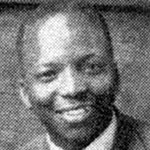
Massabalala Yengwa, was the son of the Zulu labourer who had been jailed during the African National Congress (ANC) anti-pass campaign of 1919. Yengwa was born near Mapumulo in Natal in 1923. He attended secondary school in Richmond and in 1945 began part-time study toward a B.Com. Degree at the University of Natal. Going initially into business as an accountant, he later changed to law and served his articles in Durban with J.N. Singh.
In 1945 he joined the ANC, and when the Youth League was established in Natal in 1948, he became its provincial secretary. With Jordan Ngubane and others in the Natal League, he helped to undermined the position of the conservative A.W.G. Champion and to promote the political career of Albert Luthuli, first as Champion's successor in the presidency of the Natal ANC, and then, in 1952, as president-general of the ANC. An able administrator, Yengwa served as a provincial secretary of the Natal ANC under Luthuli's leadership from 1952 until 1960; during this time he was also a member of the ANC National Executive Committee (NEC). During the Defiance Campaign he was jailed for two weeks.
In May 1953 he was banned from attending gatherings and from leaving the city of Durban. Changing its tactics a year and a half later, the government deported him to his home district for a period of two years. No sooner had this time elapsed when he was arrested and charged with treason in December 1956.
He was released from the Treason Trial a year later and took up his legal studies again, returning to Pretoria to appear as a defence witness for the remaining treason defendants in September 1960. Detained during the state of emergency in 1960, he was arrested again in 1963, held in solitary confinement, and charged with membership in the now-banned ANC. While waiting for his case to be heard, he completed his qualification as an attorney, but his troubles were not over. He was found guilty and sentenced to two years in prison. On his release, he was placed under house arrest and then banished again.
In 1966 he fled to Swaziland. After practicing as a solicitor in Swaziland for several years, he moved to London, where he has since been the director of the Luthuli Memorial Foundation. His writings include a Zulu Novel, Inqaba ka Mabelemade, published in the 1940s, and a chapter in Apartheid (1971), edited by Alex La Guma.


