
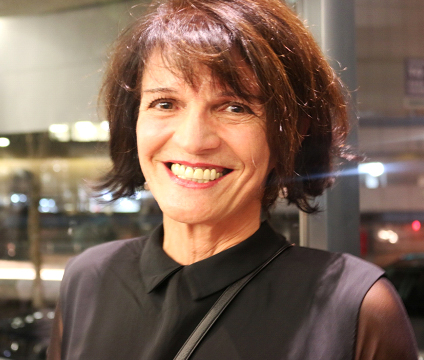
This biography was written by SAHO in collaboration with Artthrob
Modus Operandi
Penny Siopis is foremost a painter, although she frequently works with video and installations. Siopis’ work is marked by three interests, the physicality of paint, the accumulation of found objects (including video footage), material memory, and the politics of the body. She has also continually engaged with the shifting social and political situations in South Africa.
There is a sense of intimacy and personal closeness of experiences in the narratives of Siopis’ works, however they do bridge over to a wider global social context and how the viewer relates to the fragility of the subject. Siopis has had a longstanding interest in what she coins 'the poetics of vulnerability'. The juxtaposition of associations, history, femininity, as well as the traces and the repositioning of the past into the now through collective memory are what appear as you submerge into the worlds Penny Siopis creates.
Biography
Penny Siopis is of Greek descent and was born in 1953 in Vryburg in the Northern Cape Province, a little town to which her parents had moved after inheriting a bakery from her maternal grandfather. She studied Fine Arts at Rhodes University and pursued postgraduate studies at Portsmouth Polytechnic in England before taking up a lecturing position at the Natal Technikon in Durban. In 1984, she moved to Johannesburg and lectured in the Department of Fine Arts at the Witwatersrand University (Wits) until she moved to Cape Town.
In the 80s, works like Melancholia, quoted grand history paintings and the traditions of still life into overabundant, layered compositions, allegorising the excesses of wealth tilting in to disgust. The famous Patience on a Monument continued this language, but mixed the oil paint with a collage of torn up history books, with the main figure sitting on the accumulated debris of history. These ideas were examined further in her work in the 90s, which often comprised installations of huge amounts of found objects.
Siopis’ more recent work seems to engage with the things that are just beyond the limits of representation, the traumas and pains that are present but cannot be said. This manifests itself in a play between form and formlessness in the paint. Her paintings from the last several years use ink mixed in white glue to form images on the edge of representation.
In 2014/5, Siopis had a major retrospective, Time and Again, at Iziko South African National Gallery and later that year at the Wits Museum of Art. This show surveyed 30 years of her production and was accompanied by a major publication.
Siopis has exhibited locally and internationally since 1975, and has won numerous of awards including the Volkskas Atelier Award, and the Vita Art Now award. Solo exhibitions include Time and Again: A Retrospective Exhibition at the South African National Gallery, Cape Town (2014) and Wits Art Museum, Johannesburg (2015); Red: The iconography of colour in the work of Penny Siopis at the KZNSA Gallery, Durban (2009), and Three Essays on Shame at the Freud Museum, London (2005). Notable group shows include Boundary Objects at the Kunsthaus Dresden (2015); After Eden/Après Eden - The Walther Collection at La Maison Rouge, Paris (2015); Public Intimacy: Art and Other Ordinary Acts in South Africa at the Yerba Buena Center for the Arts, San Francisco (2014); Prism: Drawing from 1990-2011, Museum of Contemporary Art, Oslo (2012);Appropriated Landscapes, Walther Collection, Neu-Ulm/ Burlafingen, Germany (2011); PEEKABOO - Current South Africa, Tennis Palace Art Museum, Helsinki (2010); Black Womanhood: Images, Icons and Ideologies of the African Body, Hood Museum, New Hampshire; Davis Museum, Wellesley, Massachusetts, and the San Diego Museum of Art, California (2008), as well as the biennales of Venice (South African Pavilion 2013, and 2003), Sydney (2010), Johannesburg (1995 and 1997), Gwangju (1997) and Havana (1995).
Sources
Penny Siopis is, and has been, a witness and an active resistance participant in the social fabric of the changing South Africa. Siopis uses her experience and life in South Africa, as well as unjust societies, and personal struggle of the real world. Aside from her use of found objects, Siopis is a persistent borrower, making references from Neo-Classic history paintings to Japanese scrolls. She has responded to diverse works of literature from Freud’s Three Essays on the Theory Sexuality to Elias Canneti’s Crowds and Power.
Currently
Penny Siopis, is in several group shows in 2016, some of note are: Films at the Erg Gallery, Brussels; The Quiet Violence Of Dreams, Stevenson Gallery, Cape Town; Incarnations, a solo exhibition at the Institute of Contemporary Art Indian Ocean; The Taipei Biennial, curated by Corinne Diserens, with thematic of 'Gestures and archives of the present, genealogies of the future: A new lexicon for the biennial;' a group exhibition Home Truths: Domestic Interiors in South Africa, curated by Michael Godby, at the Iziko South African National Gallery, which also includes artists Deborah Poynton and Ian Grose; and I Love You Sugar Kane, curated by Zasha Colah, at the Institute of Contemporary Art Indian Ocean, Mauritius.
Siopis currently holds the position of Honorary Professor in Fine Arts and is the chairperson of the department's governing committee at Michaelis School of Art at the University of Cape Town.


