
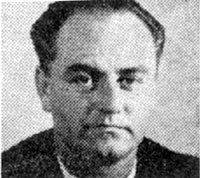
Pieter Beyleveld was born in 1916 in the Orange Free State and educated at farm schools. He joined the army at the outbreak of World War II, when many of his neighbours were violently opposed to South African participation in the war against Hitler. After a time of active service in the field he was appointed to run the Afrikaans section of the Armed Forces Radio Station in Cairo.
Returning to the country, in 1945, he saw that the enemy he had been fighting for the previous five years not only remained but, continued to flourish. He joined the Springbok Legion (an organisation of World War II ex-servicemen) and rose up the leadership rank serving as Vice Chairman. In 1953, he left his job to become the national organiser for the Labour Party. Later, he joined the Textile Workers' union as a full-time official.In 1953 he was elected to be the secretary of the South Africa Textile Workers' Industrial Union.The influence that make him embrace socialism ,he got it from Lionel Rusty Bernstein and Brian Percy Bunting.
When the Congress of Democrats was formed in 1953, he was elected as its first President. Two years later, in 1955, he became the first President of the South African Congress of Trade Unions (SACTU). He was a leading organiser for the Congress of the People in 1955. He was listed as Accused Number Six in the 1956 Treason Trial.
In 1958, Beyleveld ran for Parliament in a Cape Coloured constituency but was defeated by a United Party candidate. Due to his political activism, he came under the scrutiny of the Security Police. They traced a connection between Beyleveld and the underground South African Communist Party (SACP). Consequently, he was jailed in 1964 under the 90-day detention act.
At Abram Fischer’s trial in 1964, under the Suppression of Communism Act, Beyleveld became a state witness. He named more than 80 people as members of the SACP in a 34-page statement to the Security Police. His testimony led to the conviction of Fischer and 13 others, who were charged with membership of the banned Communist Party and conspiracy to commit sabotage. He admitted at this trial that he himself had secretly joined the Communist Party in 1956. He was co-opted onto the SACP Central Committee in August 1963 after the Rivonia arrests and was detained in July 1964.
On completion of the Fischer trial, Beyleveld encountered total ostracism and condemnation. He went to work in his wife’s office services business and faded into obscurity.


