
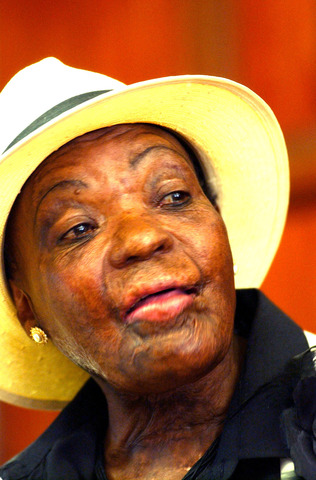
Thandi Klaasen (27 September 1931 – 15 January 2017)
Thandi Klaasen, born Thandiwe Nelly Mpambani, was one of South Africa's most celebrated jazz musicians and a defining voice of the Sophiatown cultural renaissance. The daughter of a shoemaker and a domestic worker, she grew up in Sophiatown at the heart of black urban culture and resistance politics, discovering her gift for song and dance in the churches of her community.Inspired by blues singer Emily Kwenane and The Jazz Maniacs, Klaasen began performing in local churches before pioneering an all-female quartet, The Quad Sisters, in direct response to the dominance of male groups such as The Manhattan Brothers.
While still a teenager, Klaasen survived a devastating acid attack that left her face permanently scarred and required nearly a year of hospitalisation. Her singing voice was profoundly affected. Rather than withdrawing from public life, she transformed the experience into artistic resilience, developing the distinctive world-worn rasp that would become her signature sound. In her own words: "Even if people in the street make you feel like you have leprosy or like you're dirty… you must be strong."
The attack on a young Black woman artist in apartheid Sophiatown went uninvestigated and unpunished. Under apartheid, violence against Black citizens was routinely ignored by the police. The absence of justice is part of that story.
Her professional career began in earnest in the mid-1950s, performing initially for ten shillings a show before joining The Gaieties and the Harlem Swingsters. Her reputation grew significantly through her performances alongside Dolly Rathebe, Miriam Makeba, Dorothy Masuka, and Sophie Mgcina. Under the mentorship of jazz great Kippie Moeketsi at Dorkay House, she expanded her musical range and literacy considerably.A major milestone came with her role in Todd Matshikiza and Harry Bloom's landmark musical King Kong, which opened at the University of the Witwatersrand Great Hall in February 1959. Klaasen performed in both the original South African production and the acclaimed London West End run in 1961, appearing alongside Hugh Masekela, Abdullah Ibrahim, Kippie Moeketsi, and Miriam Makeba. The production toured to record-breaking multiracial audiences and played an important role in bringing South African jazz to international attention.
Like many Black artists of her era, Klaasen was compelled by apartheid to take her career abroad, where she continued performing and campaigning actively against the apartheid regime. She shared international stages with artists including Roberta Flack and Patti Labelle, and her song Sophiatown became one of the most enduring tributes to the demolished community that shaped her.
Throughout her career, Klaasen remained an outspoken advocate for women in music, resisting exploitation and encouraging younger artists. Photographer Paul Indigo described her as "the very embodiment of the passion of an artist."
Klaasen received numerous awards over her fifty-year career, including the Count Pushkin Award for Best Female Vocalist (1976), the Woman of Distinction Award in Canada (1999), the Order of Ikhamanga in Gold for her outstanding contribution to music (2006), a Lifetime Achievement Award at the MTN South African Music Awards, and the Standard Bank Joy of Jazz Lifetime Achievement Award (2013). She was Nelson Mandela's favourite vocalist and was honoured with a state funeral following her death.
Thandi Klaasen died on 15 January 2017 at the age of 85 after a short battle with pancreatic cancer. She is survived by her daughter, the Montreal-based jazz singer Lorraine Klaasen.


