
At the request of President F. W. de Klerk, the commission of inquiry, headed by Judge Richard Goldstone, started the investigation into the Bisho massacre. In its report the commission condemned Oupa Gqozo, military ruler of Ciskei, for refusing to give permission to mass demonstrations, which promised to be peaceful. It also condemned the actions of the Ciskei Defence Force for trying its best to cause as many deaths and injuries as possible. The commission dismissed Gqozo's claim that his troops were shot at by the demonstrators. It was later established that the Ciskei soldier, who died during the shooting was shot by his colleague. The Commission recommended that the strongest possible action be taken against Gqozo and those involved in the Bisho Massacre. However, the actions of Ronnie Kasrils and other senior African National Congress members were criticized for acting irresponsibly by breaking through razor wire into Bisho. This provoked the Ciskei Defence Force to start shooting without warning, whereas Cyril Ramaphosa, African National Congress (ANC) Secretary-General was busy negotiating with the National Peace Secretariat, who had offered to act as intermediaries in talks with the Ciskei authorities. Click here to read about ANC's response on Bisho massacre
23 September 1992
Goldstone Commission investigate the Bisho Massacre
- Updated
- 23 Sep 2026
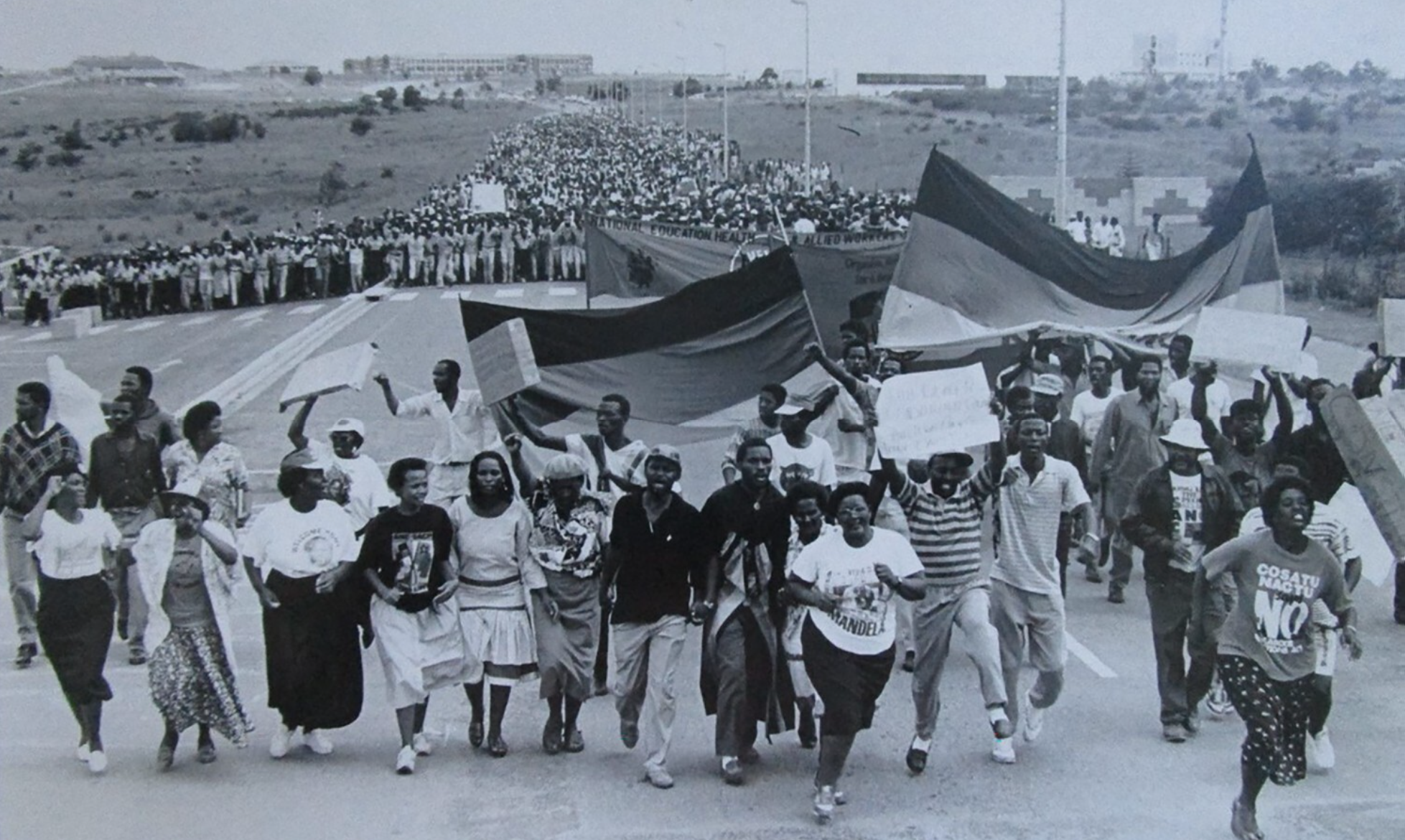
Bhisho, 1 March 1991. Demonstrators return to Bhisho from the Ciskei Council of State Buildings. Source: Daily Dispatch, 2 March 1991. Reproduced with the kind permission of the Daily Dispatch.
How we know this
- 01Fraser, R. (1990). Keesing's Records of World Events, Longman: London, p. 39078
- 02South African History Online, Bisho Massacre 1992, [online], Available at www.sahistory.org.za [Accessed: 20 September 2013]
Last updated · 23 Sep 2026
South African History Online. (2011, March 16). Goldstone Commission investigate the Bisho Massacre. South African History Online. https://sahistory.org.za/ref/E-0013049
South African History Online (2011) 'Goldstone Commission investigate the Bisho Massacre', South African History Online, 16 March. Available at: https://sahistory.org.za/ref/E-0013049 (Accessed: 9 October 2026).
South African History Online, Goldstone Commission investigate the Bisho Massacre [website], https://sahistory.org.za/ref/E-0013049, (accessed 9 October 2026).
"Goldstone Commission investigate the Bisho Massacre." South African History Online, 16 Mar. 2011, https://sahistory.org.za/ref/E-0013049. Accessed 9 Oct. 2026.
South African History Online. "Goldstone Commission investigate the Bisho Massacre." South African History Online. March 16, 2011. https://sahistory.org.za/ref/E-0013049.
Also on 23 September
- 1913Women protest against passes in the Free State
- 1941Navanethem (Navi) Pillay is born
- 1948Paul Michael Sibisi, SA artist and teacher involved in setting up cultural art workshops in Natal, is born.
- 1970South African Political activist, James Sofasonke Mpanza dies
- 1976SA announces its decision to allow multi-racial teams to represent the country in international events
- 1979Worldwide speculation begins that a bright flash detected over the southern Indian Ocean was a South African nuclear test
- 1983Gerrie Coetzee becomes the first South African boxer to win a world heavyweight title
- 2019Jazz veteran Dorothy Masuka dies
Search events by date
This day in history
What happened on your birthday?
SAHO is free because readers fund it. Donate →