
Milton Obote became Ugandan President twice. He led Uganda to Independence from Britain in 1962, becoming Prime Minister. Traditionally, the Bugandan King or Kabaka became President, although the position was considered to be only ceremonial. He was deposed by Idi Amin in 1971 and fled to Tanzania. In 1980 he returned home to Uganda following the Ugandan invasion by Tanzanian forces and the subsequent deposition of Amin. He was president until 1985, when he was deposed a second time by Museveni. When Britain granted independence to Uganda in 1962, there were some conditions that were imposed on the Independent State's administration. The British had applied the policy of Indirect Rule in almost all of the colonies that they colonised. This system of government seemed to have worked rather perfectly in Uganda, with the traditional Kings of the Baganda and the Kabakas being the most successful in asserting colonial rule in Uganda. When Uganda was being prepared for independence, beginning in the second half of the 1950s, Britain was anxious to ensure that their allies (the Kabaka) during the colonial era were taken care of by the new government. To assuage the fears of Uganda's former colonial overlords, Obote agreed to become Prime Minister, leaving the position of President to the Kabaka Yekka, with whom he had entered into a loose alliance. The Kabaka however was supported mainly by a powerful Buganda educated elite who were also seeking to maximise their gains in the new state. This had the potential to thrust Obote into a quandary. It was expected that, Obote would surround himself and fill key posts in his administrations with members of his ethnic group, the Lango. Failure to do this would have alienated them. Obote appointed the Lango in important positions in the Armed Forces and the Civil Service. This inevitably alienated the Buganda, and his relationship with the Kabaka Yekka deteriorated. In 1966 Obote declared a State of Emergency and suspended the constitution. He removed the Kabaka and assumed the position of President. Obote experimented with socialist ideas, coining a term "Common Man's Character", which would define his policies. Obote's brand of socialism sought to acquire a stake in the country's leading companies without effecting total nationalisation. This, observers believed, was an attempt to undermine the economic power wielded by the Buganda. These measures were still resisted by the Buganda and other minority ethnic groups in Uganda. Obote then instituted one-party rule. This, however, failed to unify Ugandans. In 1971, when Obote was attending a meeting of Commonwealth Heads of State in Singapore, Idi Amin staged a coup and deposed him. On his return Obote sought asylum in Tanzania from he condemned the political; excesses of his successor, who had gone on a mass killing of political opponents. In 1979, with the help of Nyerere's Tanzanian Army, Amin was overthrown. Obote got a second chance to become President of Uganda. He was overthrown again 1985 by Museveni. Obote died of kidney failure on 10 October 2005 at a hospital in Johannesburg.
19 December 1969
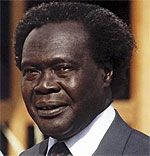
Ugandan premier Apollo Milton Obote is shot
- Updated
- 11 Dec 2020
How we know this
- 01Mazrui, A, (ed) (1993) General History of Africa: Africa since 1935. Cape Town, pg 230
- 02encyclopedia,Apollo Milton in Contemporary Black Biography,[Online],Available at: www.encyclopedia.com,,[Accessed:27 November 2013]
Last updated · 11 Dec 2020
South African History Online. (2011, March 16). Ugandan premier Apollo Milton Obote is shot. South African History Online. https://sahistory.org.za/ref/E-0012134
South African History Online (2011) 'Ugandan premier Apollo Milton Obote is shot', South African History Online, 16 March. Available at: https://sahistory.org.za/ref/E-0012134 (Accessed: 9 October 2026).
South African History Online, Ugandan premier Apollo Milton Obote is shot [website], https://sahistory.org.za/ref/E-0012134, (accessed 9 October 2026).
"Ugandan premier Apollo Milton Obote is shot." South African History Online, 16 Mar. 2011, https://sahistory.org.za/ref/E-0012134. Accessed 9 Oct. 2026.
South African History Online. "Ugandan premier Apollo Milton Obote is shot." South African History Online. March 16, 2011. https://sahistory.org.za/ref/E-0012134.
Also on 19 December
- 1888Henry Morton Stanley’s expedition reaches Fort Bodo, Congo
- 1953The 41st annual conference of the ANC in Queenstown gets underway
- 1969Ugandan premier Apollo Milton Obote is shot in the head by a gunman.
- 1982ANC attacks Koeberg nuclear power station
- 1989Two rival movements merge in Zimbabwe
- 1992SADF officers dismissed
- 1997Sugarboy Malinga wins the WBC title
- 1998House of Representatives impeaches American President Bill Clinton
Search events by date
This day in history
What happened on your birthday?
SAHO is free because readers fund it. Donate →