
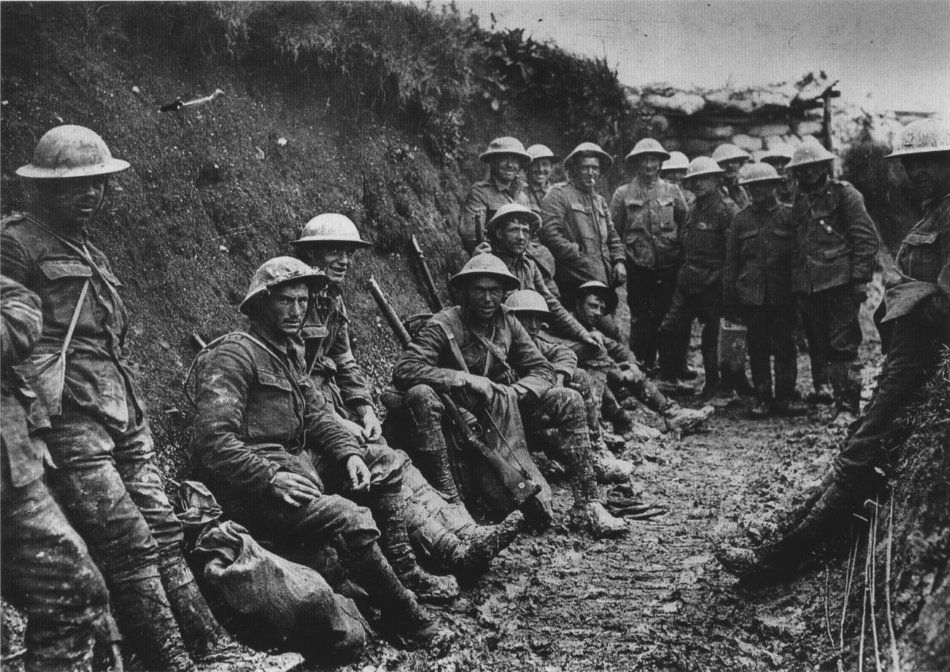
19th century Europe had a complex system of political and military alliances in place. The assassination of Austrian Archduke Franz Ferdinand by a Serbian nationalist threw this system off balance. The assassin, Gavrilo Princip, was a Bosnian Serb teenager and member of the radical nationalist group Mlada Bosnia (Young Bosnia), which was affiliated to the secret armed organisation known as Unification of Death (also the Black Hand). The motivation behind the assassination was that the Habsburg Empire, to which the Archduke was heir, had annexed Bosnia-Herzegovina from the declining Ottoman Empire in 1908. As a Serbian nationalist and a believer in a united Yugoslavia, Princip believed that the attack would result in a revolution and instability that would free the land of Habsburg rule. He was correct, and his actions resulted in a global war between the major powers of the European continent. These powers fought on two opposing sides: the Triple Entente and the Triple Alliance. The Triple Entente was comprised of the United Kingdom, France, United States and Russia who were victorious over the Triple Alliance, made up of Germany, Austria- Hungary and Italy. With the defeat of the Triple Alliance came the Treaty of Versailles, which outlined the reparations to be made by Germany in particular. It also saw the establishment of the League of Nations, the forerunner of the United Nations, which hoped to prevent a conflict of this nature from reoccurring. As one of the longest and deadliest conflicts in history, the loss of lives in World War 1 amounted to over 15 million. Amongst these losses were South African soldiers, who entered the conflict on the side of the Triple Entente and fought their most noted battle at Delville Wood in France in 1916. Gavrilo Princip's dream was only reaslied after World War 2, when Yugoslavia was united under communist rule. This lasted until the early 1990s when the union broke apart in a protracted civil war.
28 July 1914
World War I begins
- Updated
- 28 Jul 2020
How we know this
- 01News 24 - July 28 [online] Available at: news24.com [Accessed 21 July 2009]
- 02Wallis, F. (2000) Nuusdagboek: feite en fratse oor 1000 jaar, Kaapstad: Human & Rousseau.
- 03Oracle ThinkQuest, ‘World War One’, [online], available at https://library.thinkquest.org (Accessed: 24 July 2013)
- 04J Brooks Spector, (2014), The Damned Things that start world wars, from The Daily Maverick, 23 June 2014 [online] Available at www.dailymaverick.co.za [Accessed 26 June 2014]
Last updated · 28 Jul 2020
South African History Online. (2011, March 16). World War I begins. South African History Online. https://sahistory.org.za/ref/E-0011367
South African History Online (2011) 'World War I begins', South African History Online, 16 March. Available at: https://sahistory.org.za/ref/E-0011367 (Accessed: 12 October 2026).
South African History Online, World War I begins [website], https://sahistory.org.za/ref/E-0011367, (accessed 12 October 2026).
"World War I begins." South African History Online, 16 Mar. 2011, https://sahistory.org.za/ref/E-0011367. Accessed 12 Oct. 2026.
South African History Online. "World War I begins." South African History Online. March 16, 2011. https://sahistory.org.za/ref/E-0011367.
Also on 28 July
- 1902Dr. Jan Bouws, Dutch composer, is born
- 1960UN Secretary-General Hammerskjöld arrives in Congo
- 1998Amy Biehl’s murderers receive amnesty from TRC
- 2000Decision to integrate city councils of Pretoria area
- 2004Simon Mann pleads guilty in a Zimbabwean Court to attempting to purchase dangerous weapons
- 2004Library and clinic names are changed in Pretoria
- 2004South Africa gets a new R5 coin with distinct security features designed to outsmart counterfeiters
- 2005Reported arrest of London bomb mastermind, Rashid Aswat
Further reading
 Archive
South Africa in World War One, 31 October 2018
Search events by date
This day in history
What happened on your birthday?
SAHO is free because readers fund it. Donate →