
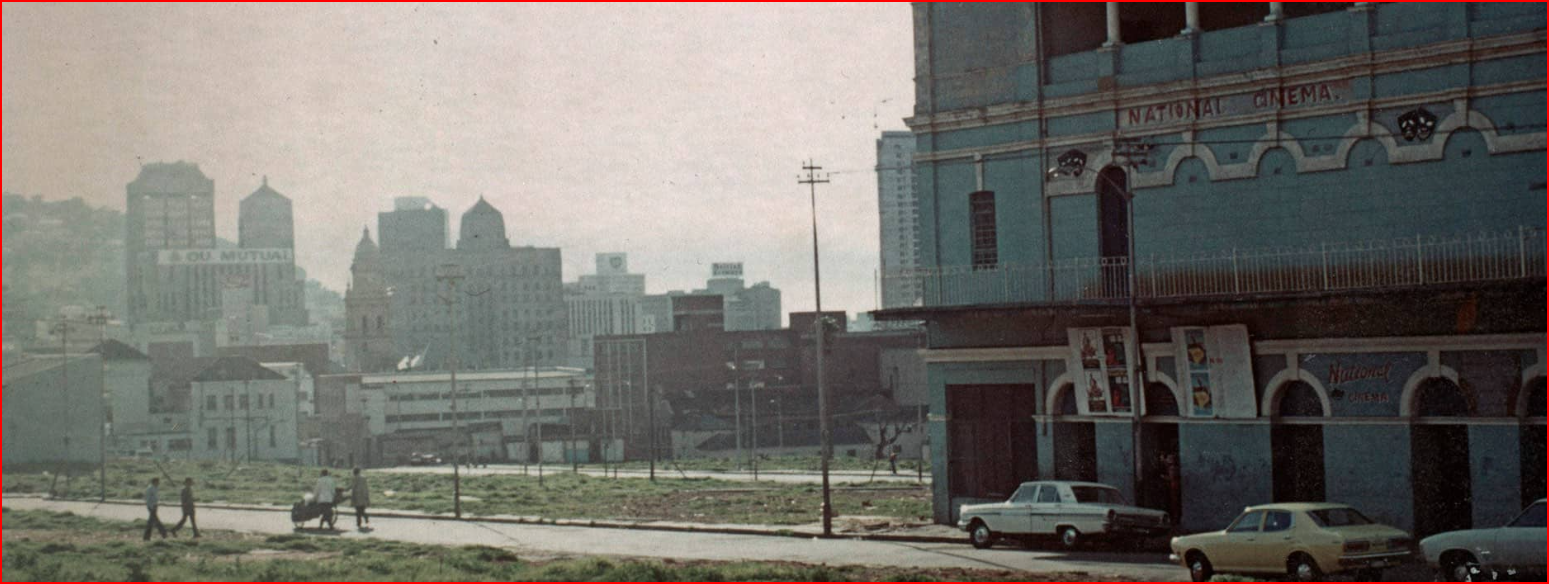
The area known as District Six got its name from having been the Sixth Municipal District of Cape Town in 1867. Its earlier unofficial name was 'Kanaldorp', a name supposedly derived from the series of canals running across the city, some of which had to be crossed in order to reach the District (kanaal is the Afrikaans for ‘canal’.)
District Six before its destruction under Apartheid, was a community representative of diversity on a number of levels – language, religion, economic class, geographical area of origin – and became a living example of how diversity could a be a strengthening characteristic of a community and need not be feared. It was a vibrant community of freed slaves, merchants, artisans, labourers and immigrants, with close links to the city and the port. It represented the polar opposite of what the Apartheid government, inaugurated by the National Party coming into power in 1948, needed people to believe and internalise.
District Six thus became one of the main urban targets for destruction in the city of Cape Town.
On 11 February 1966 it was declared a white area under the Group Areas Act of 1950, and by 1982, the life of the community was over. More than 60 000 people were forcibly removed to barren outlying areas aptly known as the Cape Flats, and their houses in District Six were flattened by bulldozers.
District Six was a multi working-class area just off the centre of Cape Town, to the South of the Castle. Today it is an almost vacant lot, shown on maps as the Suburb of Zonnebloem. Before being torn apart by the Apartheid Regime, during the sixties and seventies, District Six, was an impoverished but lively community of 55 000, predominantly Coloured People. It was once known as the soul of Cape Town, this inner-city area harboured a rich Cultural life in its narrow alleys and crowded tenements. After its demise, the district became mythologised, as a rich place of the South African imagination, inspiring novels, poems, jazz and the blockbuster musical, by David Kramer and Taliep Petersen, District Six. (The latter being an ex-resident!)
It was named the sixth District of Cape Town in 1867. Originally established as a Community of freed Slaves, Merchants, Artisans, Labourers and Immigrants. District Six was a centre with close links to the City and the Port. However, by the beginning of the 20th Century, the History of removals and marginalisation had begun!
The first to be “resettled” were the blacks were, forcibly displaced in 1901. The more prosperous began to move to the Suburbs and the Area became the neglected ward of Cape Town. In the 1940's plans were formed by the Cape Town Municipality to demolish houses under slum clearance, but it was only after the declaration of District Six, as a White Area under the Group Areas Act in 1966, that extensive demolition began. Resistance by Inhabitants was intense and the last Residents only left in the mid-1970s.
The area, together with Sophiatown, in Gauteng became a local and international symbol of the suffering caused by apartheid. A ‘Hands Off District Six’ campaign prevented Private Development and for many years. The Land remained vacant, until in the 1980s Housing for Police and Army Personnel and a Cape Technical College were erected. After the 1994 Democratic Election, claims for restitution were made by families, which had been forced out of District Six. A large number of them have been given the option to resettle in District Six or accept financial compensation! (There is an interesting link in further reading, regarding this!)


