| 1905 |
|
|
|
Charlotte Maxeke, formerly a Kimberley schoolteacher, becomes the first South African Black woman to receive a Bachelor's degree.
While on a choir trip to the United States (US) Institute of the African Methodist Episcopal Church (AMEC) with the help of Bishop Henry Turner, she decides to stay behind and study further, and duly enrolls at the Wilberforce University in Cleveland.
She also becomes the first Black female parole officer for juvenile delinquents, and runs an employment agency for Black women.
Maxeke becomes involved in many issues affecting Blacks in her time, from campaigning against the pass book laws to supporting trade union movements and exploring the concept of African unity. |
|
| 1908 |
7 January |
|
|
After passing her exams, Cecilia Makiwane is registered as a nurse and becomes the first Black professional nurse in South Africa. She resumes work at the Lovedale Hospital and serves the hospital for many years. |
|
| 1913 |
23 September |
|
|
Women protests led by Charlotte Maxeke take place in the Orange Free State, resisting government attempts to impose passes on women. Passes are burnt in front of the municipal offices. |
|
| 1913 |
21 October |
|
|
Transvaal women satyagrahis begin defiance activities by hawking without licenses in Vereeniging. They are not arrested. They cross the Natal border and encourage the miners in Newcastle to strike.
Phoenix settlement satyagrahis, including five women who cross the Natal-Transvaal border, are arrested and sent to prison in Pietermaritzburg.
Among the protest marchers of the Great March is 16 year old Valliamma Mudaliar, a tall, charming and energetic Tamil girl. |
|
| 1913 |
6 November |
|
|
|
|
| 1913 |
22 December |
|
|
Valliamma Mudaliar is arrested along with others and sentenced to three months rigorous imprisonment in Pietermaritzburg jail. Since Mudaliar is young and cannot not cope with the rigours of prison life, (which includes inhuman treatment at the hands of the jailors), she falls seriously ill and becomes bedridden. |
|
| 1914 |
27 January |
|
|
A petition is written and submitted by the Black and Coloured women of the Orange Free State (OFS) against the carrying of passes by women. |
|
| 1914 |
11 February |
|
|
Under an agreement with General J.C. Smuts, Gandhi secures Valliamma Mudaliar's release, before the expiry of her jail term. But even by then her life is hanging by a thread. |
|
| 1914 |
22 February |
|
|
Sixteen year old Valliamma Mudaliar dies in her house in Johannesburg of a fever contracted in prison.
Mourning her in Indian Opinion, Gandhi writes: "We have lost one of the holy daughters of India. She has done her duty courageously without bothering about the consequences. She is the paragon of tolerance, self-respect and character, which are the hallmarks of virtuous women. I believe that her example will not go in vain." |
|
| 1914 |
14 July |
|
|
To commemorate her memory, the Indian community in South Africa decides to build a hall. But the project does not reach fruition. Instead, a memorial stone is erected in her honour in Johannesburg. |
|
| 1918 |
|
|
|
|
|
| 1919 |
|
|
|
A protest is held in the Orange Free State (OFS) against the carrying of passes by women. |
|
| 1921 |
November |
|
|
|
|
| 1922 |
|
|
|
The first significant action by women in the rural areas occurs in Hershel. Boycott of stores as a result of price hikes, using passive resistance tactics that had been used earlier in the Orange Free State. |
|
| 1928 - 1929 |
|
|
|
The Durban Beer Protests occur in opposition to liquor acts that extend the scope of police raids on the brewers, which are usually women. |
|
| 1928 |
|
|
|
Edwin Mofutsanyana's wife and organiser of the historic 1956 women's march, Josie Palmer, is active in campaign against residential permits. |
|
| 1930 |
|
|
|
White women get the vote. This means that in effect the weight of the black vote is decreased from 3.1% to 1.4%. The first restrictions against the urbanisation of Black women are introduced. The reason the government gives for this is so as to decrease prostitution and illegal brewing in urban areas. |
|
| 1931 |
|
|
|
Establishment of the Women's section of the Communist Party, as a result of issues such as beer-brewing and food prices.Fifteen-year old Sarah Rubin, later Carneson, whose parents were founder members of South African Communist Party (SACP), joins the Young Communist League. |
|
| 1932 |
|
|
|
Founding member of the Federation of South African Women, Hilda Watts, later Bernstein joins the South African Labour Party League of Youth. |
|
| 1933 |
|
|
|
|
|
| 1934 |
|
|
|
Sarah Carneson joins the SACP. She teaches workers to read and write at the SACP's night school. |
|
| 1934 |
|
|
|
|
|
| 1935 |
|
|
|
The National Council for African Women is founded at the All African Convention with Charlotte Maxeke as president. This organisation is concerned with the welfare of women and members are usually teachers and nurses.
The first group of Indian girls matriculate in South Africa. |
|
| 1936 |
|
|
|
|
| 1936 |
26 September |
|
|
Nomzamo Zaniewe Winnifred Mandela, ex-wife of Nelson Mandela, is born at Bizana in Pondoland, Transkei. |
|
| 1937 |
|
|
|
Very strict regulations are introduced regarding the urbanisation of women as part of influx control. |
|
| 1938 |
|
|
|
Sarah Carneson works for National Union of Distributive Workers and is secretary of the Tobacco Workers' Union.
Cissie Gool represents District Six on the Cape Town City Council. She is the only woman Councillor for many years and the first Coloured woman to sit on the council. She serves on the council until 1951.
|
|
| 1940 |
|
|
|
Cissie Gool is elected president of the Non-European United Front (NEUF).
Hilda Bernstein joins the Communist Party.
Josie Palmer becomes a member of the CPSA's Johannesburg Committee
|
|
| 1941 |
|
|
|
|
|
| 1942 |
|
|
|
|
|
| 1943 |
|
|
|
Hilda Bernstein is elected Johannesburg City Councillor – the only Communist elected to public office.
The ANC officially admits women members.
|
|
| 1944 |
|
|
|
Oliver Tambo's wife, Adelaide Tambo is elected courier for the ANC.
Josie Palmer works with the National Anti-Pass Council. |
|
| 1946 |
|
|
|
|
|
| 1947 |
|
|
|
Mary Malahlela- Xakana becomes first female Black doctor in South Africa.
Josie Palmer is elected secretary of the non-racial Transvaal All Women's Union formed at the International Women's Day Meeting in Johannesburg.
|
|
| 1948 |
|
|
|
|
|
| 1949 |
|
|
|
Federation of South African Women (FEDSAW) founder and chief architect of the 1956 historic women's march, Fatima Meer, establishes the Durban Districts Women's League. |
|
| 1950 |
|
|
|
Communist Party of South Africa (CPSA) is banned.
Sonia Bunting joins the Guardian newspaper.
Florence Matomela leads an anti-pass demonstration resulting in the burning of passes in Port Elizabeth.
|
|
| 1951 |
|
|
|
Bibi Dawood helps to organise a one day strike, she helps to form the Worcester United Action Committee and is elected secretary to the Chairman, John Alwyn.
Sonia Bunting attends the World Youth Congress in Berlin as part of a delegation led by Ahmed Kathrada.
Cissie Gool appears before the Cape Town magistrate for holding a public meeting.
She also becomes active in the Franchise Action Council, the forerunner of the South African Coloured People's Organisation. |
|
| 1951 |
19 October |
|
|
Sita Gandhi and her mother Sushila and father Manilal stage a sit in the “whites only” reading room and the segregationist policy
of the Durban City Council. |
|
| 1952 |
|
|
|
The abolition of Passes and Co-ordination of Documents Act extends passes to women.
Bibi Dawood recruits volunteers for the Defiance Campaign. By July 800 defiers have signed up. Her house is campaign headquarters.
Francis Baard becomes organizer of the ANC Women's League, later secetary and treasurer of PE branch.
Dorothy Nyembe, Annie Silinga join the ANC and participate in Defiance Campaign.
Florence Matomela, one of the first women volunteers, is arrested and spends six weeks in prison.
Fatima Meer is banned.
One of the heroes of the 1956 historic women's march, Lillian Ngoyi, joins ANC and is arrested for her involvement in the Defiance Campaign.
|
|
| 1953 |
|
|
|
Bibi Dawood joins the ANC and is sent by the committee of Women (later FEDSAW) to Copenhagen for the International Democratic Conference of Women.
Lillian Ngoyi is elected President of ANCWL.
Ruth Mompati works as Legal secretary of Nelson Mandela and Oliver Tambo.
Hilda Bernstein is banned from 26 organisations, all meetings,writing and from being published.
Helen Suzman represents the United Party in Parliament.
|
|
| 1954 |
|
|
|
Florence Matomela is elected Cape Provincial Organiser of ANC Women's League.
Dorothy Nyembe is elected Chairperson of the Two-Stick branch Commmitee in Cato Manor.
Phyllis Naidoo joins the Natal Indian Congress, she raises funds for detainees arrested for Treason.
Sarah Carneson is banned and can no longer hold office in any union.
|
|
| 1954 |
17 April |
|
|
Federation of South African Women (FEDSAW is formed and the formation brings together women from the ANC, the South African Indian Congress, the Trade unions and self-help groups.
Ida Mntwana is elected national president of FEDSAW.
Josie Palmer is elected president of the Transvaal branch of FEDSAW.
|
|
| 1955 |
|
|
|
Bibi Dawood is arrested for nine months under the Suppression of Communism Act.
Lizzy Adrian Abrahams is banned under the Suppression of Communism Act for five years.
Josie Palmer is banned.
Lillian Ngoyi is a delegate to a conference of the Women's International Democratic Federation in Europe, and tours communist countries.
Lillian Ngoyi is elected to the Transvaal ANC executive.
Annie Silinga is arrested for refusing to comply with pass regulations. Many appeals are made.
Francis Baard a member of the drafting committee that produced the draft copy of the Freedom Charter.
Sonia Bunting is one of the women key note speakers at Congress of the People in Kliptown.
Sister Bernard Ncube enters the Companions Catholic Order and remains a teacher.
Black Sash, the Women's Defence of the Constitution League, is formed.
Patricia Jobodwana becomes the youngest Black woman to enrol at a university when she enrols at the University of Fort Hare for a BSc in medicine at age 14.
|
|
| 1955 |
27 October |
|
|
FEDSAW organises a march to the Union Buildings in Pretoria under the banner of FEDSAW. About 2000 women marched, lead by Ida Mntwana to protest passes for women. |
|
| 1956 |
|
|
|
Dorothy Nyembe is involved in action against forced removals from Cato Manor. She leads the Natal contingent of women to the Transvaal to participated in the anti-pass march to the Union Buildings.
Annie Silinga, the Cape leader of the ANC Women's League, is deported under police escort to the Transkei. She defies her banishment and returns to Cape Town.
Widespread national protests against the carrying of passes begin, resulting in the burning of passbooks.Many women are arrested and violence is particularly bad in the Hurutshe reserve in the Western Transvaal.
Frances Baard is elected to the executive committee of the South African Congress of Trade Unions (SACTU)
Hilda Bernstein helps establishes the South African Peace Council, and becomes its national secretary.
Lillian Ngoyi is elected President of FEDSAW
|
|
| 1956 |
9 August |
|
|
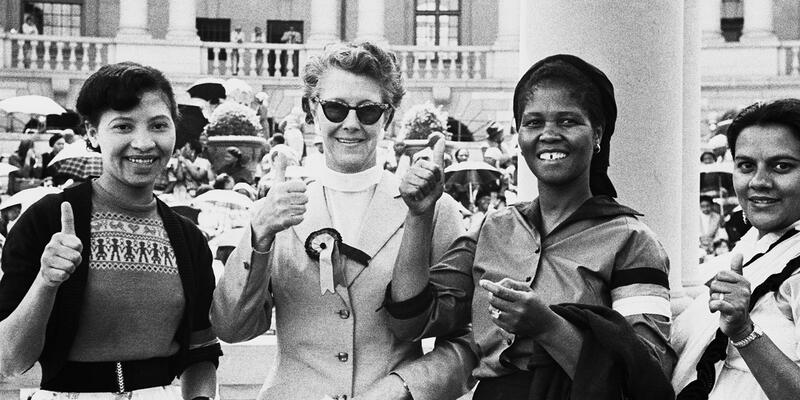
20000 women under the banner of the Federation of South African Women (FEDSAW) march to the Union Buildings in Pretoria to protest against passes for women. This day later became National Women's Day in South Africa. |
|
| 1956 |
December |
|
|
Lillian Ngoyi is the first woman elected to the National Executive Committee (NEC) of the ANC.
Congress Alliance leaders rounded, and detained, amongst them Lillian Ngoyi, Helen Joseph, Annie Silinga and Francis Baard
|
|
| 1957 |
|
|
|
Annie Silinga wins the case against her banishment and remains in Langa. |
|
| 1958 |
|
|
|
Annie Silinga is elected President of Cape Town ANC Women's League.
Albertina Sisulu is arrested
|
|
| 1959 |
|
|
|
Dorothy Nyembe leads the Cato Manor riots which were centred around beer halls, and sparked by the increase in raids. She is elected President of the ANC Women's League in Natal and participates in the call for potato boycotts.
Thayanayagie Pillay sets up a breakfast and lunch service for Treason Trialists in Pretoria.
Sonia Bunting banned from attending meetings and ordered to resign from 26 organizations.
The Progressive Party is formed and Helen Suzman is the only representative in Parliament
|
|
| 1960 |
|
|
|
The number of economically active women in South Africa is at 15.5%
Fatima Meer organizes night vigils against detentions without trial.
Adelaide Tambo leaves South Africa and works as courier for her husband in London.
Detained under State of Emergency: Frances Baard, Hilda Bernstein, Sonia Bunting , Lillian Ngoyi, Annie Silinga, Josie Palmer.
Sarah Carneson goes underground |
|
| 1962 |
|
|
|
Sonia Bunting is placed under house arrest.
Florence Matomela is banned and restricted to Port Elizabeth, where she is subsequently sent to prison for five years for furthering aims of the ANC.
Winnie Mandela is banned under the Suppression of Communism Act, and restricted to Orlando Township.
After the ANC is outlawed, Dorothy Nyembe becomes president of the Natal Rural Areas Committee and organises anti-government demonstrations by rural women during the Natal Women's Revolt.
Lillian Ngoyi is banned and confined to Orlando Township
Lillian Ngoyi receives LLB degree from UCT and is admitted as an advocate to the Supreme Court.
Ruth Mompati goes into exile and becomes secretary and head of the Women's section of the ANC in Tanzania.
|
|
| 1963 |
|
|
|
Dorothy Nyembe is arrested for leading the Natal Women's Revolt where women refuse to fill cattle dipping tanks, and eventually destroying them. |
|
| 1963 |
|
|
|
Miriam Makeba addresses the United Nations' Special Committee Against Apartheid in New York.
Sonia Bunting goes into exile and continues to work for the Communist Party. She becomes organiser of the World Campaign for the Release of South African Political Prisoners.
Dorothy Nyembe is detained and held for 12 months in solitary confinement.
Dorothy Nyembe is arrested for furthering the aims of the ANC and is sentenced to three years imprisonment.
|
|
| 1963 |
December |
|
|
Zainab Asvat leads a women's march to the Union Buildings to protest against the appointment of the Indian National Council and the Group Areas Act. |
|
| 1964 |
|
|
|
African Self Help Association is set up.
Frances Baard is sentenced to five years under Suppression of Communism Act for ANC activities.
Hilda Bernstein escapes to Botswana, then London and becomes a member of the External Mission and Women's section of the ANC |
|
| 1966 |
|
|
|
Phyllis Naidoo is banned and then arrested for ten days for breaking banning the order. She leaves for Lesotho where she becomes a victim of a parcel bomb.
Dorothy Nyembe is released and banned for five years. Restricted to magisterial district of Durban. |
|
| 1967 |
|
|
|
Sarah Carneson imprisoned for breach of banning order. |
|
| 1968 |
|
|
|
Sarah Carneson goes into exile in the UK, works for Trade Union Movement.
Florence Matomela released from prison and banned.
Dorothy Nyembe arrested again, detained and tortured |
|
| 1969 |
|
|
|
Umkhonto we Sizwe, the ANC's military wing, is officially opened to women members.
Winnie Mandela detained under Terrorism Act and held in Solitary confinement for 17 months.
Dorothy Nyembe and ten others charged under Suppression of Communism Act and found guilty of harbouring members of MK, she is sentenced to fifteen years imprisonment.
Frances Baard is released, banned and restricted to Mabopane, near Pretoria.
Mamphela Ramphele involved in student politics at the University of Natal Medical School and joins SASO under leadership of Steve Biko.
Shanthivathie Naidoo is detained
|
|
| 1970 |
|
|
|
|
|
| 1971 |
|
|
|
The Voice of Women magazine is launched. |
|
| 1972 |
|
|
|
Lillian Ngoyi's banning order lapses. |
|
| 1974 |
|
|
|
|
| |
| 1975 |
|
|
|
The Black Women's Federation is formed, drawing heavily on the Women's Charter.
Lillian Ngoyi's banning order is renewed for five years.
Ela Gandhi is banned.
Mamphela Ramphele founds Zanempilo Community Health Centre in Zinyoka, outside King William's Town.
Walter Sisulu's daughter Lindiwe Sisulu is detained. After her release she joins MK and works underground. She undergoes military training and specialises in Intelligence.
The Women's Committee at Crossroads plays a central role in resisting threats of eviction and pass raids.
|
|
| 1976 |
|
|
|
Joe Modise's wife Thandi Modise, student in Soweto, is jailed for ten years.
Mamphela Ramphele detained under Section 10 of Terrorism Act.
Winnie Mandela establishes Black women's Federation and Black Parents' Association during Soweto uprisings. She is detained under Internal Security Act.
Fatima Meer's home petrol bombed.
Gill Marcus, becomes editor of ANC's weekly bulletin
|
|
| 1976 |
19 April |
|
|
Baleka Kgositsile goes into exile and works for the ANC in Swaziland. |
|
| 1977 |
|
|
|
Baleka Kgositsile goes to Tanzania, becomes first secretary of the regional women's section of the ANC.
Winnie Mandela is banished to Brandfort in Orange Free State.
Mamphela Ramphele is banished to rural Northern Transvaal where she forms Isutheng Community Health Programme.
|
|
| 1977 |
19 May |
|
|
Black Women's Federation is banned. |
|
| 1978 |
|
|
|
|
|
| 1980 |
|
|
|
31.5% women are economically active in South Africa.
Fatima Meer builds schools in Umlazi, Port Shepstone, Inanda, establishes Tembalihle Tutorial College and a Crafts' Centre in Phoenix.
Zubeida Jaffer, journalist, is detained for two months after exposing police killings.
Geraldine Fraser-Moleketi goes into exile. She joins the ANC in Zimbabwe and works in political structures under the late Joe Gqabi.
She later becomes a member of Umkhonto we Sizwe and receives training in Angola. Geraldine receives Officer Training at Military Institute of USSR and specialised training in Cuba.
Helen Suzman receives a United Nations Human Rights Award again.
|
|
| 1980 |
13 May |
|
|
Lillian Ngoyi dies. |
|
| 1981 |
|
|
|
The United Women's Organisation is formed. This became instrumental in the formation of the United Democratic Front (UDF) in 1984.
Di Bishop is elected to the Cape Provincial Council as member of the Progressive Federal Party. |
|
| 1982 |
|
|
|
Barbara Hogan is arrested for High Treason, and sentenced to ten years imprisonment for belonging to a banned organisation, the ANC.
Dorothy Nyembe is awarded the Soviet Union's People's Friendship Award.
Ruth First is killed by a letter bomb in Maputo.
|
|
| 1983 |
|
|
|
Albertina Sisulu is elected president in absentia of the United Democratic Front. |
|
| 1983 |
December |
|
|
Natal Organization of Women (NOW) is formed. |
|
| 1984 |
|
|
|
Federation of Transvaal Women (FEDTRAW) is formed.
Sister Bernard Ncube is elected president of FEDTRAW.
Mamphela Ramphele enters South African Development Research Unit of UCT as research fellow. She is appointed senior research officer in Dept of Social Anthropology and obtains a PhD.
|
|
| 1984 |
23 March |
|
|
Dorothy Nyembe is released and participates in activities of the Natal Organisation of Women (NOW). |
|
| 1986 |
|
|
|
Brigitte Mabandla becomes legal advisor to the ANC Legal and Constitutional Affairs Department.Zubeida Jaffer is detained for editing community and trade papers.
Winnie Mandela returns to her home, becomes active in ANC politics. Her opposition to the Botha regime earns her the title “Mother of the Nation.”
The United Women's Organisation joins the Women's Front, together forming the United Women's Organisation Congress.
Sister Bernard Ncube is detained,and spends three months in solitary confinement. Sister Ncube's detentions evoke international condemnation.
Barbara Ribeiro and Fabian Ribeiro are killed by state agents.
Miriam Makeba receives the Dag Hammerskjold Peace Prize.
|
|
| 1986 |
April |
|
|
PAC's African Women's Organisation is formed in Katlehong |
|
| 1987 |
|
|
|
Zubeida Jaffer heads the Media Department at the University of the Western Cape. |
|
| 1989 |
|
|
|
Sister Bernard Ncube is part of a United Democratic Front (UDF) delegation to meet President George Bush.
Patricia De Lille is elected to the National Executive Committee of the Pan African Movement, wing of PAC.
|
|
| 1990 |
|
|
|
Patricia De Lille is appointed foreign secretary and relief and aid secretary of PAC.
Lindiwe Sisulu returns to South Africa and works as personal assistant to Dr Jacob Zuma.
Ruth Mompati is part of a delegation that opens talks with the South African Government.
Baleka Kgositsile returns to South Africa. She is elected Secretary General at first national conference of the ANC Women's League.
Geraldine Fraser-Moleketi returns from exile at request of CPSA. She resumes work as personal assistant to Joe Slovo and Chris Hani.
Barbara Hogan released from prison.
Gill Marcus returns from exile and takes up a post in the ANC\'s Department of Information and Publicity.
The Natal Organisation of Women (NOW) disbands to join the ANC. |
|
| 1991 |
|
|
|
Patricia De Lille leads the PAC delegation at CODESA.Sonia Bunting returns from exile and continues political work.
Gill Marcus is elected to the ANC National Executive Committee leading up to 1994 elections.
She trains ANC media workers and voter educators and accompanies Nelson Mandela on his election campaign.
Getrude Shope is elected first President of ANCWL
The Women's National Coalition is formed. |
|
| 1992 |
|
|
|
Dorothy Nyembe receives the Chief Albert Luthuli award from the ANC.
Lindiwe Sisulu is awarded the Human Rights Center fellowship in Geneva.
She has written extensively on women, liberation struggle, working conditions and agriculture. |
|
| 1992 |
April |
|
|
The Women's National Coalition is formally launched.
Women enter the CODESA talks under the auspices of the Women's National Coalition |
|
| 1993 |
|
|
|
Winnie Mandela elected to ANC's National Executive Committee and president of ANC Women's League. |
|
| 1994 |