

Omar Badsha was born in Durban, Natal (now known as KwaZulu-Natal) in June 1945. He grew up in a working-class Indian Muslim family, which is part of the country's small but influential Gujarati Vhora Muslim community. His grandparents immigrated to South Africa from India in the first decade following the formation of the Union of South Africa in 1910.
His father, Ebrahim Badsha, was a shop assistant, sign writer/designer, and a member of the Bantu, Indian, Coloured Arts Group (BICA), the first black arts group in Durban. His uncle Moosa Badsha was a shop assistant and photojournalist who worked for several black publications. Ebrahim Badsha had a major influence on Omar's interests in the arts and his political activism.
Omar became politically active while at high school in the wake of the 1960 Sharpeville Massacre and the government's banning of liberation organisations. He was the deputy secretary of the Durban Students Union and was later drawn into the African National Congress (ANC) underground and worked with Phyllis Naidoo, AKM Docrat, and others.
In 1965, while in high school, he was denied a passport to travel abroad to study. Later that same year, he entered a small woodcut in the Arts South Africa Today exhibition, which was awarded the Sir Basil Schonland Prize.
The winning of the Arts South Africa Today exhibition award was the beginning of Badsha's long career working as an artist, photographer, and an influential voice in the anti-apartheid artists' and writers' circles. Badsha was among the few Black artists working outside the mainstream white-dominated commercial galleries.
He has exhibited locally and internationally since the mid-1960s, and his work is represented in major public collections across South Africa and leading galleries and institutions abroad. He received a number of awards for painting and photography, including the Sir Ernest Oppenheimer Memorial Award, Arts South Africa Today, 1969, the Natal Society of Arts Annual Award, 1968, and "Images of Africa" First Prize at the African Arts Festival in Denmark, 1993.
In the early 70s, Badsha played a leading role in the revival of the Natal Indian Congress (NIC) and the trade union movement in the wake of the 1973 Durban Strikes. He was closely associated with the assassinated academic, Rick Turner, in the formation of the short-lived Education Reform Association and "Platform", a left-wing discussion group.
In 1973, in the wake of the historic 1973 Durban workers' strike, he stopped working as an artist and worked closely with trade unionists Harriet Bolton, David Hemson, Halton Cheadle, and others in setting up the General Factory Benefit Works and the formation of the Institute of Industrial Education (IIE).
Following the 1973 Durban strikes, Badsha was at the forefront of the establishment of the General Factory Workers Benefit Fund (GFWBF), the Institute of Industrial Education, and the Trade Union Coordinating Council (TUCC), out of which emerged the independent non-racial trade unions in Durban.
In late 1973, Badsha moved to Pietermaritzburg, Natal, to help with a strike at a textile factory and in the running of the Pietermaritzburg office of the Trade Union Advisory Coordinating Council (TUACC). With the banning of his colleagues Richard Turner, David Hemson, Halton Cheadle, and others, Badsha moved back to Durban and acted for a short period as secretary of TUACC and was instrumental in establishing the Chemical Workers Industrial Union (CWIU) and served as the Union's first general secretary.
Badsha's interest in photography developed from his work in the trade unions' education programs. He saw the need to document work-related injuries in chemical plants. He left the trade unions in 1976 and started working as a freelance photographer.
Early in 1977, Professor Fatima Meer, a banned activist and academic, approached Badsha to work with her to produce a book of photographs on children under apartheid. The book, Letter to Farzanah, was launched on 12 September 1978 and was banned the day after the launch. However, because the book was presold, the banning did not have any real impact on the circulation of the book, but led to widespread local and international condemnation of the apartheid government's censorship laws.
Badsha started working with the former Robben Island political prisoner Shadrack Maphumulo (also banned) to organise people in the squatter communities of the Inanda area just outside Durban to fight against forced removals. He used his own resources to produce his next book, Imijondolo, to highlight conditions in Inanda.
Badsha's darkroom, in the Grey Street area, became a hub and training ground for young photographers. This led Badsha to initiate a program to establish a network of photographers to document state repression. This initiative led to the formation of the now legendary photographers' collective, Afrapix.
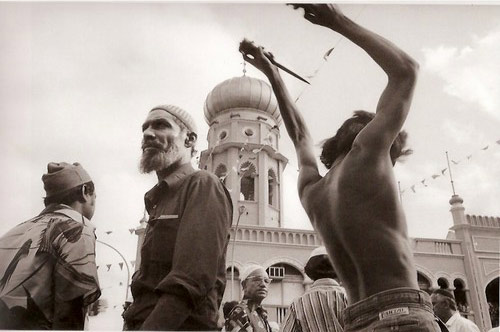
Badsha's seminal photographic book on the Durban Grey Street area, Imperial Ghetto, and his book Imijondolo on Inanda, followed by the publication of South Africa: The Cordoned Heart, established his international reputation as the country's most influential documentary photographer.
In 1982, Badsha became the head of the Photography Unit of the Second Carnegie Commission on Poverty and Development, which led to the publication of the internationally acclaimed exhibition and book South Africa: The Cordoned Heart. The exhibition was launched at a conference held in Cape Town in 1984, and the book was published in 1986 and launched at the International Centre of Photography in New York.
Badsha's publications and role in forming Afrapix established Badsha's reputation as an activist photographer and in shaping a social documentary photography tradition in the country. The exhibition and the book, South Africa: The Cordoned Heart, were critically acclaimed internationally as a seminal work that created a new vocabulary to tell the South African story. Despite international pressure, the South African government refused Badsha a passport to travel to the exhibition opening in New York.
In the late 1980s, Badsha and his family moved to Cape Town when his wife Nasima was appointed a lecturer at the University of Cape Town. In Cape Town, Badsha became active in the newly established United Democratic Front (UDF) and was a founding member and chairperson for the Cultural Workers Congress, an affiliate of the UDF. Badsha established the Centre for Documentary Photography at the University of Cape Town, which organised the first-ever conference on documentary photography in South Africa. Badsha was detained by the security police the night before the opening of this conference.
At the end of December 1990, for the first time after 25 years, Badsha was issued a passport, which was valid for a mere three months. He travelled to London and the USA, where he toured on a speaking tour for the banned African National Congress. He met his old friend Dumile Feni and other exiled South Africans and visited the exiled South African photographer Ernest Cole in the hospital, and was with him a day before his death.
After the unbanning of the ANC in 1990, Badsha became the head of the ANC Western Cape Arts and Culture Department. He spearheaded the creation of the Federation of South African Cultural Organisations (FOSACO), worked full-time as the volunteer convener of the Mass Democratic Movement, and served on the political committee of the ANC's Western Cape 1994 election campaign.
Unlike many other activists, he did not make himself available for political office in the new government but continued working with civil society, grassroots youth, and cultural organisations. In 1985, he established the Ikapa Arts Trust, which organised the annual Cape Town Festival.
In 1995, Badsha received a grant from the Danish Government to document life in Denmark. Vice President Thabo Mbeki and the Danish Foreign Minister opened an exhibition of this work in Copenhagen. Badsha visited India in 1996 on a travel grant from the Indian Government and undertook a photographic project in the State of Gujarat and the small village of Tadkeshwar, his grandparents' birthplace.
In 1997, his family moved to Pretoria when his wife, Nasima, was appointed head of the newly established division of higher education in the Department of Education. In 2000, Badsha started work on establishing South African History Online, a popular online history project, which has grown into one of Africa's largest online history websites.
In 2002, he edited the book With Our Own Hands, which focused on the government's poverty relief programmes. In 2015, Badsha's retrospective exhibition, Seedtime, opened at the Iziko National Gallery.
In December 2017, Badsha was awarded an honorary doctorate from the University of Stellenbosch and later an honorary degree from the Tshwane University. In April 2018, President Cyril Ramaphosa awarded him the National Order of Ikhamanga (silver) for establishing South African History Online. In 20xx, Badsha was awarded the Ellen Khuzwayo Award from the University of Johannesburg, and in 2025, the University of Fort Hare awarded him a Doctor of Honoris Causa. He is the author, co-editor and publisher of close to 15 books and exhibitions.
He featured in a Netflix documentary series titled "Stories of a Generation – with Pope Francis". In 2024, he was a recipient of the Department of Sports, Arts, and Culture's Living Legends Project.
In 2025, a biography by American historian Dan Magaziner titled Available Light: Omar Badsha and the Struggle for Change was published in the USA and South Africa.


