
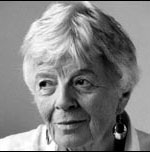
Hilda Bernstein (nee Watts) was born in London in 1915. She was educated at state schools. Her father was a committed Bolshevik and non-religious jew,that had relocated in 1900 from Russia to England. Bernstein relocated to South Africa in 1932 where she worked in advertising agencies, later in publishing and journalism. In South Africa she became active in organisations associated with the struggle for National Union of Distributive Workers. She was a member of the South African Labour Party League of Youth until 1940. After her stint in the Labour Party. In 1937 she became a member of the South African Communist Party (CPSA), she was serving on its committee until 1946. Hilda met Lionel (Rusty) Bernstein through shared political involvement. In 1941 they got married. She became a Johannesburg City Councillor from 1943 to 1946 - the only Communist to be elected to public office on a 'Whites only' vote.
Bernstein was a founding member of the Federation of South African Women (FEDSAW)- the first non-racial women's organisation in South Africa. She was one of the organisers of the Women's March to the Union Buildings that took place on the 9th of August 1956. Bernstein was also a founder of the South African Peace Council and was its national secretary until the organisation’s banning. As a contributor on South African affairs to periodicals in Africa, Britain, America and Europe, she established long standing associations with the African National Congress (ANC), particularly through the ANC Women's League.
In 1946, Bernstein was charged with sedition arising out of a mineworkers’ strike. In 1953 she was banned by Ministerial decree from 26 organisations and all meetings, including bans on writing and being published. In 1960, she was detained under the State of Emergency without charge following the Sharpeville shootings. In 1964 after the Rivonia trial, she escaped from home as the police came to make an arrest and managed to cross the border on foot to Botswana. Ultimately she arrived in London where she worked as a freelance journalist; and started new career as an artist and print-maker. While in exile, she was a member of the ANC External Mission, and of the Women's section of the ANC. She was also an active member and regular speaker on behalf of ANC and Anti-Apartheid Movement in Britain and continued to write and develop her skills as a professional print-maker.
She toured extensively in Europe, Canada and USA on behalf of the ANC and the Women's League. She was author of six books, publication list includes: The World that was Ours; The Terrorism of Torture; For Their Triumphs and for Their Tears; Steve Biko; Death is Part of the Process. Some of her more famous publications include: The Rift - the Exile Experience of South Africans and The Trials of Nelson Mandela (in Italian).She has also exhibited etchings, drawings and paintings in galleries in London, the USA and countries of Africa. Her work has been used as book jackets, book illustrations, as posters and as cards for the AAM.
In 2004 she moved back to SA and two years later died. She was awarded the Luthuli Silver Award for her "contribution to the attainment gender equality and a free and democratic society" in South Africa. She died at the age of 91 at her home in Cape Town, South Africa.


