
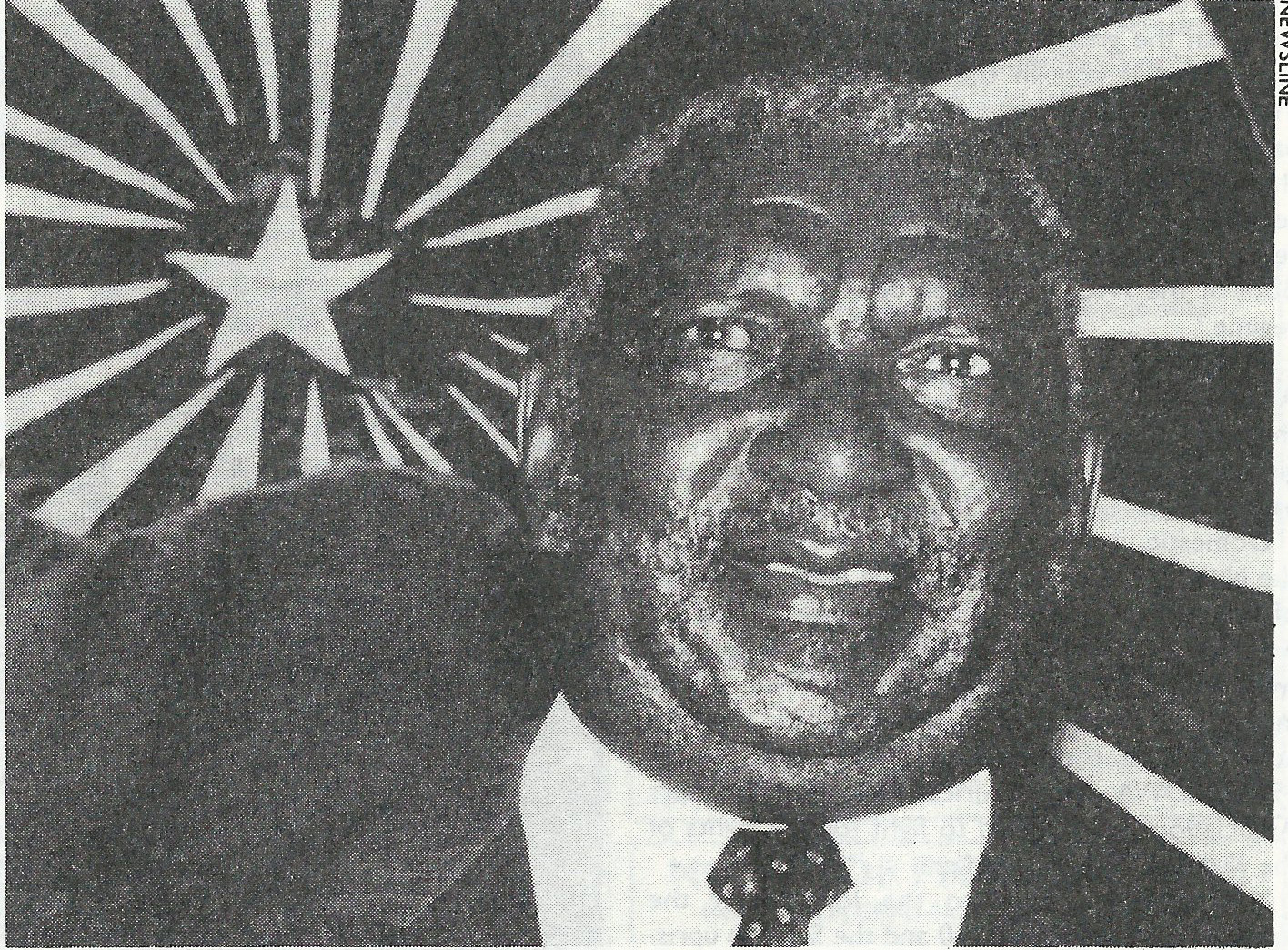
Zephania ‘Zeph’ Lekoane Mothopeng, was born on 10 September 1913, in the Orange Free State (now Free State) near the town of Vrede. Shortly after his birth, his family moved to the Transvaal where his father had bought land. It was here that he completed his primary schooling at the St. Mary's Anglican School, Daggakraal, in the district of Amersfoort and then went to St Chatswold Training College. In 1933, he moved to Johannesburg and continued his studies until matriculation in 1937.
After working for a short while in Johannesburg, he enrolled at Adams College, Amanzimtoti in Natal (now KwaZulu-Natal) where he was one of the first students to obtain a post Matriculation Teachers Certificate.
Mothopeng started teaching at Orlando Secondary School in 1941. During his time as a teacher, he held various positions in teachers associations including the Presidency of the Transvaal African Teachers Association (TATA) in 1950. In 1946, he obtained his BA degree from the University of South Africa (Unisa). Mothopeng taught Maths and Physical Science at Orlando High School for about thirteen years.
He conducted the senior school choir and in 1947, the Orlando School choir was chosen to sing to King George VI. Mothopeng conducted the choir at Orlando Communal Hall when the King and his royal entourage visited Orlando during their tour of South Africa. Mothopeng was one of the founders and first chairperson of the Johannesburg Bantu Musical Festival in 1946, which received sponsorship from the Johannesburg City Council.
Mothopeng became the Vice Principal but lost his job for opposing the introduction of Bantu Education. After losing his job, he moved to Maseru, Lesotho where he continued teaching until returning to Transvaal in 1955. By this time, Mothopeng was no longer working as a teacher. He was articled to a firm of attorneys in Johannesburg.
Mothopeng's political life began as early as 1943 when he was a member of the African National Congress Youth League (ANCYL). He later aligned himself with the organisation’s Africanist section, which was critical of its policies of engagement with White ‘liberals'. They formed their own magazine called TheAfricanist to voice their opinion within the African National Congress (ANC). In 1959, the Africanists broke away from the ANC and formed the Pan Africanist Congress (PAC). Mothopeng acted as chairman at the inaugural conference of the PAC on 6 April 1959 at Orlando Communal Hall. Robert Mangaliso Sobukwe was elected the President of the organization.
Mothopeng was elected to the PAC's National Executive and National Working Committee. He was entrusted with the drawing up of the draft Constitution which was presented for approval at the inaugural meeting of the PAC. The constitution was adopted with minor amendments.
In 1960, Mothopeng was arrested and sentenced to two years for his role in organising the Anti Pass Campaign, under the Suppression of Communism Act. He was rearrested in 1963 and convicted in 1964 for promoting the aims of a banned organisation, the PAC. He was sentenced in May 1964 for three years for being a member and furthering PAC activities and served the sentence on Robben Island.
When Mothopeng was released from prison in 1967, he was taken to Qwaqwa and banned for two years. However, he was allowed to return to his home in Johannesburg. In 1969, his banning order was renewed for another two years effectively making his banning order four years.
In the 1970s, Mothopeng continued doing underground work for the PAC. He visited Robert Sobukwe who was banished to Kimberly. Together with former Robben Island inmates, a recruitment programme was established with the PAC in Swaziland.
He was arrested again in 1976 and his trial commenced in 1978. At the time of his arrest, Mothopeng was employed as a director of the Urban Resource Centre, a voluntary community organization. He was charged with promoting the aims of the PAC and, together with his co-accused, refused to enter a plea arguing that the court was illegitimate and it did not have a mandate from the African people.
He was held in solitary confinement for about sixteen months before being brought to court. His trial, which lasted for 18 months, was held in the small town of Bethal, several hours’ drive from Johannesburg. He and sixteen others were found guilty of ‘terrorist activities’ and furthering the aims and activities of the banned PAC. He was charged with having recruited and sent men out of the country for military training and with having instigated unrest in the township of Kagiso, near Krugersdorp, on 17 June 1976, the day after the start of the youth revolt in Soweto. The state accused Mothopeng of having begun an underground organization of the PAC in 1964 while serving an earlier jail sentence on Robben Island. Mothopeng was sentenced to 15-years jail on 26 June 1979, for trying to overthrow the government. He was 66 years old.
The PAC Central Committee elected him President at a meeting in Tanzania in August 1986. President F W De Klerk released Mothopeng from prison in 1989. In February 1990, Mothopeng rejected calls from former President Nelson Mandela and Zimbabwean President Robert Mugabe to join other liberation leaders in the multiracial negotiations with the government. His position was that the power and control of all the major government institutions should be given to Black people.
Mothopeng died at the age of 77 on 23 October 1990.


