
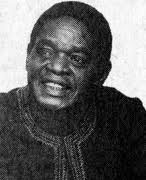
Curtis Nkondo was born on 1st February 1928 in Louis Trichardt, Northern Transvaal (now Makhado, Limpopo).
Towards the end of the 1800s, his grandmother, Ma Nkondo left Lorenco Marques (now Maputo), Mozambique, then under Portuguese rule, to escape poverty and came to South Africa with her sons. She settled near Pretoria where she worked as a domestic servant, and put her two sons through school. Ephraim Nkondo, the elder son was to become Curtis’s father, completed high school at La Maria and went on to qualify as a teacher at the Bantu Pretoria Normal College.
The Nkondos were extremely devout Christians. Ephraim, as principal of the local school, had to find school fees for the many children whose parents could not afford any. Ma Nkondo worked on church committees and busied herself with welfare work. The Nkondo children sold apples and peanuts on the busses to earn pocket money.
The Nkondos put nine children through high school and all nine trained to be teachers. One is a professor of English at Harvard University, United States of America.
From an early age, Curtis Nkondo was an avid reader; there was no library in the neighbourhood, but he reached out for whatever books he could find. By the time he reached high school he had read every Charles Dickens written. He got through his primary school in Louis Trichardt and due to there being no high school for African children in the area; he went to live with his aunt in the Western Coloured Township and attended school there.
In 1949 he wrote his matriculation examination and passed. Curtis wanted to become a lawyer; the family did not have enough money to see him through university. He entered the Bantu Pretoria Normal College and during this time the Nationalists introduced the Bantu Education Bill.
Nkondo began teaching at Pimville High School and later moved to Lamula High School in Meadowlands, Soweto where he became the principal. Nkondo taught English and Geography for two decades. When the student resistance against Bantu Education and the imposition of Afrikaans as a medium of instruction started in 1976, he was the Headmaster at Lulama High school.
At the weekends they attended meetings addressed by African National Congress (ANC), ANC Youth League (ANCYL) and the South African Communist Party (SACP) leaders.
Curtis graduated from teacher training school in 1952, where he met Eduardo Mondlane, who would later become the President of FRELIMO, the liberation movement of Mozambique. They became firm friends, largely because they shared a common passion, reading. Most of their time together was spent in serious discussion about the injustices around them, the way White people treated Black people. Curtis settled down to the routine of being a teacher like his father and his mother. He began his teaching career in the very year that the Bantu Education Act was passed.
He met Fred Hutchinson and Henry Makgothi who were involved in the ANC’s Defiance Campaign, and had served terms of imprisonment. They impressed Curtis deeply. He also met J.B. Marks who lived nearby in New Clare. Marks was chairman of the local ANC and secretary of the Mine Workers Union at the time.
In 1957 Curtis married Rose Magors, a nurse, together they had four children. In 1960, responding to the anti-pass call, Curtis and a group of teachers went to the Nhlangane police station and handed in their passes. This was the first decisive political act on his part.
He was arrested in 1962, while he was detained he concentrated on teaching and athletics, and gave expression to his political protest through poetry. In 1976, the government insisted on introducing Afrikaans, as the medium of instruction in African schools in Soweto. The pupils were outraged. It made Curtis’s position as a teacher intolerable. He decided to resign from teaching and take on a job, but industry would not have him. So he remained in the classroom, but the classroom had become transformed. The pupils were unteachable.
Curtis then principal of the Lamula Secondary School refused to teach in Afrikaans and had heated arguments with the inspectorate. As June 1976 approached, school children organised marches and meetings. Nkondo resolved to give up teaching regardless of whether he found another job or not. He was determined to take a body of the teaching fraternity with him.
He moved a resolution at the annual TATA (Transvaal African Teachers Association) conference, calling on all teachers to resign. The resolution was lost, but a significant minority stood together. They resigned from TATA and formed the Soweto Teachers Action Committee (STAC) in 1977.
Curtis was elected president. STAC called on all teachers to resign, and Curtis was among those who set the pace. When the situation on the school front subsided most teachers returned to the classroom. Curtis did not. He was banned from teaching.
In October 1976, the police arrested him. He was detained at Modder Bee Prison, and only released towards the end of 1978. They laid no charges against him, but two days after his release he was re-arrested and detained under the Terrorism Act.
On his release, in 1979, he was approached to head the newly founded Black Consciousness organisation Azanian Peoples Organisation (AZAPO). He was elected President of the Azanian People’s Organization (AZAPO) on 30 September 1979 but he did not last long. Differences arose in the leadership on tactics. Curtis was expelled, because he took a less intransigent position on working with Whites and other Black political groups, which were closely aligned to the Charterist views of the ANC. He was elected Honorary Vice President of the National Union of South African Students (NUSAS) in 1980, Vice President of the Transvaal United Democratic Front (UDF) in1983, and was the founding President of National Education Union of South Africa (NEUSA) in 1983. He helped found the Congress of South African Students (COSAS), and later the Azanian Students Organisation (AZASO) in November 1977 and the Soweto Youth Congress and several civic associations in the VaaI. He was also elected Chairperson of the Release Mandela Committee in 1985.
They detained him again. On his release he was served with a three-year banning order.
With no job, excluded from the only vocation for which he had trained, he spent three years in premature retirement reading philosophy and politics, and gardening. His eldest son got married. He applied for permission to attend his wedding. The permission was refused.
In 1986 his banning order expired. He returned to a political climate, driven into a slow smouldering anger at the new constitution with its three-chambered racial parliament, and its exclusion of the African people. The Reverend Alan Boesak had called for a United Front to oppose the fraud. He attended the UDF launch in Cape Town; He was back in active politics, and he campaigned vigorously against the new constitution.
Nkondo was arrested again in Johannesburg alongside 16 other leaders of the UDF and charged with treason. Together with others, he was tried in the Pietermaritzburg Supreme Court in what became known as the Pietermaritzburg Treason Trial in 1984. After 16 months, the case collapsed and charges levelled by the state were withdrawn.
On 21 August 1984 just as the elections drew near, he was arrested and detained at John Vorster Square. Then on December 10 he was charged with high treason. Another difficult period followed. The trial ended in 1985 and he was discharged.
He was elected as the first deputy President of the South African Democratic Teachers Union (SADTU) in 1990 after the amalgamation of NEUSA and other teacher unions.
After the first democratic elections in 1994, Nkondo became a member of the Gauteng Provincial Legislature. He served on the Association against Women and Child Abuse and the Etwatwa Community Trust. He also served in the Soweto Education Coordinating Committee and the English Language Teaching Information Centre. In recognition of his role in the teaching, Nkondo was granted honorary life membership of South African Democratic Teachers’ Union (SADTU).
From 2000 Nkondo served as South African High Commissioner to Namibia until his retirement in 2004. After his retirement he remained politically involved within the ANC serving as a member of the Provincial Disciplinary Committee.
Nkondo passed away on 3 December 2009. He is survived by his wife, four children and grand children.


