
Introduction
The 16 June 1976 Uprising that began in Soweto and spread countrywide profoundly changed the socio-political landscape in South Africa. Events that triggered the uprising can be traced back to policies of the Apartheid government that resulted in the introduction of the Bantu Education Act in 1953. The rise of the Black Consciousness Movement (BCM) and the formation of South African Students Organisation (SASO) raised the political consciousness of many students while others joined the wave of anti-Apartheid sentiment within the student community. When the language of Afrikaans alongside English was made compulsory as a medium of instruction in schools in 1974, black students began mobilizing themselves. On 16 June 1976 between 3000 and 10 000 students mobilized by the South African Students Movement's Action Committee supported by the BCM marched peacefully to demonstrate and protest against the government’s directive. The march was meant to culminate at a rally in Orlando Stadium.
On their pathway they were met by heavily armed police who fired teargas and later live ammunition on demonstrating students. This resulted in a widespread revolt that turned into an uprising against the government. While the uprising began in Soweto, it spread across the country and carried on until the following year.
The aftermath of the events of June 16 1976 had dire consequences for the Apartheid government. Images of the police firing on peacefully demonstrating students led an international revulsion against South Africa as its brutality was exposed. Meanwhile, the weakened and exiled liberation movements received new recruits fleeing political persecution at home giving impetus to the struggle against Apartheid.
Bantu Education Policy
The word ‘Bantu’ in the term Bantu education is highly charged politically and has derogatory connotations. The Bantu Educational system was designed to ‘train and fit’ Africans for their role in the newly (1948) evolving apartheid society. Education was viewed as a part of the overall apartheid system including ‘homelands’, urban restrictions, pass laws and job reservation. This role was one of labourer, worker, and servant only. As H.F Verwoerd, the architect of the Bantu Education Act (1953), conceived it:
“There is no place for [the African] in the European community above the level of certain forms of labour. It is of no avail for him to receive a training which has as its aim, absorption in the European community”
Pre-apartheid education of Africans
It is mistaken however, to understand that there was no pre-apartheid educational marginalization of black South Africans. Long before the historic 1948 white elections that gave the Nationalist Party power, there was a system of segregated and unequal education in the country. While white schooling was free, compulsory and expanding, black education was sorely neglected. Financial underprovision and an urban influx led to gravely insufficient schooling facilities, teachers and educational materials as well as student absenteeism or non-enrolment. A 1936 Inquiry identified problems, only to have almost nothing done about these needs.
Bantu education and the racist compartmentalizing of education.
In 1949 the government appointed the Eiselen Commission with the task of considering African education provision. The Commission recommended 'resorting to radical measures' for the 'effective reform of the Bantu school system'.
In 1953, prior to the apartheid government's Bantu Education Act, 90% of black South African schools were state-aided mission schools. The Act demanded that all such schools register with the state, and removed control of African education from the churches and provincial authorities. This control was centralized in the Bantu Education Department, a body dedicated to keeping it separate and inferior. Almost all the mission schools closed down. The Roman Catholic Church was largely alone in its attempt to keep its schools going without state aid. The 1953 Act also separated the financing of education for Africans from general state spending and linked it to direct tax paid by Africans themselves, with the result that far less was spent on black children than on white children.
In 1954--5 black teachers and students protested against Bantu Education. The African Education Movement was formed to provide alternative education. For a few years, cultural clubs operated as informal schools, but by 1960 they had closed down.
The Extension of University Education Act, Act 45 of 1959, put an end to black students attending white universities (mainly the universities of Cape Town and Witwatersrand). Separating tertiary institutions according to race, this Act set up separate 'tribal colleges' for black university students. The so-called 'bush' Universities such as Fort Hare, Vista, Venda, Western Cape were formed. Blacks could no longer freely attend white universities. Again, there were strong protests.
Expenditure on Bantu Education increased from the late 1960s, once the apartheid Nationalist government saw the need for a trained African labour force. Through this, more African children attended school than under the old missionary system of education, albeit grossly deprived of facilities in comparison with the education of other races, especially whites.
Nationally, pupil:teacher ratios went up from 46:1 in 1955 to 58:1 in 1967. Overcrowded classrooms were used on a rota basis. There was also a lack of teachers, and many of those who did teach were underqualified. In 1961, only 10 per cent of black teachers held a matriculation certificate [last year of high school]. Black education was essentially retrogressing, with teachers being less qualified than their students.
The Coloured Person's Education Act of 1963 put control of 'coloured' education under the Department of Coloured Affairs. 'Coloured' schools also had to be registered with the government. 'Coloured' education was made compulsory, but was now effectively separated from white schooling.
The 1965 Indian Education Act was passed to separate and control Indian education, which was placed under the Department of Indian Affairs. In 1976, the SAIC took over certain educational functions. Indian education was also made compulsory.
Because of the government's 'homelands' policy, no new high schools were built in Soweto between 1962 and 1971 -- students were meant to move to their relevant homeland to attend the newly built schools there. Then in 1972 the government gave in to pressure from business to improve the Bantu Education system to meet business's need for a better trained black workforce. 40 new schools were built in Soweto. Between 1972 and 1976 the number of pupils at secondary schools increased from 12,656 to 34,656. One in five Soweto children were attending secondary school.
Oppression through inferior education and the 1976 Soweto uprising
An increase in secondary school attendance had a significant effect on youth culture. Previously, many young people spent the time between leaving primary school and obtaining a job (if they were lucky) in gangs, which generally lacked any political consciousness. But now secondary school students were developing their own. In 1969 the black South African Student Organization (SASO) was formed.
Though Bantu Education was designed to deprive Africans and isolate them from 'subversive' ideas, indignation at being given such 'gutter' education became a major focus for resistance, most notably in the 1976 Soweto uprising. In the wake of this effective and clear protest, some reform attempts were made, but it was a case of too little, too late. Major disparities in racially separate education provision continued into the 1990s.
When high-school students in Soweto started protesting for better education on 16 June 1976, police responded with teargas and live bullets. It is commemorated today by a South African national holiday, Youth day, which honors all the young people who lost their lives in the struggle against Apartheid and Bantu Education.
In the 1980s very little education at all took place in the Bantu Education system, which was the target of almost continuous protest. The legacy of decades of inferior education (underdevelopment, poor self-image, economic depression, unemployment, crime, etc.) has lasted far beyond the introduction of a single educational system in 1994 with the first democratic elections, and the creation of the Government of National Unity.
Strikes in the Schools
Presumably, not all students of the earlier generation 'worshipped the school authorities'! The first, recorded stoppages of lessons, (always called strikes in the South African newspapers), and the first riots in African schools occurred in 1920. In February, students at the Kilnerton training centre went on a hunger strike 'for more food'... read on
Cape Schools Join the Revolt
The school students in Cape Town reacted to the news they heard of events in Soweto. A teacher at one of the Coloured schools was later to write: 'We haven't done much by way of teaching since the Soweto riots first began. Kids were restless, tense and confused. 'There is no similar record of what the African children thought, but it is known that they were aware of the extra police patrols that were set up in the townships following June 16. After the first shootings in Cape Town, a teacher at one of the schools recounted... read on
The NUSAS Issue
Throughout the 1960's black students campaigned for the right to affiliate to the National Union of South African Students (NUSAS) and just as steadfastly, the move was vetoed by the campus authorities. NUSAS was also keen to welcome the colleges into their fold. Not only would this make it the largest student organisation in the country, but it would also bring into the liberal ''old all student opponents of the government's apartheid policy.... read on
Down with Afrikaans
Countdown to conflict: The main cause of the protests that started in African schools in the Transvaal at the beginning of 1975 was a directive from the Bantu Education Department that Afrikaans had to be used on an equal basis with English as one of the languages of instruction in the department's secondary schools... read on
The introduction of Afrikaans alongside English as a medium of instruction is considered the immediate cause of the Soweto uprising, but there are a various factors behind the 1976 student unrest. These factors can certainly be traced back to the Bantu Education Act introduced by the Apartheid government in 1953. The Act introduced a new Department of Bantu Education which was integrated into the Department of Native Affairs under Dr Hendrik F. Verwoerd. The provisions of the Bantu Education Act and some policy statements made by the Bantu Education Department were directly responsible for the uprisings. Dr Verwoerd, who engineered the Bantu Education Act, announced that “Natives (blacks) must be taught from an early age that equality with Europeans (whites) is not for them”.
Although the Bantu Education Act made it easier for more children to attend school in Soweto than it had been with the missionary system of education, there was a great deal of discontent about the lack of facilities. Throughout the country there was a dire shortage of classrooms for Black children. There was also a lack of teachers and many of the teachers were under-qualified. Nationally, pupil-to-teacher ratios went up from 46:1 in 1955 to 58:1 in 1967. Because of the lack of proper classrooms and the crippling government homeland policy, students were forced to return to “their homelands” to attend the newly built schools there.
The government was spending far more on White education than on Black education; R644 was spent annually for each White student, while only R42 was budgeted for a Black school child. In 1976 there were 257 505 pupils enrolled in Form 1 at high schools which had a capacity for only 38 000 students.
To alleviate the situation pupils who had passed their standard six examinations were requested to repeat the standard. This was met with great resentment by the students and their parents. Although the situation did not lead to an immediate revolt, it certainly served to build up tensions prior to the 1976 student uprising.
In 1975 the government was phasing out Standard Eight (or Junior Certificate (JC)). By then, Standard Six had already been phased out and many students graduating from Primary Schools were being sent to the emerging Junior Secondary Schools. It was in these Junior Secondary schools that the 50-50 language rule was to be applied.
The issue that caused massive discontent and made resentment boil over into the 1976 uprising was a decree issued by the Bantu Education Department. Deputy Minister Andries Treurnicht sent instructions to the School Boards, inspectors and principals to the effect that Afrikaans should be put on an equal basis with English as a medium of instruction in all schools. These instructions drew immediate negative reaction from various quarters of the community. The first body to react was the Tswana School Boards, which comprised school boards from Meadowlands, Dobsonville and other areas in Soweto. The minutes of the meeting of the Tswana School Board held on 20 January 1976 read:
"The circuit inspector told the board that the Secretary for Bantu Education has stated that all direct taxes paid by the Black population of South Africa are being sent to the various homelands for educational purposes there.
"In urban areas the education of a Black child is being paid for by the White population, that is English and Afrikaans speaking groups. Therefore the Secretary for Bantu Education has the responsibility of satisfying the English and Afrikaans-speaking people. Consequently, as the only way of satisfying both groups, the medium of instruction in all schools shall be on a 50-50 basis.... In future, if schools teach through a medium not prescribed by the department for a particular subject, examination question papers will only be set in the medium with no option of the other language".
Teachers also raised objections to the government announcement. Some Black teachers, who were members of the African Teachers Association of South Africa, complained that they were not fluent in Afrikaans. The students initially organised themselves into local cultural groups and youth clubs. At school there was a significant number of branches of the Students Christian Movements (SCMs), which were largely apolitical in character. SASM penetrated these formations between 1974 and 1976. And when conditions ripened for the outbreak of protests, SASM formed an Action Committee on 13 June 1976, which was later renamed the Soweto Student Representative Council (SSRC). They were conscientised and influenced by national organisations such as the Black Peoples' Convention (BPC), South African Student Organisations (SASO)and by the Black Consciousness philosophy. They rejected the idea of being taught in the language of the oppressor.
The uprising took place at a time when liberation movements were banned throughout the country and South Africa was in the grip of apartheid. The protest started off peacefully in Soweto but it turned violent when the police opened fire on unarmed students. By the third day the unrest had gained momentum and spread to townships around Soweto and other parts of the country. The class of 1976 bravely took to the streets and overturned the whole notion that workers were the only essential force to challenge the apartheid regime. Indeed, they succeeded where their parents had failed. They not only occupied city centres but also closed schools and alcohol outlets.
June 16 Soweto Youth Uprising
The introduction of Afrikaans alongside English as a medium of instruction is considered the immediate cause of the Soweto uprising, but there are a various factors behind the 1976 student unrest. These factors can certainly be traced back to the Bantu Education Act introduced by the Apartheid government in 1953. The Act introduced a new Department of Bantu Education which was integrated into the Department of Native Affairs under Dr Hendrik F. Verwoerd. The provisions of the Bantu Education Act and some policy statements made by the Bantu Education Department were directly responsible for the uprisings. Dr Verwoerd, who engineered the Bantu Education Act, announced that “Natives (blacks) must be taught from an early age that equality with Europeans (whites) is not for them”.
Although the Bantu Education Act made it easier for more children to attend school in Soweto than it had been with the missionary system of education, there was a great deal of discontent about the lack of facilities. Throughout the country there was a dire shortage of classrooms for Black children. There was also a lack of teachers and many of the teachers were under-qualified. Nationally, pupil-to-teacher ratios went up from 46:1 in 1955 to 58:1 in 1967. Because of the lack of proper classrooms and the crippling government homeland policy, students were forced to return to “their homelands” to attend the newly built schools there.
The government was spending far more on White education than on Black education; R644 was spent annually for each White student, while only R42 was budgeted for a Black school child. In 1976 there were 257 505 pupils enrolled in Form 1 at high schools which had a capacity for only 38 000 students.
To alleviate the situation pupils who had passed their standard six examinations were requested to repeat the standard. This was met with great resentment by the students and their parents. Although the situation did not lead to an immediate revolt, it certainly served to build up tensions prior to the 1976 student uprising.
In 1975 the government was phasing out Standard Eight (or Junior Certificate (JC)). By then, Standard Six had already been phased out and many students graduating from Primary Schools were being sent to the emerging Junior Secondary Schools. It was in these Junior Secondary schools that the 50-50 language rule was to be applied.
The issue that caused massive discontent and made resentment boil over into the 1976 uprising was a decree issued by the Bantu Education Department. Deputy Minister Andries Treurnicht sent instructions to the School Boards, inspectors and principals to the effect that Afrikaans should be put on an equal basis with English as a medium of instruction in all schools. These instructions drew immediate negative reaction from various quarters of the community. The first body to react was the Tswana School Boards, which comprised school boards from Meadowlands, Dobsonville and other areas in Soweto. The minutes of the meeting of the Tswana School Board held on 20 January 1976 read:
"The circuit inspector told the board that the Secretary for Bantu Education has stated that all direct taxes paid by the Black population of South Africa are being sent to the various homelands for educational purposes there.
"In urban areas the education of a Black child is being paid for by the White population, that is English and Afrikaans speaking groups. Therefore the Secretary for Bantu Education has the responsibility of satisfying the English and Afrikaans-speaking people. Consequently, as the only way of satisfying both groups, the medium of instruction in all schools shall be on a 50-50 basis.... In future, if schools teach through a medium not prescribed by the department for a particular subject, examination question papers will only be set in the medium with no option of the other language".
Teachers also raised objections to the government announcement. Some Black teachers, who were members of the African Teachers Association of South Africa, complained that they were not fluent in Afrikaans. The students initially organised themselves into local cultural groups and youth clubs. At school there was a significant number of branches of the Students Christian Movements (SCMs), which were largely apolitical in character. SASM penetrated these formations between 1974 and 1976. And when conditions ripened for the outbreak of protests, SASM formed an Action Committee on 13 June 1976, which was later renamed the Soweto Student Representative Council (SSRC). They were conscientised and influenced by national organisations such as the Black Peoples' Convention (BPC), South African Student Organisations (SASO)and by the Black Consciousness philosophy. They rejected the idea of being taught in the language of the oppressor.
The uprising took place at a time when liberation movements were banned throughout the country and South Africa was in the grip of apartheid. The protest started off peacefully in Soweto but it turned violent when the police opened fire on unarmed students. By the third day the unrest had gained momentum and spread to townships around Soweto and other parts of the country. The class of 1976 bravely took to the streets and overturned the whole notion that workers were the only essential force to challenge the apartheid regime. Indeed, they succeeded where their parents had failed. They not only occupied city centres but also closed schools and alcohol outlets.
Timeline of June 16
It is hard to get a clear picture of what exactly happened on the day of June 16th. Most of the information comes from eyewitness accounts of students who participated, journalists who were on the scene, as well as the police reports on the events. As with all history, a lot depends on the perspective of the person telling the story as well as those who have subsequently written about it. Some accounts directly contradict each other. We are not endeavouring to write an objective account but are providing a platform for people to tell their own stories which we hope will form an accurate portrayal of events. Please send us an e-mail us and tell us if any of the information is factually incorrect.
07:00
Not all the children who were to participate in the march on June 16 knew about it on the morning of the 16th. For many it was an ordinary school day. But, by this time, students were feeling very frustrated and dissatisfied with the Bantu education system in general and the introduction of Afrikaans as a medium of instruction. It was exam time for the senior students and many were scared that they would fail the exams if they would have to write in Afrikaans.
Nonetheless the march that was planned by the Action Committee of the Soweto Students Representative Council (SSRC) was well organised and was to be conducted in a peaceful way. The leaders of the original march, mainly came from two high schools, Naledi High in Naledi and Morris Isaacson in Mofolo. Sfiso Ndlovo argues, however, that the main centre of organisational activity was Phefeni Junior Secondary, close to Vilakazi Street in Orlando. Phefeni was certainly close to the railway station from which many students got off their trains to join the march. The plan was that students from Naledi High were to march from their direction and pick up students from the schools on their way. The Morris Isaacson students were to march from their school doing the same until they met at a central point where they would proceed peacefully together to the Orlando Stadium. Other schools also were part of the original plan but it is not clear that the students at all those schools were fully aware of the march.
07:30
The first students to gather together were at Naledi High. The mood was high spirited and jovial. At assembly the principal gave support to the children and wished them good luck. The first chairperson of the Action Committee, Tepello Motopanyane addressed them and informed them that discipline and a peaceful march were to be the order of the day.
Meanwhile, at Morris Isaacson students also gathered. They were also addressed by one of the leaders of the Action Committee, Tsietsi Mashinini, and then set out.
On the way they passed by other schools, where some were waiting and those who were not were recruited on the spot to join.
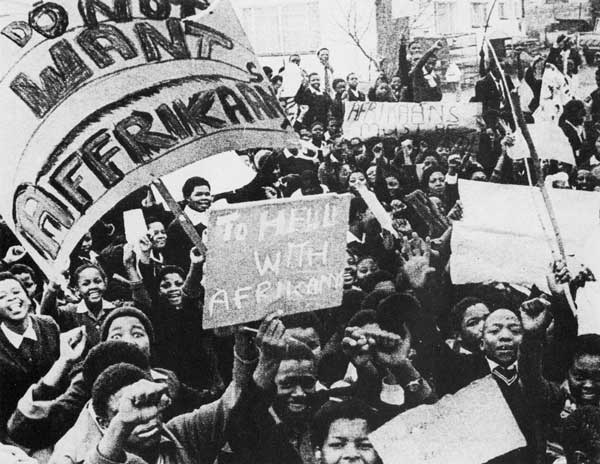 "We were singing and it was jovial, the mood, exciting and with the placards we started going."
- Dan Moyane Morris Isaacson High School
"The first time we heard of it was during our short break. Our leaders informed the principal that students from Morris Isaacson were marching. We then joined one of the groups and marched."
- Sam Khosa Ibhongo secondary School
In the end there were 11 columns of students marching to Orlando Stadium to meet at the central point of "Uncle Toms" Municipal hall. Before this point, there had been some minor skirmishes with police but it was here that police stopped them, barricading their path. Other schools had been stopped by the police earlier on and had dispersed but managed to join later. It is hard to determine how many students there were, estimates range from 1 000 to 10 000.
09:00
The march was halted and some people helped Tietsi Mashinini climb up onto a tractor so that everyone could see him when he addressed the crowd:
Brothers and Sisters, I appeal to you-keep calm and cool. We have just received a report that the police are coming. Don't taunt them, don't do anything to them. Be cool and calm. We are not fighting.
It was a tense moment for both the police and the students. Police reports stated that the situation was explosive and they retreated to await further reinforcements.
09:30
The students carried on marching until they got to what is now Hector Petersen Square, close to Orlando High School. The march came to a halt again. Different reports of what actually started the shooting have been put forward.

"Despite the tense atmosphere the students remained calm and well ordered.
Suddenly a white policeman lobbed a teargas canister into the front of the crowd. People ran out of the smoke dazed and coughing. The crowd retreated slightly but remained facing the police, waving placards and singing. A white policeman drew his revolver. Black journalists standing by the police heard a shot: "Look at him. He's going to shoot at the kids". A single shot ran out. There was a split seconds silence and pandemonium broke out. Children screamed. More shots were fired. At least four students fell and others ran screaming in all directions." Brooks & Brickhill Whirlwind before the storm, 1980
12:00
After the first massacre, the students fled in different directions. Anger at the senseless killings inspired retaliatory action. West Rand Administrative Buildings (WRAB) vehicles and buildings were set alight and burned to the ground, a white WRAB official was pulled out of his car and beaten to death, bottlestores were burned and looted. Other encounters with the police occurred where more students were killed especially in the vicinity of the Regina Mhundi church in Orlando and the Esso garage in Chiawelo. As students were stopped by the police in one area they moved their protest action to others. By the end of the day most of Soweto, including Diepkloof, which was relatively quiet during the morning, had felt the impact of the protest. For the students at some schools, this was the first they heard or saw. Schools were closed early at about 12:00 and many students walked out of school to a township on fire.
"It was past twelve, past twelve to one. Sister Joseph allowed us to go home, because now it was chaos around. So when we went home we could see that now cars were burning, especially the company cars, those from town, those owned by whites".
As more students were let out of school they joined those protesters that were closest to them. Some accounts see the events of the afternoon to be chaos or a "free for all" especially on the basis that bottlestores and beerhalls were raided and looted. The apartheid press certainly tried to portray it that way. It was clear that the events of the afternoon were not organised and an atmosphere of panic and defiance existed. However, others argue that the students attacked targets for political reasons and were disciplined in who and what they attacked. A white university student who was sympathetic was actually taken to safety by the schoolchildren themselves. It was overwhelmingly, WRAB structures and cars that were razed. One black owned business was attacked, the shop of Richard Maponya but this was deliberate. Maponya was a wealthy businessman who was despised by most people because "he exploits us and is a sell out".
There probably was an element of free for all in the looting of bottlestores. Many students came home with booze and a lot of people enjoyed the results of the plunder. But people had long seen alcohol as a method used by the apartheid government to try and make black people apathetic. Most of the beerhalls were built by the municipality. People were shouting "less liquor, better education". There were probably different motivations at play in the raids of the bottlestores. In any political protest there are those that are more politically motivated and disciplined than others, to see it as one or the other is to misunderstand the nature of political mass action.
Fires continued blazing into the night. At 21:00 Armoured Police cars later known as Hippos started moving into Soweto. Official figures were that 23 people had been killed, but some reports estimated that it was at least 200. It is hard to know how many people had been killed because of police efforts to cover up the number of people who died.
Events on June 17
The second day... was marked by uncontrollable fury and burning hostility...Police also assumed another attitude. They shot at random, and at anyone who would raise a fist and shout "Power", into their face
Many others joined the original protesters. Not everyone had heard about Hector Petersen and the others who were killed yet, but the word was spreading.
The following day I pick up stones. I joined the struggle....On the 16th I just came home and stay...because we formed the slogan "an injury to one is an injury to all" So we were supposed to be there.
- Solomon Marikele Rhulane Senior Primary
The heavily biased Cilliers Report for this day sums up the events. Schools, trains, buses, delivery vehicles, West Rand Administrative Buildings (WRAB) buildings, cars of business people, all were targeted. The fury and frustration that had been simmering amongst township youth had free reign. There was enormous police presence on the morning of the 17th 1500 police armed with sten guns, automatic rifles, and hand machine carbines had taken up strategic positions in the township. Helicopters flew overhead. The army was on standby. The police force had never developed other methods of crowd control other than the use of live bullets. The police shot at people indiscriminately and casualties were even higher than the day before.
The violent reaction of the police only made the children angrier.
At a press conference Mr. Manie Mulder announced that nearly all the WRAB buildings in Soweto had been destroyed. This amounted to 21 offices being burnt down, 10 being plundered, 3 schools burnt as well as unknown numbers of municipal halls, beerhalls, bottlestores.
The Rand had lost value overnight. Thousands of workers had refused to go to work. It was indeed a crisis for the Apartheid government. It was also a serious loss of face in light of US Secretary of State, Henry Kissingers impending visit to South Africa.
 Demonstartion during Henry Kissinger's visit... Kiss-inja (a dog) Soweto, September, 1976
To add to this, 300 predominantly white Wits students marched through the city centre to protest the killing of schoolchildren. As they marched through the streets they were joined by many black workers.
At this point the political leadership of the Soweto Students Representative Council (SSRC), SASM and other organisations were desperately trying to take leadership of the protest and to channel the anger of the youth and to give the movement political direction. The ANC in exile called for immediate international action and the intensification of economic sanctions. The protest action also spread to other townships around Soweto. In Thembisa, students organised a solidarity march, which, although heavily guarded did not result in violence. In Kagiso, police tried to stop a gathering of students and adults; the result was a forced retreat and the destruction of WRAB buildings, vehicles and schools. When the police returned with reinforcements, they shot indiscriminately into the crowd, killing at least five people.
Events on June 18
On the third day of the Uprising 18th June, the situation in Soweto was still volatile. Outside butchery in Moroka there were some fatalities. Fires were blazing in many Soweto townships, like Zola, Ikwezi, Moletsane, Naledi and Tladi. Administrative buildings, wine stores and beer halls, which were hated by the young people, were also set on fire. Buses and cars running through Soweto were burned. Police intensified their terror in trying to return the situation to normality in the township. However this angered the insurgents young people and brought them up against heavily armed police. They used stones to counter armoured police cars, helicopters and guns. At about 10 a.m the chairman of the West Rand Administrative Board (WRAB) Manie Mulder was in Soweto to asses the situation. He was escorted by a large police vans. All the WRAB owned cars that had escaped being burned were taken out of Soweto after Mulder's visit. The columns of cars drove past Orlando police station into the direction of Johannesburg.
But in general the action on this day had already moved to the East and West Rand and Alexandra townships as well as other parts of the country. The people in other parts of the country were not revolting to pledge their solidarity with the people of Soweto. They shared the same problem, the same sorrows and the same causes of resentment and rebellion. A general stawaway was organised in Alexandra Township and four people were killed when the police opened fire on marching residents. The government, which for the first time publicly addressed the issue, and justified the harsh measures taken by the police. There were some reports of students seizing weapons from police and using them to shoot back.
Response to the June 16 Soweto Youth Uprising by organisations in exile
June 16 marks the commemoration of National Youth Day in South Africa. This is the day the country reflects on the massacre of school children during the Soweto Uprising of 1976. The response of the organisations in exile can be understood in the context of the events that took place on the day. The students had organised a peaceful march against the Afrikaans Medium Decree, issued in 1974, which made it mandatory for Black schools to use the Afrikaans language as the medium of instruction in Mathematics, Social Sciences and Geography at the secondary school level. Punt Janson, the Deputy Minister of then Bantu Education, was quoted as saying: “I have not consulted the African people on the language issue and I’m not going to. An African might find that ‘the big boss’ spoke only Afrikaans or spoke only English. It would be to his advantage to know both languages.”
The policy was deeply unpopular since Afrikaans was regarded by some as the language of the oppressor. It was against this background that on 30 April 1976, students from the Orlando West Junior School in Soweto went on strike and boycotted classes. By 16 June, their rebellion spread to other schools in Soweto. Incidentally, the student-organised mass rally on this date turned violent, as the police responded with bullets to stones thrown by the angry students. Many students were shot. The official death toll was 23, but it could have been higher than 200 because the incident triggered widespread violence throughout South Africa, which claimed more lives. The first student to be shot on that fateful day was 15-year old Hastings Ndlovu. However, the killing in the same incident of Hector Pieterson, aged 12, and in particular the publication of his photograph taken by Sam Nzima, made him an international icon of the uprising. It became the major rallying point of the struggle against apartheid.
Military Response: Camps in exile
The incident triggered widespread violence not only in Soweto but also throughout South Africa. For the political organisations in exile, notably, the African National Congress(ANC) and Pan Africanist Congress(PAC), the Soweto unrest in June 1976 provided a golden opportunity both for recruitment and military training of young men and women. Many Black people felt in danger of being arrested by the police and further underground activities were launched as a result of this threat. Discreet recruitment operations culminated in many incensed students taking up arms against the government, and being sent for military training. Hence the mushrooming of military camps such as Mkhumbane in Temeke (Tanzania) outside the country, under the command and mentorship of Ntate Mashego and the Engineering camp in Angola. Recruits were advised on how to unlawfully cross the border(s) into Botswana, Swaziland, Angola, Mozambique and Tanzania, where they received military training. It is essential to note that the accession to power of the Mozambique Liberation Front (Frelimo) in Mozambique and the Popular Movement for the Liberation of Angola (MPLA) in Angola in 1975, together with the exodus of thousands of young people in the months following the Soweto uprising, created favourable conditions for the resumption of sabotage activity in South Africa, especially after the collapse of the ANC/Zimbabwe African Peoples Union (ZAPU) joint operation (i.e.the Wankie Campaign). These developments were followed by the infiltration of trained fighters back into South Africa, bombings of white installations and the subsequent arrest and trials of anti-apartheid activists.
Clearly, an issue that gave rise to a vast number of trials under security legislation was the massive recruitment of people and their transportation out of South Africa. While there is certainly some indication that this was already on the increase prior to June 1976, the revolts of 1976 gave an enormous boost to the activity of organisations recruiting members for military training. This is especially so in the case of the ANC, but there is also some evidence that PAC activity had been revitalised to some extent. As a result, there were many South Africans in ANC and PAC training camps. The period also witnessed a large number of trials against recruitment for military training. Those who were brought to trial for this offence seemed to reach a peak in 1977 and the first part of 1978. Many trained guerrilla fighters returned to South Africa, often wielding a large quantity of arms, explosives and ammunition. This group included the Black school children who fled or were recruited in the wake of the June 1976 rebellion. Their activities gave rise to a number of trials as exemplified by the case of Petrus Bushy Molefe, aged 22, who underwent training in East Germany, and was charged for sabotage and terrorism under the Sabotage and Terrorism Acts of June 1962 and June 1967 respectively. Related to this was the large quantity of arms and ammunition found by police in their attempts to uncover guerrillas in the urban areas and in clashes in the rural areas. It is important to note that most of the arms caches that were uncovered comprised weapons originating from the then Soviet Union, and the Eastern bloc countries, which suggests that the West was not prepared to lend similar support to the Southern African liberation movements.<
On 30 November 1976 a group of armed guerrillas clashed with the South African Police near Bordergate, on the Swaziland/South African border. A hand grenade was detonated by one of the guerrillas, injuring two policemen, and allowing the insurgents to escape. Shortly before this incident a railway line near Dikgale, in the Pietersburg district, was damaged in a successful sabotage attempt. From December 1976, in a series of raids covering Johannesburg, Soweto, Alexandra, Rustenburg, Odi, Nebo, Pietersburg and Sekhukhuniland, security police detained a number of ANC activists. Towards the middle of 1977 twelve accused activists, who included Mosima Gabriel “Tokyo” Sexwale, were charged under the Terrorism Act in the famous trial of the “Pretoria 12”. They were mainly accused of being members or active supporters of certain unlawful organisations in South Africa, Swaziland, Mozambique, Russia and China such as the ANC, the South African Communist Party(SACP) and Umkhonto we Sizwe(MK). They were also alternately charged with endangering, in various ways, the maintenance of law and order in South Africa; undergoing military and other training; possession of explosives, ammunition, firearms and weapons; harbouring and rendering assistance to guerrillas; as well as taking part in the activities of a banned organisation. On the whole, they were accused of conspiring to overthrow the white government and were all convicted on the main count of sedition.
Thus, the response of the political organisations operating in exile was one that was premised on mobilisation, recruitment of people and the organisation of the armed phase of the struggle from outside in order to topple the apartheid government. Clearly, the events of the Soweto revolt and the response from the liberation movement in exile are not isolated developments. They have their roots in the spirit of resistance to the growing crisis of apartheid. The collective resistance to oppression and exploitation in South Africa also fundamentally underpins the relationship that was forged between internal and external forms of organisation after this incident. It led to major transformations in the strategies of the various exiled liberation movements more in accordance with the changing conditions in the country. A militant approach, that found expression in the recruitment and subsequent training of the cadres in neighbouring as well as some European and Asian countries, was emphasised.
References to Youth and the National Liberation Struggle 1894-1994
- Brits, J. P. (1995). The Concise Dictionary of Historical and Political Terms, London: Penguin.
- Christie, P. (1991). The Right to Learn: The Struggle for Education in South Africa, Johannesburg: Sached Trust/Ravan Press.
- Cross, M. (1992). Resistance and Transformation: Education Culture and Reconstruction in South Africa, Johannesburg: Skotaville.
- Howcroft, P. unpublished South African Encyclopaedia papers.
- Kallaway, P. (ed) (1984). Apartheid and Education: The Education of Black South Africans, Johannesburg: Ravan Press.
- Saunders, C. & Southey, N. (1998). A Dictionary of South African History, Cape Town: David Philip.


