The Mfecane - known as the Difaqane or Lifaqane in Sesotho - was a period of profound political, social, and demographic transformation in southern Africa during the early nineteenth century. The Nguni word mfecane translates roughly as "the crushing" or "scattering," while the Sesotho difaqane means "forced migration" or "the hammering."
- Introduction
- The Problem of Sources
- Causes of the Mfecane
- Key Events and Leaders
- The Experience of Displacement
- Consequences of the Mfecane
- Historiographical Debates: Whose History?
- Legacy
- Further Reading
- References
Introduction
The Mfecane - known as the Difaqane or Lifaqane in Sesotho - was a period of profound political, social, and demographic transformation in southern Africa during the early nineteenth century. The Nguni word mfecane translates roughly as "the crushing" or "scattering," while the Sesotho difaqane means "forced migration" or "the hammering." The original Xhosa term ukufaca means "to be weak, emaciated by hunger" - placing emphasis on famine rather than warfare. These varied meanings capture the scale of upheaval that reshaped the region between approximately 1815 and 1840. This era witnessed widespread warfare, mass migrations, the collapse of existing chiefdoms, and the emergence of powerful new states. Its effects extended far beyond present-day South Africa, reaching modern-day Tanzania, Zambia, Zimbabwe, and Mozambique. Understanding the Mfecane requires moving beyond simplistic explanations to examine the complex interplay of environmental crisis, political centralisation, trade dynamics, and the expanding influence of European colonialism. Critically, the way the Mfecane has been narrated and remembered carries political significance. Colonial and Apartheid-era historians used particular interpretations of this period to justify white land claims and portray African societies as inherently violent. A people's history must therefore examine not only what happened, but how those events have been represented - and misrepresented - in the service of dispossession.
The Problem of Sources
One of the fundamental challenges in understanding the Mfecane is the nature of the available sources. The people who lived through these events relied on oral traditions to pass down their history. When communities were destroyed or scattered, their oral traditions were often lost. When groups merged with others, new oral traditions emerged to suit the changing composition of society. Europeans who recorded accounts of this period often did not understand or accurately interpret the stories they heard. As SAHO notes in its article on Political Changes from 1750 to 1835, "a lot of information on the mfecane is unconfirmed in writing." The written accounts that do exist were produced largely by missionaries, traders, and colonial officials - each with their own interests and biases. The largest collection of Zulu oral evidence was compiled by James Stuart, a colonial official, at the turn of the twentieth century. Historian Julian Cobbing has argued that Stuart distorted much of this evidence. Yet other scholars, such as Carolyn Hamilton, have emphasised the importance of taking African oral traditions seriously as historical sources, even when they challenge colonial narratives. R.T. Kawa's Ibali lamaMfengu (1929), written by a Mfengu intellectual, represents an important African voice in this historiography. Yet as scholars have noted, mainstream South African historians in the 1980s and 1990s largely excluded African writers' interpretations, rendering the Mfecane debate effectively a "white-only" discussion. Any contemporary people's history must work to centre African voices and perspectives.
Causes of the Mfecane
Historians have long debated the causes of the Mfecane, and scholarship has evolved considerably since the late twentieth century. Contemporary understanding recognises multiple, interconnected factors rather than a single cause.
Environmental Crisis
Paleoclimatic research has revealed that south-eastern Africa experienced prolonged drought conditions between approximately 1800 and 1820, with a particularly severe episode from 1809 to 1823. This drought was significantly amplified by major volcanic eruptions, including an unidentified event in 1809 and the massive eruption of Mount Tambora in Indonesia on 15 April 1815. The Tambora eruption - one of the most powerful in recorded history - injected sulphate aerosols into the stratosphere, reducing regional rainfall by up to 20 percent and causing colder winters across the region. Nguni oral traditions refer to this era as madlathule - meaning "the time of eating up everything" or "eat and be silent" - describing acute famine conditions. Evidence from the Killie Campbell Africana Library at the University of KwaZulu-Natal includes first-hand witness accounts calling this the Mahlatule famine, translated as "the time we were obliged to eat grass." Tree-ring analyses from baobabs in Pafuri and other ancient trees across southern Africa have confirmed this period of extreme drought, providing scientific evidence for what oral histories had long preserved. The introduction of maize by European traders had made communities more vulnerable to drought. While maize provided higher yields during good years, it required more water than traditional grains such as sorghum and millet. When drought struck, maize crops failed catastrophically, contributing to widespread famine. BaSotho and BaTswana oral traditions also record severe drought during these years. The famine did not strike evenly - some years of plenty preceded the decline in rainfall. When conditions were good, people began planting in marginal areas and some traditional resilience networks were not enforced. This made the eventual drought all the more devastating.
Political Centralisation and Competition
Prior to the Mfecane, processes of political centralisation had already been intensifying in south-eastern Africa since at least the late 1700s. Competition between chiefdoms for control over trade routes and grazing land was increasing, particularly around Delagoa Bay (present-day Maputo), where the international ivory trade offered unprecedented opportunities for wealth accumulation. This trade allowed ambitious leaders to amass wealth, which they used to cultivate political power. As wealth and power became mutually reinforcing, inequalities within and between societies increased. When environmental crisis struck, this unequal distribution of resources meant that ordinary people were far more vulnerable to famine than their leaders, intensifying social tensions and competition for survival. The competition for resources caused larger groups to seek protection from marauding bands. Leaders who could offer security attracted followers, enabling them to build larger and more powerful political formations. This was not simply violence for its own sake - it was a rational response to desperate circumstances, as people sought safety and access to food in a time of acute scarcity.
The Role of European Colonial Expansion
In 1988, historian Julian Cobbing published a provocative challenge to conventional understandings of the Mfecane in his article "The Mfecane as Alibi." He argued that the concept had been constructed by colonial and Apartheid-era historians to present the era as a period of "black-on-black destruction," thereby concealing European responsibility for violence and displacement and justifying white claims to supposedly empty land. Cobbing contended that the roots of the conflicts lay substantially in the labour demands of Portuguese slave traders operating from Delagoa Bay and European settlers in the Cape Colony. He argued that slave raiding by Griqua, Kora, and other groups armed with European weapons and horses, operating from the Cape frontier, caused widespread devastation in the interior. While some of Cobbing's specific claims - particularly regarding missionary involvement in slave raiding - have been contested by scholars such as Elizabeth Eldredge, his intervention forced a fundamental reassessment of the period. Scholars now recognise that European colonialism was not external to the Mfecane but deeply implicated in its causes and consequences. The expansion of the Cape Colony's frontier, the slave trade from Delagoa Bay, and the arms trade all contributed to the instability of the era. Slave exports from ports like Delagoa Bay surged after 1823, reaching over 1,000 annually by the late 1820s and peaking at 2,800 from Lourenço Marques and Inhambane to Réunion in 1827-1828 alone. This external demand for labour exacerbated demographic disruption in affected regions. Most contemporary historians reject both the old "Shaka-centric" explanation and Cobbing's more extreme claims. Instead, they understand the Mfecane as resulting from the complex interaction of environmental factors, internal political dynamics, and external pressures from European colonialism and trade.
Key Events and Leaders
The Rise of the Zulu Kingdom
The Zulu Kingdom emerged as a dominant power in the coastal regions of present-day KwaZulu-Natal during this period. Under Shaka kaSenzangakhona, who came to power around 1816, the Zulu incorporated numerous Nguni chiefdoms through a combination of military conquest and diplomacy. Shaka introduced military innovations, including the short stabbing spear (iklwa) and reorganised age-based regiments (amabutho) into a formidable standing army. However, the Zulu expansion was itself shaped by earlier conflicts, particularly between the Mthethwa Paramountcy under Dingiswayo and the Ndwandwe Paramountcy under Zwide. The Zulu Kingdom rose to prominence partly from the ruins of the Mthethwa after Dingiswayo's death. The defeated Ndwandwe scattered in multiple directions, their refugee groups contributing to upheavals across the region. It is important to note that colonists and missionaries often misidentified African groups during this period. The term "Mantatees" became a catch-all name used for all non-Xhosa Africans of whom Cape colonists became aware, whether through hearsay or as incoming labourers. This blurring of identities in colonial records makes it difficult to trace the precise movements and experiences of specific communities.
Mzilikazi and the Ndebele Kingdom
Around 1821, Mzilikazi of the Khumalo clan broke away from Zulu authority after refusing to remit cattle from a raid. He led his followers northward into the Highveld, where they established themselves through conquest and the incorporation of local Sotho-Tswana populations. Known as the Ndebele (or Matabele), Mzilikazi's followers caused considerable disruption as they moved across the interior, eventually settling north-west of present-day Pretoria. After conflicts with Voortrekker settlers in the late 1830s, Mzilikazi led his people north across the Limpopo River, establishing the Ndebele Kingdom in present-day Zimbabwe with its capital at Bulawayo. The Ndebele state that emerged was a hybrid formation, blending Nguni military organisation with elements drawn from the various peoples they had incorporated. Mzilikazi has been described as a "traditional organic intellectual" who used a combination of coercion and consent to build his power base and create a new polity in the midst of crisis.
Moshoeshoe and the Basotho Kingdom
Perhaps the most enduring state to emerge from this era was the Basotho Kingdom, founded by Moshoeshoe I. The son of a minor chief of the Koena (Crocodile) clan, Moshoeshoe gathered displaced and vulnerable peoples in the Caledon River valley, offering them protection and incorporating them into an expanding polity. In 1820, Moshoeshoe became chief of a larger unit of Southern Sotho groups who had fallen under his centralised authority due to competition for resources intensified by drought. In 1824, Moshoeshoe established his capital at the mountain fortress of Thaba Bosiu - meaning "mountain at night" - an easily defended flat-topped mountain with natural springs that could support thousands of people and their livestock. There were only seven paths of access to the top, all easily guarded. From this stronghold, Moshoeshoe successfully defended his people against attacks from the Ndebele, Griqua, Boers, and later British forces. Unlike many other leaders of this era, Moshoeshoe emphasised diplomacy and incorporation over pure military conquest. He gave assistance to defeated enemies, allocating them land and incorporating them into the Basotho nation. "Peace," he said, "is like the rain which makes the grass grow, while war is like the wind which dries it up." In 1833, the first missionaries from the Paris Evangelical Missionary Society arrived in the Sotho kingdom. Through his endorsement of missionaries, Moshoeshoe was able to form useful external relationships. The missionaries also helped to write the Sesotho language and contributed to uniting the Basotho people. The territory Moshoeshoe consolidated eventually became the Kingdom of Lesotho - one of the few African states to resist complete colonial absorption.
The Swazi Kingdom
The Ngwane people, living in present-day Eswatini, also consolidated into a stronger kingdom during this period. Under Sobhuza I, they retreated to more defensible higher elevations to escape conflicts with the Ndwandwe and later the expanding Zulu state. Sobhuza combined diplomacy with military strength, negotiating marriage alliances with Ndwandwe and later Zulu chiefs while building an army capable of repelling incursions. The kingdom that emerged took the name of his successor, Mswati, becoming the Swazi Kingdom.
Other New Formations
Soshangane, a general of the defeated Ndwandwe, fled to Mozambique where he established the Gaza Kingdom, dominating the Tsonga peoples of the region and at times clashing with Portuguese settlements. Zwangendaba, another Ndwandwe commander, led his followers - who became known as the Ngoni - on an extraordinary migration northward across the Zambezi River, eventually establishing states in the region between Lakes Malawi and Tanganyika, thousands of kilometres from their original homeland. The Kololo, a Sotho community harassed by the Ndebele, fled northward from the Highveld under Sebetwane and eventually founded a kingdom in modern Zambia. Each of these migrations created new encounters, conflicts, and incorporations - reshaping societies across vast distances.
The Experience of Displacement
The Mfengu and the Eastern Cape
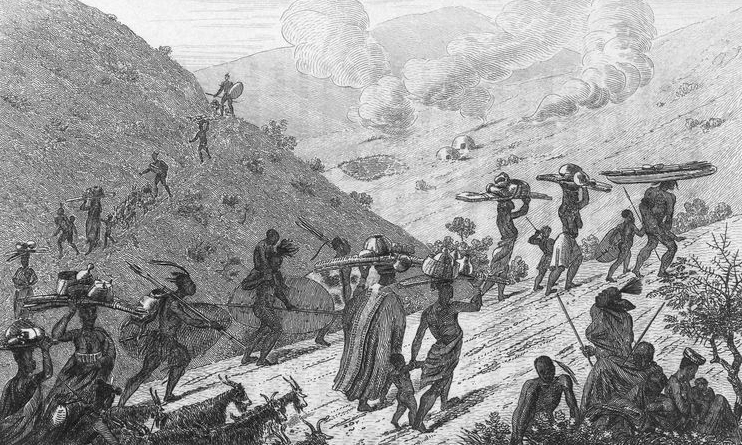
To the east, refugee clans fled to the lands of the Xhosa people. Those who were accepted became known as amaMfengu - meaning "wanderers" - a term derived from the Xhosa verb ukumfenguza, to wander about seeking service. The Mfengu - primarily people of Hlubi, Bhele, and Zizi origin - arrived in the territories of the Gcaleka Xhosa under Chief Hintsa around 1827-1830. Their experience was complex and contested. According to some accounts, they were incorporated as subordinates, subjected to conditions that some historians have compared to serfdom - forced labour in cattle herding and agriculture, with vulnerability to arbitrary confiscation of property. In 1835, during the frontier war, the Mfengu formed an alliance with the British Cape Colony. Colonial officials later presented this as a "rescue" of grateful refugees from Xhosa oppression. However, scholars such as Julian Cobbing and Alan Webster have challenged this narrative, arguing that the Mfengu identity was partly constructed by British missionaries and officials to cover up the seizure of African labourers during the 1835 war. They argue that many so-called "Fingoes" were not only refugees from Natal but also impoverished Xhosa and others brought into the colony as forced labourers. The Mfengu were granted lands in the frontier districts of the Transkei and Ciskei - at Xhosa expense and in order to act as a buffer against further Xhosa resistance to colonial expansion. With their social organisation disrupted during displacement, many Mfengu were receptive to Christianity and Western education from an early date. In the nineteenth century, many became successful peasant farmers and provided some of the first Western-style political leaders among Cape Africans. This complex history illustrates how the upheavals of the Mfecane era created opportunities for colonial exploitation, while also demonstrating African agency and adaptation in the face of crisis.
Refugees and Labour
Thousands of displaced people from the interior poured into the Cape Colony seeking subsistence. Many became labourers working for white colonists at desperately low wages. The colonial labour market was directly fed by the disruptions of the era - people who had lost their land, cattle, and communities had little choice but to seek work on European terms. This pattern would continue and intensify throughout the nineteenth century, laying the groundwork for the migrant labour system that would characterise South African capitalism. The connection between dispossession and labour exploitation, already visible during the Mfecane, would become the defining feature of the Apartheid economy.
Consequences of the Mfecane
Political Transformation
The era saw the replacement of numerous small, decentralised chiefdoms with larger, more centralised kingdoms. The Zulu, Ndebele, Swazi, Basotho, Gaza, and Pedi kingdoms all emerged or consolidated during this period. These new states were characterised by standing armies, centralised authority under powerful monarchs, and the incorporation of diverse peoples under new political identities. The Zulu Kingdom created a sense of unity and identity among people of different clans. Other kingdoms that came into being include the Swazi, Gaza, the Ndebele (who replaced the Rozwi), Ngoni, Kololo, and Lesotho. As the SAHO article on political changes notes, great numbers of people were displaced, and frightened communities left their own areas in places like the Orange Free State, Natal, and the Transvaal.
Demographic and Social Transformation
The Mfecane caused massive population displacement across southern and central Africa. Traditional estimates suggested between one and two million deaths, though contemporary historians consider these figures exaggerated. Much of the apparent "depopulation" resulted from people fleeing to defensible locations, hiding from intruders, or migrating to new territories rather than mass mortality. Revisionist analyses, emphasising European frontier raiding for labour and slaves, challenge traditional attributions of massive internal death tolls, arguing instead for exaggerated narratives that obscured colonial complicity in the turmoil. Empirical evidence from oral traditions and early settler accounts supports notable but localised depopulation, with broader shifts reflecting adaptive migrations rather than wholesale annihilation. Nonetheless, the suffering was immense. Thousands died from warfare and famine, countless communities were uprooted, and village life was disrupted across vast areas. Oral traditions describe desperate conditions, with some communities reduced to eating grass and roots during the worst of the famines. In extreme cases, famine drove some to cannibalism - a reality documented in oral histories from KwaZulu-Natal.
European Colonial Expansion and the "Empty Land" Myth
The disruptions of the Mfecane had significant consequences for European colonial expansion. Areas that had been temporarily depopulated, or whose inhabitants were hiding in defensive positions, appeared to European observers to be empty and unclaimed. This perception - encouraged by the narrative of devastating "black-on-black" violence - helped justify white claims to land in the interior. When the Afrikaner Voortrekkers reached the Highveld after their incursion from the Cape in the Great Trek of the 1830s, they claimed that the region was almost devoid of African inhabitants because, the thinking went, they had all fled in the face of the Mfecane. The Boers believed the land was deserted and abandoned and therefore theirs for the taking. Part of Afrikaner mythology also claimed that the Boers had "rescued" the few scattered tribes by giving them protection against the forces of Shaka. This myth of a vacant interior became particularly destructive in the hands of the Apartheid government. The state used this myth as justification for its construction of the homelands (Bantustans). Although the homelands housed 70% of the population, they comprised only 13% of the total landmass. The Apartheid government justified this incredibly unequal distribution by claiming that the land in white hands was historically "empty land" - land that had belonged to nobody and therefore could not form part of a homeland. As the historian Shula Marks documented in her influential work "The Myth of the Empty Land," this narrative served to legitimate white supremacy and land dispossession. Archaeological evidence and carbon dating conclusively show that Iron Age agropastoral farmers - the precursors of the contemporary Bantu-speaking population - had been present in the eastern half of South Africa since around 300 CE, more than a thousand years before European arrival. See SAHO's article on The Empty Land Myth for more detail.
Historiographical Debates: Whose History?
The Mfecane remains one of the most contested concepts in southern African historiography. The term itself only emerged in the 1830s and was consolidated as a historical concept by colonial historians in the late nineteenth and early twentieth centuries. George McCall Theal, considered the "grandfather of South African history" writing in the 1890s, gave credence to theories that Bantu-speaking peoples had arrived in South Africa at roughly the same time as Europeans, and that large tracts of land had been "left vacant" during the Mfecane. Early accounts blamed the disruption entirely on Shaka and Zulu aggression, portraying African societies as inherently violent and unstable. This interpretation served to justify European colonial expansion - if Africans were naturally prone to destroying each other, then European rule could be presented as bringing civilisation and order. In 1966, John Omer-Cooper's The Zulu Aftermath reframed the Mfecane as a period of African political innovation and state-building, challenging colonial narratives that dismissed African societies as lacking history or development. While still centring Shaka as the primary cause, Omer-Cooper emphasised African agency and the sophisticated political formations that emerged. This "Africanist" interpretation was part of a broader effort by historians to support the process of building new, modern nations across the decolonising continent. But as Cobbing argued in the 1980s, the Apartheid state had co-opted this interpretation. The Mfecane seemed to be perfect justification for the "empty land" hypothesis which supported white settlers taking the heartland of South Africa, while a "horseshoe" of black reserves curved around the white heartland. By the end of the 1970s, the Omer-Cooper version of the Mfecane had been adopted as a charter of origins for the new black rulers of the autonomous Bantustans - convenient for Apartheid's policy of "retribalisation." Cobbing's 1988 intervention, "The Mfecane as Alibi," fundamentally challenged this narrative. By arguing that the concept had been constructed to conceal colonial violence and justify land dispossession, Cobbing sparked an intense debate that continues to shape the field. Some critics, such as Jeffrey Peires, described Cobbing as "a reactionary wolf dressed up in the clothing of a progressive sheep," while others accused him of developing a Eurocentric hypothesis that robbed Africans of agency within their own history. The current scholarly consensus recognises the Mfecane as a real period of upheaval with multiple causes: environmental crisis, internal political dynamics, and external pressures from European colonialism and trade all played significant roles. Scholars also acknowledge that the way the Mfecane has been narrated and remembered carries political significance, having been used to serve various ideological purposes from colonial justification to Apartheid-era propaganda. The South African school curriculum (CAPS 2011) now notes that the Mfecane need not be covered in detail "as it is now considered outdated" in its traditional form. Historians are moving away from the idea of mfecane/difaqane as linked to colonial-era ideas about the centrality of "the wars of Shaka." Wars and disruptions took place, but most of them were not caused solely by Shaka and the Zulu.
Legacy
The Mfecane fundamentally reshaped southern Africa. The kingdoms established during this era - Lesotho, Eswatini, and the cultural identities of the Zulu, Ndebele, and others - persist to the present day. The period also established patterns of displacement, migrant labour, and contested land claims that shaped the region's subsequent history. The vulnerability of displaced communities during this period caused some to welcome white settlers as potential allies against their immediate enemies, rather than recognising them as future oppressors. These areas offered space for white settlement when dissatisfaction with British rule at the Cape inspired the Great Trek - the emigration of frontier farmers from the colony that would reshape the political geography of the subcontinent. Understanding the Mfecane requires moving beyond simplistic narratives of African savagery or European innocence. It was a period of genuine crisis and transformation, shaped by environmental catastrophe, political ambition, and the expanding reach of global trade and colonialism. The suffering it caused was real, as were the remarkable achievements of leaders like Moshoeshoe who built new societies from the chaos. Perhaps most importantly, the continuing debates over the Mfecane remind us that history is never simply about the past. How we tell the story of this era carries implications for how we understand land, identity, and justice in southern Africa today. The myths constructed around the Mfecane were used to justify dispossession and Apartheid. A people's history must expose these myths while honouring the experiences of those who lived through - and survived - this transformative era.