
On 1 December 1834, slavery came to an end in the Cape Colony. The move to abolish slavery in the Colony came a year after the Slavery Abolition Bill of 1833 was passed by the British House of Commons and by the House of Lords. Although the Bill was passed in August 1833 it came into effect on 1 August 1834. On that date slavery was abolished throughout the vast British Empire, with a few exceptions. One was the Cape Colony, where it was delayed for four months until 1 December. The Act apprenticed slaves to their masters for a period of four years. This enabled them to learn trades and afforded a transition period for the owners. A certain amount was granted as compensation to the owners, which they had to collect personally in Britain and was in some cases barely enough to pay for their expenses. The abolition of slavery and the way in which it was enacted was one of the contributing factors leading to the Great Trek (starting in 1835) from the Cape Colony. Piet Retief, in his famous manifesto to the Grahamstown Journal, wrote: “We complain of the severe losses, which we have been forced to sustain by the emancipation of our slaves, and the vexatious laws, which have been enacted respecting them”. Though the abolition of slavery has been historically treated as the main cause of the Great Trek, there were other equally compelling reasons for the settlers to leave the Cape Colony. Further reading list: A history of prison labour in South Africa Indenture: A new system of slavery? Ship list of Indian Indentured Labourers Slave Resistance The Early Cape Slave Trade The First Slaves at the Cape ‘Liberated’ Slaves? by Joline Young
1 December 1834
Slavery abolished in the Cape
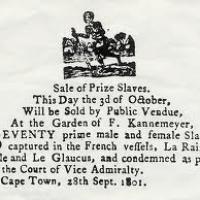
Sale of prize slaves was widely practiced
- Updated
- 22 Jul 2026
Sale of prize slaves was widely practiced
How we know this
- 01Potgieter, D.J. et al. (eds) (1970). Standard Encyclopaedia of Southern Africa. Cape Town: NASOU. v. 9, p. 659-660.
- 02South African History Online (2011). ‘Early Trading Systems' in Classroom: Grade 7 [online]. Available at www.sahistory.or.za [Accessed 25 November 2011]
Last updated · 22 Jul 2026
South African History Online. (2019, December 1). Slavery abolished in the Cape. South African History Online. https://sahistory.org.za/ref/E-0149779
South African History Online (2019) 'Slavery abolished in the Cape', South African History Online, 1 December. Available at: https://sahistory.org.za/ref/E-0149779 (Accessed: 27 October 2026).
South African History Online, Slavery abolished in the Cape [website], https://sahistory.org.za/ref/E-0149779, (accessed 27 October 2026).
"Slavery abolished in the Cape." South African History Online, 1 Dec. 2019, https://sahistory.org.za/ref/E-0149779. Accessed 27 Oct. 2026.
South African History Online. "Slavery abolished in the Cape." South African History Online. December 1, 2019. https://sahistory.org.za/ref/E-0149779.
Also on 1 December
- 1880The railway line between Durban and Pietermaritzburg is completed
- 1890Kimberly linked by rail to Barkley West
- 1978Transkei’s first President, Paramount Chief Botha Sigcau, dies
- 1986Dr Ribeiro and his wife are gunned down
- 1987Julius Nyerere chairman of the Chama Cha Mapinduzi (CCM) addresses the ANC in Arusha
- 1988World Aids Day is internationally observed for the first time
- 1999Unesco lists Robben Island as a World Heritage Site
- 1999South African GMO Act implemented
Further reading
 Article
Convict Stations & Labour in the Cape Colony
 Article
History of Slavery and early colonisation in SA timeline 1602-1841
 Article
Amersfoort Legacy - History of education in South Africa
 Article
Indenture: A new system of slavery?
 Article
Slave Resistance
 Article
The Early Cape Slave Trade
Search events by date
This day in history
What happened on your birthday?
SAHO is free because readers fund it. Donate →
Contribute to this record0 comments
Comments are reader contributions. They are not part of the archival record.