
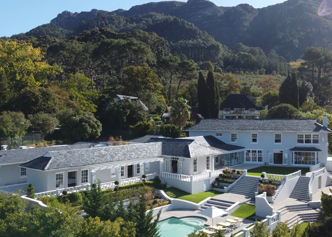
The other picture of a Mansion, 'owned by Deputy Minister- Paul Mashatile, in Constantia. (Link in Further Reading.)
The Former estate in the magisterial district of Wynberg, 24 km, by road from Cape Town. It was over 7.63 square kilometres, in extent and was granted to Governor Simon van der Stel on 13 July 1685 by Hendrik Adriaan van Reede tot Drakenstein. He was the Lord of Mijdrecht, which is a town in the Netherlands. He was visiting the Commissioner of the Dutch East India Company. During the 18th and early 19th centuries it was subdivided into six farms, on each of which there still stands a fine old Cape Homesteads. The origin of the name given by Simon Van der Stel is most probably, as suggested by Dr. A. J. Boeseken, that he named it after Constantia, daughter of the Commissioner; 'Rijckloff van Goens', who made the original grant, later confirmed by Van Reede. Perhaps the meaning of the name (constancy) was an additional reason. As such allegorical names were very popular at the time! Van der Stel built a simple country-house there in 1692, without gables and with small casement windows. After his retirement in 1699 he lived at Constantia until his death in 1712, upon which the estate was divided into three parts and sold. The parts were called: Groot Constantia; Klein Constantia and Bergvliet.
Groot Constantia was slightly over 193.33 square kilometres in extent and the Homestead it stood upon was transferred to Olof Berg in 1716 and after his death in 1734 passed successively through the hands of Carl George Wieser who was an outstanding wine farmer. Jacob van der Spuy, Johannes Serrurier and Hendrik Cloete remained the owners from 1778 to 1885. Hendrik Cloete made Constantia wine world-renowned. Moreover, he employed the architect L.M. Thibault and the sculptor Anton Anreith to build a new wine-cellar for him; the bas-relief on the pediment, dated 1791, ranks among South Africa's greatest works of art. Shortly afterwards Cloete enlarged and improved the unassuming home of Van der Stel, converting it into a country-house famous for its beauty, and undoubtedly the work of the same partners. The front part of the house was widened, large sash-windows were put in place of the old side-hung casements, the walls and ceilings were raised, and the magnificent gables were added. There is conflicting evidence about the date of the figure on the front gable, but as its niched formed part of the alterations made in 1792-73 it is likely that the figure is of the same date. It apparently replaced a painting over the door of the original house possibly intended to represent Constancy.
In 1799 Hendrik Cloete died, and in 1800 Groot Constantia was transferred to his son, Hendrik jr. During the latter's lifetime the size of the farm was much increased by freehold and quitrent grants. He died in 1818. In 1823 his widow, Anna Catharina Scheller, made a large deduction in favour of their fourth son, J. G. Cloete, and in 1824 the remainder with the homestead on it, was transferred to their third son, Jacob Pieter Cloete, who died in 1875. Ten years later the Cape Government acquired the property for use as an experimental wine-farm. In Dec. 1925 a fire, still unexplained, burnt out the Homestead, leaving only the walls standing. The architect F. K. Kendall was commissioned by the South African Government to restore it. He recreated Groot Constantia as it appeared just after 1793, when it was at its best, and made it structurally far sounder. It remains incomparably the finest old Cape house still standing and was proclaimed a Historical Monument in 1936. After the restoration the homestead -now a Museum under the administration of the Department of Public Works - was refurnished at his own expense by the art collector and connoisseur A. A. de Pass. The rooms contain a variety of tables, chairs, four-poster beds, settees, desks and wardrobes, in indigenous and imported woods, such as stink-wood and yellow-wood, rosewood and teak. These pieces of furniture exemplify the fine craftsmanship that created them and the loving care in which they were held by generations of owners.
There are also some I7th Century Dutch paintings among which seascapes by: Hendrik Cornelisz Vroom and Willem van de Velde. Also discovered were: some old Maps and title-deeds; Delft and Oriental jars, vases, plates and dishes and engraved and cut glass. Among the kitchen utensils are brass and copper pans and kettles.
Bergvliet, about 4.5 square kilometre Area and the larger part of Klein Constantia, slightly over 1.7 square kilometres was acquired in 1716 by Isaac Scheepers and Jan Brommaert in partnership. Both portions then passed through the hands of J. Brommaert alone, Elbert Diemer, Pieter Heufke (Peter Hoffke), Gerrit van der Port, Jacob Rohland, Johann Nicolaus Schott and Petrus Michiel Eksteen, son of the owner of 'Zorgvliet'. In 1783 Sophia Cloete, Eksteen's widow, transferred the properties to their son Hendrik Oostwald Eksteen. Then in 1793 Eksteen deducted about 200 morgen (171hectares) for his brother-in-law Cornelis Brink, consisting of the larger part of Klein Constantia, mentioned above, and over 60 morgen (51 hectares) of Bergvliet too.
Bergvliet, with its area thus a little reduced, remained in the possession of H. O. Eksteen until his death, and in 1812 was transferred by his widow, Elisabeth Scholtz, to their youngest son, another H. O. Eksteen. In 1830 he went bankrupt though and his property was divided into four parts and sold. His cousin Johannes Paulus Eksteen acquired one part in 1830, described as the remainder although it was the first to be transferred; a small part (including part of 'Baasharmanskraal') went to Thomas Dreyer in 1831; the third to L. J. Colyn in 1832; the rest to two partners, and from them to L. J. Colyn in 1836. There was apparently no homestead on Bergvliet until P. M. Eksteen built one about 1769. Probably that house is the one still standing there, though it was considerably altered about the 18305. Today a large township, Bergvliet, occupies part of the farm.
Nova Constantia (a trifle more than part II of the original Klein Constantia) was transferred from H. O. Eksteen to C. Brink in 1793. Brink built a house on the property, and the following year transferred about 1.47 square kilometres to his brother Arend. This was possibly to meet part of the costs of building. The remaining extent of a little less than 0.24 square kilometres was transferred in 1801, to H. C. Carinus (from the estate of Carinus who passed in 1805), to J. G. van Helsdingen. A month later it was transferred again to Lambertus Johannes Colyn. Then in 1836, it was again transferred from the widow of L. J. Colyn to their son, also L. J. Colyn. The house was built in 1796, but it is nevertheless more likely to have been built by Cloete then by A. Brink. It greatly resembles Nova Constant, and the two houses may easily have been designed by the same hand. Cloete used the name Cis-Constantia for the property, and a later owner, Henry Batt called it:' Plumstead', after a place in Norfolk from which he came.
Klein Constantia II must not be confused with the property of the same name transferred by Pieter de Meyer in 1976. It is a deduction from Groot Constantia, made in 1823 by Anna Catharina Scheller, widow of Hendrik Cloete jr., for their youngest son Johannes Gerhardus. The name of the older Klein Constantia had been replaced by: Hoop op Constantia, Nova Constantia and Buitenverwachting. before the date at which the present Klein Constantia came into existence. The homestead on the property appears to date from before the deduction; its gables are of about 1800 in style, and its windows probably of the same date. It has been claimed that the walls are older still.
High Constantia, was never part of Constantia; it was part of the adjoining farm: 'Witteboomen', which belonged to Simon van der Stel. There was a Company's post on Witteboomen, granted to W. Duckitt in 1806 in exchange for Newlands. Duckitt probably built the house, now demolished. It owes its name to its position, not its history. MARY ALEXANDER COOK Constantia Valley. This fertile Valley situated south-west of Wynberg, in the curve formed by the Constantiaberg and the Steenberg mountains. It is well-watered hill country, transitional from mountain to plain; consisting of sheltered valleys and rounded slopes, the terrain is dissected by numerous streams, including the Spaansemat river; Keysers river and Diep Rivers. All of which flow into the Zandvlei near Muizenberg. During the 18th century Constantia wine, a type of sweet muscadel, became very popular in Europe. The three chief producers during the 18th and 19th centuries were the estates Groot Constantia, Alphen and High Constantia. Even today the valley is mainly rural and is still given over largely to the vine, but has been much encroached upon by road-building and as a result of subdivision of farms. Constantia still produces some fine wines, but is even better known today for its table grapes, most of which are exported. It is also a productive vegetable-farming area, and flowers are cultivated on many farms.
The population of the valley in 1960 was: White 4,481; Coloured 9,643; Bantu 1,366; Asiatic 66. The Valley lies away from the railway and is served by bus lines.
Whether visiting for the day, or spending the night; your visit to the oldest uninterrupted wine growing region in the Southern-hemisphere will leave you coming back for more!


