
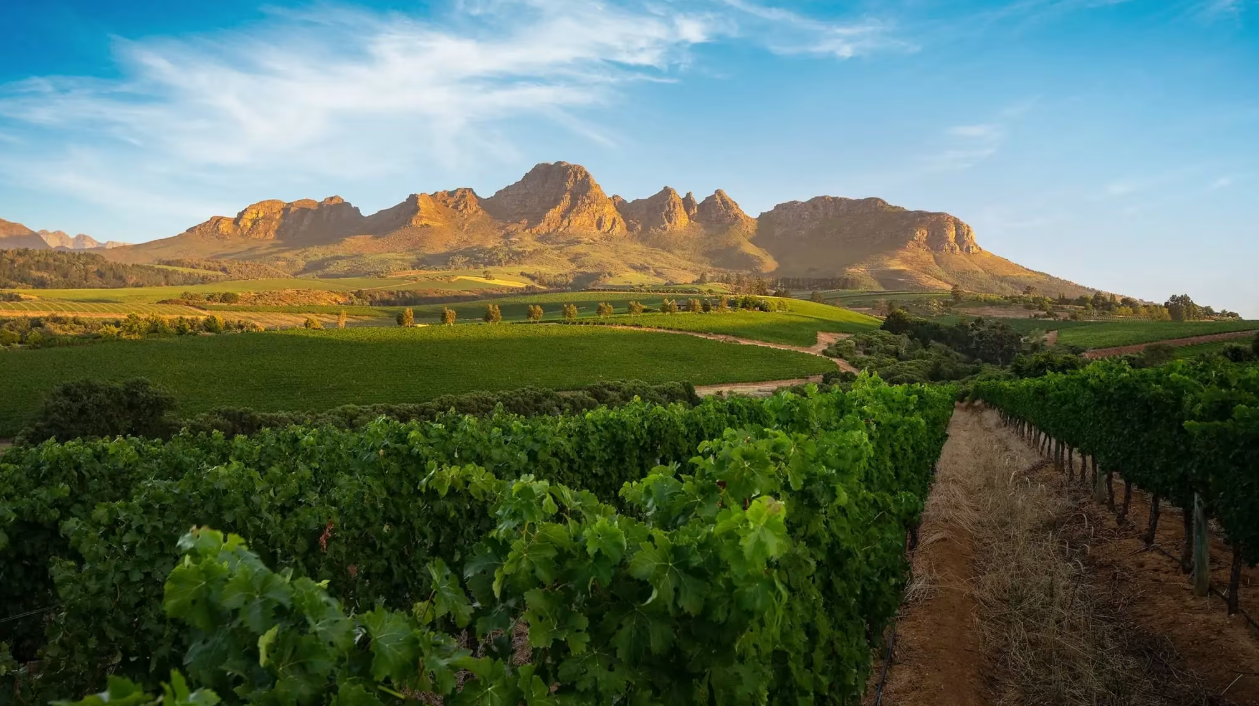
This Historic Town, is a living Museum with a vibrant 'Street Culture'. The Town has a variety of soils and locations ideally suited to flourishing of a wide variety of grape cultivars. This has seen Stellenbosch continue to dominate the South African wine scene in terms of quality. With the growing acceptance of South African wines globally, Stellenbosch remains at the forefront of growth in the wine Industry. "Discover and explore the more than 150 Wine Farms and Estates where both connoisseurs and novice wine-drinkers can enjoy the fruit of the vine. Sample award-winning wines, relax and drink in the atmospheres of the Winelands."
The Stellenbosch Winelands, is the undisputed Gourmet Capital and offers something for all tastes. From the most discerning of diners to those who enjoy relaxed honest hospitality or celebrating the best of 'local is lekker'. Or do some Outdoor Activity by participating in one of Stellenbosch's many Hiking Trails.
Stellenbosch is the second oldest Town, in South Africa and has fondly been called ‘Eikestad’, which is Afrikaans for; 'City of Oaks'. The Streets are lined with some of the most beautiful surviving examples of Cape Dutch, Georgian and Victorian Architecture in the Cape. 'Dorp'-(Afrikaans meaning town) this Street is a National Monument and taking the time to walk around this old part of Stellenbosch, with its secluded lanes, water furrows, cosmopolitan restaurants and coffee bistros, with superb views of mountain, vineyards and orchards, is an idyllic morning venture.
The name ‘Stellenbosch’ is almost synonymous with the wine industry. Not only does it have the oldest wine Route in the Country, and arguably the most famous, but the Town has one of the most modern experimental Wineries, in the World. The only Viticulture and Oenological Department in the Country, are at its University. Stellenbosch hosts South Africa’s, oldest Music School, the famous Stellenbosch Conservatoire and there is a collection of Galleries and Museums housing National and International art collections worth viewing.
For the nature lover there are a number of excellent hikes in the Jonkershoek Nature Reserve. The full-day Vineyard Hiking Trail, a fairly new, 24 kilometre long trail, starts on the slopes of the 'Papegaaiberg' Mountain and winds its way through Vineyards, Forests, Olive Groves and the Coastal Renosterveld.
While many of the Historical Buildings are close by and it is possible to discover some of Stellenbosch, on foot! The Toy & Miniature Museum is situated behind the Information Bureau and is the only one of its kind in South Africa! Close to Market Street is the Town Square, known as 'Die Braak'. The Braak (Village green) in Stellenbosch is an open Area about the size of two rugby fields. It borders 'Bird Street' which on one side has modern shops and offices while on the other, the History surrounding the Braak! The first Building we come across on the Northern side of the green is 'St Mary's Church', which was built in 1852 and is an example of the type of Cape Dutch Architecture that was in fashion in the 1850's. To the West are a number of Buildings and the most interesting is the old VOC 'Kruithuis', which was built in 1877. Kruit is the Afrikaans and Dutch word for gunpowder and ammunition and this Building was used to store, the local supplies for the Dutch East India Company. Its round roof is not thatched like all the other Buildings of that era but is built of bricks to protect the ammunition stored in it! Outside its Main Gate are two Cannons, that date back to the 1800's as well! In the old days the 'Kruithuis' was on the outskirts of the Town but, due to the growth of Stellenbosch, it now finds itself in the Centre of the Town.
On the Southern side of the green is the lovely old Rhenish Church which dates back to 1823. It was built by Missionaries and was inaugurated, on the 5th February 1824. The Northern wing which faces 'Die Braak' and was added in 1840. "A very interesting fact is that the two Church bells, which hang close by in the Church Garden. Both of them still have their bell ropes so are obviously rung on Sundays, to invite worshipers. The lettering on the bells is in German, so they must have been cast in Germany and brought to South Africa!"
Also to be found, on the Braak is the P J Olivier Art Centre which Houses an Educational Centre for the Arts. Most of the old Buildings around the Braak have been declared National Monuments and as such are not allowed to be altered in any way!
Best Afrikaans school in South Africa with 3.62 distinctions per matric
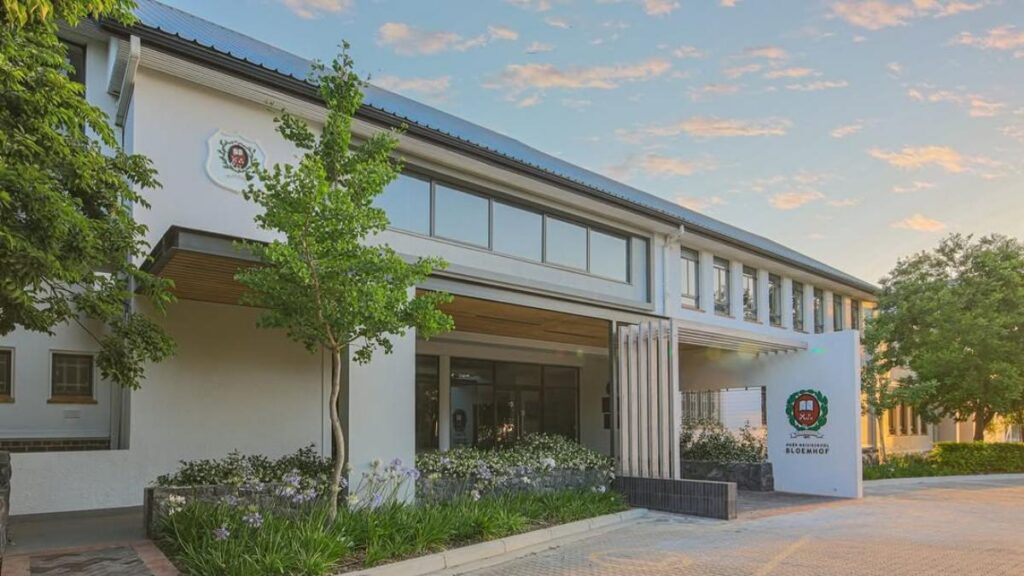
Hoër Meisieskool Bloemhof has been crowned the top Afrikaans school in South Africa with 3.62 distinctions per candidate in the 2025 matric exams. Hoër Meisieskool Bloemhof is a government high school for girls located in Stellenbosch, Western Cape. Founded in 1874 by Rev. JH Neethling, Prof. NJ Hofmeyr and Prof. J. Murray, it is the oldest Afrikaans-medium girls’ high school in South Africa. Neethling named the boarding house Bloemhof, as he wished the young ladies to be flowers for the people. In 1879, Miss Gilson, the school’s first principal, requested permission for the school itself also to be called Bloemhof. For the first few decades, it was an English-medium school, but in 1925, the language of instruction was changed to Afrikaans. The original school was housed in a Ryneveld Street building, today known as the Eben Donges Centre. In 1960, the school moved to its current premises, which includes the school building, boarding house and sports fields. Hoër Meisieskool Bloemhof’s leading feeder school is Laerskool Eikestad, and its brother school is Paul Roos Gymnasium. Along with Rhenish Girls’ High, they form a mini-campus with some shared academic subjects and educators. Bloemhof is known for outstanding academic, cultural and sporting achievements, which makes it one of the most sought-after schools in the Cape. Sports the school excel at include athletics, tennis, swimming, water polo, artistic swimming, hockey and netball. It also offers a strong cultural program, including a school choir, orchestra, school newspaper, and debate team. Learners can take drama, art and music as subjects. Bloemhof is founded on Christian principles. The values encouraged among its learners are respect, care, integrity, and a strong work ethic. It is a quintile 5 public school and forms part of the Western Cape Education Department (WCED).
Hoër Meisieskool Bloemhof is the top Afrikaans school in South Africa
Hoër Meisieskool Bloemhof continued its exceptional academic performance with strong matric results in 2025. The school achieved a 100% pass rate, 96% of candidates received university exemption, and 73% passed with a B symbol or higher 55.7% of candidates passed with four or more A symbols. Hoër Meisieskool Bloemhof’s grade average was 75.4%. 55 learners passed with an A average. Collectively, its matric candidates achieved 508 subject A symbols, averaging 3.63 per learner. Malaika Nel passed with eight distinctions. In addition, 13 candidates earned 7 A symbols, 12 earned 6 A symbols, and 29 earned 5 A symbols. Its top learner was Karmi Gouws with an average of 93.67%, followed by Leandi Roos with 93.17% and Malaika Nel (92.17%). These results helped to make Hoër Meisieskool Bloemhof the top-performing Afrikaans school in the 2025 matric exams. The Solidarity Support Centre for Schools (SCS) released its list of the Top 20 Afrikaans schools, based on the number of distinctions per candidate. Afrikaans schools include single-medium, dual-medium and parallel-medium schools where at least 15 candidates are offered Afrikaans Home Language. To qualify for the Solidarity Support Centre for Schools Top 20 List, more than a third of the matric group had to be Afrikaans-speaking. The table below shows the top-performing Afrikaans schools in the 2025 National Senior Certificate (NSC) exams. (LINK PROVIDED IN REFERENCES)


