
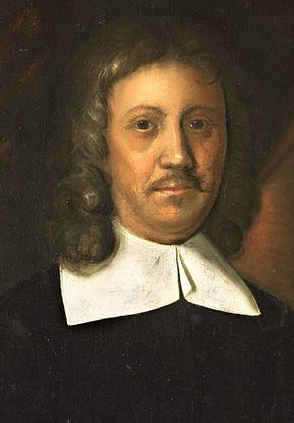
Johan Anthoniszoon "Jan" van Riebeeck (Jan van Riebeeck) was born on 21 April 1619 in Culemborg, Netherlands to a surgeon. He spent his youth in Schiedam, Netherlands where, on 28 March 1649, he married Maria de la Queillerie, with whom he had eight children.
Jan van Riebeeck joined the Dutch East India Company (Vereenigde Oost-Indische Compagnie - also referred to as VOC) in 1639 where he began as an assistant surgeon on a voyage to Batavia (today known as Jakarta) in the East Indies in April 1639 and then further on to Dejima (today forming part of Nagasaki) in Japan in 1643.
In 1645 van Riebeeck was given charge of the Dutch East India Company trading station at Tongkin in French Indochina (today known as Vietnam). He was dismissed from the post, when he was found to be conducting trade in his personal capacity, defying the ban on private trading.
Following his dismissal, on his voyage to the Netherlands, van Riebeeck spent 18 days in Table Bay, near the Cape of Good Hope, which, upon his return, he advocated as an ideal location for a provisioning station, a view that was commonly shared amongst traders and company officers.
In 1647 a Dutch trade ship, the Nieuwe Haerlem, was wrecked in Table Bay and a number of the crew remained to look after the cargo that could not be transferred to other ships in the trade fleet. The crew established a camp, bartered with the indigenous Khoisan, and awaited their rescue which would take an estimated year to arrive. On their return in 1648, a report was submitted that further demonstrated the value of the Cape. In 1651 a decision was made by the Dutch East India Company to establish a presence in the Cape of Good Hope.
Jan van Riebeeck was given the command of the Dutch expedition to establish and fortify a provisioning station in the Cape to supply trade ships with fresh goods and water. van Riebeeck set off from Texel, Netherlands on 24 December 1651 and arrived in Table Bay on 6 April 1652.

Jan van Riebeeck arrives in Table Bay in April 1652
The VOC had no desire for either the conquest or the administration of a territory in southern Africa. Their interest was to ensure the provision of vital supplies to their shipping fleets on their way to and from the Dutch East Indies. van Riebeeck's specific instructions were not to colonize the Cape, but to build a fort, to erect a flagpole for signalling to passing ships, and to build pilot boats to escort passing ships safely into the bay.
van Riebeeck constructed the Fort de Goede Hoop (Fort of Good Hope) to operate from. The Fort was replaced in 1666 with the construction of the Castle of Good Hope.
At the Cape of Good Hope, van Riebeeck experienced crop failure, owing primarily to the differing climate as compared to that of the Netherlands, and disorder amongst the men accompanying him as the labour demands of provisioning passing ships were beyond the capabilities of the men stationed there.
In 1655 van Riebeeck reported that without the presence of dedicated individuals working their own farms, the station would fail. Consequently, in 1657, the Dutch East India Company sent settlers that were contracted to the company, who would be released from said contracts on the condition that they worked the land and sold their produce to the company. These settlers were referred to as free burghers.
van Riebeeck spent his time introducing crops such as grapes, apples, and potatoes that would prove beneficial to both the passing ships and the settlement itself. In 1659, van Riebeeck established a vineyard producing red wine to combat scurvy, having noted in his travels that wine consumed on travelling ships seemed to prevent scurvy to an extent.
He served as the commander and administrator of the burgeoning colony in the Cape of Good Hope until 1662, after which he was promoted, in 1665, to Secretary to the Governor-General of the Dutch East Indies where he served until his death on 18 January 1677 in Batavia.
Johan Anthoniszoon "Jan" van Riebeeck remains a significant figure in South African history for his role in establishing the colony at the Cape of Good Hope. His image was prominently displayed on banknotes and stamps during the Apartheid era, and statues of both him and his wife can be found on Adderley Street in Cape Town.

The statue of Jan van Riebeeck in Adderley Street, Cape Town


