
Cradock is a Historic Town that has retained much of its 19th-Century charm. Its beautifully restored Victorian and Karoo-style buildings, combined with its rich History of the Anglo-Boer War and early settlers, make it a fascinating place to explore. The Town is famous for its traditional Karoo lamb dishes, the Great Fish River Museum, and the historic Tuishuise & Victoria Manor, which transports visitors back to Colonial times.
'Kaladokhwe' is an isiXhosa word distorted from the name Cradock, while Nxuba is the local name for the Great Fish River.
On August 26, the Minister of Sport, Arts and Culture, Nathi Mthethwa gazetted the new names for Eastern Cape Towns and Villages. The name changes were approved in terms of Section 10 (2) of the South African Geographical Names Council Act (Act No 118 of 1998). The name changes will mainly affect towns and villages in the Amathole District Municipality while Cradock, which will be renamed Nxuba, is in the Chris Hani District Municipality. The other name that was proposed for Cradock was Kaladokhwe.
Following the Frontier War of 1811-12 the British established a military outpost on a site about 20km south of present-day Cradock. The fort was manned by a detachment under Col John Graham who, at that stage, was stationed in Graaff-Reinet. On 12 July 1812 Ensign Andries Stockenstrom was appointed Deputy-Landdrost at Graaff-Reinet. His brief was explicit and quite detailed: he was to establish his residency at the outpost, and he was to organise for the construction of a drostdy, a set of administrative offices, a prison, and sufficient residential accomodation for his staff. Stockenstrom was obviously not impressed with the site chosen for him, and after a lengthy exchange of letters with Cape Town, he was allowed to transfer his residency to Buffel's Kloof, a loan-farm owned by Piet van Heerden located on the east bank of the Great Fish River, which he found to be "most central and convenient for public business". The Great Fish River Museum is a Cradock Monument dedicated to the History of the hard lives of the pioneer settlers of the Middle Karoo.
Van Heerden was paid 3,500 rix-dollars in compensation for improvements he had made to the lease property, and on 30 July 1813 work began on a prison, and houses for the court messenger and the police constable. The new village soon began to take shape, and early in January 1814 its inhabitants petitioned the Governor for the privilege of naming the settlement in his honour. He replied that he felt "flattered by the proposition to give my name to the deputy-drostdy and can only in return offer my best wishes for its prosperity". Matters were placed on a formal footing on 21 January 1814 when the following announcement appeared in the Government Gazette: "Notice is hereby given that His Excellency, The Governor and Commander-in-Chief, at the particular request of the Landdrost and Heemraden of Graaff-Reinet, has been pleased to consent to the residence of the Deputy-Landdrost, of said district being in future called Cradock."
Although the village was not properly surveyed until March 1842, the first erven were granted by title deed on 27 August 1818. Lord Charles Somerset, who succeeded Cradock as Governor in 1814. Somerset was not impressed by the new settlement, which he described as "a miserable place which could never advance", and on 12 March 1825 he relocated its drostdy to Somerset East. This decision was reversed on 20 May 1831, and in June 1836 a new Resident Magistrate and Civil Commissioner was appointed to Cradock. The departure of dissaffected Dutch farmers from the district in 1836 and 1837 was a setback to the local economy, but it was largely offset by the influx of English settlers into the region. James Backhouse visited Cradock in May 1839 and reported that: "We rode into Cradock, which is a small town of two imperfect streets, bordered with apple, pear, almond and mulberry-trees. The houses are white, and are chiefly of two stories, in the old, Dutch style."
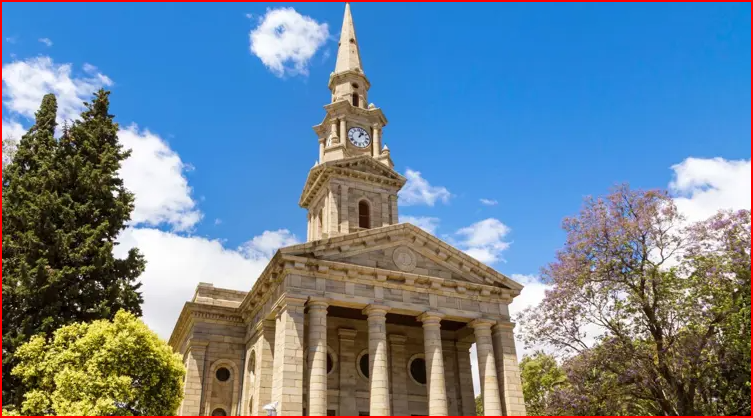
By the 1880's Cradock had become a thriving centre for local and regional business, and could boast of a number of fine buildings. A new town hall and public offices were erected in 1864-65 for about o6,000, and work on the new Dutch Reformed Church, a replica of St Martin's-in-the-Fields in London, was completed in 1868 at a cost of o30,000. Today this building is widely regarded as one of the finest pieces of ecclesiastical architecture in the Cape (Smith 1964).
The 1865 census indicated that Cradock had a population of 1,845. In 1875 this number had dropped marginally to 1,712, but by 1891
it had risen to 4,389. By 1904 it stood at 7,762, of whom 3,313 were literate.
During the Colonial Era, Cradock was served by a number of good newspapers: the "Cradock Despatch" was founded in 1850, the "Het Cradocksche Nieuwsblad" in 1856, the "Cradock Register" in 1858, and the weekly "Midland News and Karoo Farmer" in 1891.


