
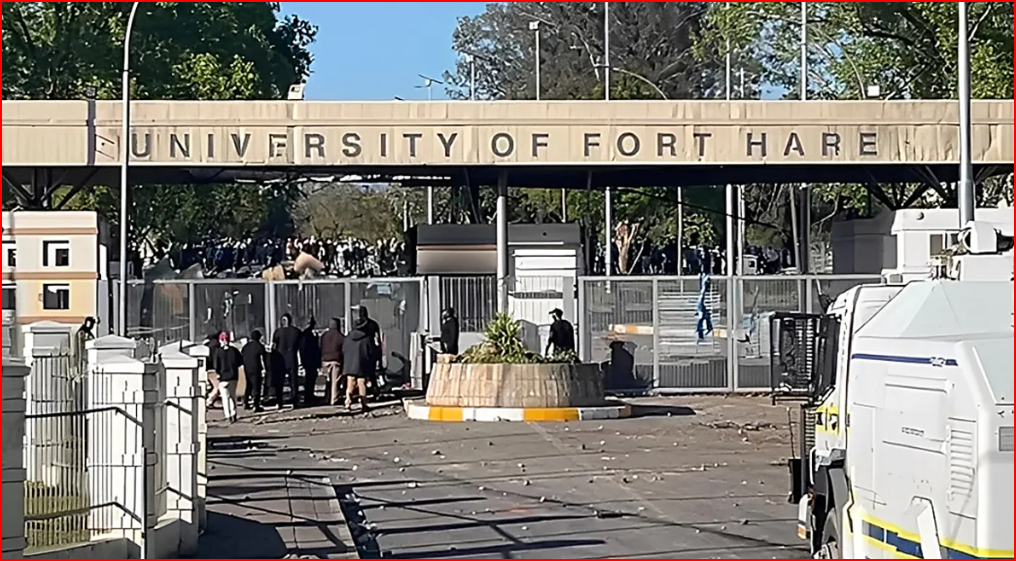
Parliament, Thursday, 9 October 2025 – The Select Committee on Education, Sciences and the Creative Industries has noted with sadness the violent protests at the University of Fort Hare that have resulted in the academic programme being abruptly halted.
The Chairperson of the committee, Mr Makhi Feni, said the committee condemns what looks like an orchestrated plan with the uttermost disgust.
He said: “The actions of burning public benefit institutions for no apparent reason sets back poor students, and university infrastructure development by years. In this age, where we are talking about lack of accommodation challenges despite government efforts, students resort to this kind of behaviour. This is unacceptable.”
“We are disappointed by the level of vandalism that seems to be happening down there in Fort Hare University. It is said that we had thought the university had successfully shaken its tag of being the most infamous and violent institution.”
On Wednesday, the students at Fort Hare burnt the entire administration building to ground following days of protests for what students labelled as “demanding their democratic representation through an SRC”. (SRC- Students Representitive Council)
Mr Feni said the demand was so ludicrous and ill-timed so as to deliberately sabotage the examinations, for which the student so need the energy they are wasting on protests.
“It is unfortunate that we find ourselves regressing when Fort Hare University has improved on so many aspects including research output, governance, programme offerings and many more. Universities are places to grow and be intellectually empowered, the University of Fort Hare students have sadly opted to be an anti-thesis of that.”
The South African Native College, later to become the University of Fort Hare, was founded in 1916., on the Site of the earlier British Military Site. The University of Fort Hare produced graduates from South Africa and as far North as Kenya and Uganda. Many went on to prominent careers in fields as diverse as politics, medicine, literature and art. Some politically active alumni like: Oliver Tambo; Nelson Mandela; Govan Mbeki; Robert Sobukwe and Mangosuthu Buthelezi, in South Africa. Robert Mugabe and Herbert Chitepo in Zimbabwe. Elius Mathu and Charles Njonjo in Kenya. These have all impacted their Nations. In the Arts, Fort Hare has released from South African poet Dennis Brutus; Drum journalist Can Themba; sculptor and painter Ernest Mancoba and Xhosa author and scholar Archibald Campbell Jordan. The first black Zimbabwean medical doctor, Ticofa Samuel Parirenyatwa, and the historian, novelist and politician Stanlake Samkange, were also among the many non-South Africans who spent formative Years at Fort Hare.
Following a decision by the Ministry of Education, the University has, since January 2004, been incorporating and integrating a new Campus in East London, formerly of Rhodes University, into the University of Fort Hare. This development in a new larger operating environment presents significant challenges as well as opportunities for the expansion of the University. Thus, enabling it to play a stimulating and catalytic role in the development of the Buffalo City Region. Hence it is posed to grow into a much larger student pool. By establishing Fort Hare, across the three Campuses in Alice, Bisho and East London. As the backbone to a new Academic system, five new Faculties were established in 2005-6.


