
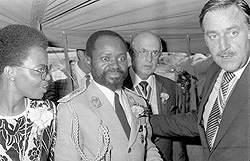
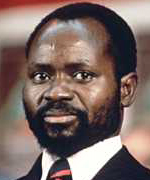
This feature celebrates Samora Machel and examines the mysterious circumstances surrounding his death and acknowledges the contribution that he made to Mozambique and her Independence. Machel was a revolutionary leader of the Mozambican liberation movement FRELIMO and Independent Mozambique's First President, he was killed in a plane crash in October 1986.
Samora Machel and the controversy surrounding his death
The revolutionary of Mocambique leader liberation movement FRELIMO and first Mozambican President Samora Moises Machel, was killed in plane crash on 19 October 1986. The death of the President sent shockwaves throughout the world. Also killed in the crash were thirty three members of his party and the crew of the Russian built Tupolev TU 134A.
The plane was returning from a Summit of African leaders held in Zambia. It went down in the Lebombo mountains near Mbuzini in Neslpruit eastern Transvaal (now Mpumalanga). The crash site was an area where the South African border connected with Swaziland and Mozambique. The fact that it chrashed over South African territory raised some questions about the possibilities of the involvement of the apartheid government. Of thirty-four people on board only nine survived the crash.
After the crash a Commission, made of representatives from South Africa, Mozambique and Soviet Union, was instituted to establish the cause of the crash. Many possible reasons, ranging from the mechanical fault to bad weather conditions, were put forward as the cause of the crash. However the investigations failed to pin-point the precise cause of the crash. The new democratic South African government have called for a new inquiry to determine the real cause of the crash and death of the President Machel and his party.
Events leading to the plane crash
The crash happened at a time when Mocambique government was in the midst of an armed attack by the National Resistance Movement in Mozambique (RENAMO). RENAMO was a rebel group backed by the South African and Rhodesian government. There was also mounting tension between South Africa, Mozambique and Malawi. The Mozambican Chief of Staff accused the President of Malawi, Hastings Kamuzu Banda, of setting up a base for RENAMO in tis territory and issuing the rebels with travel documents. One month prior to the crash, an angry Mozambican President Machel issued his Malawian counterpart with an ultimatum to stop his support for RENAMO. He threatened to seal off Mozambique's borders with Malawi.
On 7 October 1986, a fter six South African soldiers died in a landmine explosion on the Mocambique border, the SA Minister of Defence, Magnus Malan, threatened the Mozambican leader personally when he said, "He will clash head-on with South Africa." The two countries got embroiled in a bitter verbal exchange. Two weeks before the crash, the South African government accused Machel of having revived his support to the banned African National Congress (ANC) and its guerilla forces.
On 18 October, Carlos Cardosa, Director of the Mocambican News Agency Agência de Informação de Moçambique (AIM), received an anonymous message informing him that the President (Machel) had died. The message was very bizarre as Machel was preparing to leave for Zambia. On the same day before leaving for Zambia, Machel had convened a meeting with journalists, FRELIMO leaders and military officers. Machel announced that he had received information that the South Africans wanted to eliminate him. He gave instructions to his Cabinet and Party what had to be done if he failed to return.
The plane crash
On the night of Sunday 19 October 1986, the Mocambique presidential aircraft, a Tupolev TU 134A turned towards the South African border in response to signals from a VOR ( a very high frequency omnidirectional radio), which was emanating not from Maputo, but from the crash site on the Lebombo mountain near Mbuzini, Nelspruit.
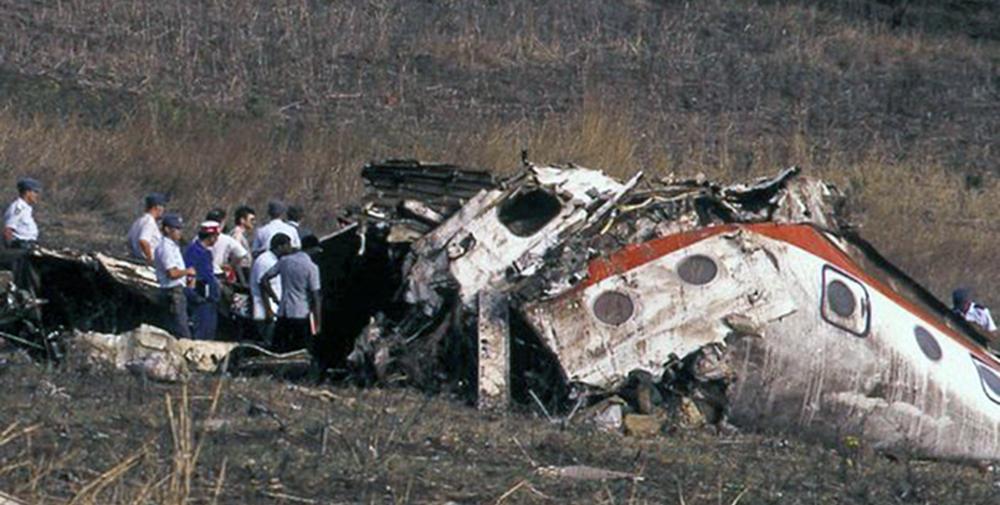
The South African police arrived on the crash site four and a half hours after the crash. It was alleged that they initially ignored the dead and wounded people and started collecting the documents papers scattered around the scene as well as the victims' valuable personal items and cash. Foreign Minister, Pik Botha, Niel Barnard, head of the National Intelligence Service, who arrived later, admitted that the documents had been removed from the scene for copying.
Mozambican authorities were only informed about the incident nine hours after it had happened.
Account of the survivors
"The pilot, Yuri Novodran, had been flying for 25 years. The other crew members - co-pilot Igor Kartamichev, navigator Andrei Kudriachov and radio operator Anatoli Choulipov - were also very experienced."
Vladimir Novosselov, a surviving member of the Soviet crew, felt that the crash was not an accident. He maintained that the Soviet crew of the Presidential plane was highly experienced.
Another survivor of the crash was Machel's bodyguard, Fernando Maniel João. He was lucky to survive and had the least serious injuries. At midnight he managed to contact the Komatiepoort police from the phone of a mission post. He requested the Komatiepoort police to contact Mozambique and inform them of the crash, but the Mozambican government was only officially informed of the disaster by the South African authorities at 6:50 on the following day.
"At about six o'clock in the evening the President left Lusaka. The plane gained height and headed towards Maputo. When we were flying over Zambia, the altimeter showed 11,400 metres. When we crossed the Mocambican frontier, the Tupolev descended to 10,600 metres. Novodron ordered contact to be made with Maputo Airport, requesting authorisation to land. The airport services granted the request. Weather conditions were favourable for the flight. Maputo was ahead and to the left of the left of the pilots. To the right, and very close, was the Mozambique-South African border. We were gradually descending. The altitude was 5,200 metres. Then we dropped to 3,000 metres. We were 113 kilometres away from Maputo. Novodran switched off the autopilot and took over the manual controls. He was an excellent pilot. Even navigator Kudriachov and radio operator Choulipov, who have spent around 14,000 hours in the air, did not know a more experienced captain than Novodran. We descended to less than a thousand metres. The last thing I remember was that the altimeter was reading 970 metres - after that, nothing."
Another survivor, Almeido Pedro, said that the South African police appeared on the scene of the crash at about 2:00 in the morning of Monday 20 October (four and a half hours after the crash). "The police 'didn't go to the aid of the people who were crying out. There were people who died for lack of assistance." Pedro said he saw "all of them collecting papers, diplomatic bags, dollars. They took lots of things." This was confirmed by João: "The South Africans were not at all concerned with the lives of the wounded. They were just messing around with the other things there." He said he became angry with the South Africans for refusing to take the wounded to hospital. He spoke to a police inspector, who finally ordered helicopters and medical staff to come and take the injured to the hospital in Nelspruit. The first of the injured arrived at Nelspruit at 8:00, almost 11 hours after the crash.
Aftermath - Inquiries into the crash
South Africa's reaction to the crash was very slow and suspicious. The South African officials relayed false information to the Mozambican authorities. It took them nine hours to report the incident in spite of Mozambique Minister of Security reporting the plane missing. When news of the crash was communicated to Mozambique, it was reported that the crash had taken place in Natal, some 200 kilometres away from the actual site of the accident.
A few days after the crash, Mozambique and South Africa agreed to establish an International Commission of Inquiry (ICI) with the participation of the International Civil Aviation Organization (ICAO) and in line with to ICAO procedures. According to the ICAO (also known as the Chicago Convention), the procedures dictated that South Africa should lead the investigation process as it was the country where the crash occurred. The procedures also dictated the inclusion of Mozambique, as the owner of the aircraft and of the Soviet Union as the manufacturer. In compliance with these procedurers the South African government thus instituted the Margo Commission under the chairmanship of Justice Cecil Margo to conduct investigations. The Morgo Commission sat and heard evidence at the Rand Supreme Court in Johannesburg from 20 - 28 January 1987. Mozambique and the Soviet Union withdrew from the investigation from the Commission, accusing the South Africa government of refusing to treat them as equal partners in the investigation.
The investigation were stalled for several weeks as a result of General Lothar Neethling's refusal to make the cockpit voice recorder (the black box) available to the Commission. He had seized it at the scene of the crash. Colonel Des Lynch, who headed the police investigation, told the Commission that it took a letter from a lawyer to persuade Neethling to release the box to the investigators. Based on the evidence gathered from the black box, the Margo Commission concluded that the aircraft was airworthy and fully serviced and that there was no evidence of sabotage or external forces involved. It held the Soviet Crew responsible, claiming that the plane had locked onto a VOR (very high frequency omnidirectional radio), which they had mistaken for Maputo.
"It unanimously determined that the cause of the accident was that the flight- crew failed to follow procedural requirements for an instrument let-down approach, but continued to descend under visual flight rules in darkness and some cloud without having contact with the minimum safe altitude and minimum assigned altitude, and in addition ignored the Ground Warning Proximity alarm."
The Soviet report
The Soviet Union disagreed with the Margo Commission and issued its own report. It accused South African government of undermining its expertise and experience. The Soviet report focused on the 37 degrees' right turn that led the plane into the hills of Mbuzini. It rejected the finding of the Margo Commission. It strengthened suspicions of the involvement of the South African security forces. It suggested that the plane was deliberately diverted by a false navigational beacon signal, using technology provided by Israeli intelligence agents.
Samora Machel's Relationship with the Soviet Union
While he was president, Samora Machel supported and allowed revolutionaries fighting white minority regimes in Rhodesia and South Africa to operate within Mozambique. Soon after Mozambique's independence both of these countries attacked Mozambique with an anti-Frelimo organization called RENAMO. RENAMO's activities included: the killing of peasants, the destruction of schools and hospitals built by Frelimo,and the blowing up of railway lines and hydroelectric facilities. The Mozambique economy was strangled by these depredations, and began to depend on overseas aid - in particular from the Soviet Union.
The Mozambique Medical Commission
Mozambique conducted its own medical investigations on victims of the crash. The investigations revealed that unknown people interfered with six bodies people who died during the crash. The bodies were found to have been cut and stitched up on the side of the neck. The incisions, about seven centimeters long, were made with a sharp instrument on one or other side of the neck, along the line of the cleido mastoideo muscle.
The affected bodies, included those of a Soviet crew member, President Samora's two Cuban doctors, two Mozambican stewardesses and a functionary of the Mozambiquan Foreign Ministry. The investigation failed to determine the precise time at which the cuts had been made. It further indicated that the cuts were not the cause of death. A South African, Prof. Nel, strengthened the theory that the cuts had been made to collect blood samples, but declared also that it was not normal procedure.
Truth & Reconciliation Commission (TRC) investigation

Following the demise of the apartheid regime in 1994, the newly elected democratic government opened new probes into the death of the former Mozambican president, Samora Machel. The Truth and Reconciliation Commission (TRC), which was instituted in 1996 under the chairmanship of Archbishop Desmond Tutu, was tasked to contribute to the investigations. It called everyone suspected of being involved in the plane crash, and those had close ties with Machel in Mozambique Some of the suspects called by the TRC were senior government officials and officials attached to the government security institutions.
The TRC's investigation did not find any conclusive evidence to support either of the earlier reports. Circumstantial evidence collected did, however, bring into question the conclusions reached by the Margo Commission. For example, a police video in the TRC's possessiont shows the South African Foreign Minister Roelof “Pik” Botha telling journalists at the crash site that President Samora Machel and others killed in the crash were his and President P. W. Botha's very good friends, and that their deaths were therefore a tragedy for South Africa.
The TRC report concluded that the questions of a false beacon and the absence of a warning from the South African authorities require further investigation by an appropriate structure.
In his State of the Nation address on 3 February 2006, South Africa's state President Thabo Mbeki announced that there would be a commemoration of the 20th anniversary of Samora Machel's death. In his parliamentary report, the Minister of Safety and Security, Charles Nqakula, said that South Africa, together with its Mozambican counterpart, would resume investigations into the death of Samora Machel. "We owe it to the people of Mozambique to ensure the matter is thoroughly investigated." He added: "Discussions are underway for dealing with the matter."


Death of Samora Machel
After analysing the information on these article, and after recalling my knowledge of the parties involved in the crash investigation. I found it extremely difficult to move against the Russian report. It is awkward to conclude that Samora Michel was a good friend of Botha while he was anti apartheid government and helpfull to those fighting apartheid. The then president had a lot to answer if he was alive, despite he refused to attend the Truth and Reconciliation commission. The death of Samora seems like nothing but an internationally planned mission.