
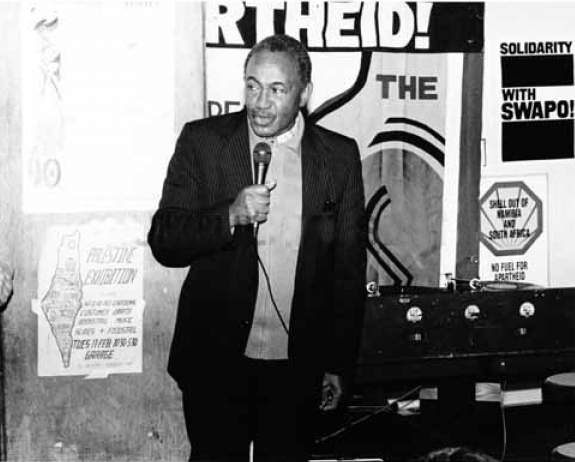
Archibald Jacob Gumede was born in Pietermaritzburg on 1st of March in 1914,the son of Lillian (born Mgqogqoza) and Josiah Tshangana Gumede a former ANC president. He attended various primary schools in Pietermaritzburg and matriculated in 1932 at Lovedale Missionary Institute, in the Eastern Cape in the former Ciskei. Gumede subsequently studied at the South African Native College (now University of Fort Hare) at Alice, in the Eastern Cape, for a medical aid course, but dropped out after two years. During this time, he came into contact with African National Congress (ANC) stalwart, Zakes K. Matthews, and Tengo Don Davidson Jabavu (one-time president of the All African Convention) who were lecturing at Fort Hare.
Gumede returned to Natal in 1936 where he was employed as a health assistant and sanitary inspector. In 1940, he began to work for his father and, until his arrest in 1956, worked as clerk for various legal firms. Gumede joined the African National Congress in 1949, becoming Pietermaritzburg assistant branch secretary, alongside Selby Msimang who was secretary at the time.In 1951, he became assistant secretary for the Natal ANC. He did not play an active role in the ANC's Defiance Campaign in the early 1950s, as the organisation in Natal had not been developed sufficiently. However, he was very active during the call for the Congress of the People, coming into close contact with the members of the Natal Indian Congress (NIC), including Dr. Motala, B Hafajee, M.P. Naicker, M.D. Naidoo, J.N. Singh, Monty Naicker, S. Chetty and S.B. Mungal. In addition, he worked closely with Harry Gwala. Gumede also came into contact with Moses Mabhida, exiled South African Communist Party secretary general who died in 1986.
During this period, he grew close to Albert Chief Luthuli who was elected to the ANC presidency in 1952. Together they were charged with high treason and later the charges were withdrawn. In 1955, Gumede led the Natal delegation to the Congress of the People in Kliptown, Johannesburg. After the formation of the Liberal Party, Gumede became a member as he felt that there was no difference between its policies and what he stood for, and he maintained that the liberals were, in word and deed, very supportive of Congress movement members facing treason charges in 1956.Gumede also participated in the ANC campaigns against the extension of the pass laws to women, Bantu Education and the removals in Charlestown and Roosboom in Northern Natal. In December 1956, he was arrested along with the other Congress activists and taken to Johannesburg. He then appeared at the preparatory examination of the Treason Trial in Johannesburg but charges against him were dropped in October 1957. During his time in Johannesburg, Gumede stayed in Sophiatown. He views this period as one of personal political development, during which he had the opportunity to meet Congress leaders from all over South Africa.
He returned to Pietermaritzburg and continued his ANC work until the state of emergency, following the 1960 Sharpeville shootings, when he was detained. ANC campaigns at that time included the potato boycott against Bethal farmers in the Transvaal who were using pass offenders as labourers on their potato fields, and the £1-a-day minimum wage campaign. He also attended the Pietermaritzburg All-In-Conference on 25 and 26 March 1961, which was addressed by Nelson Mandela. Gumede was banned for a five-year period under the Suppression of Communism Act in October 1963, and in the same month was detained in Pietermaritzburg until February 1964 in terms of the 90-day legislation. Gumede began his legal studies with the University of South Africa. In 1958, Gumede managed to become an articled clerk with an Indian firm of attorneys in Pietermaritzburg after his application to White firms had been turned down for fear of their losing clientele. He passed his Attorney's Admission Diploma in 1966 and was admitted as an attorney in 1967. In 1970, Gumede established his own legal practice in Pinetown, Natal.
In 1976, before the Soweto uprisings, Gumede participated in the formation of an Education Action Committee to deal with the problems at African schools. In the aftermath of the Soweto riots, he became active in the Parents' Committee established in the Durban area. Once again, Gumede worked together with the NIC when Indian pupils boycotted school. In 1979, after the Sowetan newspaper editor Percy Qoboza initiated a petition to release Nelson Mandela, Gumede and others established the Release Mandela Committee of which he became chairman. In 1982, he became a member of the Clermont Commuters' Committee, and also served on the Joint Commuters' Committee, an umbrella body embracing representatives from many areas around Durban and Pinetown. In addition, Gumede was secretary of Isolomuzi, a civic organisation dealing mainly with health matters. In 1983, Gumede attended the anti-South African Indian Council committee meeting in Johannesburg where Dr. Allan Boesak mooted the concept of a united front against the government's constitutional proposals. He participated in its planning and formation and was nominated to a steering committee to establish the United Democratic Front (UDF) in Natal.
In August 1983, at the national launch of the UDF at Mitchells Plain, Cape Town, he was elected President, along with Oscar Mpetha and Albertina Sisulu, wife of Walter Sisulu. He was re-elected President in April 1985 at the UDF's first annual conference in Azaadville, Krugersdorp. Gumede was an active participant in the campaign and, in August 1984, he and other UDF activists were detained shortly before the elections. Following a court application, they were released. When new detention orders were issued by the Minister of Law and Order, Gumede and others, including Mewa Ramgobin and George Sewpershad, sought refuge in the British consulate in Durban. Dr H Coovadia and Z Yacoob, representing the UDF and the Natal Indian Congress (NIC), travelled to the United Kingdom in an attempt to secure British intervention, but were unable to do so. The unbanned Dr. Beyers Naudé visited the six men in the Consulate on 27 September 1984 and by a British Labour Party Member of Parliament, Donald Anderson, in October. When Ramgobin, Sewpershad and MJ Naidoo left the consulate on 6 October they were immediately arrested, even though the Natal Attorney-General had withdrawn their detention orders. On 13 December, after a 90-day sit-in, Gumede, Paul David (a release Mandela Committee member), and Billy Nair left the consulate. Gumede and David were immediately arrested and subsequently charged with high treason. A bail application on behalf of the eight accused (Gumede, Mokoena, Nkondo, Ramgobin, Jassat, David, Naidoo, and Sewpershad) was refused. When the trial came to court in Pietermaritzburg it eventually included 16 accused. In April 1985 they were granted bail and the trial proper began in August. On 9 December charges against 12 of the accused, including Gumede, were withdrawn following the collapse of evidence by Isaak de Vries a senior lecturer at the Rand Afrikaans University and a key expert witness for the state (he had given evidence at 19 previous trials). Charges against the remaining four accused, office-bearers of the South African Allied Workers' Union were withdrawn on 23 June 1986.
In April 1986, Gumede attended the funeral of Moses Mabhida in Maputo, Mozambique. Whilst there, he held informal discussions with the late Mozambican President, Samora Machel. On 24 February 1988 the South African government restricted 17 organisations, including the UDF. At the same time 18 individuals, including Gumede and Albertina Sisulu, received banning orders restricting them to certain geographical areas and curtailing their political involvement. Gumede continued his legal practice and began assisting victims of the violence in Natal. He was involved in numerous peace efforts, but due to his restriction orders it was difficult for him to do so formally. Gumede's restriction orders were lifted following the State President's announcement of the unbanning of the ANC and lifting of restrictions on the UDF. His father, a founder member of the South African Native National Congress (SANNC), which subsequently became the African National Congress, to a great extent influenced Gumede's political views.
In 1919, Josiah Gumede accompanied the SANNC deputation to the United Kingdom to object to the implementation of the 1913 Land Act. He was Natal ANC president from 1924-30 and ANC national president from 1927-30. In 1929, he joined the League of African Rights (established by the South African Communist Party) and became its president. In addition, Gumede's decision to take an active role in the ANC was influenced by Oliver Msimang, a friend of his father, and his cousin, Selby Msimang. Subsequently, he came under the influence of Chief Albert Luthuli who gave him great personal assurance that the goals he was pursuing and methods being used were correct. Others who left a deep impression on Gumede included Bram Fischer and liberals Alan Paton and Peter Brown. As a result of these contacts, Gumede developed the view that in order to fight for the rights of the people, one should not adopt the tactics of the other side and regard people only in terms of colour. His wife, Edith Gumede, died tragically in a motorcar accident in 1990, the same year the ANC and other political parties were unbanned.
In May 1990, Gumede formed part of the ANC delegation, which met South African government representatives at Groote Schuur in Cape Town. After the 1994 general elections, Gumede became a parliamentarian in South Africa's first multiracial parliament. In 1996, his emphysema began to worsen, forcing him to attend parliamentary sittings irregularly. On June 1998, a week before his death, Gumede was admitted to St Aidan's Mission Hospital in Durban. On the 27 June 1998, Archibald Jacob Gumede passed away. He leaves behind seven children. The eldest, Donald Gumede, followed his father's footsteps and became a member of parliament as well.


